
LCA 模板题,但是 UVA 特色超长题面 + 大模拟。
科技:DFS 序求 LCA,@Alex_Wei 首先(?)在洛谷发布。
但是初看可能没那么容易懂(很长一段时间内我都只会复读那段代码根本不懂为啥)所以按我的理解方法记录一下吧。
Solution
首先对整棵树 DFS 一遍,记 的父亲为 ,DFS 序为 。
什么是 DFS 序
在 DFS 一颗树的过程中,设置一个计数器,每访问一个节点就将计数器加 ,则此时计数器的值即为该点的 DFS 序。
可参考代码第 行。
对于询问 ,若 ,则显然有 。
否则,设 。
先给出结论: 为 的 。即,DFS 序在 中的点的父亲节点中,DFS 最小的。可参考代码第 行、第 理解。
现在来证明这个结论。
情形一,。
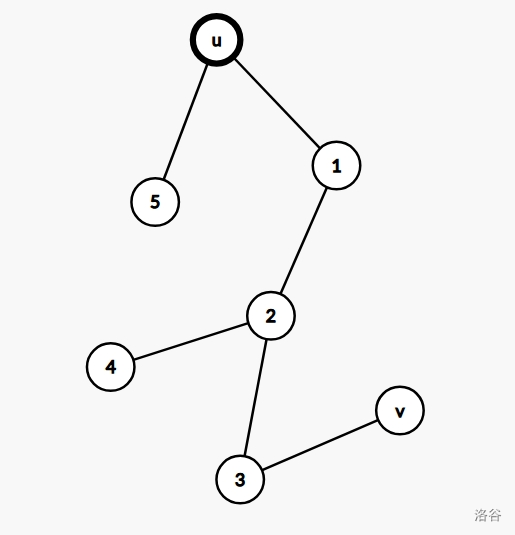
那么 对应的点要么为图中的 ,要么为 。即 对应点必为 的儿子之一。由子树根节点 DFS 序最小的性质可知此时结论成立。
否则即为情形二。
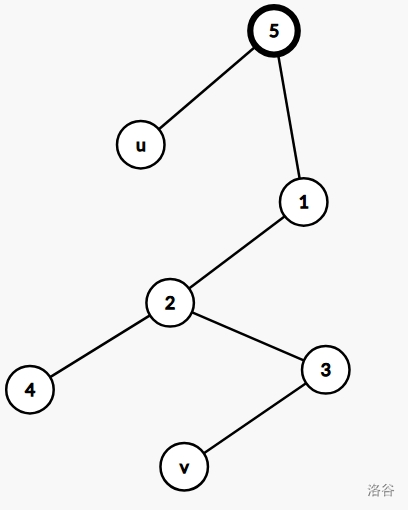
这时考察节点 ,它是 到 路径上的第 个点。并且由于 ,可知 不在查询的范围内。即, 的范围必然包含了从 出发到 的第一个儿子(可能等于 ),且不包含 自身。同样由子树根节点 DFS 序最小的性质可知结论成立。
Implementation
上面提到了查询一个区间中 DFS 序最小的节点的功能,可以用 ST 表实现。
对于本题,注意数据中存在一子多父的情况。此时应取最后的一个作为实际的父节点。
查询时先用并查集判断是否有关系,再根据题意模拟即可。
Code
static 的作用可以理解为设置一个只能在函数内部访问的全局变量,其只会被零初始化一次,因此可以用作计数器。更多见 cppreference。
#include <algorithm>
#include <cstdlib>
#include <iostream>
#include <map>
#include <string>
#include <utility>
#define MAXN 303
#define LOGN 9
using namespace std;

struct
{
    int to, nxt;
} edges[MAXN];
map<string, int> idchp;
int n, fa[MAXN], head[MAXN], dfn[MAXN], st[LOGN][MAXN], dep[MAXN];

inline int getidof(const string &s)
{
    int &id = idchp[s];
    if (!id)
        id = ++n;
    return id;
}
inline void add_edge(const int &from, const int &to)
{
    static int cnt;
    edges[++cnt] = {to, head[from]}, head[from] = cnt;
}
int getfa(const int &x)
{
    return !fa[x] ? x : fa[x] = getfa(fa[x]);
}
void dfs(const int &u)
{
    static int ts;
    dfn[u] = ++ts, dep[u] = dep[fa[u]] + 1, st[0][ts] = fa[u];
    for (int i = head[u]; i; i = edges[i].nxt)
        dfs(edges[i].to);
}
inline int calc(const int &x, const int &y)
{
    return dfn[x] < dfn[y] ? x : y;
}
inline int LCA(int x, int y)
{
    if (x == y)
        return x;
    x = dfn[x], y = dfn[y];
    if (x > y)
        swap(x, y);
    int lg = __lg(y - x);
    return calc(st[lg][x + 1], st[lg][y - (1 << lg) + 1]);
}

int main()
{
    ios_base::sync_with_stdio(false);
    cin.tie(nullptr), cout.tie(nullptr);
    string ustr, fstr;
    while (cin >> ustr >> fstr && ustr != "no.child")
        fa[getidof(ustr)] = getidof(fstr);
    for (int i = 1; i <= n; ++i)
        if (fa[i])
            add_edge(fa[i], i);
    for (int i = 1; i <= n; ++i)
        if (!fa[i])
            dfs(i);
    for (int i = 1; (1 << i) <= n; ++i)
        for (int j = 1; j <= n - (1 << i) + 1; ++j)
            st[i][j] = calc(st[i - 1][j], st[i - 1][j + (1 << (i - 1))]);
    int u, v;
    while (cin >> ustr >> fstr)
    {
        u = getidof(ustr), v = getidof(fstr);
        if (getfa(u) != getfa(v))
        {
            cout << "no relation\n";
            continue;
        }
        int lca = LCA(u, v);
        if (lca == u)
        {
            int g = dep[v] - dep[u];
            if (g == 1)
                cout << "parent\n";
            else if (g == 2)
                cout << "grand parent\n";
            else
            {
                for (int kk = 0; kk < g - 2; ++kk)
                    cout << "great ";
                cout << "grand parent\n";
            }
        }
        else if (lca == v)
        {
            int g = dep[u] - dep[v];
            if (g == 1)
                cout << "child\n";
            else if (g == 2)
                cout << "grand child\n";
            else
            {
                for (int kk = 0; kk < g - 2; ++kk)
                    cout << "great ";
                cout << "grand child\n";
            }
        }
        else
        {
            int du = dep[u] - dep[lca];
            int dv = dep[v] - dep[lca];
            if (du == 1 && dv == 1)
                cout << "sibling\n";
            else
            {
                int m = min(du, dv) - 1; // cousin number
                int removed = abs(du - dv);
                if (removed == 0)
                    cout << m << " cousin\n";
                else
                    cout << m << " cousin removed " << removed << "\n";
            }
        }
    }
    return 0;
}