
Just some random thoughts arised by a simple problem. But it seems that I’m reinventing wheels once more :(
If there’s any mistake in the article, please don’t hesitate to point it out in the comment.
Introduction
Yesterday night, my friend asked me a question on polynomials (his profile picture is pixelated in order to prevent privacy issues):
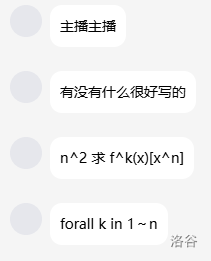
(Translation: Ciallo! Is there any solution for for all in time complexity that is easy to implement?)
And unfortunately I didn’t figure out the solution at first. I even considered it as an unsolvable problem:

(Translation: It’s actually unsolvable. I guess, isn’t it?)
But I suddenly realized that in the latest algorithm for polynomial composition, we have done a similar process working on .
So it might be solvable in ?
Why not give it a try?
Solution
We need to get coefficients for every possible . Let’s introduce another term to control the number of in a specific product, and rewrite the coefficient as .
Do you remember how we handled the linear homogeneous recursions using polynomials? We transformed it into an evaluation of a certain coefficient, in the form of a fraction: . We apply Bostan-Mori algorithm on this fraction afterwards.
For the bivariate polynomial with , we could apply a similar technique. Let’s say if we are now finding the coefficient . We multiply by on both numerator and denominator to eliminate odd powers of on the denominator, resulting in , where .
After this iteration, we can only conserve about half of the elements depending on the parity of : if is even, we rewrite it as , otherwise we rewrite it as . Now the problem is reduced to a subproblem with same form with the degree of halved. When , the variable is entirely eliminated, and we only need to get using polynomial inversion in time. (Can be done in , but not necessary.)
Consider the time complexity of the algorithm: after each iteration, although the degree of is lifted to twice as before, but the degree of is halved. Thus, for every polynomial involved in the calculation, the product of degree for is always , so we can multiply two polynomials within time.
We handled multiplications, because after this number of iterations we will drop into the corner case of . Thus, the whole time complexity is .
Polynomial Composition
Now let us move on to polynomial composition. Suppose we have two polynomials , and a new polynomial is required. (Assume that calculation is done under .) The expression seems to have many similarities with the previous question.
We need to assign a coefficient for each single depending on . We can still maintain the variable , since we know that the term with should be multiplied by .
Thus, we are actually multiplying the whole expression with to let every valid term be of . With the help of this polynomial, the answer could be written as:
The following step is just the same as we have done in the previous part. Moreover, we need to store every coefficient from to , which is slightly different. But an advantage is that the numerator only relates to , instead of both .
Suppose we are handling . Still multiplying by , getting . But the problem is: if we still do casework on the parity of , we will get two branches, leading to wrong time complexity as .
Can we avoid operations on ? Putting into the recursion might be a good choice. Now we have the results for ,and we need to multiply it by .
For the first iteration, as we need coefficient of , we just need to focus on and of , since . Now , and we need in the next iteration. So the number of needed values is depending on . More specifically, we just need to figure out in order to correctly deal with the previous iterations.
As we have said in the previous part, , and , so the time complexity is still per iteration, in total. When , an inverse is needed, which can also be done in .
Thus, polynomial composition under modulo is solved in time complexity.
Code
Not written yet.
References:
-
Yasunori Kinoshita, Baitian Li: Power Series Composition in Near-Linear Time.
-
alpha1022: 多项式不存在了:多项式复合(逆)的 O(nlog^2n) 做法.