
简化题意
给定一棵树,从点 开始,每次可以选择一个到当前点距离不超过 的点,并跳到那个点上,不能重复经过某个点,求遍历的点权和最大值。
大家想必都会了,选出最长链即可。
看看分值分布,不难猜到 比 简单—— 时一定可以遍历所有点。
方案如何构造?看下图:
我们证明:
- 结论 A:从一个点 出发,一定能够遍历 的子树内所有点,并停止到 的某个儿子。
- 结论 B:从一个点 的儿子出发,一定能够遍历 的子树内所有点,并停止到 。
使用归纳法,假设其成立,并证明自洽性。
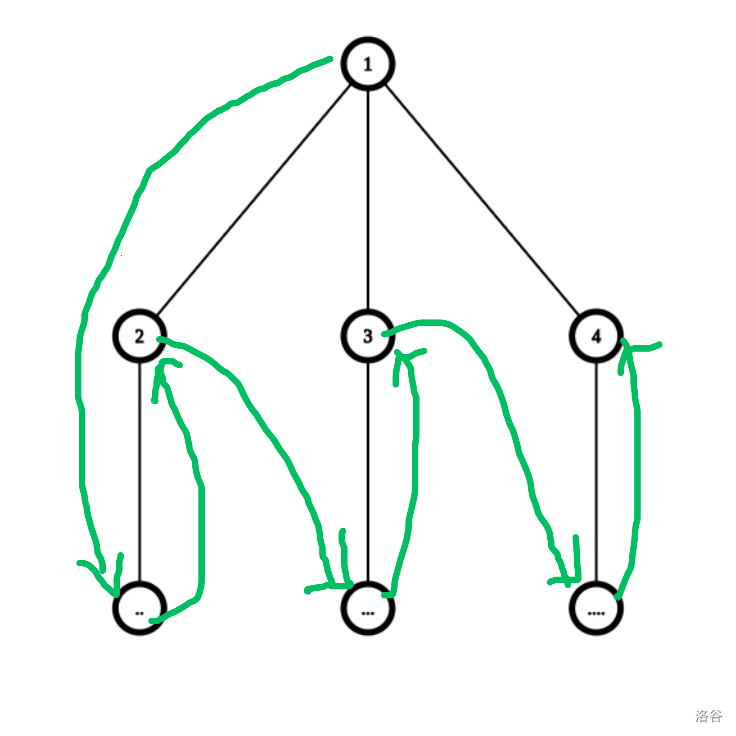
如图,如果结论 成立,那么从点 跳到 的某个儿子后,一定可以遍历完 的子树并跳到 ,之后再跳到 的儿子,重复此操作。最后一定停在 的儿子上,于是结论 可以推出结论 。
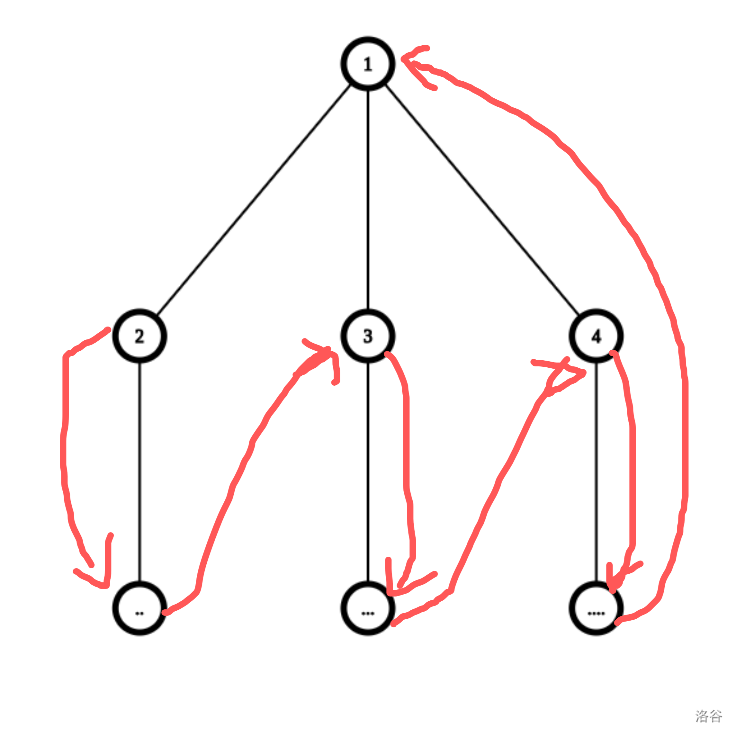
如图,如果结论 成立,那么从 开始可以遍历 的子树并跳到 的儿子,从 的儿子跳到 ,重复此操作,最后可以停在 上。于是结论 可以推出结论 。
于是显然这两个结论都是成立的。方案就如上构造即可。
这才是最困难的。不过 给了我们些许启示。
观察在 中的两种跳法:
- 遍历点的子树时,从它自己出发的,并在它们的某个儿子停止。
- 遍历点的子树时,从子树外直接跳到它们的某个儿子,并在它们自己停止。
这暗示我们,这两种结点应该分别讨论。设计以下状态:
- ,表示从 出发,在 的子树内跳跃,不限制终点,所能得到的最大点权和(不含 )。
- ,表示从 出发,在 的子树内跳跃,最后停在 的某个儿子上,所能得到的最大点权和(不含 )。
- ,表示从 的儿子出发,在 的子树内跳跃,不限制终点(但要经过 ),所能得到的最大点权和(不含 )。
- ,表示从 的儿子出发在 的子树内跳跃,最后停在 上,所能得到的最大点权和(不含 )。
答案即为 。现在考虑转移:
的转移
为何不先讲 ?因为 更简单。
显然只有一种最优跳法:
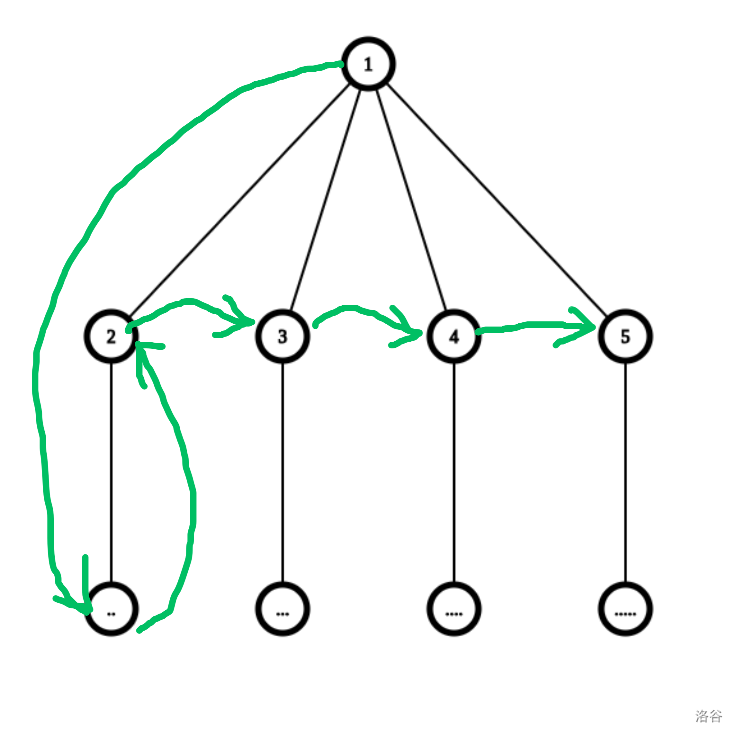
转移式为:
其中 表示 的儿子组成的集合。
的转移
也大差不差,只是最后不用停在儿子上:
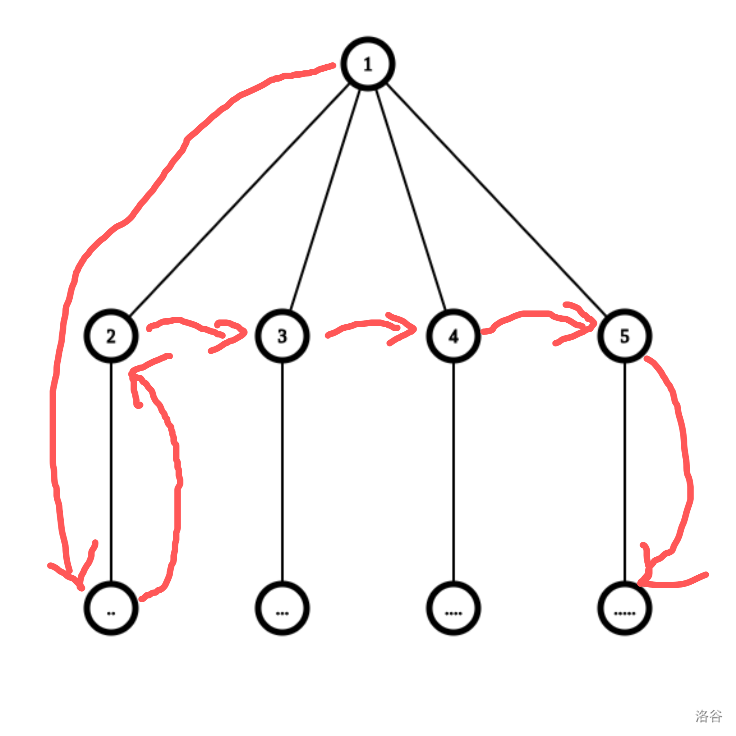
注意特判只有一个儿子的情况。
其实,另外还有一种可能更优的走法:
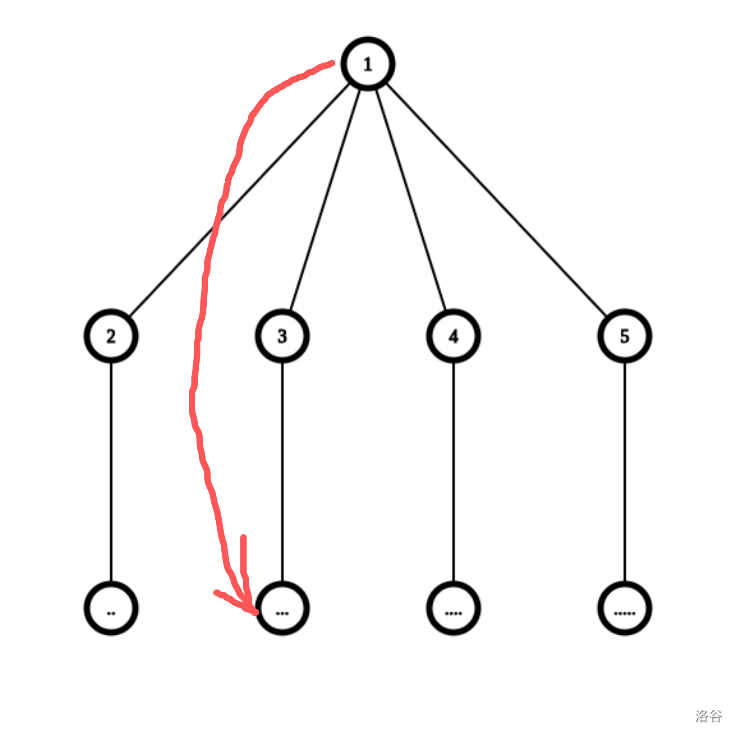
是很容易被忽略的。这种走法在某一个儿子的 特别大时是优的。注意这种走法是会经过点 的,详情请见 的定义。
转移式为:
的转移
与 类似(其实就是反过来走):
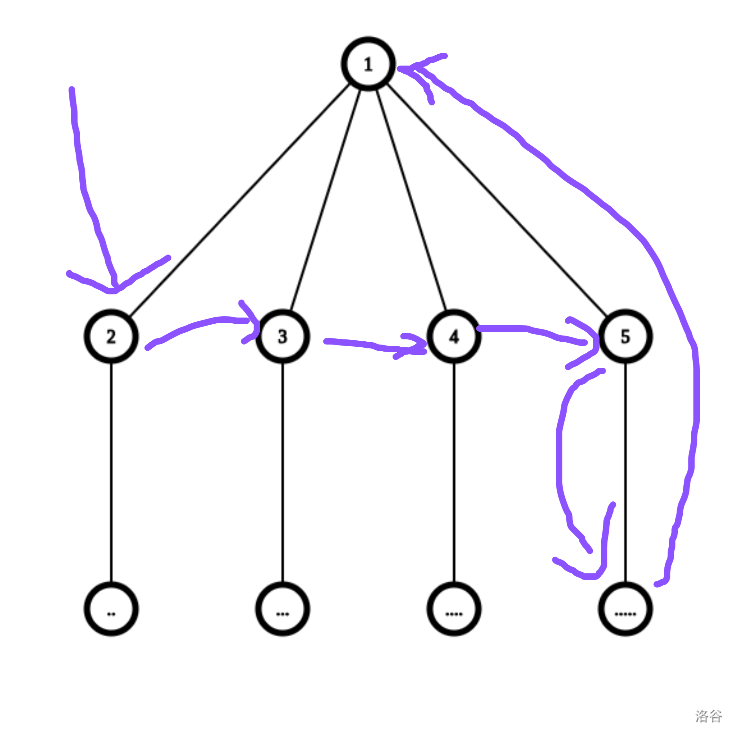
转移式:
的转移
首先有一种朴素的走法:
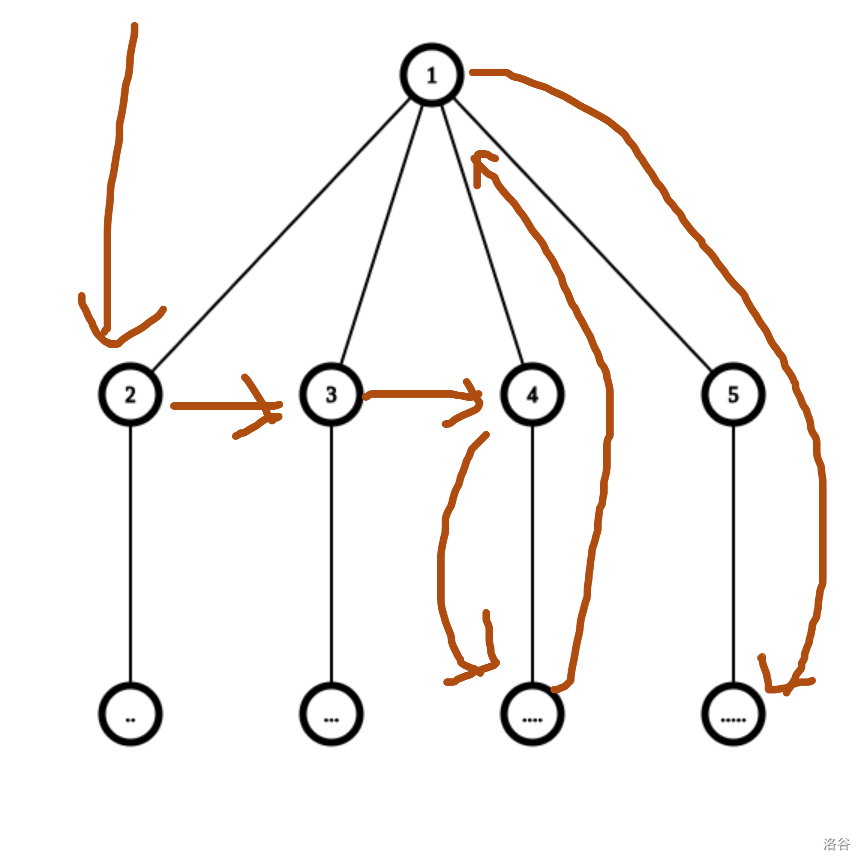
(注意,路径会经过 点,详情请见 的定义)。
但是,还有另一种跳法:
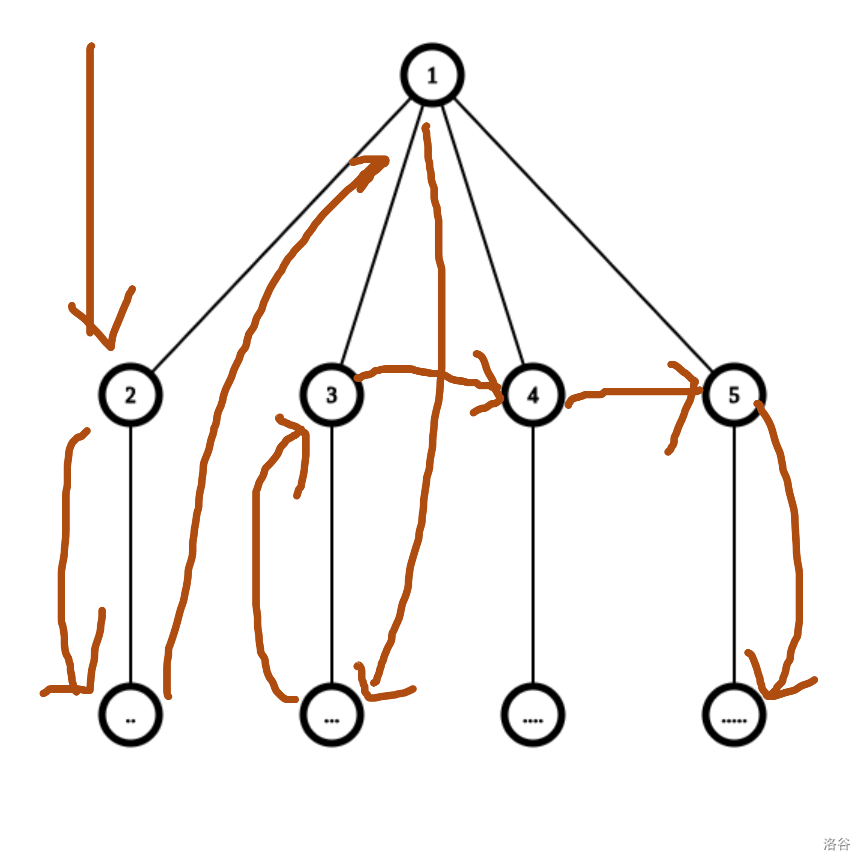
转移式:
注意特判儿子数量为 和 的情况。
好了,现在转移也做完了,就只剩下构造方案了。这部分没什么好说的,记录转移时最优的 ,按照图片的跳法跳就行……虽然非常难写。
代码
本人的代码写得十分丑陋,仅供参考或对拍。
#include <bits/stdc++.h>
#define ll long long

using namespace std;

const int maxn = 2e5 + 5;

int head[maxn], nxt[maxn << 1], to[maxn << 1], cnt = 0;
ll a[maxn], ans = 0;
int go[maxn], lnk[maxn], m = 0, siz[maxn];

static inline void match(int u, int v){
    nxt[++ cnt] = head[u], to[cnt] = v, head[u] = cnt;
}
namespace solve1{
static inline ll dfs(int x, int f){
    ll res = 0;
    for(int i = head[x]; i; i = nxt[i]){
        int j = to[i];
        if(j == f) continue;
        ll u = dfs(j, x);
        if(u > res) res = u, go[x] = j;
    }
    if(x == 1) ans = res + a[x];
    return res + a[x];
}}
namespace solve2{
ll F[2][maxn], G[2][maxn];
int fx[2][maxn], fy[2][maxn], gx[2][maxn], gy[2][maxn], gz[maxn];
int tf0[maxn];
priority_queue<pair<ll, int> > f1, f0, g0, g1;
pair<ll, int> AA[3], BB[3], CC[3];
static inline void dfs(int x, int f){
    siz[x] = 1;
    ll sum = 0;
    for(int i = head[x]; i; i = nxt[i]){
        int j = to[i];
        if(j == f) continue;
        dfs(j, x);
        sum += a[j], siz[x] += siz[j];
    }
    while(!f1.empty()) f1.pop();
    while(!f0.empty()) f0.pop();
    while(!g0.empty()) g0.pop();
    while(!g1.empty()) g1.pop();
    for(int i = head[x]; i; i = nxt[i]){
        int j = to[i];
        if(j == f) continue;
        f1.push(make_pair(F[1][j], j)), f0.push(make_pair(F[0][j], j));
        g0.push(make_pair(G[0][j], j)), g1.push(make_pair(G[1][j], j));
    }
    if(f1.empty()){
        F[0][x] = F[1][x] = G[0][x] = G[1][x] = 0;
        fx[0][x] = fy[0][x] = fx[1][x] = fy[1][x] = x;
        gx[0][x] = gx[1][x] = x;
        return;
    }
    pair<ll, int> A, B;
    // 1
    A = g1.top(), g1.pop();
    F[1][x] = sum + A.first, fx[1][x] = A.second;
    // 2
    B = f0.top(), f0.pop();
    if(A.second == B.second){
        if(g1.empty()) F[0][x] = sum + B.first, fy[0][x] = B.second;
        else{
            if(g1.top().first - A.first > f0.top().first - B.first) A = g1.top();
            else B = f0.top();
        }
    }
    if(!g1.empty()) F[0][x] = sum + A.first + B.first, fx[0][x] = A.second, fy[0][x] = B.second;
    if(g0.top().first + a[g0.top().second] > F[0][x]) F[0][x] = g0.top().first + a[g0.top().second], fx[0][x] = g0.top().second, tf0[x] = 1;
    // 3
    A = f1.top(), f1.pop();
    G[1][x] = sum + A.first, gx[1][x] = A.second;
    // 4
    B = g0.top(), g0.pop();
    if(A.second == B.second){
        if(g0.empty()) G[0][x] = sum + B.first, gy[0][x] = B.second;
        else{
            if(f1.top().first - A.first > g0.top().first - B.first) A = f1.top();
            else B = g0.top();
        }
    }
    if(!f1.empty()) G[0][x] = sum + A.first + B.first, gx[0][x] = A.second, gy[0][x] = B.second;
    while(!f1.empty()) f1.pop();
    while(!f0.empty()) f0.pop();
    while(!g0.empty()) g0.pop();
    while(!g1.empty()) g1.pop();
    for(int i = head[x]; i; i = nxt[i]){
        int j = to[i];
        if(j == f) continue;
        f1.push(make_pair(F[1][j], j)), f0.push(make_pair(F[0][j], j));
        g1.push(make_pair(G[1][j], j));
    }
    if(f1.size() < 3) return;
    for(int i = 0; i < 3; i ++){
        AA[i] = f1.top(), f1.pop();
        BB[i] = g1.top(), g1.pop();
        CC[i] = f0.top(), f0.pop();
    }
    pair<ll, int> C;
    A = B = C = make_pair(0, 0);
    for(int i = 0; i < 3; i ++){
        for(int j = 0; j < 3; j ++){
            for(int k = 0; k < 3; k ++){
                if(AA[i].second != BB[j].second && BB[j].second != CC[k].second && CC[k].second != AA[i].second){
                    if(AA[i].first + BB[j].first + CC[k].first >= A.first + B.first + C.first){
                        A = AA[i], B = BB[j], C = CC[k];
                    }
                }
            }
        }
    }
    if(sum + A.first + B.first + C.first > G[0][x]){
        G[0][x] = sum + A.first + B.first + C.first;
        gx[0][x] = A.second, gy[0][x] = B.second, gz[x] = C.second;
    }
}
static inline pair<int, int> calc(int x, int f, int tp){
    if(x == 1) ans = F[0][x] + a[1], tp = 0;
    if(siz[x] == 1) return make_pair(x, x);
    pair<int, int> res;
    int r = 0, s = 0;
    if(tp == 0){
        r = x;
        if(tf0[x]){
            res = calc(fx[0][x], x, 2);
            go[r] = res.first;
        }else{
            if(fx[0][x]){
                res = calc(fx[0][x], x, 3);
                go[r] = res.first, r = res.second;
            }
            for(int i = head[x]; i; i = nxt[i]){
                int j = to[i];
                if(j == f || j == fx[0][x] || j == fy[0][x]) continue;
                r = go[r] = j;
            }
            res = calc(fy[0][x], x, 0);
            go[r] = res.first, r = res.second;
        }
        return make_pair(x, 0);
    }else if(tp == 1){
        r = x;
        res = calc(fx[1][x], x, 3);
        go[r] = res.first, r = res.second;
        for(int i = head[x]; i; i = nxt[i]){
            int j = to[i];
            if(j == f || j == fx[1][x]) continue;
            r = go[r] = j;
        }
        return make_pair(x, r);
    }else if(tp == 2){
        if(gz[x]){
            res = calc(gx[0][x], x, 1);
            s = res.first, r = res.second;
            r = go[r] = x;
            res = calc(gy[0][x], x, 3);
            go[r] = res.first, r = res.second;
            for(int i = head[x]; i; i = nxt[i]){
                int j = to[i];
                if(j == f || j == gx[0][x] || j == gy[0][x] || j == gz[x]) continue;
                r = go[r] = j;
            }
            res = calc(gz[x], x, 0);
            go[r] = res.first;
        }else{
            for(int i = head[x]; i; i = nxt[i]){
                int j = to[i];
                if(j == f || j == gx[0][x] || j == gy[0][x]) continue;
                if(!s) s = r = j;
                else r = go[r] = j;
            }
            if(gx[0][x]){
                res = calc(gx[0][x], x, 1);
                go[r] = res.first, r = res.second;
                if(!s) s = res.first;
            }
            r = go[r] = x;
            res = calc(gy[0][x], x, 2);
            go[r] = res.first;
        }
        return make_pair(s, 0);
    }else{
        for(int i = head[x]; i; i = nxt[i]){
            int j = to[i];
            if(j == f || j == gx[1][x]) continue;
            if(!s) s = r = j;
            else r = go[r] = j;
        }
        res = calc(gx[1][x], x, 1);
        go[r] = res.first, r = res.second;
        go[r] = x;
        if(!s) s = res.first;
        return make_pair(s, x);
    }
    return make_pair(0, 0);
}}
namespace solve3{
static inline int dfs(int x, int f, int u, int op){
    ans += a[x];
    int v = x;
    if(!op){
        v = x;
        for(int i = head[x]; i; i = nxt[i]){
            int j = to[i];
            if(j == f) continue;
            v = go[dfs(j, x, v, 1)] = j;
        }
    }else{
        v = u;
        for(int i = head[x]; i; i = nxt[i]){
            int j = to[i];
            if(j == f) continue;
            go[v] = j;
            v = dfs(j, x, 0, 0);
        }
    }
    return v;
}}
static inline void solve(){
    printf("%lld\n", ans);
    int x = 1;
    while(x) lnk[++ m] = x, x = go[x];
    printf("%d\n", m);
    for(int i = 1; i <= m; i ++) printf("%d ", lnk[i]);
    printf("\n");
}

int main(){
    int n, k;
    scanf("%d %d", &n, &k);
    for(int i = 1; i < n; i ++){
        int u, v;
        scanf("%d %d", &u, &v);
        match(u, v), match(v, u);
    }
    for(int i = 1; i <= n; i ++) scanf("%lld", &a[i]);
    if(k == 1) solve1::dfs(1, 0);
    if(k == 2) solve2::dfs(1, 0), solve2::calc(1, 0, 0);
    if(k == 3) solve3::dfs(1, 0, 0, 0);
    solve();
    return 0;
}