
建议评绿。
思路
首先黑白染色后可以发现,每次移动就是从黑点到白点,或者从白点到黑点。因为起点和终点都是白点,所以要经过所有点,要保证黑点数比白点数少一个。也就是, 为偶数且 为奇数时,才有可能达到要求。
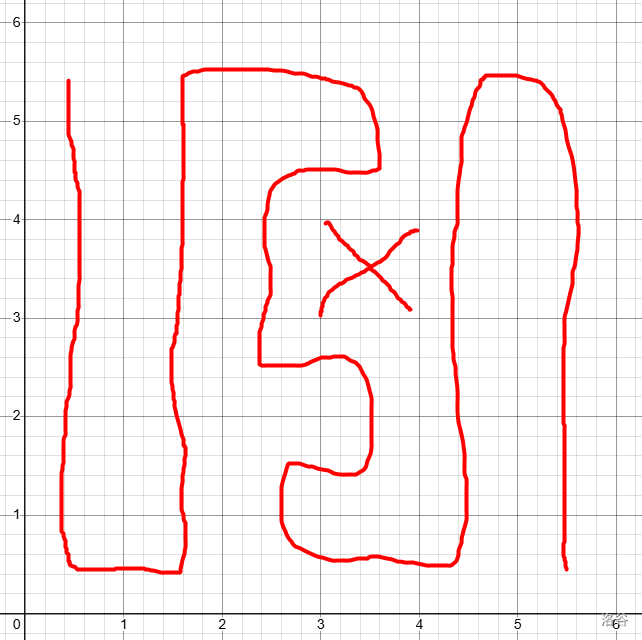
下面给一种构造性证明这种情况一定能达到要求:
- 将格子两列一组分组。
- 障碍格子不在的组,竖向蛇形排列。
- 在障碍格子所在的组,横向蛇形排列。
例如, 时,可以这么构造:
代码
#include <bits/stdc++.h>
#define ll long long
#define pii pair <int, int>
#define pll pair <ll, ll>
#define fi first
#define se second
#define y1 noip200
#define stp(x) fixed << setprecision(x)

using namespace std;

const int N = 5e5 + 50, p = 1e9 + 7, inf = 1 << 29;

int n, x, y;

void init() {

}

void solve() {
	cin >> n >> x >> y;
	if (n % 2 == 1 || (x + y) % 2 == 0) {
		cout << "No\n";
		return;
	}
	cout << "Yes\n";
	int a = 1, b = 1;
	for (int i = 1; i < (y + 1) / 2; i++) {
		for (int j = 1; j < n; j++) cout << "D", a++;
		cout << "R", b++;
		for (int j = 1; j < n; j++) cout << "U", a--;
		cout << "R", b++;
	}
	bool ok = 0;
	for (int i = 1; i < n; i++) {
		if (i & 1) {
			if ((a == x && b + 1 == y) || ok) cout << "DR", ok = 1;
			else cout << "RD";
			a++, b++;
		} else {
			if ((a == x && b - 1 == y) || ok) cout << "DL", ok = 1;
			else cout << "LD";
			a++, b--;
		}
	}
	for (int i = 1; i <= n / 2 - (y + 1) / 2; i++) {
		cout << "R", b++;
		for (int j = 1; j < n; j++) cout << "U", a--;
		cout << "R", b++;
		for (int j = 1; j < n; j++) cout << "D", a++;
	}
	cout << endl;
}

int main() {
	ios::sync_with_stdio(0);
	cin.tie(0);
	cout.tie(0);
	init();
	int t = 1;
	cin >> t;
	while (t--) solve();
	return 0;
}