
考试的时候只做出了 T1,没想到 T2 是区间 DP。
题意
给你一个有 个点与 条边的无向图,而每个点都有两个度,给它染色,问至少需多少种颜色。
有多组测试数据。
分析
关于“每个点都有两个度”的理解
想一想,它等价于每个点都只有两条边与之相连,那必然是一或几个环。
证明
这里对一个联通块进行讨论。
我们构造一个满足条件且不完全是环的非空图,先有一个点 ,为满足条件(有两个度),我们可以向外延伸出 , 两点,如图:
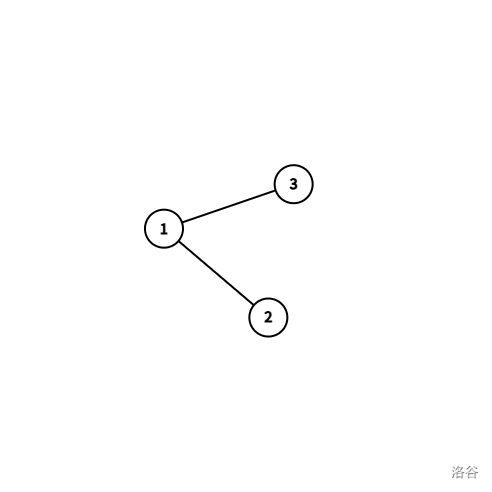
我们发现有 两点不满足条件,有两种解决方案:
1.在 间连边。但会违反不能完全是环的问题。
2.继续延伸,会出现同样的情况。
所以你明显无法构造一个图使得它非空,且不完全是环,又满足条件。所以他必须是个环。
答案的求解
明显,图可能不联通,所以要按联通块的方式处理。
对每个环考虑,我们称环里编号最小的节点名叫搜索起点。从搜索起点开始,与下一个节点绑定,若绑定过则不操作。让每个绑定里的第一个节点附 ,第二个附 ,明显,有以下两种情况:
1.环的大小为偶数。
(加重颜色的是附 的点。)
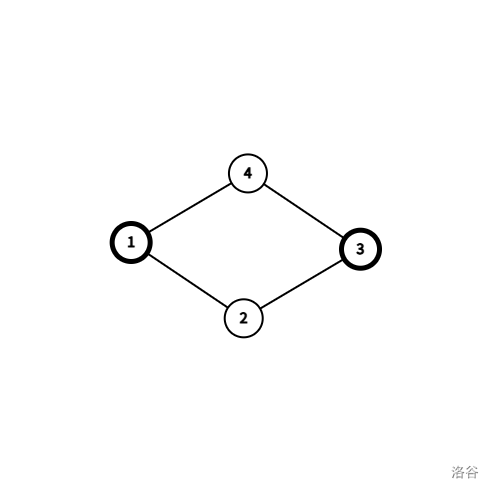
没有矛盾。
2.环的大小为奇数。
(标红的是附 的,标黄的是矛盾点。)
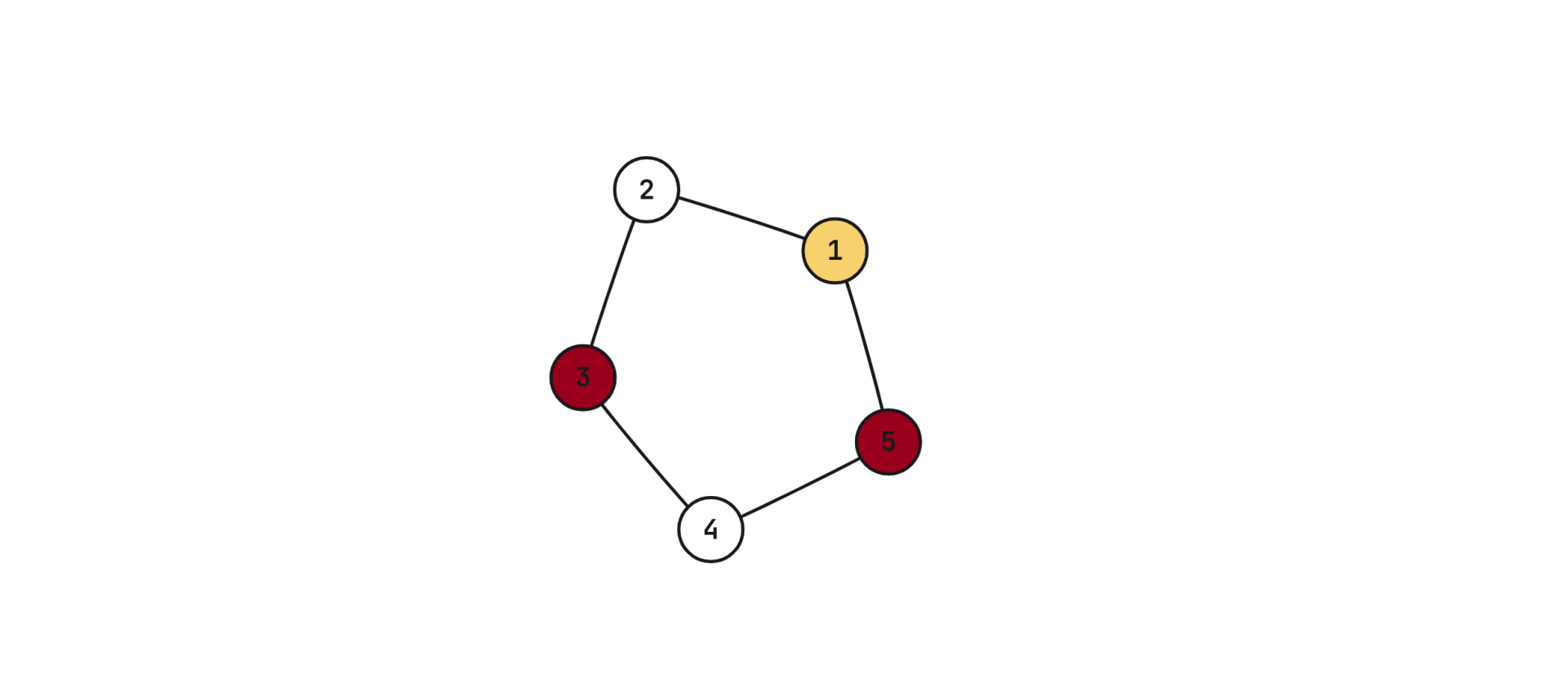
(原图给删了,用平板弄了个新的。)
此时,就有矛盾了:
是搜索起点,附 。
但它又与 绑定在一块,所以附 。
为了让他与世无争,给 附 。
这下很简单了:
若环的大小为偶数,输出 ;
若环的大小为奇数,输出 。
AC Code
代码
//警示后人:十年OI一场空,不开long long见祖宗
#include <bits/stdc++.h>
using namespace std;
#define int long long
using ll=long long;
using pll=pair<int,int>;
template<typename T>
inline void readinVector(vector<T>& vec,int l,int r){
	for(int i=l;i<=r;i++)cin>>vec[i];
}
template<typename T>
class matvec{
public:
	vector<vector<T> >mat;
	matvec(){}
	matvec(int n){
		mat.resize(n+1);
	}
	void rs(int n){
		mat.resize(n+1);
	}
	matvec(int n,int m){
		mat.resize(n+1,vector<T>(m+1));
	}
	matvec(int n,int m,T v){
		mat.resize(n+1,vector<T>(m+1,v));
	}
	vector<T>& operator[](int i){
		return mat[i];
	}
	void p_b(const vector<T>&vec){
		 mat.push_back(vec);
	}
};
int n;
vector<vector<int> >g;
vector<int>vis;
int got=0;
int cnt=0;
void dfs(int u,int fa){
	vis[u]=1;
	for(int v:g[u]){
		if(v==fa)continue;
		if(vis[v]){
			got=1;
			cnt=1;
			return ;
		}
		dfs(v,u);
		if(got){
			cnt++;
			return;
		}
	}
}
int T=1;
void solve(){
	g.clear();
	vis.clear();
	int n;
	cin>>n;
	g.resize(n+1);
	vis.resize(n+1);
	for(int i=1;i<=n;i++){
		int f,t;
		cin>>f>>t;
		g[f].push_back(t);
		g[t].push_back(f);
	}
	int ans=2;
	for(int i=1;i<=n;i++){
		if(!vis[i]){
			dfs(i,0);
			if(cnt%2){
				ans=3;
				break;
			}
		}
		cnt=0;
		got=0;
	}
	cout<<ans<<endl;
}
signed main(){
//	freopen("xxx.in","r",stdin);
//	freopen("xxx.out","w",stdout);
	ios::sync_with_stdio(false);
	cin.tie(nullptr);
    cin>>T;
	while(T--)solve();
	return 0;
}
代码的解释
WARNING
多测不清空,考完两行泪。
但我清空了,即使在考场上被硬控了几分钟
还有, DFS 函数中的判断 是否等于一,要写在循环内,因为在搜索起点时,他会进行两次递归。为防止这点,要在这里让它止步。
时间复杂度分析
差点忘写了。
dfs 的时间复杂度
看似 ,因为 solve 里有一个 的循环,而 DFS 的最坏复杂度为 。但实际上,solve 的循环是寻找下一个联通块,所以他贡献的是联通块的数量。而每一次 DFS 搜索的复杂度为联通块的大小,合起来为 。
合起来:。