
前言
本文主要讲解 是什么,最简单的模板怎么做。
0x10 模板介绍
思路:将有可能的情况(如在最短路题目中可以走的地点等)加入队列等待处理,在下一个 循环 递归 中处理。
适用于:求最短路的成本(距离/时间/花费)、找联通快
:为什么用队列?
:队列先进先出,所以当你第一次到达终点的时候就肯定是最短的路线,可以用来找最短路。
0x20 最短路
个人认为最短路是 最常考的考法,可能是因为我做的少罢。
0x21 一维最短路
一维最短路例题 P1135 奇怪的电梯。
思路:
暴如力,将可以到达的层数加入队列 ,当当前层数是目标层数时,就找到了到达目标层数的最短路,这时候输出 top.step (目前的步数)就是正确答案。因为队列先进先出,所以当你第一次到达终点(目标层数)的时候就肯定是最短的路线。
如果把所有能去的层数都去了( q.size() == 0 )还没到,那就到不了力!(悲)所以我们在到达的时候就把拿来判断是否达到过的 变量 ans 设为 false ,这样就可以在结束的时候通过判断 ans 是 true 还是 false 来知道有没有到达目标层数。
呆马:
#include <bits/stdc++.h>
using namespace std;
const int N = 2e2 + 10;

struct lift
{
	int sit/*当前层数*/, step/*多少步*/;
};

int n, a, b, k[N];
bool v[N], ans = true; // ans默认false
queue <lift> q;

void bfs(int x, int s)
{
	q.push( {x, s} );
	v[x] = true;
	while (q.size())
	{
		lift top = q.front();
		q.pop();
		if (top.sit == b)
		{
			cout << top.step;
			ans = false; // 到达过,ans变成false
			return ;
		}
		if ((top.sit + k[top.sit]) <= n/*电梯有这层*/ and !v[top.sit + k[top.sit]]/*没到过*/)
		{
			v[top.sit + k[top.sit]] = true;
			q.push( {top.sit + k[top.sit], top.step + 1} );
		}
		if ((top.sit - k[top.sit]) >= 1/*电梯有这层*/ and !v[top.sit - k[top.sit]]/*没到过*/)
		{
			v[top.sit - k[top.sit]] = true;
			q.push( {top.sit - k[top.sit], top.step + 1} );
		}
	}
}

int main()
{
	cin >> n >> a >> b;
	for (int i = 1; i <= n; i++)
		cin >> k[i];
	bfs(a, 0);
	if (ans) // 如果没到达那ans就还是true,则代表没到达,会触发cout << -1。如果ans不是true而是false,就代表到过了,故不会触发。
		cout << -1;

	return 0;
}
0x22 二维最短路
二维最短路例题:P1825 [USACO11OPEN] Corn Maze S
思路
和一维最短路的差不多,像啊很像啊,只不过从 sit 变成 x 和 y。
只不过里面的司马滑梯很恶心人,但是想到正解之后就明了了很多,这里就不放死法了。
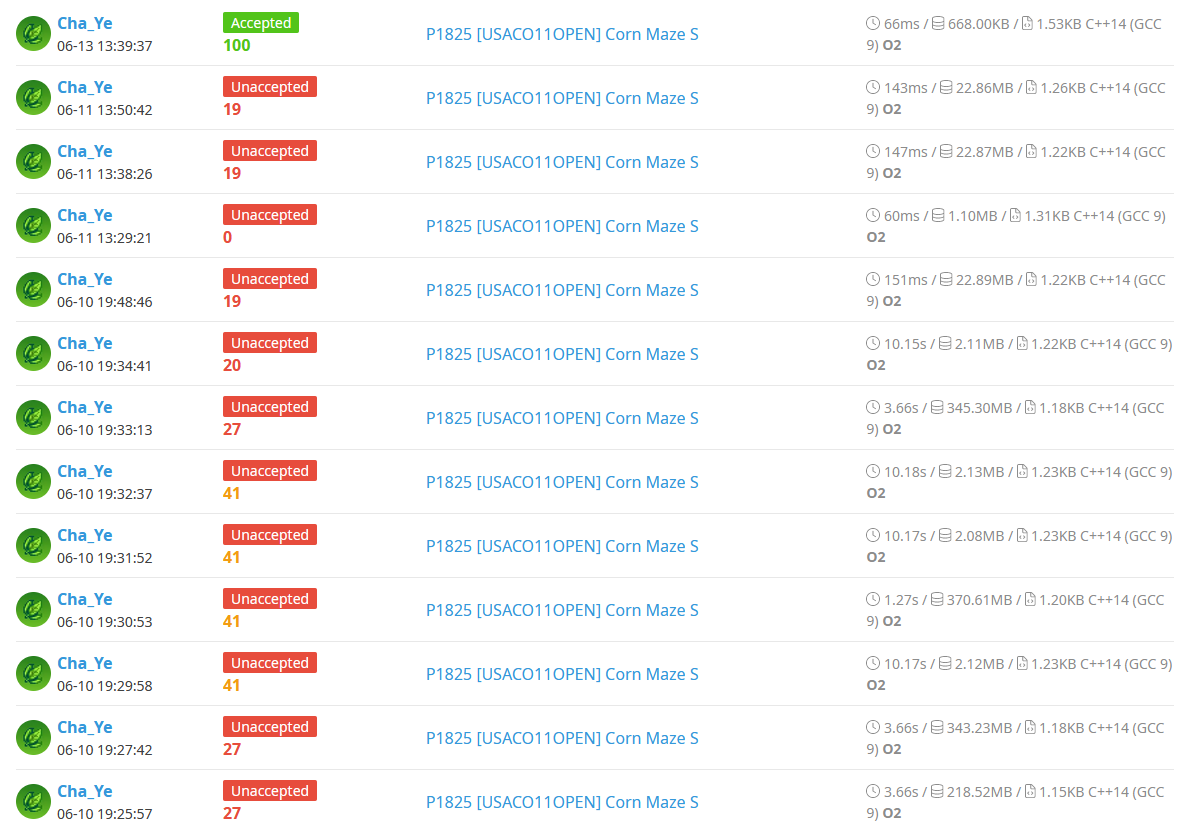
滑梯的解决方法:用两个数组把每个滑梯的起点 x y 和终点 x y 存下,然后等到达滑梯口的时候直接查询并传送就好了,如果滑梯有 将会更恶心。
贷蚂
#include <bits/stdc++.h>
#define int long long
using namespace std;
const int N = 3e2 + 10, INF = 0x3f3f3f3f;
const int dx[4] = {1, -1, 0, 0};
const int dy[4] = {0, 0, 1, -1};

struct sit
{
	int x, y, step;
};

struct tpsit
{
	int x, y;
};

int n, m, sx, sy, ex, ey, ans = INF;
char c, a[N][N];
bool v[N][N];
tpsit tps[N], tpe[N];
queue <sit> q;

void bfs(int sx, int sy)
{
	q.push( {sx, sy, 0} );

	while (q.size())
	{
		sit top = q.front();
		q.pop();

		if (top.x == ex and top.y == ey)
		{
			cout << top.step;
			return ;
		}

		if (a[top.x][top.y] >= 'A' and a[top.x][top.y] <= 'Z')
		{
			char t = a[top.x][top.y];
			if (top.x == tps[(int)t].x and top.y == tps[(int)t].y)
				top.x = tpe[(int)t].x, top.y = tpe[(int)t].y;
			else
				top.x = tps[(int)t].x, top.y = tps[(int)t].y;
		}
		for (int k = 0; k < 4; k++)
		{
			int xx = top.x + dx[k];
			int yy = top.y + dy[k];

			if (xx >= 1 and xx <= n and yy >= 1 and yy <= m and v[xx][yy])
			{
				v[xx][yy] = false;
				q.push( {xx, yy, top.step + 1} );
			}
		}
	}
}

signed main()
{
	cin >> n >> m;
	for (int i = 1; i <= n; i++)
		for (int j = 1; j <= m; j++)
		{
			cin >> c;
			a[i][j] = c;
			if (c == '@')
				sx = i, sy = j, v[i][j] = false;
			else if (c == '=')
				ex = i, ey = j, v[i][j] = true;
			else if (c == '#')
				v[i][j] = false;
			else if (c == '.')
				v[i][j] = true;
			else
			{
				v[i][j] = true;
				if(tps[(int)c].x and tps[(int)c].y)
					tpe[(int)c].x = i, tpe[(int)c].y = j;
				else
					tps[(int)c].x = i, tps[(int)c].y = j;
			}
		}
	bfs(sx, sy);

	return 0;
}
0x30 连通块
连通块经典例题:P1451 求细胞数量
思路
找到数字的时候直接开始 !
:把也是数字的地方的坐标塞进队列,并把它变成 0 ,这样就不会重复搜到了。一个 下来所有连通的是数字的地方就都变成 0 了,所以主函数中的 for 中找到了几次数字就有几个细胞。
逮玛
#include <bits/stdc++.h>
using namespace std;
const int N = 1e2 + 10;

struct node
{
	int x, y;
};

int n, m, a[N][N], ans;
bool v[N][N];
int dx[4] = {1, -1, 0, 0};
int dy[4] = {0, 0, 1, -1};

queue <node> q;

bool check(int x, int y)
{
	if (x >= 1 and x <= n and y >= 1 and y <= m and !v[x][y])
		return true;
	else
		return false;
}

void bfs(int x, int y)
{
	q.push( {x, y} );
	v[x][y] = true;
	while (q.size())
	{
		node top = q.front();
		a[top.x][top.y] = 0;
		v[top.x][top.y] = false;
		q.pop();

		for (int i = 0; i < 4; i++)
		{
			int xx = top.x + dx[i];
			int yy = top.y + dy[i];
			if (a[xx][yy] != 0 and !v[xx][yy])
			{
				q.push( {xx, yy} );
				v[xx][yy] = true;
			}
		}
	}
}

int main()
{
	cin >> n >> m;
	for (int i = 1; i <= n; i++)
		for (int j = 1; j <= m; j++)
		{
			char c;
			cin >> c;
			a[i][j] = c - 48;
		}
	for (int i = 1; i <= n; i++)
		for (int j = 1; j <= m; j++)
		{
			if (a[i][j] != 0)
			{
				ans++;
				bfs(i, j);
				memset(v, false, sizeof(v));
			}
		}
	cout << ans;

	return 0;
}
0x40 后言
我不知道其他什么题型可以用 了,我做的题还是太少力。😭😭😭😭😭😭😭😭😭😭😭
既然如此只好开始怒切 水题了!!!