今天,看到题单上面的 90pts 不顺眼,就想着继续卡常
然后,测了一下数据点8:
我以为的瓶颈:0.006597s
gp_hash_table 插入数据:0.906644s
(我本机速度较快,实际上达不到这个时间)
然后,我直接把 gp_hash_table 换成了 cc_hash_table,您猜怎么着,过了!
然后,我才发现,原来是出题人故意卡 gp_hash_table
以下是实验过程:
- 自定义 hash 三次测试的结果:
const int maxn=2e5+5;

int t,n,m,l,r,a[maxn];

void solve(){
	mt19937 gen(random_device{}());
#if 0
	auto hsh=[](int x)->size_t{return hash<bitset<32>>()(x);};
	static gp_hash_table<int,int,decltype(hsh)> mp(hsh);
#else
	static gp_hash_table<int,int> mp;
#endif
	mp.clear();
	F(i,1,2e5) mp[gen()]++;
}

signed main(){
	F(i,1,100) solve();
    return not "FST";
}
自定义 hash:
>>> (0.926+0.973+0.938)/3
0.9456666666666665
非自定义 hash:
>>> (0.732+0.725+0.719)/3
0.7253333333333333
后者仅慢
cc_hash_table:1.921,1.744
- 然后就是特殊构造的数据(指这个测试点,仅保留向
gp_hash_table中插入数据的部分代码):(考虑到 IO 带来的时间,以下计时使用user)
自定义 hash:
>>> (0.118+0.133+0.121)/3
0.124
非自定义 hash:
>>> (0.877+0.856+0.893)/3
0.8753333333333334cc_hash_table:0.138,0.176(你没有看错,cc_hash_table 前者更快)
所以,我的建议是使用 gp_hash_table 加上自定义的 hash 函数
当然,用 cc_hash_table 也是不错的选择,只不过就要承受数据随机是的 2 倍常数
另外,(gp/cc)_hash_table 的遍历的时间相较于插入是可以忽略不计的
double ans1,ans2;

void solve(){
	mt19937 gen(random_device{}());
#if 1
	auto hsh=[](int x)->size_t{return hash<bitset<32>>()(x);};
	static gp_hash_table<int,int,decltype(hsh)> mp(hsh);
#else
	static gp_hash_table<int,int> mp;
#endif
	mp.clear();
	int st=clock();
	F(i,1,2e5) mp[gen()]++;
	ans1+=(clock()-st)*1.0/CLOCKS_PER_SEC;
	st=clock();
	volatile unsigned res=0;
	for(auto i:mp) res+=i.x+i.y;
	ans2+=(clock()-st)*1.0/CLOCKS_PER_SEC;
}

signed main(){
	F(i,1,100) solve();
	cout<<ans1<<" "<<ans2<<endl;
    return not "FST";
}
输出:
0.783067 0.162547然后,交上去就打脸了,实测 cc_hash_table 比 gp_hash_table 快
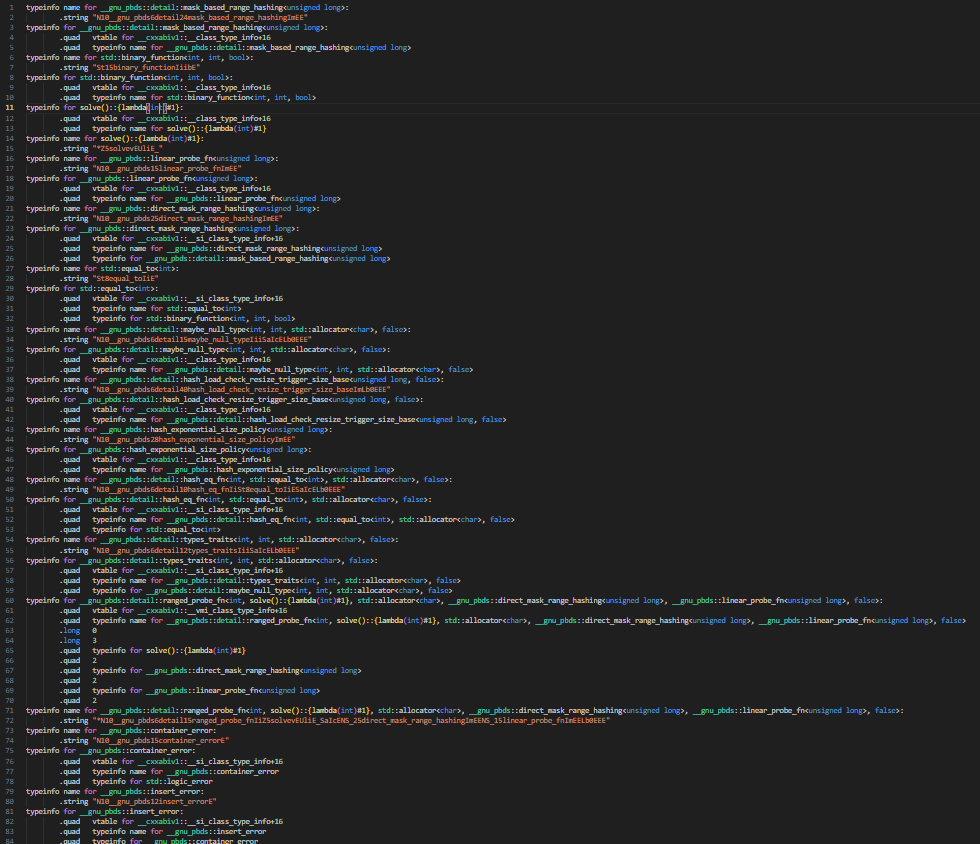
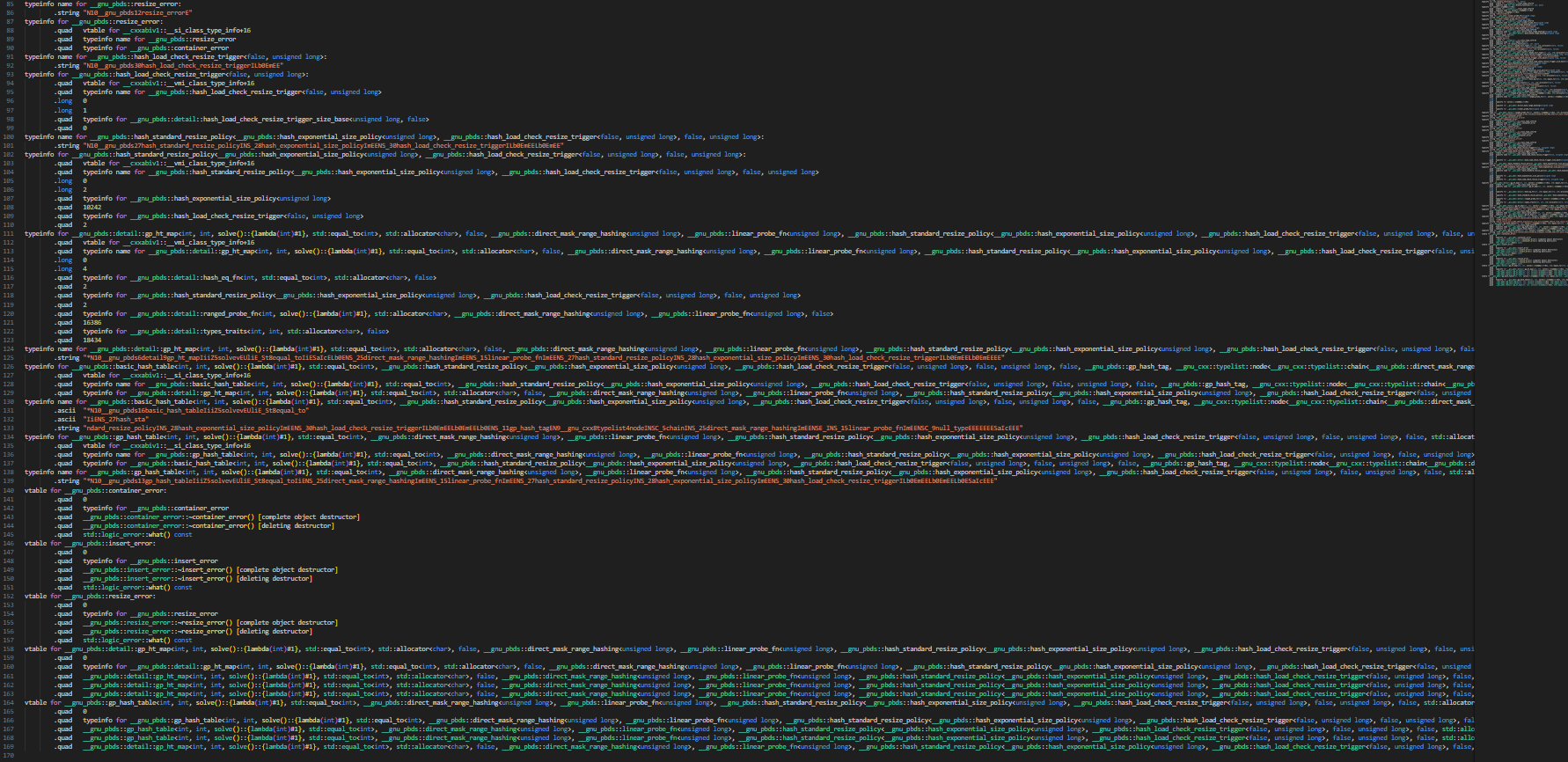
彩蛋:你的代码看似没有使用多态,但是 gp_hash_table 的虚表的汇编有 170 行,不愧是你,pbds