
1. 二次探测定理
(, 素数)
可解得 或
于是 或
2. 费马小定理
(素数)
又可表示为
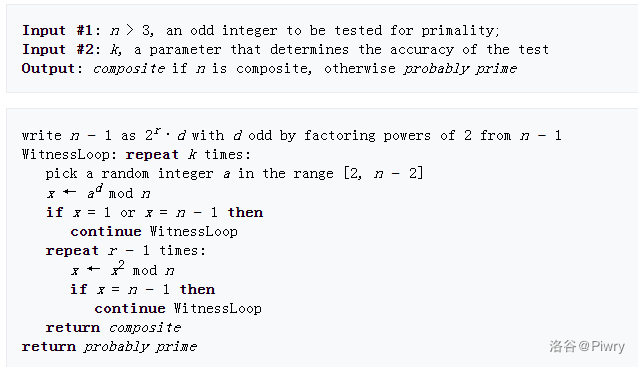
3. 算法思路
随机数字做 ,从 开始自乘,根据二次探测定理若 则或,由此检验 ;注意最后需要验证
建议 , 。(来源)
CODE
#include <cstdio>
#include <cstdlib>
#define ll long long

ll Pow(ll x, ll k, const ll M){
	ll ret =1;
	for(; k; x =x*x%M, k >>=1) if(k&1) ret =ret*x%M;
	return ret;
}

bool mr(ll p){
	if(p < 2) return 0;
	if(p == 2) return 1;
	if(p == 3) return 1;
	ll d =p-1, r =0;
	while(!(d&1)) ++r, d >>=1;
	for(int k =0; k < 20; ++k){
		ll a =1ll*rand()*rand()*rand()*rand()%(p-2-1)+2;/*[2, p-2]*/
		ll x =Pow(a, d, p);
		if(x == 1 || x == p-1) continue;
		for(int i =0; i < r-1; ++i){
			x =x*x%p;
			if(x == p-1) break;
		}
		if(x != p-1) return 0;
	}
	return 1;
}
以下是之前的版本,仅供参考,不保证正确性
1. 二次探测定理
(,素数)
可解得或
于是或
因此只要枚举比小的数即可确定是素数
2. 费马小定理
(素数)
又可表示为
可以通过证明得到这种方法(?且选取质数做?)得到的的优越性
(关于此条没有找到完整的证明,但通过检验(10^7,时间10s左右;可以自行验证更大数据;但据经验分析取100个质数(建议筛法)非高精度情况下不可能出错,int范围20个即可)接下来的算法思路是可以应付OI竞赛 )
3. 算法思路
用质数做,从开始自乘,根据二次探测定理若则或,由此检验;注意最后
寻找个质数,检验的错误率可忽略不计
4. 一些性质
- 为后会一直为
CODE
#include <cstdio>
#define ll long long

inline ll read(){
	ll x = 0; bool f =0; char c =getchar();
	while(c < '0' || c > '9') (c == '-') ? f =1, c =getchar() : c =getchar();
	while(c >= '0' && c <= '9') x = (x<<3) + (x<<1) + (48^c), c =getchar();
	return (f) ? -x : x;
}

ll qPow(ll x, ll k, const ll &M){
	ll ans =1;
	do if(k&1) ans =ans*x%M; while((x =x*x%M) && (k >>=1));
	return ans;
}

const int N =20;
ll TRY[] ={2, 3, 5, 7, 11, 13, 17, 19, 23, 29, 31, 37, 41, 43, 47, 53, 59, 61, 67, 71};

bool Miller_Rabin(ll P){
	for(int i =0; i < N; ++i)
		if(P == TRY[i]) return 1;
	for(int i =0; i < N; ++i){
		/*事实上对于一般取500样本,这条可以检测的不会出错,质数太大的又没用*/
		//if(TRY[i]*TRY[i]%P == 1) return 0;//TRY一定奇数,不可能P-1
		ll t =P-1, k =0; while(!t&1) ++k, t >>=1;
		ll res =P-1/*!避免cur第一次就为1*/, cur =qPow(TRY[i], t, P)%P;
		while(k--){
			if(cur == 1){
				if(res == P-1) break;
				else return 0;/*by 20.7 : 这个 else 基本就不可能用到*/
			}
			res =cur, cur =cur*cur%P;
		}
		if(cur != 1) return 0;
	}
	return 1;
}

int main(){
	while(1) printf("%s", (Miller_Rabin(read())) ? "Yes\n" : "No\n");
}