
刚学计算几何,来写一篇题解。
先考虑一个粒子的运动情况。
若不考虑碰撞,一个粒子将会沿着一条射线运动,于是可以记录两个量来表示一个粒子:起始点 和速度 。这样表示有一个非常好用的东西: 时刻粒子所在的位置 所表示的向量 。
当发生碰撞时,有下面这张图:
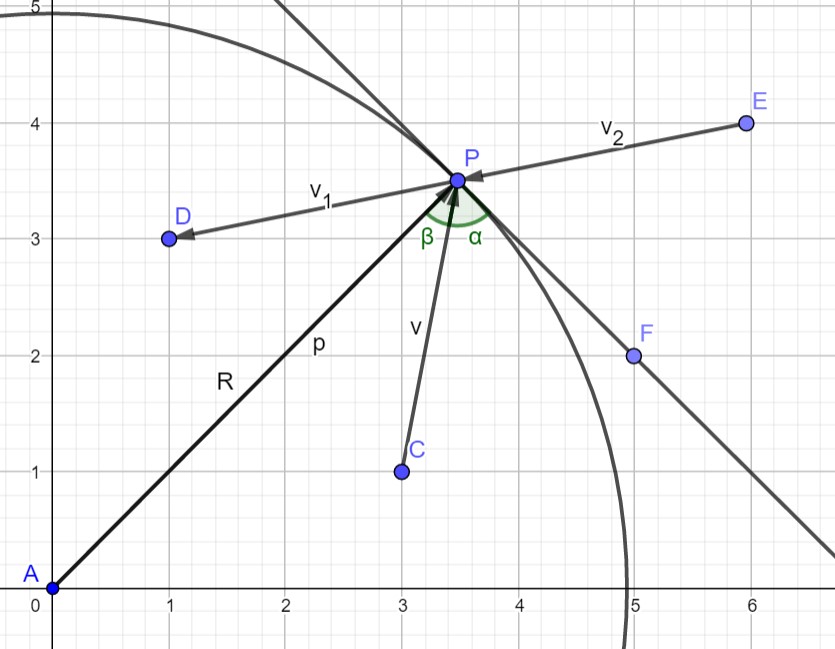
此时 在圆上,碰撞前的速度为 ,碰撞后的速度为 , 由 平移而来。我们需要将 旋转 至 。 不难由 算出:
由三角恒等变换得:
向量旋转有公式,直接贴上:
逆时针旋转 得到 。
不难发现,最近距离只与两个粒子有关,于是可以枚举两个粒子 ,单独考虑它们的运动情况。
设粒子 的起始点为 ,速度为 ,粒子 的起始点为 ,速度为 ,运动时间为 ,粒子间距离表示为矢量 ,则有:
粒子间距离即为 ,有:
这个二次函数在对称轴取到最小值,即:
代入原方程:
这样就能够轻松地求出两个粒子的最小距离。
但是这样算还有一个小问题: 有取值范围,不一定能取到对称轴,即二次函数在 的取值范围上是单调的。这个问题会在 的运动轨迹不相交时出现,特判一下这种情况即可。
Code:
#include <iostream>
#include <cstring>
#include <cstdio>
#include <algorithm>
#include <cmath>
#define maxn 105
#define Rint register int
#define INF 0x3f3f3f3f
using namespace std;
typedef long long lxl;
const double eps=1e-9;

template <typename T>
inline T read()
{
	T x=0,f=1;char ch=getchar();
	while(ch<'0'||ch>'9') {if(ch=='-') f=-1;ch=getchar();}
	while(ch>='0'&&ch<='9') {x=(x<<1)+(x<<3)+ch-'0';ch=getchar();}
	return x*f;
}

inline bool zero(double x) {return fabs(x)<eps;}

struct Point
{
	double x,y;
	inline Point(double x=0,double y=0):x(x),y(y){}
	inline Point operator + (const Point &T)const// 加
	{
		return Point(x+T.x,y+T.y);
	}
	inline Point operator - ()const// 取负
	{
		return Point(-x,-y);
	}
	inline Point operator - (const Point &T)const// 减
	{
		return *this+(-T);
	}
	inline Point operator * (const double &a)const// 数乘
	{
		return Point(x*a,y*a);
	}
	inline Point operator / (const double &a)const// 数除
	{
		return Point(x/a,y/a);
	}
	inline double operator * (const Point &T)const// 点乘
	{
		return x*T.x+y*T.y;
	}
	inline double operator % (const Point &T)const// 叉乘
	{
		return x*T.y-y*T.x;
	}
	inline double len() {return sqrt((*this) * (*this));}// 向量长度
	inline void rotate(double cosa,double sina)// 向量旋转 a 角度
	{
		(*this)=Point(x*cosa-y*sina,x*sina+y*cosa);
	}
	inline Point unit()// 同方向的单位向量
	{
		return (*this)/(*this).len();
	}
	inline void read()
	{
		scanf("%lf%lf",&x,&y);
	}
};

typedef Point Vec;// 向量的坐标表示

struct node
{
	Point p;// 起始点
	Vec v;// 速度
	double t,T;// t:还需多久发生碰撞 T:走过该方向的割线所需时间
	int cnt;// 碰撞次数
}A[maxn];

Point cir;
double R,ans=INF;
int n,k;

inline void calcu(node &a)
{
	double v=a.v.len();// 速率
	double d=fabs(a.p%a.v)/v;// 圆心到直线的距离
	double m=sqrt(R*R-d*d);// 割线长度的一半
	a.T=2*m/v;
	a.t=(m+a.v.unit()*(-a.p))/v;
}

inline void flip(node &a)// 碰撞
{
	double len=a.p.len()*a.v.len();
	double sn=a.p*a.v/len,cs=(a.p%a.v)/len;
	double sina=2*sn*cs,cosa=cs*cs-sn*sn;
	a.v.rotate(cosa,sina);
}

inline void update(Point pa,Point pb,Vec va,Vec vb)
{
	if((pa-pb)*(vb-va)>0&&(pa+va-pb-vb)*(va-vb)>0)// 特判不相交
		ans=min(ans,fabs((pa-pb)%(vb-va))/(vb-va).len());
	else ans=min(ans,min((pa-pb).len(),(pa+va-pb-vb).len()));
}

inline void solve(node a,node b)
{
	double t;
	Vec v1,v2;
	while(a.cnt<k&&b.cnt<k)
	{
		t=min(a.t,b.t);
		a.t-=t;b.t-=t;
		v1=a.v*t,v2=b.v*t;
		update(a.p,b.p,v1,v2);
		a.p=a.p+v1,b.p=b.p+v2;
		if(zero(a.t)) flip(a),a.t=a.T,++a.cnt;
		if(zero(b.t)) flip(b),b.t=b.T,++b.cnt;
	}
}

int main()
{
	// freopen("P4682.in","r",stdin);
	cir.read();scanf("%lf",&R);
	n=read<int >(),k=read<int >();
	for(int i=1;i<=n;++i)
	{
		A[i].p.read(),A[i].v.read();
		A[i].p=A[i].p-cir;
		calcu(A[i]);
	}
	for(int i=1;i<=n;++i)
		for(int j=i+1;j<=n;++j)
			solve(A[i],A[j]);
	printf("%.3lf\n",ans);
	return 0;
}