
提供一个神奇的思路。
首先二维数点能想到扫描线+线段树。
边框不能取,珂以把长、宽都减,因为你可以这么框:
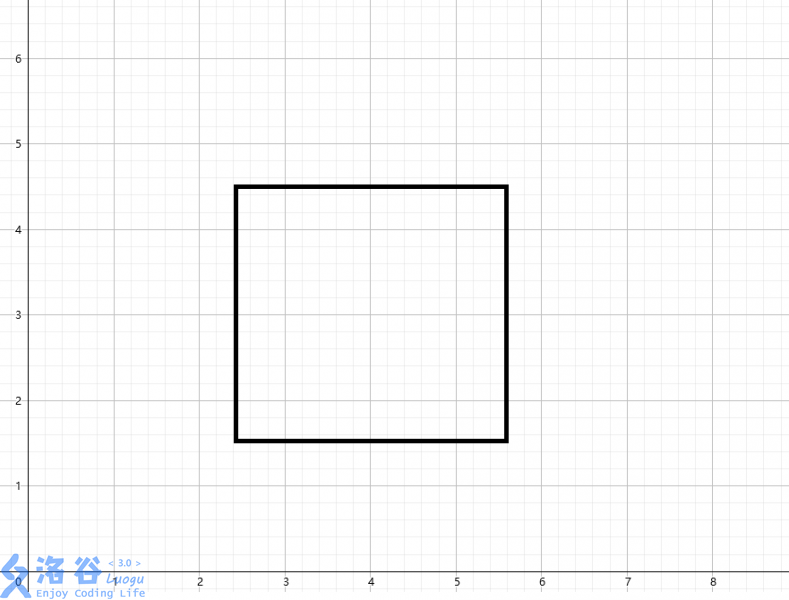
也就是说边界不取整数。
然后将坐标系上每个点扩展为一个矩形:
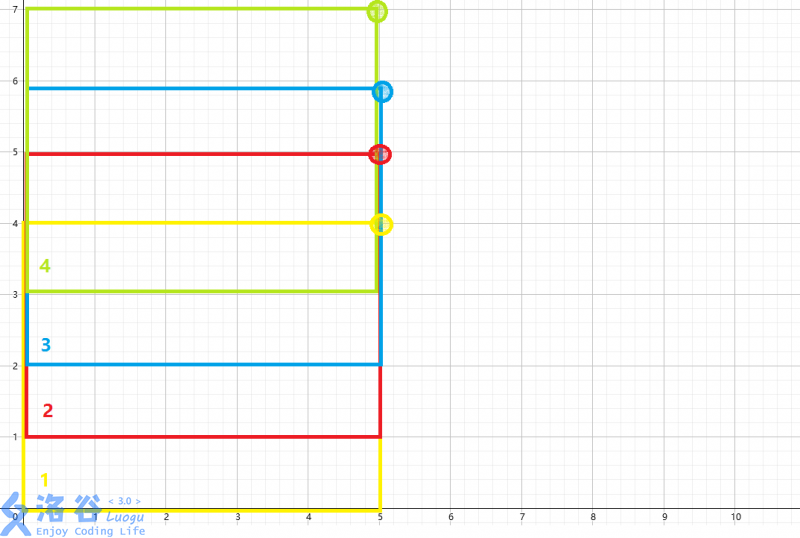
大概就是这种感觉:把每个点向左下角扩展得到它代表的矩形。
对于每颗星星,把它能影响到的矩形加上它的贡献。
不考虑横坐标,它能影响到的矩形为:到的点所代表的所有矩形。
考虑上横坐标,用扫描线,及时删除不在当前横坐标能覆盖的星星。
这样把每个可能的矩形缩成一个点,用线段树维护最大值,边扫边取最大值就行了。
时间复杂度:
(说着轻快其实蒟蒻调了好长时间,边界的处理太麻烦了,具体细节还是看代码吧)
#include <iostream>
#include <cstdio>
#include <algorithm>
#include <cmath>
#include <cstring>

#define maxn 10005
#define inf 0x3f3f3f3f
#define pn putchar('\n')
#define px(x) putchar(x)
#define ps putchar(' ')
#define pd puts("======================")
#define pj puts("++++++++++++++++++++++")

using namespace std;

inline int read(){
	int x=0,y=0;
	char ch=getchar();
	while(ch<'0'||ch>'9'){if(ch=='-')y=1;ch=getchar();}
	while(ch>='0'&&ch<='9')x=(x<<1)+(x<<3)+(ch^48),ch=getchar();
	return y?-x:x;
}
template<typename T>
inline T read(){
	T x=0;
	int y=0;
	char ch=getchar();
	while(ch<'0'||ch>'9'){if(ch=='-')y=1;ch=getchar();}
	while(ch>='0'&&ch<='9')x=(x<<1)+(x<<3)+(ch^48),ch=getchar();
	return y?-x:x;
}
struct Segment_Tree{
	long long dat[maxn<<2],tag[maxn<<2];
#define ls(x) (x<<1)
#define rs(x) (x<<1|1)
	inline void update(int node){
		dat[node]=max(dat[ls(node)],dat[rs(node)]);
	}
	inline void datadown(int node,long long d){
		dat[node]+=d;
		tag[node]+=d;
	}
	inline void pushdown(int node){
		datadown(ls(node),tag[node]);
		datadown(rs(node),tag[node]);
		tag[node]=0;
	}
	void add(int L,int R,int l,int r,int node,long long d){
		if(L<=l&&R>=r){
			datadown(node,d);
			return;
		}
		if(tag[node])pushdown(node);
		int mid=l+r>>1;
		if(L<=mid)add(L,R,l,mid,ls(node),d);
		if(R>mid)add(L,R,mid+1,r,rs(node),d);
		update(node);
	}
	inline void clear(){
		memset(dat,0,sizeof dat);
		memset(tag,0,sizeof tag);
	}
}st;
int dis[maxn];
//离散化数组
struct POINT{
	int x,y,ll,rr;
	long long d;
}p[maxn];
//星星:x、y是坐标,ll、rr是它能覆盖的矩形范围,d是亮度
inline bool cmp(POINT x,POINT y){
	return x.x<y.x;
}
int main(){
	int t=read();
	while(t--){
		int n=read(),w=read()-1,h=read()-1,len=0,head=1;
        //长宽各-1
		for(register int i=1;i<=n;++i)
			p[i].x=read(),dis[++len]=p[i].y=read(),p[i].d=read<long long>();
		dis[++len]=(1ll<<31)-1;
        //加了一个无穷大的边界
		sort(dis+1,dis+1+len);
		sort(p+1,p+1+n,cmp);//把星星按横坐标排序
		len=unique(dis+1,dis+1+len)-dis-1;
		long long ans=0;
		for(register int i=1;i<=n;++i){
			p[i].ll=upper_bound(dis+1,dis+1+len,p[i].y)-dis,p[i].rr=upper_bound(dis+1,dis+1+len,p[i].y+h)-dis;
            //要用upper_bound,两边是可以等于的
			st.add(p[i].ll,p[i].rr,1,len,1,p[i].d);
			while(p[i].x-w>p[head].x)st.add(p[head].ll,p[head].rr,1,len,1,-p[head].d),++head;
            //通过head头指针删除点
			ans=max(ans,st.dat[1]);
		}
		printf("%lld\n",ans);
		st.clear();
	}
}