marp: true color: black headingDivider: 2 math: mathjax
网络流
陈祉余
最大权闭合子图
什么是最大权闭合子图
- 给你一张图,每一个点有点权,要求选一个点就要将所有的后继全部选上,问最大权方案。
最大权闭合子图怎么做
-
可以网络流建模,我们定义和源点在一起的点为不选,和汇点在一起的点为选。每一个权值为正数的点向源点连流量为权值的边,权值为负数的点向汇点连流量为权值的绝对值的边,原图上的边连流量为inf的边,跑最小割。
-
将所有连向源点的边的流量和减去最小割,就是答案。
-
最大权闭合子图建模的核心就是将问题转化成选 A 就必须选 B 的形式。
为什么是正确的
-
可以发现,流量为inf的边一定不会被割掉,所以一旦一个前驱状态与源点在一起,它的所有后继就会跟源点在一起。
-
并且,最小割=不选的正点+选的负点的绝对值之和,正点总权值减去最小割一定最大。本质上是一种调整法
U103816 【模板】最大权闭合子图
模板,给个链接
代码
#include<bits/stdc++.h>
namespace fast_IO {
#define IOSIZE 1000000
	char ibuf[IOSIZE], obuf[IOSIZE], *p1 = ibuf, *p2 = ibuf, *p3 = obuf;
#define getchar() ((p1==p2)and(p2=(p1=ibuf)+fread(ibuf,1,IOSIZE,stdin),p1==p2)?(EOF):(*p1++))
#define putchar(x) ((p3==obuf+IOSIZE)&&(fwrite(obuf,p3-obuf,1,stdout),p3=obuf),*p3++=x)
#define isdigit(ch) (ch>47&&ch<58)
#define isspace(ch) (ch<33)
	template<typename T> inline T read() { T s = 0; int w = 1; char ch; while (ch = getchar(), !isdigit(ch) and (ch != EOF)) if (ch == '-') w = -1; if (ch == EOF) return false; while (isdigit(ch)) s = s * 10 + ch - 48, ch = getchar(); return s * w; }
	template<typename T> inline bool read(T &s) { s = 0; int w = 1; char ch; while (ch = getchar(), !isdigit(ch) and (ch != EOF)) if (ch == '-') w = -1; if (ch == EOF) return false; while (isdigit(ch)) s = s * 10 + ch - 48, ch = getchar(); return s *= w, true; }
	template<typename T> inline void print(T x) { if (x < 0) putchar('-'), x = -x; if (x > 9) print(x / 10); putchar(x % 10 + 48); }
	inline bool read(char &s) { while (s = getchar(), isspace(s)); return true; }
	inline bool read(char *s) { char ch; while (ch = getchar(), isspace(ch)); if (ch == EOF) return false; while (!isspace(ch)) *s++ = ch, ch = getchar(); *s = '\000'; return true; }
	inline void print(char x) { putchar(x); }
	inline void print(char *x) { while (*x) putchar(*x++); }
	inline void print(const char *x) { for (int i = 0; x[i]; i++) putchar(x[i]); }
	inline bool read(std::string& s) { s = ""; char ch; while (ch = getchar(), isspace(ch)); if (ch == EOF) return false; while (!isspace(ch)) s += ch, ch = getchar(); return true; }
	inline void print(std::string x) { for (int i = 0, n = x.size(); i < n; i++) putchar(x[i]); }
	inline bool read(bool &b) { char ch; while(ch=getchar(), isspace(ch)); b=ch^48; return true; }
	inline void print(bool b) { putchar(b+48); }
	template<typename T, typename... T1> inline int read(T& a, T1&... other) { return read(a) + read(other...); }
	template<typename T, typename... T1> inline void print(T a, T1... other) { print(a), print(other...); }
	struct Fast_IO { ~Fast_IO() { fwrite(obuf, p3 - obuf, 1, stdout); } } io;
	template<typename T> Fast_IO& operator >> (Fast_IO &io, T &b) { return read(b), io; }
	template<typename T> Fast_IO& operator << (Fast_IO &io, T b) { return print(b), io; }
#define cout io
#define cin io
#define endl '\n'
} using namespace fast_IO;
using namespace std;
#define int long long
const int M=2000+10,inf=1e17;
int h[M],ne[M<<3],to[M<<3],w[M<<3],idx=1;
int n,m;
int s,t;
void add(int u,int v,int c)
{
	to[++idx]=v;
	w[idx]=c;
	ne[idx]=h[u];
	h[u]=idx;
}
void Add(int u,int v,int c)
{
	add(u,v,c);
	add(v,u,0);
}
int cur[M];
int dep[M];
bool vst[M];
bool bfs()
{
	for(int i=s;i<=t;i++)
		dep[i]=inf,vst[i]=0;
	queue<int> q;
	q.emplace(s);
	dep[s]=0;
	while(q.size())
	{
		auto u=q.front();
		q.pop();
		for(int i=h[u];i;i=ne[i])
		{
			int v=to[i];
			if(dep[v]==inf&&w[i])
			{
				dep[v]=dep[u]+1;
				q.emplace(v);
			}
		}
	}
	return dep[t]!=inf;
}
int dfs(int u,int flow)
{
	if(u==t||!flow)
		return flow;
	int tmp=0;
	vst[u]=1;
	for(int &i=cur[u];i;i=ne[i])
	{
		int v=to[i];
		if(w[i]&&dep[v]==dep[u]+1&&!vst[v])
		{
			int d=dfs(v,min(flow-tmp,w[i]));
			if(d)
			{
				w[i]-=d;
				w[i^1]+=d;
				tmp+=d;
				if(tmp==flow)
					break;
			}
		}
	}
	vst[u]=0;
	return tmp;
}
int dinic()
{
	int ans=0;
	while(bfs())
	{
		for(int i=s;i<=t;i++)
			cur[i]=h[i];
		int d=dfs(s,inf);
		while(d)
		{
			ans+=d;
			d=dfs(s,inf);
		}
	}
	return ans;
}
signed main()
{
	cin>>n>>m;
	s=0,t=n+1;
	int ans=0;
	for(int i=1,p;i<=n;i++)
	{
		cin>>p;
		if(p>0)
		{
			ans+=p;
			Add(s,i,p);
		}
		else
			Add(i,t,-p);
	}
	for(int i=1,u,v;i<=m;i++)
	{
		cin>>u>>v;
		Add(u,v,inf);
	}
	ans-=dinic();
	cout<<ans<<endl;
	return 0;
}
P4174 [NOI2006] 最大获利
问题陈述
有 个基站,修建代价为 ,有 个用户,每一个用户要用基站 ,同时满足会有收益 ,问最大收益。
P4174 [NOI2006] 最大获利
解法
- 这是一个最大权闭合子图,用户要求的两个基站必须同时满足。
- 每一个用户向源点连边,流量为收益,用户向要求的两个基站连边,流量为 ,基站向汇点连边,流量为基站代价
- 用所有用户的总收益减去最小割就是答案
代码
#include<bits/stdc++.h>
namespace fast_IO {
#define IOSIZE 1000000
	char ibuf[IOSIZE], obuf[IOSIZE], *p1 = ibuf, *p2 = ibuf, *p3 = obuf;
#define getchar() ((p1==p2)and(p2=(p1=ibuf)+fread(ibuf,1,IOSIZE,stdin),p1==p2)?(EOF):(*p1++))
#define putchar(x) ((p3==obuf+IOSIZE)&&(fwrite(obuf,p3-obuf,1,stdout),p3=obuf),*p3++=x)
#define isdigit(ch) (ch>47&&ch<58)
#define isspace(ch) (ch<33)
	template<typename T> inline T read() { T s = 0; int w = 1; char ch; while (ch = getchar(), !isdigit(ch) and (ch != EOF)) if (ch == '-') w = -1; if (ch == EOF) return false; while (isdigit(ch)) s = s * 10 + ch - 48, ch = getchar(); return s * w; }
	template<typename T> inline bool read(T &s) { s = 0; int w = 1; char ch; while (ch = getchar(), !isdigit(ch) and (ch != EOF)) if (ch == '-') w = -1; if (ch == EOF) return false; while (isdigit(ch)) s = s * 10 + ch - 48, ch = getchar(); return s *= w, true; }
	template<typename T> inline void print(T x) { if (x < 0) putchar('-'), x = -x; if (x > 9) print(x / 10); putchar(x % 10 + 48); }
	inline bool read(char &s) { while (s = getchar(), isspace(s)); return true; }
	inline bool read(char *s) { char ch; while (ch = getchar(), isspace(ch)); if (ch == EOF) return false; while (!isspace(ch)) *s++ = ch, ch = getchar(); *s = '\000'; return true; }
	inline void print(char x) { putchar(x); }
	inline void print(char *x) { while (*x) putchar(*x++); }
	inline void print(const char *x) { for (int i = 0; x[i]; i++) putchar(x[i]); }
	inline bool read(std::string& s) { s = ""; char ch; while (ch = getchar(), isspace(ch)); if (ch == EOF) return false; while (!isspace(ch)) s += ch, ch = getchar(); return true; }
	inline void print(std::string x) { for (int i = 0, n = x.size(); i < n; i++) putchar(x[i]); }
	inline bool read(bool &b) { char ch; while(ch=getchar(), isspace(ch)); b=ch^48; return true; }
	inline void print(bool b) { putchar(b+48); }
	template<typename T, typename... T1> inline int read(T& a, T1&... other) { return read(a) + read(other...); }
	template<typename T, typename... T1> inline void print(T a, T1... other) { print(a), print(other...); }
	struct Fast_IO { ~Fast_IO() { fwrite(obuf, p3 - obuf, 1, stdout); } } io;
	template<typename T> Fast_IO& operator >> (Fast_IO &io, T &b) { return read(b), io; }
	template<typename T> Fast_IO& operator << (Fast_IO &io, T b) { return print(b), io; }
#define cout io
#define cin io
#define endl '\n'
} using namespace fast_IO;
using namespace std;
#define int long long
const int M=55000+10,inf=1e17;
int h[M],ne[M<<3],to[M<<3],w[M<<3],idx=1;
int n,m;
int s,t;
void add(int u,int v,int c)
{
	to[++idx]=v;
	w[idx]=c;
	ne[idx]=h[u];
	h[u]=idx;
}
void Add(int u,int v,int c)
{
	add(u,v,c);
	add(v,u,0);
}
int cur[M];
int dep[M];
bool vst[M];
bool bfs()
{
	for(int i=s;i<=t;i++)
		dep[i]=inf,vst[i]=0;
	queue<int> q;
	q.emplace(s);
	dep[s]=0;
	while(q.size())
	{
		auto u=q.front();
		q.pop();
		for(int i=h[u];i;i=ne[i])
		{
			int v=to[i];
			if(dep[v]==inf&&w[i])
			{
				dep[v]=dep[u]+1;
				q.emplace(v);
			}
		}
	}
	return dep[t]!=inf;
}
int dfs(int u,int flow)
{
	if(u==t||!flow)
		return flow;
	int tmp=0;
	vst[u]=1;
	for(int &i=cur[u];i;i=ne[i])
	{
		int v=to[i];
		if(w[i]&&dep[v]==dep[u]+1&&!vst[v])
		{
			int d=dfs(v,min(flow-tmp,w[i]));
			if(d)
			{
				w[i]-=d;
				w[i^1]+=d;
				tmp+=d;
				if(tmp==flow)
					break;
			}
		}
	}
	vst[u]=0;
	return tmp;
}
int dinic()
{
	int ans=0;
	while(bfs())
	{
		for(int i=s;i<=t;i++)
			cur[i]=h[i];
		int d=dfs(s,inf);
		while(d)
		{
			ans+=d;
			d=dfs(s,inf);
		}
	}
	return ans;
}
signed main()
{
	cin>>n>>m;
	s=0,t=n+m+1;
	for(int i=1,p;i<=n;i++)
	{
		cin>>p;
		Add(i,t,p);
	}
	int ans=0;
	for(int i=1,a,b,c;i<=m;i++)
	{
		cin>>a>>b>>c;
		ans+=c;
		Add(s,i+n,c);
		Add(i+n,a,inf);
		Add(i+n,b,inf);
	}
	ans-=dinic();
	cout<<ans<<endl;
	return 0;
}
P2762 太空飞行计划问题
问题陈述
个实验,选择一个实验就必须选一些仪器,每一个仪器有 的费用,每一个实验完成后有 的收益,问最大获利,输出方案。
P2762 太空飞行计划问题
解法
-
前面是正常的最小割问题,关键在于怎样输出方案。
-
在最后一次增广后,所有的与源点没有流量经过的点就被划分到与汇点在一起,即选上了。所以此时选上的点就是最后一次 中有层数的点。
代码
#include<bits/stdc++.h>
namespace fast_IO {
#define IOSIZE 1000000
	char ibuf[IOSIZE], obuf[IOSIZE], *p1 = ibuf, *p2 = ibuf, *p3 = obuf;
#define getchar() ((p1==p2)and(p2=(p1=ibuf)+fread(ibuf,1,IOSIZE,stdin),p1==p2)?(EOF):(*p1++))
#define putchar(x) ((p3==obuf+IOSIZE)&&(fwrite(obuf,p3-obuf,1,stdout),p3=obuf),*p3++=x)
#define isdigit(ch) (ch>47&&ch<58)
#define isspace(ch) (ch<33)
	template<typename T> inline T read() { T s = 0; int w = 1; char ch; while (ch = getchar(), !isdigit(ch) and (ch != EOF)) if (ch == '-') w = -1; if (ch == EOF) return false; while (isdigit(ch)) s = s * 10 + ch - 48, ch = getchar(); return s * w; }
	template<typename T> inline bool read(T &s) { s = 0; int w = 1; char ch; while (ch = getchar(), !isdigit(ch) and (ch != EOF)) if (ch == '-') w = -1; if (ch == EOF) return false; while (isdigit(ch)) s = s * 10 + ch - 48, ch = getchar(); return s *= w, true; }
	template<typename T> inline void print(T x) { if (x < 0) putchar('-'), x = -x; if (x > 9) print(x / 10); putchar(x % 10 + 48); }
	inline bool read(char &s) { while (s = getchar(), isspace(s)); return true; }
	inline bool read(char *s) { char ch; while (ch = getchar(), isspace(ch)); if (ch == EOF) return false; while (!isspace(ch)) *s++ = ch, ch = getchar(); *s = '\000'; return true; }
	inline void print(char x) { putchar(x); }
	inline void print(char *x) { while (*x) putchar(*x++); }
	inline void print(const char *x) { for (int i = 0; x[i]; i++) putchar(x[i]); }
	inline bool read(std::string& s) { s = ""; char ch; while (ch = getchar(), isspace(ch)); if (ch == EOF) return false; while (!isspace(ch)) s += ch, ch = getchar(); return true; }
	inline void print(std::string x) { for (int i = 0, n = x.size(); i < n; i++) putchar(x[i]); }
	inline bool read(bool &b) { char ch; while(ch=getchar(), isspace(ch)); b=ch^48; return true; }
	inline void print(bool b) { putchar(b+48); }
	template<typename T, typename... T1> inline int read(T& a, T1&... other) { return read(a) + read(other...); }
	template<typename T, typename... T1> inline void print(T a, T1... other) { print(a), print(other...); }
	struct Fast_IO { ~Fast_IO() { fwrite(obuf, p3 - obuf, 1, stdout); } } io;
	template<typename T> Fast_IO& operator >> (Fast_IO &io, T &b) { return read(b), io; }
	template<typename T> Fast_IO& operator << (Fast_IO &io, T b) { return print(b), io; }
//#define cout io
//#define cin io
#define endl '\n'
} using namespace fast_IO;
using namespace std;
#define int long long
const int M=1000+10,inf=1e17;
int n,m;
int h[M],to[M<<1],ne[M<<1],w[M<<1],idx=1;
int s=1,t=2;
void Add(int u,int v,int c)
{
	to[++idx]=v;
	w[idx]=c;
	ne[idx]=h[u];
	h[u]=idx;
}
void add(int u,int v,int c)
{
//	cout<<u<<" "<<v<<" "<<c<<endl;
	Add(u,v,c);
	Add(v,u,0);
}
int dep[M];
int cur[M];
bool bfs()
{
	for(int i=s;i<=2+n+m;i++)
		dep[i]=inf;
	dep[s]=0;
	queue<int> q;
	q.emplace(s);
	while(q.size())
	{
		int u=q.front();
		q.pop();
		for(int i=h[u];i;i=ne[i])
		{
			int v=to[i];
			if(w[i]&&dep[v]==inf)
			{
				dep[v]=dep[u]+1;
				q.emplace(v);
			}
		}
	}
	return dep[t]!=inf;
}
int dfs(int u,int flow)
{
	if(u==t||!flow)
		return flow;
	int tmp=0;
	for(int &i=cur[u];i;i=ne[i])
	{
		int v=to[i];
		if(w[i]&&dep[v]==dep[u]+1)
		{
			int d=dfs(v,min(flow-tmp,w[i]));
			if(d)
			{
				w[i]-=d;
				w[i^1]+=d;
				tmp+=d;
				if(tmp==flow)
					break;
			}
		}
	}
	return tmp;
}
int dinic()
{
	int ans=0;
	while(bfs())
	{
		for(int i=s;i<=2+n+m;i++)
			cur[i]=h[i];
		int d=dfs(s,inf);
		if(d)
		{
			ans+=d;
			d=dfs(s,inf);
		}
	}
	return ans;
}
signed main()
{
	cin>>m>>n;
	int ans=0;
	for(int i=1,c;i<=m;i++)
	{
		cin>>c;
		add(s,i+2,c);
		ans+=c;
		int x;
		char C;
		while(scanf("%c",&C),C==' ')
		{
			scanf("%lld",&x);
			add(i+2,2+m+x,inf);
		}
	}
	for(int i=1,c;i<=n;i++)
	{
		cin>>c;
		add(2+m+i,t,c);
	}
	ans-=dinic();
	vector<int> v1,v2;
	for(int i=2;i<=2+n+m;i++)
	{
		if(dep[i]!=inf)
		{
			if(2<i&&i<=2+m)
				v1.emplace_back(i-2);
			if(2+m+1<=i&&i<=2+m+n)
				v2.emplace_back(i-m-2);
		}
	}
	for(auto i:v1)
		cout<<i<<" ";
	cout<<endl;
	for(auto i:v2)
		cout<<i<<" ";
	cout<<endl;
	cout<<ans<<endl;
	return 0;
}
P3410 拍照
问题陈述
小 有 个下属,现小 要带着一些下属让别人拍照。
有 个人,每个人都愿意付给小 一定钱来和 个下属中的一些人进行合影。如果这一些下属没带齐那么就不能拍照,小 也不会得到钱。
对于每个下属,如果他带了那么小 需要给他一些钱,保证当他拍照时配合。
,费用在 之间。
P3410 拍照
解法
与上一道题一样。
代码
#include<bits/stdc++.h>
namespace fast_IO {
#define IOSIZE 1000000
	char ibuf[IOSIZE], obuf[IOSIZE], *p1 = ibuf, *p2 = ibuf, *p3 = obuf;
#define getchar() ((p1==p2)and(p2=(p1=ibuf)+fread(ibuf,1,IOSIZE,stdin),p1==p2)?(EOF):(*p1++))
#define putchar(x) ((p3==obuf+IOSIZE)&&(fwrite(obuf,p3-obuf,1,stdout),p3=obuf),*p3++=x)
#define isdigit(ch) (ch>47&&ch<58)
#define isspace(ch) (ch<33)
	template<typename T> inline T read() { T s = 0; int w = 1; char ch; while (ch = getchar(), !isdigit(ch) and (ch != EOF)) if (ch == '-') w = -1; if (ch == EOF) return false; while (isdigit(ch)) s = s * 10 + ch - 48, ch = getchar(); return s * w; }
	template<typename T> inline bool read(T &s) { s = 0; int w = 1; char ch; while (ch = getchar(), !isdigit(ch) and (ch != EOF)) if (ch == '-') w = -1; if (ch == EOF) return false; while (isdigit(ch)) s = s * 10 + ch - 48, ch = getchar(); return s *= w, true; }
	template<typename T> inline void print(T x) { if (x < 0) putchar('-'), x = -x; if (x > 9) print(x / 10); putchar(x % 10 + 48); }
	inline bool read(char &s) { while (s = getchar(), isspace(s)); return true; }
	inline bool read(char *s) { char ch; while (ch = getchar(), isspace(ch)); if (ch == EOF) return false; while (!isspace(ch)) *s++ = ch, ch = getchar(); *s = '\000'; return true; }
	inline void print(char x) { putchar(x); }
	inline void print(char *x) { while (*x) putchar(*x++); }
	inline void print(const char *x) { for (int i = 0; x[i]; i++) putchar(x[i]); }
	inline bool read(std::string& s) { s = ""; char ch; while (ch = getchar(), isspace(ch)); if (ch == EOF) return false; while (!isspace(ch)) s += ch, ch = getchar(); return true; }
	inline void print(std::string x) { for (int i = 0, n = x.size(); i < n; i++) putchar(x[i]); }
	inline bool read(bool &b) { char ch; while(ch=getchar(), isspace(ch)); b=ch^48; return true; }
	inline void print(bool b) { putchar(b+48); }
	template<typename T, typename... T1> inline int read(T& a, T1&... other) { return read(a) + read(other...); }
	template<typename T, typename... T1> inline void print(T a, T1... other) { print(a), print(other...); }
	struct Fast_IO { ~Fast_IO() { fwrite(obuf, p3 - obuf, 1, stdout); } } io;
	template<typename T> Fast_IO& operator >> (Fast_IO &io, T &b) { return read(b), io; }
	template<typename T> Fast_IO& operator << (Fast_IO &io, T b) { return print(b), io; }
#define cout io
#define cin io
#define endl '\n'
} using namespace fast_IO;
using namespace std;
#define int long long
const int N=300+10,M=1e5+10,inf=1e17;
int n,m;
int h[N],to[M<<1],ne[M<<1],w[M<<1],idx=1;
int s=1,t=2;
void Add(int u,int v,int c)
{
	to[++idx]=v;
	w[idx]=c;
	ne[idx]=h[u];
	h[u]=idx;
}
void add(int u,int v,int c)
{
	Add(u,v,c);
	Add(v,u,0);
}
int dep[N];
int cur[N];
bool bfs()
{
	for(int i=1;i<=n+m+2;i++)
		dep[i]=inf;
	dep[s]=0;
	queue<int> q;
	q.emplace(s);
	while(q.size())
	{
		int u=q.front();
		q.pop();
		for(int i=h[u];i;i=ne[i])
		{
			int v=to[i];
			if(dep[v]==inf&&w[i])
			{
				dep[v]=dep[u]+1;
				q.emplace(v);
			}
		}
	}
	return dep[t]!=inf;
}
int dfs(int u,int flow)
{
	if(u==t||!flow)
		return flow;
	int tmp=0;
	for(int &i=cur[u];i;i=ne[i])
	{
		int v=to[i];
		if(dep[v]==dep[u]+1&&w[i])
		{
			int d=dfs(v,min(w[i],flow-tmp));
			if(d)
			{
				w[i]-=d;
				w[i^1]+=d;
				tmp+=d;
				if(tmp==flow)
					break;
			}
		}
	}
	return tmp;
}
int dinic()
{
	int ans=0;
	while(bfs())
	{
		for(int i=1;i<=n+m+2;i++)
			cur[i]=h[i];
		int d=dfs(s,inf);
		while(d)
		{
			ans+=d;
			d=dfs(s,inf);
		}
	}
	return ans;
}
signed main()
{
	cin>>m>>n;
	int ans=0;
	for(int i=1,c;i<=m;i++)
	{
		cin>>c;
		add(s,i+2,c);
		ans+=c;
		cin>>c;
		while(c)
		{
			add(i+2,2+m+c,inf);
			cin>>c;
		}
	}
	for(int i=1,c;i<=n;i++)
	{
		cin>>c;
		add(2+m+i,t,c);
	}
	ans-=dinic();
	cout<<ans<<endl;
	return 0;
}
CF311E biologist
问题陈述
有 条狗,每一条狗有 的性别。每一只狗有性转药物,代价是 ,且只能使用一次。
现在有 位富人,每一个富人指定了 条狗,要求这些狗的性别变为给定的 。
当你没有满足这个要求时,如果这个富人是你的朋友(输入给出),你要倒扣 的钱。当你满足要求后,会得到 的钱,求最大的收益(可以为负数)
CF311E biologist
解法
-
这是一个最大权闭合子图,每一个询问中的所有点必须同时选。
-
因为最大收益,所以套路的考虑总收益减去最小的不能拿到的收益,就是最小割。
-
具体的,将每一个初始性别为 的点连向源点,初始性别为 的点连向汇点,流量为改变性别的代价。
-
对于每一个询问,新建一个虚点,如果要求性别为 ,连向源点,流量为收益加上倒扣的钱,并向询问中的所有要求的点连流量为 的边。
-
所有询问的总收益减去最小割就是答案
代码
#include<bits/stdc++.h>
namespace fast_IO {
#define IOSIZE 1000000
	char ibuf[IOSIZE], obuf[IOSIZE], *p1 = ibuf, *p2 = ibuf, *p3 = obuf;
#define getchar() ((p1==p2)and(p2=(p1=ibuf)+fread(ibuf,1,IOSIZE,stdin),p1==p2)?(EOF):(*p1++))
#define putchar(x) ((p3==obuf+IOSIZE)&&(fwrite(obuf,p3-obuf,1,stdout),p3=obuf),*p3++=x)
#define isdigit(ch) (ch>47&&ch<58)
#define isspace(ch) (ch<33)
	template<typename T> inline T read() { T s = 0; int w = 1; char ch; while (ch = getchar(), !isdigit(ch) and (ch != EOF)) if (ch == '-') w = -1; if (ch == EOF) return false; while (isdigit(ch)) s = s * 10 + ch - 48, ch = getchar(); return s * w; }
	template<typename T> inline bool read(T &s) { s = 0; int w = 1; char ch; while (ch = getchar(), !isdigit(ch) and (ch != EOF)) if (ch == '-') w = -1; if (ch == EOF) return false; while (isdigit(ch)) s = s * 10 + ch - 48, ch = getchar(); return s *= w, true; }
	template<typename T> inline void print(T x) { if (x < 0) putchar('-'), x = -x; if (x > 9) print(x / 10); putchar(x % 10 + 48); }
	inline bool read(char &s) { while (s = getchar(), isspace(s)); return true; }
	inline bool read(char *s) { char ch; while (ch = getchar(), isspace(ch)); if (ch == EOF) return false; while (!isspace(ch)) *s++ = ch, ch = getchar(); *s = '\000'; return true; }
	inline void print(char x) { putchar(x); }
	inline void print(char *x) { while (*x) putchar(*x++); }
	inline void print(const char *x) { for (int i = 0; x[i]; i++) putchar(x[i]); }
	inline bool read(std::string& s) { s = ""; char ch; while (ch = getchar(), isspace(ch)); if (ch == EOF) return false; while (!isspace(ch)) s += ch, ch = getchar(); return true; }
	inline void print(std::string x) { for (int i = 0, n = x.size(); i < n; i++) putchar(x[i]); }
	inline bool read(bool &b) { char ch; while(ch=getchar(), isspace(ch)); b=ch^48; return true; }
	inline void print(bool b) { putchar(b+48); }
	template<typename T, typename... T1> inline int read(T& a, T1&... other) { return read(a) + read(other...); }
	template<typename T, typename... T1> inline void print(T a, T1... other) { print(a), print(other...); }
	struct Fast_IO { ~Fast_IO() { fwrite(obuf, p3 - obuf, 1, stdout); } } io;
	template<typename T> Fast_IO& operator >> (Fast_IO &io, T &b) { return read(b), io; }
	template<typename T> Fast_IO& operator << (Fast_IO &io, T b) { return print(b), io; }
#define cout io
#define cin io
#define endl '\n'
} using namespace fast_IO;
using namespace std;
#define int long long
const int N=2e4+10,M=1e5+10,inf=1e17;
int n,m,g;
int h[N<<1],ne[M<<1],w[M<<2],to[M<<2],idx=1;
int s,t;
int a[N],v[N];
void add(int u,int v,int c)
{
	to[++idx]=v;
	w[idx]=c;
	ne[idx]=h[u];
	h[u]=idx;
}
void Add(int u,int v,int c)
{
	add(u,v,c);
	add(v,u,0);
}
int cur[N<<1];
int dep[N<<1];
bool vst[N<<1];
bool bfs()
{
	for(int i=s;i<=t;i++)
		dep[i]=inf,vst[i]=0;
	queue<int> q;
	q.emplace(s);
	dep[s]=0;
	while(q.size())
	{
		int u=q.front();
		q.pop();
		for(int i=h[u];i;i=ne[i])
		{
			int v=to[i];
			if(w[i]>0&&dep[v]==inf)
			{
				q.emplace(v);
				dep[v]=dep[u]+1;
			}
		}
	}
	return (dep[t]!=inf);
}
int dfs(int u,int flow)
{
	if(u==t||!flow)
		return flow;
	vst[u]=1;
	int res=0;
	for(int &i=cur[u];i;i=ne[i])
	{
		int v=to[i];
		if(w[i]&&dep[v]==dep[u]+1&&!vst[v])
		{
			int d=dfs(v,min(flow-res,w[i]));
			if(d)
			{
				w[i]-=d;
				w[i^1]+=d;
				res+=d;
				if(res==flow)
					break;
			}
		}
	}
	vst[u]=0;
	return res;
}
int dinic()
{
	int ans=0;
	while(bfs())
	{
		for(int i=s;i<=t;i++)
			cur[i]=h[i];
		int d=dfs(s,inf);
		while(d)
		{
			ans+=d;
			d=dfs(s,inf);
		}
	}
	return ans;
}
signed main()
{
	cin>>n>>m>>g;
	s=0,t=n+m+1;
	for(int i=1;i<=n;i++)
		cin>>a[i];
	for(int i=1;i<=n;i++)
	{
		cin>>v[i];
		if(a[i])
			Add(i,t,v[i]);
		else
			Add(s,i,v[i]);
	}
	int ans=0;
//	for(int i=1,a,w,k,s;i<=m;i++)
//	{
//		cin>>a>>w>>k;
//		ans+=w;
//		for(int j=1;j<=k;j++)
//			cin>>v[j];
//		cin>>s;
//		if(a==0)
//			Add(s,i+n,w+g*s);
//		else
//			Add(i+n,t,w+g*s);
//		for(int j=1;j<=k;j++)
//		{
//			if(a==0)
//				Add(i+n,v[j],inf);
//			else
//				Add(v[j],i+n,inf);
//		}
//	}
	for(int i=1;i<=m;i++)
	{
		int opt,w,k,ss;
		cin>>opt>>w>>k;
		ans+=w;
		for(int j=1;j<=k;j++)
			cin>>v[j];
		cin>>ss;
		for(int j=1;j<=k;j++)
		{
			if(opt==0)
				Add(i+n,v[j],inf);
			else
				Add(v[j],i+n,inf);
		}
		if(opt==0)
			Add(s,i+n,w+ss*g);
		else
			Add(i+n,t,w+ss*g);
	}
	int num=dinic();
//	cout<<num<<endl;
	ans-=num;
	cout<<ans<<endl;
	return 0;
}
P1361 小M的作物/P4313 文理分科/P1646 [国家集训队] happiness
解法
这一类题目的通法都是新建虚点来表示同时选,解法同上。
代码
#include<bits/stdc++.h>
namespace fast_IO {
#define IOSIZE 1000000
	char ibuf[IOSIZE], obuf[IOSIZE], *p1 = ibuf, *p2 = ibuf, *p3 = obuf;
#define getchar() ((p1==p2)and(p2=(p1=ibuf)+fread(ibuf,1,IOSIZE,stdin),p1==p2)?(EOF):(*p1++))
#define putchar(x) ((p3==obuf+IOSIZE)&&(fwrite(obuf,p3-obuf,1,stdout),p3=obuf),*p3++=x)
#define isdigit(ch) (ch>47&&ch<58)
#define isspace(ch) (ch<33)
	template<typename T> inline T read() { T s = 0; int w = 1; char ch; while (ch = getchar(), !isdigit(ch) and (ch != EOF)) if (ch == '-') w = -1; if (ch == EOF) return false; while (isdigit(ch)) s = s * 10 + ch - 48, ch = getchar(); return s * w; }
	template<typename T> inline bool read(T &s) { s = 0; int w = 1; char ch; while (ch = getchar(), !isdigit(ch) and (ch != EOF)) if (ch == '-') w = -1; if (ch == EOF) return false; while (isdigit(ch)) s = s * 10 + ch - 48, ch = getchar(); return s *= w, true; }
	template<typename T> inline void print(T x) { if (x < 0) putchar('-'), x = -x; if (x > 9) print(x / 10); putchar(x % 10 + 48); }
	inline bool read(char &s) { while (s = getchar(), isspace(s)); return true; }
	inline bool read(char *s) { char ch; while (ch = getchar(), isspace(ch)); if (ch == EOF) return false; while (!isspace(ch)) *s++ = ch, ch = getchar(); *s = '\000'; return true; }
	inline void print(char x) { putchar(x); }
	inline void print(char *x) { while (*x) putchar(*x++); }
	inline void print(const char *x) { for (int i = 0; x[i]; i++) putchar(x[i]); }
	inline bool read(std::string& s) { s = ""; char ch; while (ch = getchar(), isspace(ch)); if (ch == EOF) return false; while (!isspace(ch)) s += ch, ch = getchar(); return true; }
	inline void print(std::string x) { for (int i = 0, n = x.size(); i < n; i++) putchar(x[i]); }
	inline bool read(bool &b) { char ch; while(ch=getchar(), isspace(ch)); b=ch^48; return true; }
	inline void print(bool b) { putchar(b+48); }
	template<typename T, typename... T1> inline int read(T& a, T1&... other) { return read(a) + read(other...); }
	template<typename T, typename... T1> inline void print(T a, T1... other) { print(a), print(other...); }
	struct Fast_IO { ~Fast_IO() { fwrite(obuf, p3 - obuf, 1, stdout); } } io;
	template<typename T> Fast_IO& operator >> (Fast_IO &io, T &b) { return read(b), io; }
	template<typename T> Fast_IO& operator << (Fast_IO &io, T b) { return print(b), io; }
#define cout io
#define cin io
#define endl '\n'
} using namespace fast_IO;
using namespace std;
#define int long long
const int N=1000+10,M=1000*1000+100000,inf=1e17;
int n,m;
int s,t;
map<int,int> mp;
int cnt;
int id(int i)
{
	if(mp.find(i)!=mp.end())
		return mp[i];
	else
		return mp[i]=++cnt;
}
int h[M<<1],to[M<<2],ne[M<<2],w[M<<2],idx=1;
void Add(int u,int v,int c)
{
	to[++idx]=v;
	w[idx]=c;
	ne[idx]=h[u];
	h[u]=idx;
}
void add(int u,int v,int c)
{
	Add(u,v,c);
	Add(v,u,0);
}
int cur[M<<1],dep[M<<1];
bool bfs()
{
	queue<int> q;
	for(int i=1;i<=cnt;i++)
		dep[i]=0;
	dep[s]=1;
	q.emplace(s);
	while(!q.empty())
	{
		int u=q.front();
		q.pop();
		for(int i=h[u];i;i=ne[i])
		{
			int v=to[i];
			if(!dep[v]&&w[i])
			{
				dep[v]=dep[u]+1;
				q.emplace(v);
			}
		}
	}
	return dep[t];
}
int dfs(int u,int flow)
{
	if(u==t||!flow)
		return flow;
	int tmp=0;
	for(int &i=cur[u];i;i=ne[i])
	{
		int v=to[i];
		if(dep[v]==dep[u]+1&&w[i])
		{
			int d=dfs(v,min(w[i],flow-tmp));
			if(!d)
				dep[v]=0;
			w[i]-=d;
			w[i^1]+=d;
			tmp+=d;
			if(tmp==flow)
				break;
		}
	}
	return tmp;
}
int dinic()
{
	int ans=0;
	while(bfs())
	{
		for(int i=1;i<=cnt;i++)
			cur[i]=h[i];
		int d=dfs(s,inf);
		while(d)
		{
			ans+=d;
			d=dfs(s,inf);
		}
	}
	return ans;
}
signed main()
{
	s=++cnt;
	t=++cnt;
	cin>>n;
	int sum=0;
	for(int i=1,x;i<=n;i++)
	{
		cin>>x;
		add(id(i),t,x);
		sum+=x;
	}
	for(int i=1,x;i<=n;i++)
	{
		cin>>x;
		add(s,id(i),x);
		sum+=x;
	}
	cin>>m;
	for(int i=1,k,c0,c1;i<=m;i++)
	{
		cin>>k>>c0>>c1;
		int id1=++cnt,id2=++cnt;
		for(int j=1,x;j<=k;j++)
		{
			cin>>x;
			add(id(x),id1,inf);
			add(id2,id(x),inf);
		}
		add(id1,t,c0);
		add(s,id2,c1);
		sum+=c0;
		sum+=c1;
	}
	cout<<sum-dinic()<<endl;
	return 0;
}
P3749 [六省联考 2017] 寿司餐厅
问题陈述
有 种寿司,第 种寿司的类型为 。
如果你吃了第 种到第 种寿司,你会得到 的收益。
如果你吃了 个类型为 的寿司,你会付出 的代价 。
最大化收益与代价的差。
P3749 [六省联考 2017] 寿司餐厅
解法
-
这道题里面限制不是很明显,先考虑观察性质。
-
发现这道题中唯一满足
选了A就要选B的条件的只有同时选一个区间这一个,所以考虑每一个区间 , 向 和 连边,流量为 ,再将每一个区间看作一种物品,依据权值正负向源/汇点连边。 -
现在考虑这个代价怎么表示。因为这个代价的形式非常奇特,所以考虑拆成两部分来考虑,前一部分是 ,后一部分是 。前面这一部分只要选了就必须有,所以考虑新建节点来表示,让区间 连向新点,流量为 ,新点连向汇点,流量为 ,同时,区间 的收益减去 ,后就是模板。
代码
#include<bits/stdc++.h>
namespace fast_IO {
#define IOSIZE 1000000
	char ibuf[IOSIZE], obuf[IOSIZE], *p1 = ibuf, *p2 = ibuf, *p3 = obuf;
#define getchar() ((p1==p2)and(p2=(p1=ibuf)+fread(ibuf,1,IOSIZE,stdin),p1==p2)?(EOF):(*p1++))
#define putchar(x) ((p3==obuf+IOSIZE)&&(fwrite(obuf,p3-obuf,1,stdout),p3=obuf),*p3++=x)
#define isdigit(ch) (ch>47&&ch<58)
#define isspace(ch) (ch<33)
	template<typename T> inline T read() { T s = 0; int w = 1; char ch; while (ch = getchar(), !isdigit(ch) and (ch != EOF)) if (ch == '-') w = -1; if (ch == EOF) return false; while (isdigit(ch)) s = s * 10 + ch - 48, ch = getchar(); return s * w; }
	template<typename T> inline bool read(T &s) { s = 0; int w = 1; char ch; while (ch = getchar(), !isdigit(ch) and (ch != EOF)) if (ch == '-') w = -1; if (ch == EOF) return false; while (isdigit(ch)) s = s * 10 + ch - 48, ch = getchar(); return s *= w, true; }
	template<typename T> inline void print(T x) { if (x < 0) putchar('-'), x = -x; if (x > 9) print(x / 10); putchar(x % 10 + 48); }
	inline bool read(char &s) { while (s = getchar(), isspace(s)); return true; }
	inline bool read(char *s) { char ch; while (ch = getchar(), isspace(ch)); if (ch == EOF) return false; while (!isspace(ch)) *s++ = ch, ch = getchar(); *s = '\000'; return true; }
	inline void print(char x) { putchar(x); }
	inline void print(char *x) { while (*x) putchar(*x++); }
	inline void print(const char *x) { for (int i = 0; x[i]; i++) putchar(x[i]); }
	inline bool read(std::string& s) { s = ""; char ch; while (ch = getchar(), isspace(ch)); if (ch == EOF) return false; while (!isspace(ch)) s += ch, ch = getchar(); return true; }
	inline void print(std::string x) { for (int i = 0, n = x.size(); i < n; i++) putchar(x[i]); }
	inline bool read(bool &b) { char ch; while(ch=getchar(), isspace(ch)); b=ch^48; return true; }
	inline void print(bool b) { putchar(b+48); }
	template<typename T, typename... T1> inline int read(T& a, T1&... other) { return read(a) + read(other...); }
	template<typename T, typename... T1> inline void print(T a, T1... other) { print(a), print(other...); }
	struct Fast_IO { ~Fast_IO() { fwrite(obuf, p3 - obuf, 1, stdout); } } io;
	template<typename T> Fast_IO& operator >> (Fast_IO &io, T &b) { return read(b), io; }
	template<typename T> Fast_IO& operator << (Fast_IO &io, T b) { return print(b), io; }
#define cout io
#define cin io
#define endl '\n'
} using namespace fast_IO;
using namespace std;
#define int long long
const int N=100+10,M=1e5+10,inf=1e17;
int n,m;
int a[N];
int d[N][N];
int s=1,t=2;
int id[N][N],cnt=2;
int h[M],to[M<<1],ne[M<<1],w[M<<1],idx=1;
void Add(int u,int v,int c)
{
	to[++idx]=v;
	w[idx]=c;
	ne[idx]=h[u];
	h[u]=idx;
}
void add(int u,int v,int c)
{
	Add(u,v,c);
	Add(v,u,0);
}
int dep[M];
int cur[M];
bool bfs()
{
	for(int i=s;i<=cnt;i++)
		dep[i]=inf;
	dep[s]=0;
	queue<int> q;
	q.emplace(s);
	while(q.size())
	{
		int u=q.front();
		q.pop();
		for(int i=h[u];i;i=ne[i])
		{
			int v=to[i];
			if(w[i]&&dep[v]==inf)
			{
				dep[v]=dep[u]+1;
				q.emplace(v);
			}
		}
	}
	return dep[t]!=inf;
}
int dfs(int u,int flow)
{
	if(u==t||!flow)
		return flow;
	int tmp=0;
	for(int &i=cur[u];i;i=ne[i])
	{
		int v=to[i];
		if(w[i]&&dep[v]==dep[u]+1)
		{
			int d=dfs(v,min(flow-tmp,w[i]));
			if(d)
			{
				w[i]-=d;
				w[i^1]+=d;
				tmp+=d;
				if(tmp==flow)
					break;
			}
		}
	}
	return tmp;
}
int dinic()
{
	int ans=0;
	while(bfs())
	{
		for(int i=s;i<=cnt;i++)
			cur[i]=h[i];
		int d=dfs(s,inf);
		while(d)
		{
			ans+=d;
			d=dfs(s,inf);
		}
	}
	return ans;
}
signed main()
{
	cin>>n>>m;
	int maxa=0;
	for(int i=1;i<=n;i++)
		cin>>a[i],maxa=max(maxa,a[i]);
	for(int i=1;i<=n;i++)
		for(int j=i;j<=n;j++)
			cin>>d[i][j],id[i][j]=++cnt;
	int ans=0;
	for(int i=1;i<=n;i++)
	{
		for(int j=i;j<=n;j++)
		{
			int cost=d[i][j];
			if(i==j)
			{
				if(m)
					add(id[i][j],cnt+a[i],inf);
				cost-=a[i];
			}
			add(id[i][j],id[i+1][j],inf);
			add(id[i][j],id[i][j-1],inf);
			if(cost>0)
				add(s,id[i][j],cost),ans+=cost;
			else
				add(id[i][j],t,-cost);
		}
	}
	if(m)
		for(int i=1;i<=maxa;i++)
			add(++cnt,t,i*i);
	ans-=dinic();
	cout<<ans<<endl;
	return 0;
}
[ARC085E] MU
问题陈述
我们有 颗宝石,标记为 到 。
你可以执行以下任意次数(可能为零)的操作。
- 选择一个正整数 ,然后击碎所有标有 倍数的宝石。
然后,每打碎一个 ,如果标有 的宝石没有被打碎,就会得到 日元。但是, 可能是负数,在这种情况下,你将被收取金钱。
通过最佳操作,您可以赚取多少日元?
[ARC085E] MU
解法
-
首先,最后最大,就要打碎的总权值最小,而网络流只能表示打碎了什么,所以要跑最小权值闭合子图。
-
考虑将所有权值取反,然后跑最大权值闭合子图,求出以后就是最小要打碎的权值的相反数。我们要求最后的最大权值,就要用总权值减去这一部分,所有加上相反数即可。
代码
#include<bits/stdc++.h>
namespace fast_IO {
#define IOSIZE 1000000
	char ibuf[IOSIZE], obuf[IOSIZE], *p1 = ibuf, *p2 = ibuf, *p3 = obuf;
#define getchar() ((p1==p2)and(p2=(p1=ibuf)+fread(ibuf,1,IOSIZE,stdin),p1==p2)?(EOF):(*p1++))
#define putchar(x) ((p3==obuf+IOSIZE)&&(fwrite(obuf,p3-obuf,1,stdout),p3=obuf),*p3++=x)
#define isdigit(ch) (ch>47&&ch<58)
#define isspace(ch) (ch<33)
	template<typename T> inline T read() { T s = 0; int w = 1; char ch; while (ch = getchar(), !isdigit(ch) and (ch != EOF)) if (ch == '-') w = -1; if (ch == EOF) return false; while (isdigit(ch)) s = s * 10 + ch - 48, ch = getchar(); return s * w; }
	template<typename T> inline bool read(T &s) { s = 0; int w = 1; char ch; while (ch = getchar(), !isdigit(ch) and (ch != EOF)) if (ch == '-') w = -1; if (ch == EOF) return false; while (isdigit(ch)) s = s * 10 + ch - 48, ch = getchar(); return s *= w, true; }
	template<typename T> inline void print(T x) { if (x < 0) putchar('-'), x = -x; if (x > 9) print(x / 10); putchar(x % 10 + 48); }
	inline bool read(char &s) { while (s = getchar(), isspace(s)); return true; }
	inline bool read(char *s) { char ch; while (ch = getchar(), isspace(ch)); if (ch == EOF) return false; while (!isspace(ch)) *s++ = ch, ch = getchar(); *s = '\000'; return true; }
	inline void print(char x) { putchar(x); }
	inline void print(char *x) { while (*x) putchar(*x++); }
	inline void print(const char *x) { for (int i = 0; x[i]; i++) putchar(x[i]); }
	inline bool read(std::string& s) { s = ""; char ch; while (ch = getchar(), isspace(ch)); if (ch == EOF) return false; while (!isspace(ch)) s += ch, ch = getchar(); return true; }
	inline void print(std::string x) { for (int i = 0, n = x.size(); i < n; i++) putchar(x[i]); }
	inline bool read(bool &b) { char ch; while(ch=getchar(), isspace(ch)); b=ch^48; return true; }
	inline void print(bool b) { putchar(b+48); }
	template<typename T, typename... T1> inline int read(T& a, T1&... other) { return read(a) + read(other...); }
	template<typename T, typename... T1> inline void print(T a, T1... other) { print(a), print(other...); }
	struct Fast_IO { ~Fast_IO() { fwrite(obuf, p3 - obuf, 1, stdout); } } io;
	template<typename T> Fast_IO& operator >> (Fast_IO &io, T &b) { return read(b), io; }
	template<typename T> Fast_IO& operator << (Fast_IO &io, T b) { return print(b), io; }
#define cout io
#define cin io
#define endl '\n'
} using namespace fast_IO;
using namespace std;
#define int long long
const int N=100+10,inf=1e17;
int n;
int s,t;
int h[N],to[N<<4],w[N<<4],ne[N<<4],idx=1;
void Add(int u,int v,int c)
{
	to[++idx]=v;
	w[idx]=c;
	ne[idx]=h[u];
	h[u]=idx;
}
void add(int u,int v,int c)
{
	Add(u,v,c);
	Add(v,u,0);
}
int cur[N];
int dep[N];
bool bfs()
{
	for(int i=1;i<=t;i++)
		dep[i]=inf;
	dep[s]=0;
	queue<int> q;
	q.emplace(s);
	while(q.size())
	{
		int u=q.front();
		q.pop();
		for(int i=h[u];i;i=ne[i])
		{
			int v=to[i];
			if(w[i]&&dep[v]==inf)
			{
				dep[v]=dep[u]+1;
				q.emplace(v);
			}
		}
	}
	return dep[t]!=inf;
}
int dfs(int u,int flow)
{
	if(u==t||!flow)
		return flow;
	int tmp=0;
	for(int &i=cur[u];i;i=ne[i])
	{
		int v=to[i];
		if(w[i]&&dep[v]==dep[u]+1)
		{
			int d=dfs(v,min(w[i],flow-tmp));
			if(d)
			{
				w[i]-=d;
				w[i^1]+=d;
				tmp+=d;
				if(tmp==flow)
					break;
			}
		}
	}
	return tmp;
}
int dinic()
{
	int ans=0;
	while(bfs())
	{
		for(int i=1;i<=t;i++)
			cur[i]=h[i];
		int d=dfs(s,inf);
		while(d)
		{
			ans+=d;
			d=dfs(s,inf);
		}
	}
	return ans;
}
signed main()
{
	cin>>n;
	s=n+1,t=s+1;
	int ans=0,sum=0;
	for(int i=1,a;i<=n;i++)
	{
		cin>>a;
		sum+=a;
		a=-a;
		if(a>0)
			add(s,i,a),ans+=a;
		else
			add(i,t,-a);
	}
	for(int i=1;i<=n;i++)
		for(int j=i<<1;j<=n;j+=i)
			add(i,j,inf);
	ans-=dinic();
	sum+=ans;
	cout<<sum<<endl;
	return 0;
}
P2805 [NOI2009] 植物大战僵尸
问题陈述
一个 的矩阵,每一个位置上有植物,你操控僵尸进攻。消灭一个植物的方式是走到那个植物的位置上。消灭植物会获得一个能量值,能量值有正有负。植物可以攻击一些位置,植物的攻击力是无限大,走上去,来不及攻击就会被消灭。僵尸只能从一行的最右边走到最左边。问最大能量收入。
P2805 [NOI2009] 植物大战僵尸
解法
-
一样考虑限制,容易得到要消灭这个位置的植物,一定要先消灭保护着这个位置的植物,所以被保护的植物向保护它的植物连边,流量为 。 走到左边就必须经过右边,所以每一行,向自己右边的那一个格子连流量为 的边。其余按照正常点权连边即可。
-
但这样过不了样例。发现在这种情况时,会发生错误:
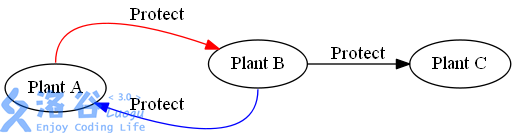 本来 都不能被攻击到,但是当有点连向 时,可能不经过整个环就流走了,所以在建边之前用拓扑排序去掉所有环,再建图。
代码
#include<bits/stdc++.h>
namespace fast_IO {
#define IOSIZE 1000000
	char ibuf[IOSIZE], obuf[IOSIZE], *p1 = ibuf, *p2 = ibuf, *p3 = obuf;
#define getchar() ((p1==p2)and(p2=(p1=ibuf)+fread(ibuf,1,IOSIZE,stdin),p1==p2)?(EOF):(*p1++))
#define putchar(x) ((p3==obuf+IOSIZE)&&(fwrite(obuf,p3-obuf,1,stdout),p3=obuf),*p3++=x)
#define isdigit(ch) (ch>47&&ch<58)
#define isspace(ch) (ch<33)
	template<typename T> inline T read() { T s = 0; int w = 1; char ch; while (ch = getchar(), !isdigit(ch) and (ch != EOF)) if (ch == '-') w = -1; if (ch == EOF) return false; while (isdigit(ch)) s = s * 10 + ch - 48, ch = getchar(); return s * w; }
	template<typename T> inline bool read(T &s) { s = 0; int w = 1; char ch; while (ch = getchar(), !isdigit(ch) and (ch != EOF)) if (ch == '-') w = -1; if (ch == EOF) return false; while (isdigit(ch)) s = s * 10 + ch - 48, ch = getchar(); return s *= w, true; }
	template<typename T> inline void print(T x) { if (x < 0) putchar('-'), x = -x; if (x > 9) print(x / 10); putchar(x % 10 + 48); }
	inline bool read(char &s) { while (s = getchar(), isspace(s)); return true; }
	inline bool read(char *s) { char ch; while (ch = getchar(), isspace(ch)); if (ch == EOF) return false; while (!isspace(ch)) *s++ = ch, ch = getchar(); *s = '\000'; return true; }
	inline void print(char x) { putchar(x); }
	inline void print(char *x) { while (*x) putchar(*x++); }
	inline void print(const char *x) { for (int i = 0; x[i]; i++) putchar(x[i]); }
	inline bool read(std::string& s) { s = ""; char ch; while (ch = getchar(), isspace(ch)); if (ch == EOF) return false; while (!isspace(ch)) s += ch, ch = getchar(); return true; }
	inline void print(std::string x) { for (int i = 0, n = x.size(); i < n; i++) putchar(x[i]); }
	inline bool read(bool &b) { char ch; while(ch=getchar(), isspace(ch)); b=ch^48; return true; }
	inline void print(bool b) { putchar(b+48); }
	template<typename T, typename... T1> inline int read(T& a, T1&... other) { return read(a) + read(other...); }
	template<typename T, typename... T1> inline void print(T a, T1... other) { print(a), print(other...); }
	struct Fast_IO { ~Fast_IO() { fwrite(obuf, p3 - obuf, 1, stdout); } } io;
	template<typename T> Fast_IO& operator >> (Fast_IO &io, T &b) { return read(b), io; }
	template<typename T> Fast_IO& operator << (Fast_IO &io, T b) { return print(b), io; }
#define cout io
#define cin io
#define endl '\n'
} using namespace fast_IO;
using namespace std;
#define int long long
const int N=(20*30)+10,M=5e6+10,inf=1e17;
int h[N],to[M],ne[M],w[M],idx=1;
int in[N];
int sc[N];
vector<int> at[N];
int n,m;
int s=1,t=2;
int cnt=2;
map<pair<int,int>,int> mp;
int id(int x,int y)
{
	if(mp.find(make_pair(x,y))!=mp.end())
		return mp[make_pair(x,y)];
	else
		return mp[make_pair(x,y)]=++cnt;
}
void Add(int u,int v,int c)
{
	to[++idx]=v;
	w[idx]=c;
	ne[idx]=h[u];
	h[u]=idx;
}
void add(int u,int v,int c)
{
//	cout<<u<<" "<<v<<" "<<c<<endl;
	Add(u,v,c);
	Add(v,u,0);
}
bool vst[N];
void topsort()
{
	queue<int> q;
	for(int i=3;i<=cnt;i++)
	{
		if(!in[i])
		{
			q.emplace(i);
			vst[i]=1;
		}
	}
	while(q.size())
	{
		int u=q.front();
		q.pop();
		for(auto i:at[u])
		{
			in[i]--;
			if(in[i]==0&&!vst[i])
				q.emplace(i),vst[i]=1;
		}
	}
}
int dep[N];
int cur[N];
bool bfs()
{
	for(int i=s;i<=cnt;i++)
		dep[i]=inf;
	dep[s]=0;
	queue<int> q;
	q.emplace(s);
	while(q.size())
	{
		int u=q.front();
		q.pop();
		for(int i=h[u];i;i=ne[i])
		{
			int v=to[i];
			if(dep[v]==inf&&w[i])
			{
				dep[v]=dep[u]+1;
				q.emplace(v);
			}
		}
	}
	return dep[t]!=inf;
}
int dfs(int u,int flow)
{
	if(u==t||!flow)
		return flow;
	int tmp=0;
	for(int &i=cur[u];i;i=ne[i])
	{
		int v=to[i];
		if(dep[v]==dep[u]+1&&w[i])
		{
			int d=dfs(v,min(flow-tmp,w[i]));
			if(d)
			{
				w[i]-=d;
				w[i^1]+=d;
				tmp+=d;
				if(tmp==flow)
					break;
			}
		}
	}
	return tmp;
}
int dinic()
{
	int ans=0;
	while(bfs())
	{
		for(int i=s;i<=cnt;i++)
			cur[i]=h[i];
		int d=dfs(s,inf);
		while(d)
		{
			ans+=d;
			d=dfs(s,inf);
		}
	}
	return ans;
}
signed main()
{
	cin>>n>>m;
	for(int i=1,w,r,c;i<=n;i++)
	{
		for(int j=1;j<=m;j++)
		{
			cin>>sc[id(i,j)];
			cin>>w;
			for(int k=1;k<=w;k++)
			{
				cin>>r>>c;
				r++;c++;
				at[id(i,j)].emplace_back(id(r,c));
				in[id(r,c)]++;
			}
			if(j<m)
			{
				at[id(i,j+1)].emplace_back(id(i,j));
				in[id(i,j)]++;
			}
		}
	}
	topsort();
	int ans=0;
	for(int i=3;i<=cnt;i++)
	{
		if(!vst[i])
			continue;
		if(sc[i]<0)
			add(i,t,-sc[i]);
		else
			add(s,i,sc[i]),ans+=sc[i];
		for(auto j:at[i])
			if(vst[j])
				add(j,i,inf);
	}
//	for(auto i:at[6])
//		cout<<i<<endl;
//	cout<<vst[5]<<" "<<vst[6]<<endl;
	ans-=dinic();
	cout<<ans<<endl;
	return 0;
}
最大密度子图
什么是最大密度子图
- 定义一个图的密度为边数除以点数,现在给你一张图,求一个密度最大的子图。
最大密度子图怎么做
-
首先,这是一个 分数规划问题,可以二分解决。
-
我们设 为边数, 为点数, 为比值的最大值,有 ,所以 ,,所以只用找出 的最大值即可。
-
这个式子可以直接转化为最大权闭合子图的问题,当选了一条边时,这一条边的两的端点也会被选上。所以将原图的每一个点赋点权 ,原图的边建立一个新点,权值为 ,并向两个端点连边,最大权闭合子图就是最大值。
UVA1389 Hard Life
问题陈述
John 是某公司的 CEO。公司内部共 个员工,员工之间可能曾经因为小事有了过节,总是闹矛盾。
若员工 和员工 有矛盾,用边 表示,共 个矛盾。
最近,该公司内部越来越不团结,John 决定裁员。他想得到一个被裁人员的清单,使得被裁人员间的不团结率最高。
不团结率定义为被裁人员间的矛盾总数与被裁人员数的比值(不团结率 = 被裁人员之间的矛盾总数 / 被裁人员数)。
输出方案。
UVA1389 Hard Life
解法
- 最大密度子图模板。输出方案就像之前最大全闭合子图一样输出即可。
代码
#include<bits/stdc++.h>
namespace fast_IO {
#define IOSIZE 1000000
	char ibuf[IOSIZE], obuf[IOSIZE], *p1 = ibuf, *p2 = ibuf, *p3 = obuf;
#define getchar() ((p1==p2)and(p2=(p1=ibuf)+fread(ibuf,1,IOSIZE,stdin),p1==p2)?(EOF):(*p1++))
#define putchar(x) ((p3==obuf+IOSIZE)&&(fwrite(obuf,p3-obuf,1,stdout),p3=obuf),*p3++=x)
#define isdigit(ch) (ch>47&&ch<58)
#define isspace(ch) (ch<33)
	template<typename T> inline T read() { T s = 0; int w = 1; char ch; while (ch = getchar(), !isdigit(ch) and (ch != EOF)) if (ch == '-') w = -1; if (ch == EOF) return false; while (isdigit(ch)) s = s * 10 + ch - 48, ch = getchar(); return s * w; }
	template<typename T> inline bool read(T &s) { s = 0; int w = 1; char ch; while (ch = getchar(), !isdigit(ch) and (ch != EOF)) if (ch == '-') w = -1; if (ch == EOF) return false; while (isdigit(ch)) s = s * 10 + ch - 48, ch = getchar(); return s *= w, true; }
	template<typename T> inline void print(T x) { if (x < 0) putchar('-'), x = -x; if (x > 9) print(x / 10); putchar(x % 10 + 48); }
	inline bool read(char &s) { while (s = getchar(), isspace(s)); return true; }
	inline bool read(char *s) { char ch; while (ch = getchar(), isspace(ch)); if (ch == EOF) return false; while (!isspace(ch)) *s++ = ch, ch = getchar(); *s = '\000'; return true; }
	inline void print(char x) { putchar(x); }
	inline void print(char *x) { while (*x) putchar(*x++); }
	inline void print(const char *x) { for (int i = 0; x[i]; i++) putchar(x[i]); }
	inline bool read(std::string& s) { s = ""; char ch; while (ch = getchar(), isspace(ch)); if (ch == EOF) return false; while (!isspace(ch)) s += ch, ch = getchar(); return true; }
	inline void print(std::string x) { for (int i = 0, n = x.size(); i < n; i++) putchar(x[i]); }
	inline bool read(bool &b) { char ch; while(ch=getchar(), isspace(ch)); b=ch^48; return true; }
	inline void print(bool b) { putchar(b+48); }
	template<typename T, typename... T1> inline int read(T& a, T1&... other) { return read(a) + read(other...); }
	template<typename T, typename... T1> inline void print(T a, T1... other) { print(a), print(other...); }
	struct Fast_IO { ~Fast_IO() { fwrite(obuf, p3 - obuf, 1, stdout); } } io;
	template<typename T> Fast_IO& operator >> (Fast_IO &io, T &b) { return read(b), io; }
	template<typename T> Fast_IO& operator << (Fast_IO &io, T b) { return print(b), io; }
//#define cout io
//#define cin io
#define endl '\n'
} using namespace fast_IO;
using namespace std;
#define int long long
const int N=100+10,M=1e5+10,inf=1e17;
const double eps=1e-6;
int n,m;
pair<int,int> edge[M];
int s=1,t=2;
int h[M],to[M<<4],ne[M<<4],idx=1;
double w[M<<4];
void Add(int u,int v,double c)
{
	to[++idx]=v;
	w[idx]=c;
	ne[idx]=h[u];
	h[u]=idx;
}
void add(int u,int v,double c)
{
//	cout<<u<<" "<<v<<" "<<c<<endl;
	Add(u,v,c);
	Add(v,u,0);
}
void init()
{
	for(int i=0;i<=idx;i++)
		to[i]=ne[i]=w[i]=0;
	for(int i=s;i<=2+n+m;i++)
		h[i]=0;
	idx=1;
}
int build(double g)
{
	int ans=0;
	init();
	for(int i=1;i<=n;i++)
		add(i+2,t,g);
	for(int i=1;i<=m;i++)
	{
		add(s,2+n+i,1);
		ans++;
		add(2+n+i,2+edge[i].first,inf);
		add(2+n+i,2+edge[i].second,inf);
	}
	return ans;
}
int dep[M];
int cur[M];
bool bfs()
{
	for(int i=s;i<=2+n+m;i++)
		dep[i]=inf;
	dep[s]=0;
	queue<int> q;
	q.emplace(s);
	while(q.size())
	{
		int u=q.front();
		q.pop();
		for(int i=h[u];i;i=ne[i])
		{
			int v=to[i];
			if(dep[v]==inf&&w[i])
			{
				dep[v]=dep[u]+1;
				q.emplace(v);
			}
		}
	}
	return dep[t]!=inf;
}
double dfs(int u,double flow)
{
	if(u==t||!flow)
		return flow;
	double tmp=0;
	for(int &i=cur[u];i;i=ne[i])
	{
		int v=to[i];
		if(w[i]&&dep[v]==dep[u]+1)
		{
			double d=dfs(v,min(w[i],flow-tmp));
			if(d)
			{
				w[i]-=d;
				w[i^1]+=d;
				tmp+=d;
				if(tmp==flow)
					break;
			}
		}
	}
	return tmp;
}
double dinic()
{
	double ans=0;
	while(bfs())
	{
		for(int i=s;i<=2+n+m;i++)
			cur[i]=h[i];
//		cout<<endl;
		double d=dfs(s,inf);
		while(d)
		{
//			cout<<d<<endl;
			ans+=d;
			d=dfs(s,inf);
		}
	}
	return ans;
}
double check(double g)
{
	double ans=build(g);
	ans-=dinic();
	return ans;
}
signed main()
{
	while(cin>>n>>m)
	{
		for(int i=1;i<=m;i++)
			cin>>edge[i].first>>edge[i].second;
		double l=0,r=m;
		while(r-l>eps)
		{
			double mid=(l+r)/2.0;
			if(check(mid)>0)
				l=mid;
			else
				r=mid;
		}
		check(l);
		vector<int> ans;
		for(int i=3;i<=2+n+m;i++)
			if(dep[i]!=inf&&i<=2+n)
					ans.emplace_back(i-2);
		if(ans.size()==0)
		{
			cout<<1<<endl<<1<<endl;
			continue;
		}
		cout<<ans.size()<<endl;
		for(int i:ans)
			cout<<i<<endl;
		cout<<endl;
	}
	return 0;
}
[Gym-100548C] The Problem Needs 3D Arrays
问题陈述
一个排列是由 n 个不同的正整数组成的序列 ,且每个整数都不超过 n。假设序列 S 的 表示序列 S 中的逆序对数量(如果 且 ,则称 为 S 的一个逆序对), 表示序列 S 的长度。给定长度为 n 的排列 P,你的任务是找到 P 的一个子序列 S,使得 的值最大。P 的子序列是满足 的序列 。
[Gym-100548C] The Problem Needs 3D Arrays
解法
这也是比较板的一道题,将原序列的逆序对提出来,建成边,直接跑最大密度子图。
代码
#include<bits/stdc++.h>
namespace fast_IO {
#define IOSIZE 1000000
	char ibuf[IOSIZE], obuf[IOSIZE], *p1 = ibuf, *p2 = ibuf, *p3 = obuf;
#define getchar() ((p1==p2)and(p2=(p1=ibuf)+fread(ibuf,1,IOSIZE,stdin),p1==p2)?(EOF):(*p1++))
#define putchar(x) ((p3==obuf+IOSIZE)&&(fwrite(obuf,p3-obuf,1,stdout),p3=obuf),*p3++=x)
#define isdigit(ch) (ch>47&&ch<58)
#define isspace(ch) (ch<33)
	template<typename T> inline T read() { T s = 0; int w = 1; char ch; while (ch = getchar(), !isdigit(ch) and (ch != EOF)) if (ch == '-') w = -1; if (ch == EOF) return false; while (isdigit(ch)) s = s * 10 + ch - 48, ch = getchar(); return s * w; }
	template<typename T> inline bool read(T &s) { s = 0; int w = 1; char ch; while (ch = getchar(), !isdigit(ch) and (ch != EOF)) if (ch == '-') w = -1; if (ch == EOF) return false; while (isdigit(ch)) s = s * 10 + ch - 48, ch = getchar(); return s *= w, true; }
	template<typename T> inline void print(T x) { if (x < 0) putchar('-'), x = -x; if (x > 9) print(x / 10); putchar(x % 10 + 48); }
	inline bool read(char &s) { while (s = getchar(), isspace(s)); return true; }
	inline bool read(char *s) { char ch; while (ch = getchar(), isspace(ch)); if (ch == EOF) return false; while (!isspace(ch)) *s++ = ch, ch = getchar(); *s = '\000'; return true; }
	inline void print(char x) { putchar(x); }
	inline void print(char *x) { while (*x) putchar(*x++); }
	inline void print(const char *x) { for (int i = 0; x[i]; i++) putchar(x[i]); }
	inline bool read(std::string& s) { s = ""; char ch; while (ch = getchar(), isspace(ch)); if (ch == EOF) return false; while (!isspace(ch)) s += ch, ch = getchar(); return true; }
	inline void print(std::string x) { for (int i = 0, n = x.size(); i < n; i++) putchar(x[i]); }
	inline bool read(bool &b) { char ch; while(ch=getchar(), isspace(ch)); b=ch^48; return true; }
	inline void print(bool b) { putchar(b+48); }
	template<typename T, typename... T1> inline int read(T& a, T1&... other) { return read(a) + read(other...); }
	template<typename T, typename... T1> inline void print(T a, T1... other) { print(a), print(other...); }
	struct Fast_IO { ~Fast_IO() { fwrite(obuf, p3 - obuf, 1, stdout); } } io;
	template<typename T> Fast_IO& operator >> (Fast_IO &io, T &b) { return read(b), io; }
	template<typename T> Fast_IO& operator << (Fast_IO &io, T b) { return print(b), io; }
//#define cout io
//#define cin io
#define endl '\n'
} using namespace fast_IO;
using namespace std;
#define int long long
const int N=100+10,M=1e5+10,inf=1e17;
const double eps=1e-8;
int n,m;
pair<int,int> edge[M];
int s=1,t=2;
int h[M],to[M<<4],ne[M<<4],idx=1;
int p[N];
double w[M<<4];
void Add(int u,int v,double c)
{
	to[++idx]=v;
	w[idx]=c;
	ne[idx]=h[u];
	h[u]=idx;
}
void add(int u,int v,double c)
{
	Add(u,v,c);
	Add(v,u,0);
}
void init()
{
	for(int i=0;i<=idx;i++)
		to[i]=ne[i]=w[i]=0;
	for(int i=s;i<=2+n+m;i++)
		h[i]=0;
	idx=1;
}
int build(double g)
{
	int ans=0;
	init();
	for(int i=1;i<=n;i++)
		add(i+2,t,g);
	for(int i=1;i<=m;i++)
	{
		add(s,2+n+i,1);
		ans++;
		add(2+n+i,2+edge[i].first,inf);
		add(2+n+i,2+edge[i].second,inf);
	}
	return ans;
}
int dep[M];
int cur[M];
bool bfs()
{
	for(int i=s;i<=2+n+m;i++)
		dep[i]=inf;
	dep[s]=0;
	queue<int> q;
	q.emplace(s);
	while(q.size())
	{
		int u=q.front();
		q.pop();
		for(int i=h[u];i;i=ne[i])
		{
			int v=to[i];
			if(dep[v]==inf&&w[i])
			{
				dep[v]=dep[u]+1;
				q.emplace(v);
			}
		}
	}
	return dep[t]!=inf;
}
double dfs(int u,double flow)
{
	if(u==t||!flow)
		return flow;
	double tmp=0;
	for(int &i=cur[u];i;i=ne[i])
	{
		int v=to[i];
		if(w[i]&&dep[v]==dep[u]+1)
		{
			double d=dfs(v,min(w[i],flow-tmp));
			if(d)
			{
				w[i]-=d;
				w[i^1]+=d;
				tmp+=d;
				if(tmp==flow)
					break;
			}
		}
	}
	return tmp;
}
double dinic()
{
	double ans=0;
	while(bfs())
	{
		for(int i=s;i<=2+n+m;i++)
			cur[i]=h[i];
		double d=dfs(s,inf);
		while(d)
		{
			ans+=d;
			d=dfs(s,inf);
		}
	}
	return ans;
}
double check(double g)
{
	double ans=build(g);
	ans-=dinic();
	return ans;
}
signed main()
{
	int T;
	cin>>T;
	for(int kk=1;kk<=T;kk++)
	{
		cin>>n;
		m=0;
		for(int i=1;i<=n;i++)
			cin>>p[i];
		for(int i=1;i<=n;i++)
			for(int j=i+1;j<=n;j++)
				if(p[i]>p[j])
					edge[++m]=make_pair(i,j);
		double l=0,r=m;
		while(r-l>eps)
		{
			double mid=(l+r)/2.0;
			if(check(mid)>0)
				l=mid;
			else
				r=mid;
		}
		cout<<fixed<<setprecision(10)<<"Case #"<<kk<<": "<<l<<endl;
	}
	return 0;
}
Maximum average Sequence
题目描述
众所周知,华中科技大学校园内有无数树木。 给定一个数字序列 ,请找出这些数字的一个子序列,使其平均序列值最大。平均序列的定义是:满足 能整除 或 能整除 的数对数量,除以该子序列的长度。 例如,在序列 中,最大平均序列是 。共有三对数满足 能整除 或 能整除 ,且子序列长度为 ,因此答案为 。 ,表示序列的长度。 包含 个序列元素 。 输出问题的答案。设标准答案为 ,你的答案为 ,当且仅当 时,答案被视为正确。
Maximum average Sequence
类似上一道题,直接向上一道题一样,将倍数提出来,二分后建边即可。
代码
#include<bits/stdc++.h>
namespace fast_IO {
#define IOSIZE 1000000
	char ibuf[IOSIZE], obuf[IOSIZE], *p1 = ibuf, *p2 = ibuf, *p3 = obuf;
#define getchar() ((p1==p2)and(p2=(p1=ibuf)+fread(ibuf,1,IOSIZE,stdin),p1==p2)?(EOF):(*p1++))
#define putchar(x) ((p3==obuf+IOSIZE)&&(fwrite(obuf,p3-obuf,1,stdout),p3=obuf),*p3++=x)
#define isdigit(ch) (ch>47&&ch<58)
#define isspace(ch) (ch<33)
	template<typename T> inline T read() { T s = 0; int w = 1; char ch; while (ch = getchar(), !isdigit(ch) and (ch != EOF)) if (ch == '-') w = -1; if (ch == EOF) return false; while (isdigit(ch)) s = s * 10 + ch - 48, ch = getchar(); return s * w; }
	template<typename T> inline bool read(T &s) { s = 0; int w = 1; char ch; while (ch = getchar(), !isdigit(ch) and (ch != EOF)) if (ch == '-') w = -1; if (ch == EOF) return false; while (isdigit(ch)) s = s * 10 + ch - 48, ch = getchar(); return s *= w, true; }
	template<typename T> inline void print(T x) { if (x < 0) putchar('-'), x = -x; if (x > 9) print(x / 10); putchar(x % 10 + 48); }
	inline bool read(char &s) { while (s = getchar(), isspace(s)); return true; }
	inline bool read(char *s) { char ch; while (ch = getchar(), isspace(ch)); if (ch == EOF) return false; while (!isspace(ch)) *s++ = ch, ch = getchar(); *s = '\000'; return true; }
	inline void print(char x) { putchar(x); }
	inline void print(char *x) { while (*x) putchar(*x++); }
	inline void print(const char *x) { for (int i = 0; x[i]; i++) putchar(x[i]); }
	inline bool read(std::string& s) { s = ""; char ch; while (ch = getchar(), isspace(ch)); if (ch == EOF) return false; while (!isspace(ch)) s += ch, ch = getchar(); return true; }
	inline void print(std::string x) { for (int i = 0, n = x.size(); i < n; i++) putchar(x[i]); }
	inline bool read(bool &b) { char ch; while(ch=getchar(), isspace(ch)); b=ch^48; return true; }
	inline void print(bool b) { putchar(b+48); }
	template<typename T, typename... T1> inline int read(T& a, T1&... other) { return read(a) + read(other...); }
	template<typename T, typename... T1> inline void print(T a, T1... other) { print(a), print(other...); }
	struct Fast_IO { ~Fast_IO() { fwrite(obuf, p3 - obuf, 1, stdout); } } io;
	template<typename T> Fast_IO& operator >> (Fast_IO &io, T &b) { return read(b), io; }
	template<typename T> Fast_IO& operator << (Fast_IO &io, T b) { return print(b), io; }
//#define cout io
//#define cin io
#define endl '\n'
} using namespace fast_IO;
using namespace std;
#define int long long
const int N=100+10,M=1e5+10,inf=1e17;
const double eps=1e-8;
int n,m;
pair<int,int> edge[M];
int s=1,t=2;
int h[M],to[M<<4],ne[M<<4],idx=1;
int p[N];
double w[M<<4];
void Add(int u,int v,double c)
{
	to[++idx]=v;
	w[idx]=c;
	ne[idx]=h[u];
	h[u]=idx;
}
void add(int u,int v,double c)
{
	Add(u,v,c);
	Add(v,u,0);
}
void init()
{
	for(int i=0;i<=idx;i++)
		to[i]=ne[i]=w[i]=0;
	for(int i=s;i<=2+n+m;i++)
		h[i]=0;
	idx=1;
}
int build(double g)
{
	int ans=0;
	init();
	for(int i=1;i<=n;i++)
		add(i+2,t,g);
	for(int i=1;i<=m;i++)
	{
		add(s,2+n+i,1);
		ans++;
		add(2+n+i,2+edge[i].first,inf);
		add(2+n+i,2+edge[i].second,inf);
	}
	return ans;
}
int dep[M];
int cur[M];
bool bfs()
{
	for(int i=s;i<=2+n+m;i++)
		dep[i]=inf;
	dep[s]=0;
	queue<int> q;
	q.emplace(s);
	while(q.size())
	{
		int u=q.front();
		q.pop();
		for(int i=h[u];i;i=ne[i])
		{
			int v=to[i];
			if(dep[v]==inf&&w[i])
			{
				dep[v]=dep[u]+1;
				q.emplace(v);
			}
		}
	}
	return dep[t]!=inf;
}
double dfs(int u,double flow)
{
	if(u==t||!flow)
		return flow;
	double tmp=0;
	for(int &i=cur[u];i;i=ne[i])
	{
		int v=to[i];
		if(w[i]&&dep[v]==dep[u]+1)
		{
			double d=dfs(v,min(w[i],flow-tmp));
			if(d)
			{
				w[i]-=d;
				w[i^1]+=d;
				tmp+=d;
				if(tmp==flow)
					break;
			}
		}
	}
	return tmp;
}
double dinic()
{
	double ans=0;
	while(bfs())
	{
		for(int i=s;i<=2+n+m;i++)
			cur[i]=h[i];
		double d=dfs(s,inf);
		while(d)
		{
			ans+=d;
			d=dfs(s,inf);
		}
	}
	return ans;
}
double check(double g)
{
	double ans=build(g);
	ans-=dinic();
	return ans;
}
signed main()
{
	cin>>n;
	m=0;
	for(int i=1;i<=n;i++)
		cin>>p[i];
	for(int i=1;i<=n;i++)
		for(int j=i+1;j<=n;j++)
			if(p[i]%p[j]==0||p[j]%p[i]==0)
				edge[++m]=make_pair(i,j);
	double l=0,r=m;
	while(r-l>eps)
	{
		double mid=(l+r)/2.0;
		if(check(mid)>0)
			l=mid;
		else
			r=mid;
	}
	cout<<fixed<<setprecision(10)<<l<<endl;
	return 0;
}