
拉伸!

(Splay 树又称伸展树,所以拉伸)
恶心人的东西,写出来比 fhq treap 长了 30 行,但是比某后缀数组好学得多。
定义
Splay 树又称伸展树(上文提到了),是一种平衡二叉查找树,由 Daniel Sleator 和 Robert Tarjan 于 1985 年发明。
Splay 树核心原理是通过伸展操作将某个节点旋转到根节点,使得他能够在均摊 的时间复杂度内完成平衡树得若干操作。
为了使 Splay 树保持平衡,我们需要进行旋转操作(抽象至极),将某个点向上移动一个位置,并且保持 Splay 的二叉搜索树性质不变。
基本操作
旋转分为左旋和右旋,但本质上没什么区别。
设当前结点为 x,父亲结点是 y,y 的父亲为 z,且旋转是右旋:
- 更新父亲与儿子信息:将 y 的左儿子标记为 x 的右儿子,x 的右儿子标记为 y,若 z 存在,将 z 对应的儿子标记成 x。(父亲节点的信息也要一同更改)
- 更新结点信息:先 y 再 x 最后到 z。
需要注意一点:所有操作都要至下而上进行。
左旋反之,不做叙述。
借用一张 OI Wiki 上的图片:
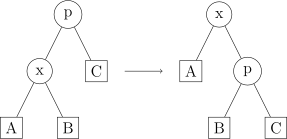
旋转的实现( 数组是左右儿子):
void rotate(int x){
	int y=fa[x],z=fa[y],s=pd(x);
	son[y][s]=son[x][s^1];
	if(son[x][s^1])fa[son[x][s^1]]=y;
	son[x][s^1]=y;
	fa[y]=x;
	fa[x]=z;
	if(z)son[z][y==son[z][1]]=x;
	maintain(y);
	maintain(x);
}
那旋转有啥用啊?
别忘了,Splay 的核心操作是伸展操作,求每访问一个节点 x 都要将其旋转到根节点(我也不知道为什么)。
但是我们不能每次将 x 向上旋转一层,非常容易被毒瘤数据卡,这样的数据构造也不难,只需要使得平衡树被构造为一条链即可。
所以我们需要用到双旋(以上介绍的旋转操作为单旋)。
我们设当前结点是 x,父亲是 p,p 的父亲是 g,分类讨论一下:
zig
对于 p 为根节点的情况(即 g 不存在),我们直接旋转 x 即可。
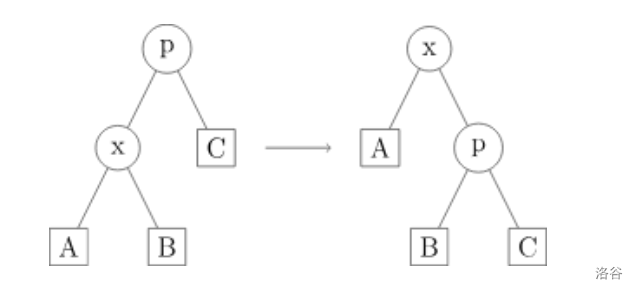
zig zig
若 x - p - g 为直链(即是同侧儿子),我们先将 p 向上旋转一次,再将 x 也旋转一次。
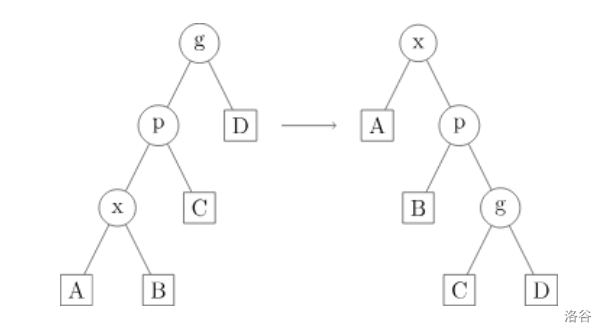
zig zag
若 x - p - g 不是直链,我们直接将 x 向上旋转两次。
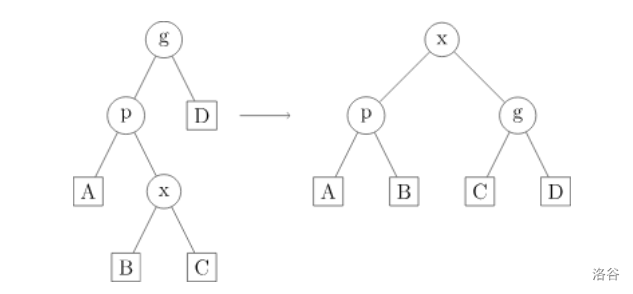
判断使用哪种旋转的话我们只需要判断是左儿子还是右儿子即可,实现不难,不放代码了。
时间复杂度
老师讲了 40min 愣是没听懂,只记得单次均摊复杂度是 的,具体可以看 OI Wiki。
平衡树操作
Splay 可以实现普通平衡树的各种操作,大致和普通二叉搜索树一样,只多了一步 splay 到根。
- 查找单个结点:无论按照值还是排名找,只需在二叉搜索树上找到那个结点然后将其 splay 到根就行了。
- 插入单个结点:只需要在二叉搜索树上找到对应位置插 入后将其 splay 到根。
- 删除单个结点:先找到对应结点,splay 到根,删除它后我们得到了两棵 splay 树,只需将右子树的权值最小的结点 splay 到根,将左子树插入到右子树的左儿子。
- 查排名:额外记录每个结点的子树大小,然后找单个结点的同时计算排名,记得查询完后 splay 到根。
- 查前驱/后继:直接在对应二叉搜索树上查询即可,记得最后 splay 到根。
Q:为什么要 splay 到根啊?
A:我不知道啊。
区间操作没学会,回头补上。
代码
P3369 AC 代码(有亿点点长)。
#include<bits/stdc++.h>
#define int long long
#ifdef __linux__
#define getchar getchar_unlocked
#define putchar putchar_unlocked
#else
#define getchar _getchar_nolock
#define putchar _putchar_nolock
#endif
using namespace std;
namespace FastIO {
	void read(){}
	template <class T1,class ... T2> inline void read(T1 &x,T2 &... oth){
		bool pd=0;x=0;char ch=getchar();
		while(!isdigit(ch)){pd|=ch=='-';ch=getchar();}
		while(isdigit(ch)){x=(x<<3)+(x<<1)+(ch^48);ch=getchar();}
		x=pd?-x:x;
		read(oth...);
	}
	template <class T> void _write(T x){
		if(x<0){putchar('-');x=-x;}
		if(x>9) _write(x/10);
		putchar(x%10^48);
	}
	void write(){}
	template <class T1,class ... T2>
	inline void write(T1 x,T2 ...oth){_write(x);putchar('\n');write(oth...);}
	inline void endline(){putchar('\n');}
}//Orz lby
using namespace FastIO;

const int N=100005;
int rt,tot,fa[N],ch[N][2],val[N],cnt[N],sz[N];

void maintain(int x){
	sz[x]=sz[ch[x][0]]+sz[ch[x][1]]+cnt[x];
}
bool get(int x){
	return x==ch[fa[x]][1];
}
void clear(int x){
	ch[x][0]=ch[x][1]=fa[x]=val[x]=sz[x]=cnt[x]=0;
}
void rotate(int x){
	int y=fa[x],z=fa[y],chk=get(x);
	ch[y][chk]=ch[x][chk^1];
	if(ch[x][chk^1])fa[ch[x][chk^1]]=y;
	ch[x][chk^1]=y;
	fa[y]=x;
	fa[x]=z;
	if(z)ch[z][y==ch[z][1]]=x;
	maintain(y);
	maintain(x);
}
void splay(int x){
	for(int i=fa[x];i=fa[x],i;rotate(x)){
		if(fa[i]){
			if(get(x)==get(i))rotate(i);
			else rotate(x);
		}
	}
	rt=x;
}

void ins(int k){
	if(!rt){
		val[++tot]=k;
		cnt[tot]++;
		rt=tot;
		maintain(rt);
		return;
	}
	int cur=rt,f=0;
	while(1){
		if(val[cur]==k){
			cnt[cur]++;
			maintain(cur);
			maintain(f);
			splay(cur);
			break;
		}
		f=cur;
		cur=ch[cur][val[cur]<k];
		if(!cur){
			val[++tot]=k;
			cnt[tot]++;
			fa[tot]=f;
			ch[f][val[f]<k]=tot;
			maintain(tot);
			maintain(f);
			splay(tot);
			break;
		}
	}
}
int rk(int k){
	int res=0,cur=rt;
	while(1){
		if(k<val[cur])
			cur=ch[cur][0];
		else{
			res+=sz[ch[cur][0]];
			if(!cur)return res+1;
			if(k==val[cur]){
				splay(cur);
				return res+1;
			}
			res+=cnt[cur];
			cur=ch[cur][1];
		}
	}
}
int kth(int k){
	int cur=rt;
	while(1){
		if(ch[cur][0]&&k<=sz[ch[cur][0]])
			cur=ch[cur][0];
		else{
			k-=cnt[cur]+sz[ch[cur][0]];
			if(k<=0){
				splay(cur);
				return val[cur];
			}
			cur=ch[cur][1];
		}
	}
}
int pre(){
	int cur=ch[rt][0];
	if(!cur)return cur;
	while(ch[cur][1])
		cur=ch[cur][1];
	splay(cur);
	return cur;
}
int nxt(){
	int cur=ch[rt][1];
	if(!cur)return cur;
	while(ch[cur][0])
		cur=ch[cur][0];
	splay(cur);
	return cur;
}
void del(int k){
	rk(k);
	if(cnt[rt]>1){
		cnt[rt]--;
		maintain(rt);
		return;
	}
	if(!ch[rt][0]&&!ch[rt][1]){
		clear(rt);
		rt=0;
		return;
	}
	if(!ch[rt][0]){
		int cur=rt;
		rt=ch[rt][1];
		fa[rt]=0;
		clear(cur);
		return;
	}
	if(!ch[rt][1]){
		int cur=rt;
		rt=ch[rt][0];
		fa[rt]=0;
		clear(cur);
		return;
	}
	int cur=rt,x=pre();
	fa[ch[cur][1]]=x;
	ch[x][1]=ch[cur][1];
	clear(cur);
	maintain(rt);
}
signed main(){

	int n,opt,x;
	read(n);
	while(n--){
		read(opt,x);
		if(opt==1)ins(x);
		else if(opt==2)del(x);
		else if(opt==3)write(rk(x));
		else if(opt==4)write(kth(x));
		else if(opt==5)ins(x),write(val[pre()]),del(x);
		else ins(x),write(val[nxt()]),del(x);
	}
	return 0;
}
练习
以及一定要记住数组要开到 ( 为初始的节点数, 为操作数)!!!
参考资料
- 老师给的课件
- OI Wiki