CF1117D Magic Gems
记 fi 表示填满体积为 i 有几种填法,考虑新的石头的状态(爆或不爆),有:
fi={1 (i<m)fi−m+fi−1 (i≥m)
先将 n<m 的情况特判掉。
发现第 i 项只与第 i−m 与 第 i−1 项有关,画个转移图(每行有 m 的数,以 m=4 为例):
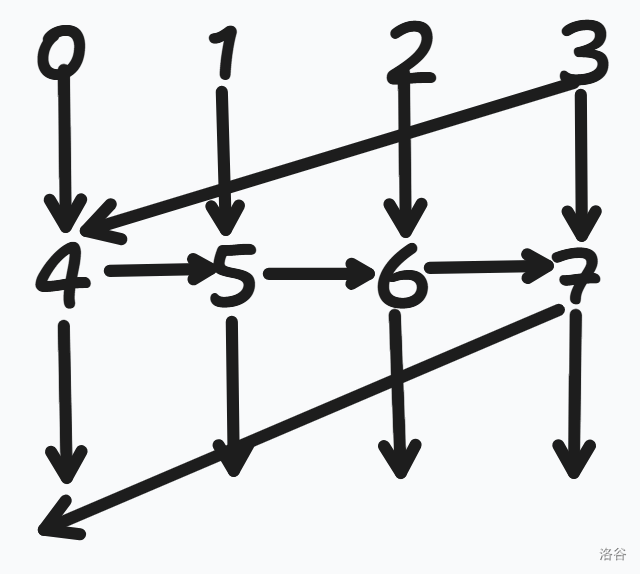
对于图中第 p(p 从 0 开始) 行,其上所有数可写成 p×i+q(0≤q≤m−1)的形式,那么考虑维护形如:
fpmfpm+1⋮fpm+m−1
的矩阵(m 为第几行)。
先推一下式子,有:
fpm=fpm−1+f(p−1)m
fpm+1=fpm+f(p−1)m+1=fpm−1+f(p−1)m+1+f(p−1)m
以此类推,对于 fpm+q,有:
fpm+q=∑i=0qf(p−1)m+i+fpm−1
其中 pm−1=(p−1)m+m−1。
由上,则可得出转移矩阵:
1 0 0 0 ⋯ 11 1 0 0 ⋯ 11 1 1 0 ⋯ 1⋮1 1 1 1 ⋯ 2
写成转移形式就是:
fpmfpm+1⋮fpm+m−1=1 0 0 0 ⋯ 11 1 0 0 ⋯ 11 1 1 0 ⋯ 1⋮1 1 1 1 ⋯ 2×f(p−1)mf(p−1)m+1⋮f(p−1)m+m−1
那么对于任意 n,m,其转移矩阵共需乘上 ⌊mn⌋ 次,n 对应的答案就是最终答案矩阵的第 n%m 项,初始答案矩阵为全 1。
注意: 所有下标都是从 0 开始的。
C++#include<bits/stdc++.h>
#define pii pair<int,int>
#define lowbit(x) (x&(-x))
#define int long long
#define inf 1000000000000000000ll
using namespace std;
const int Maxn=1e2+5;
const int Mod=1e9+7;
int n,m;
struct Mat
{
int n,m;
int a[Maxn][Maxn];
Mat()
{
memset(a,0,sizeof(a));
}
}base,f;
Mat operator*(const Mat& p,const Mat& q)
{
Mat r;
r.n=p.n,r.m=q.m;
for(int i=0;i<p.n;i++)
{
for(int j=0;j<q.n;j++)
{
for(int k=0;k<p.m;k++)
{
r.a[i][j]=(r.a[i][j]+p.a[i][k]*q.a[k][j]%Mod)%Mod;
}
}
}
return r;
}
Mat ksm(Mat a,int b)
{
Mat base=a,ans;
ans.n=a.n,ans.m=a.m;
for(int i=0;i<ans.n;i++) ans.a[i][i]=1;
while(b)
{
if(b&1) ans=ans*base;
base=base*base;
b>>=1;
}
return ans;
}
signed main()
{
ios::sync_with_stdio(0);
cin.tie(0),cout.tie(0);
cin>>n>>m;
if(n<m)
{
cout<<1<<'\n';
return 0;
}
int p=n/m,q=n%m;
f.n=m,f.m=1;
for(int i=0;i<m;i++) f.a[i][0]=1;
base.n=base.m=m;
for(int i=0;i<m;i++)
{
base.a[i][m-1]++;
for(int j=0;j<=i;j++)
base.a[i][j]++;
}
// for(int i=0;i<m;i++)
// {
// for(int j=0;j<m;j++) cout<<base.a[i][j]<<" ";
// cout<<'\n';
// }
f=ksm(base,p)*f;
// for(int i=0;i<m;i++) cout<<f.a[i][0]<<'\n';
cout<<f.a[q][0]<<'\n';
return 0;
}