
前言
书接上回,学习字符串实在太过于痛苦,未尝深刻理解。故作此文,用以加深印象。
同时,在这里给大家道歉,由于本人太菜,刷题量很少,所以例题放得太简单了!请各位谅解。
前置知识:、(其实不会也无大碍)。
,中文名称其为 自动机。是一种可以用来处理多模式串匹配等问题的自动机。
引入
我们通过一个简单的问题引入 :
给定 个模式串 和一个文本串 。求有多少个 在 中出现过,。
考虑一个最暴力的做法,直接枚举 的每一个子串,判断是否存在 与其相等。这个东西可以 加上 unordered_map 实现,做到 。但显然这并不能通过此题。如何优化,注意到这是多模式串问题,所以想到建 。建出 后可以在每一个 的结束字符上进行标记,然后匹配时用 在 上走就行了。由于这个是 的经典应用,故在此不展开。
可是在 上匹配的最劣时间复杂度仍然是 的,具体地说,如果当前 匹配到 中的节点 ,但 不存在一个子节点满足 ,那么此时我们称其为失配了。而在现在,处理失配唯一的方法便是从最初始的 的下一位 开始从 的根节点重新匹配。
所以如果我们能在 的时间内处理失配的问题,那就可以做到线性。观察失配的问题出在哪里?对于下面这一组数据:
- 为
abcd。 - 分别为
abc、bc。
那么对于 建出的 就长这样:
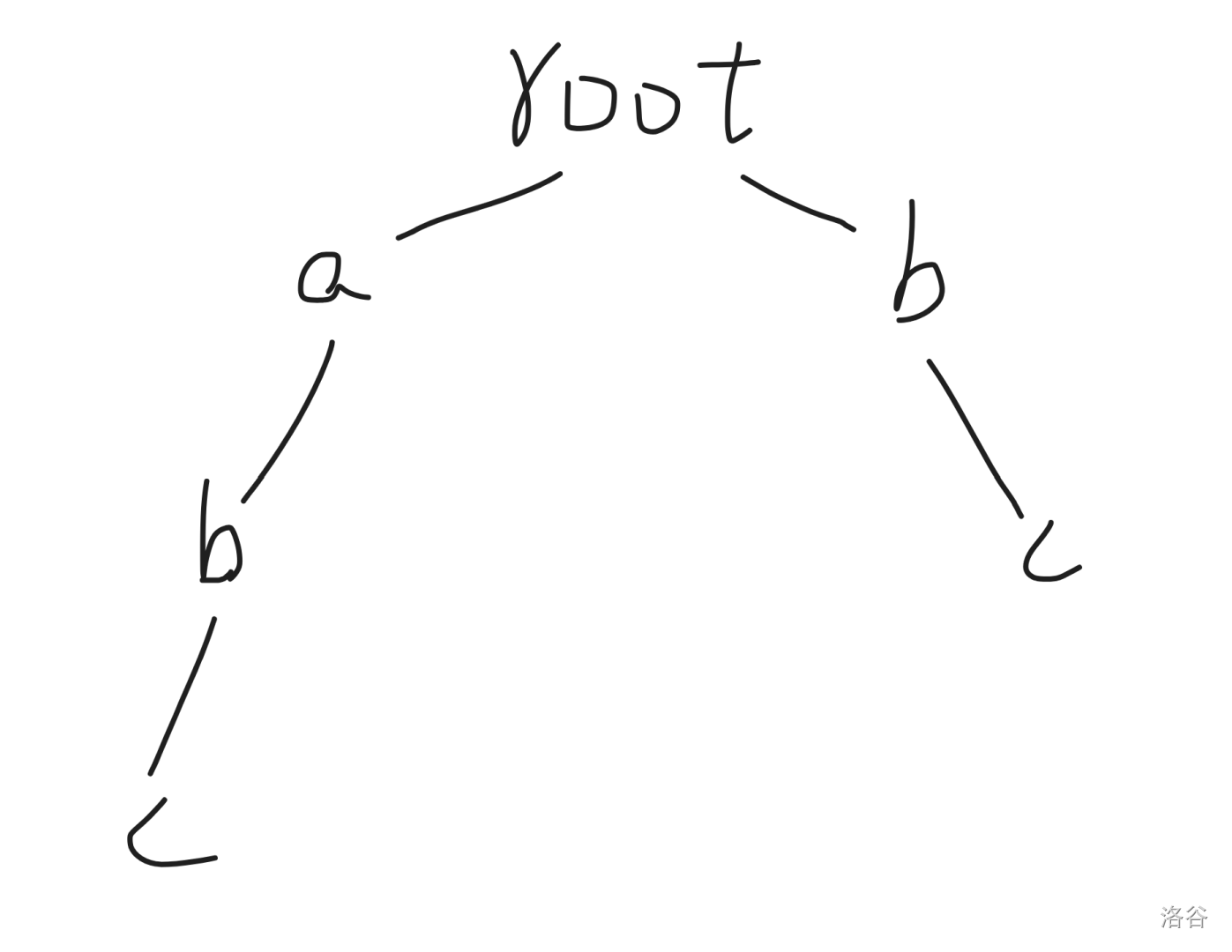
不妨模拟一下匹配的过程,发现是先从根走到 a,然后再依次走到 b、c。再想往下匹配时发现不存在 d 这个子节点了,所以重新退回根,然后用 的初始的下一位 b 再进行第二次匹配。这样我们便可以匹配出 abc 和 bc 这两个子串,但是观察一下就会发现,在第一次匹配时因为 abc 已经包含 bc 作为后缀,所以如果我们对于所有的 abc 的后缀都标记一下,就可以直接往下匹配 d 了。由此,我们引出了 指针的概念。
指针
指针,又称失配指针,可以很好地处理上文所提及的失配问题。
详细地说,我们先仍然对 建出 ,而每一个 中的节点的对应的状态就是它所代表的 的一段前缀。然后记 中状态 的失配指针 指向的是 的最长后缀 。这其实就和 中的 指针有几分相似。
比如上面那个 中便存在这么一个 指针(红色的边):
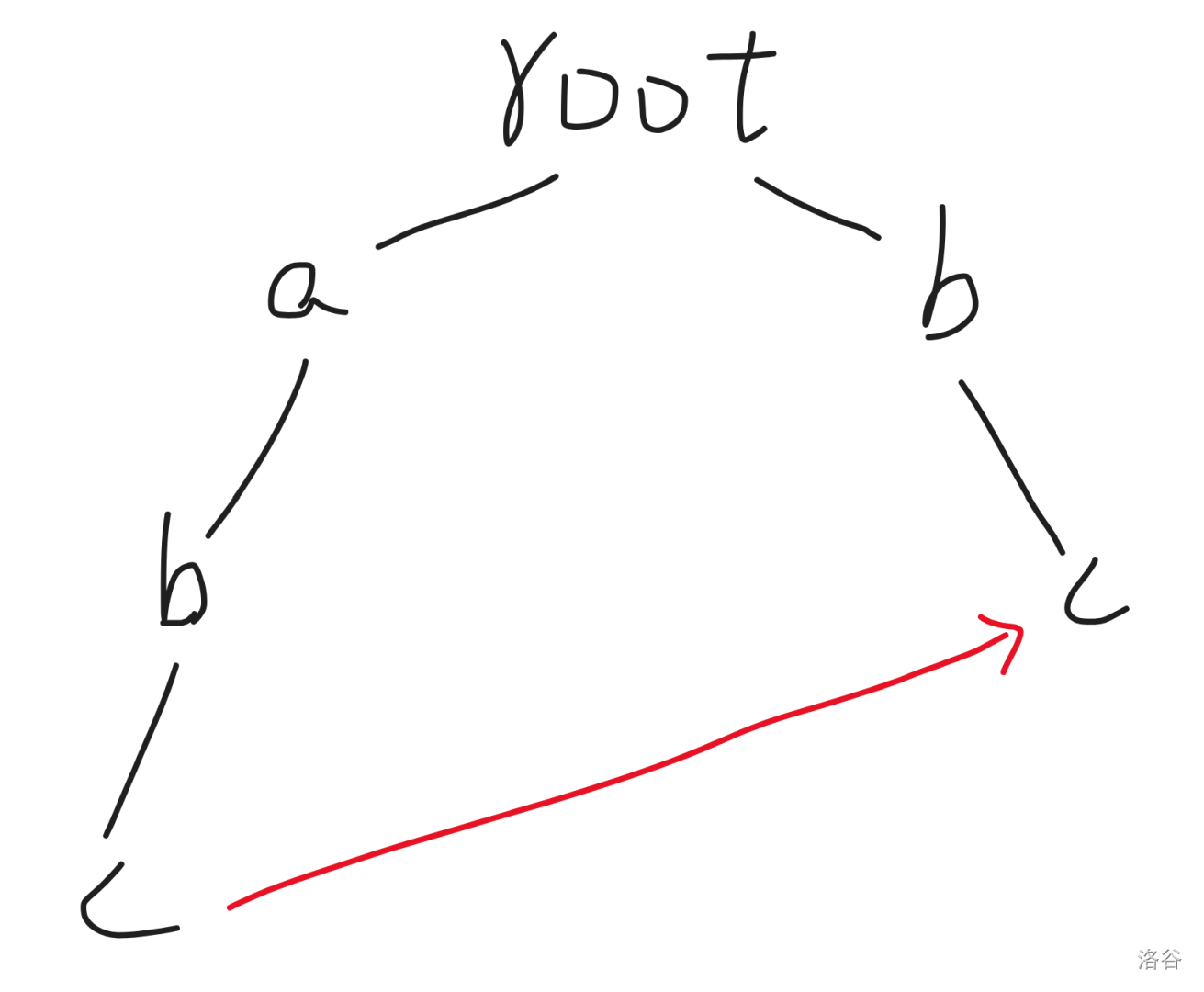
因为 bc 是 中 abc 的最长后缀,所以这条 指针存在。
而由于这条 指针的存在,我们可以在走到 c 的时候按照这个 指针跳到 bc 的结尾,这样就可以把这两个字符串都标记为出现过。更一般的情况下,一个状态 可能可以到达 ,所以我们需要不断地沿着 指针往上跳,然后将跳到的状态标记为存在。考虑到如果跳到了一个已经被标记的状态 ,我们便可以停止了,因为 的 指针指向的一系列状态都被标记过了。因此每一个状态最多只会被标记一次,时间复杂度是线性的。
每次跳 都会到达原状态的最长后缀,所以可以做到不漏标记状态,正确性显然。
指针的构建
接下来考虑 指针的构建方法。
由于 指针和 指针的十分相似,所以可以参考 指针的构建方法。
具体地说,假设当前构建到 中的状态 , 对应的字符为 , 表示 的儿子且该儿子对应的字符为 , 在 中的父亲为 。则循环执行以下过程:
- 若 中存在 的边,则令 。
- 否则令 。
- 若 跳到根节点却仍未找到,就令 (钦定 为 的根)。
为什么这是正确的?
首先, 对应的是状态 的最长后缀,那么如果存在 ,则状态 一定是 的最长后缀。
而如果不存在,就不断对 跳 ,因为 对应的仍然是状态 的最长后缀,所以第一次找到存在的 时,状态 一定也是 的最长后缀。
最后,如果整个 中都不存在 ,那么最长后缀为空,所以指向根节点是没问题的。
因为构建过程维持了 的性质,即指向 的最长后缀,所以是正确的。
容易发现,在构建过程中我们需要知道所有深度比 小的状态的 指针,所以需要采用 构建。
接下来看一个例子:
对于
heatt、att、earth这三个字符串构建 指针。
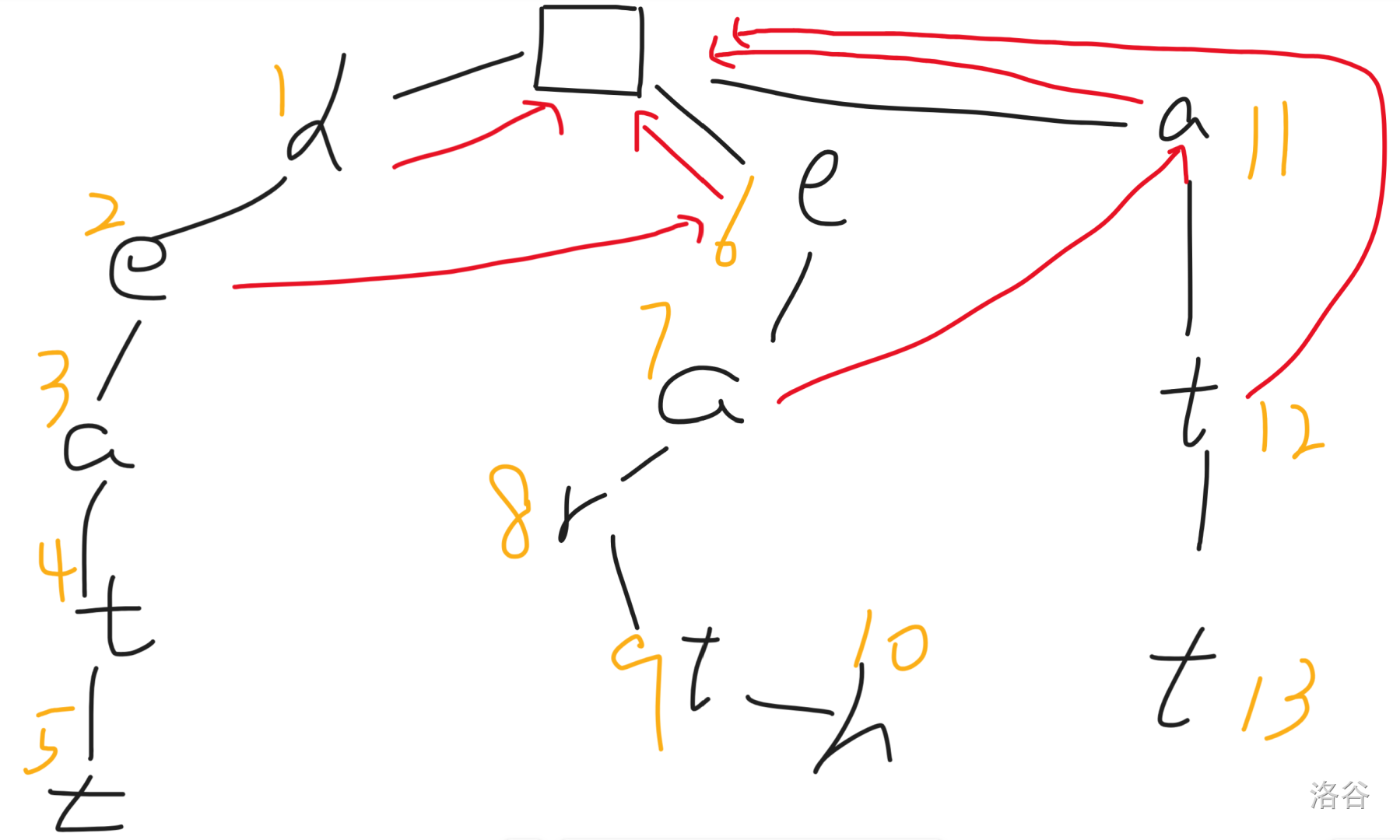
首先把 建出来,长这样(橙色数字是状态的编号,红色边是 指针):
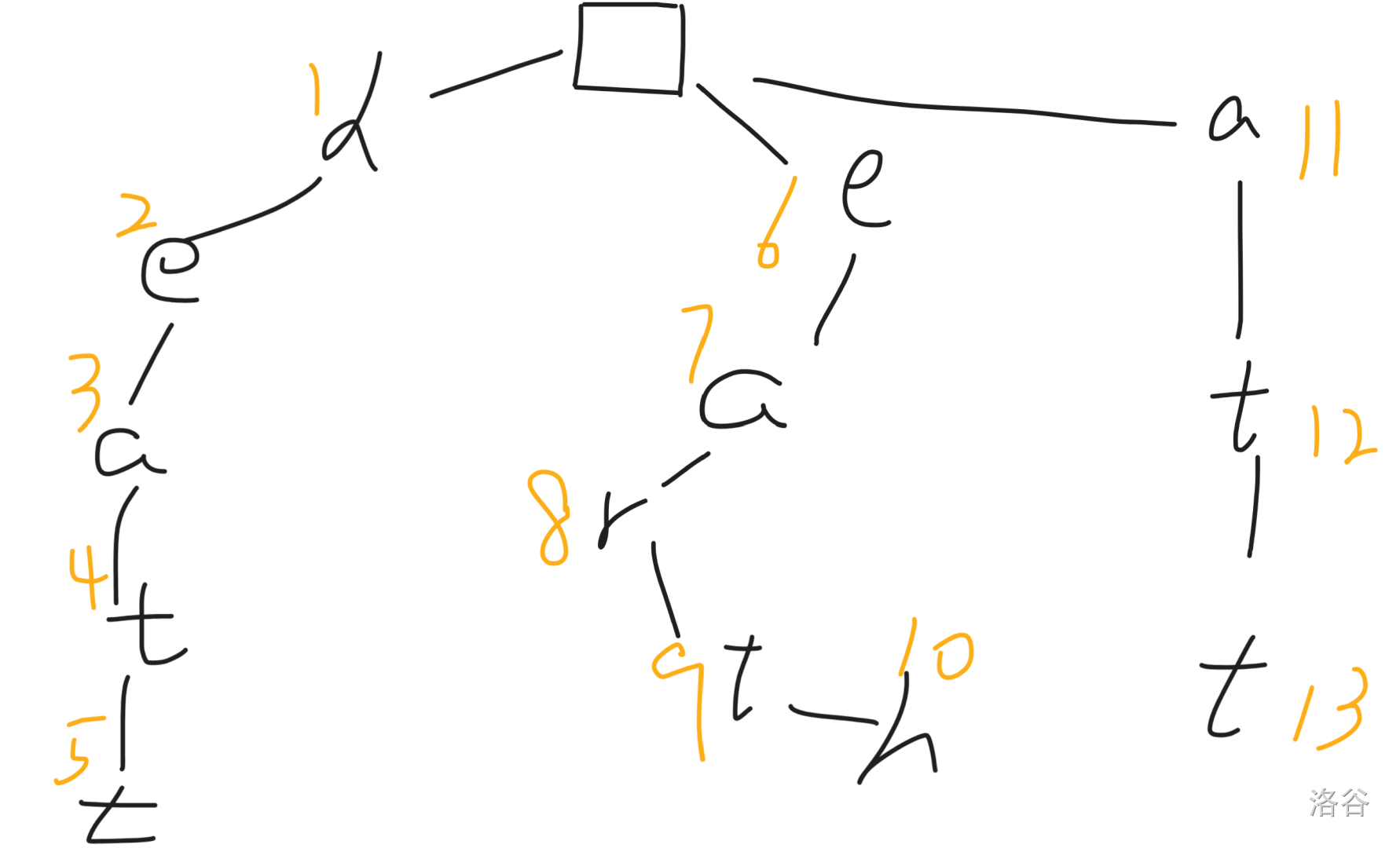
我们记根节点对应第 层,则对于第 层的每一个节点,其 指针直接指向根节点(这个是为了方便实现而做的),得到:
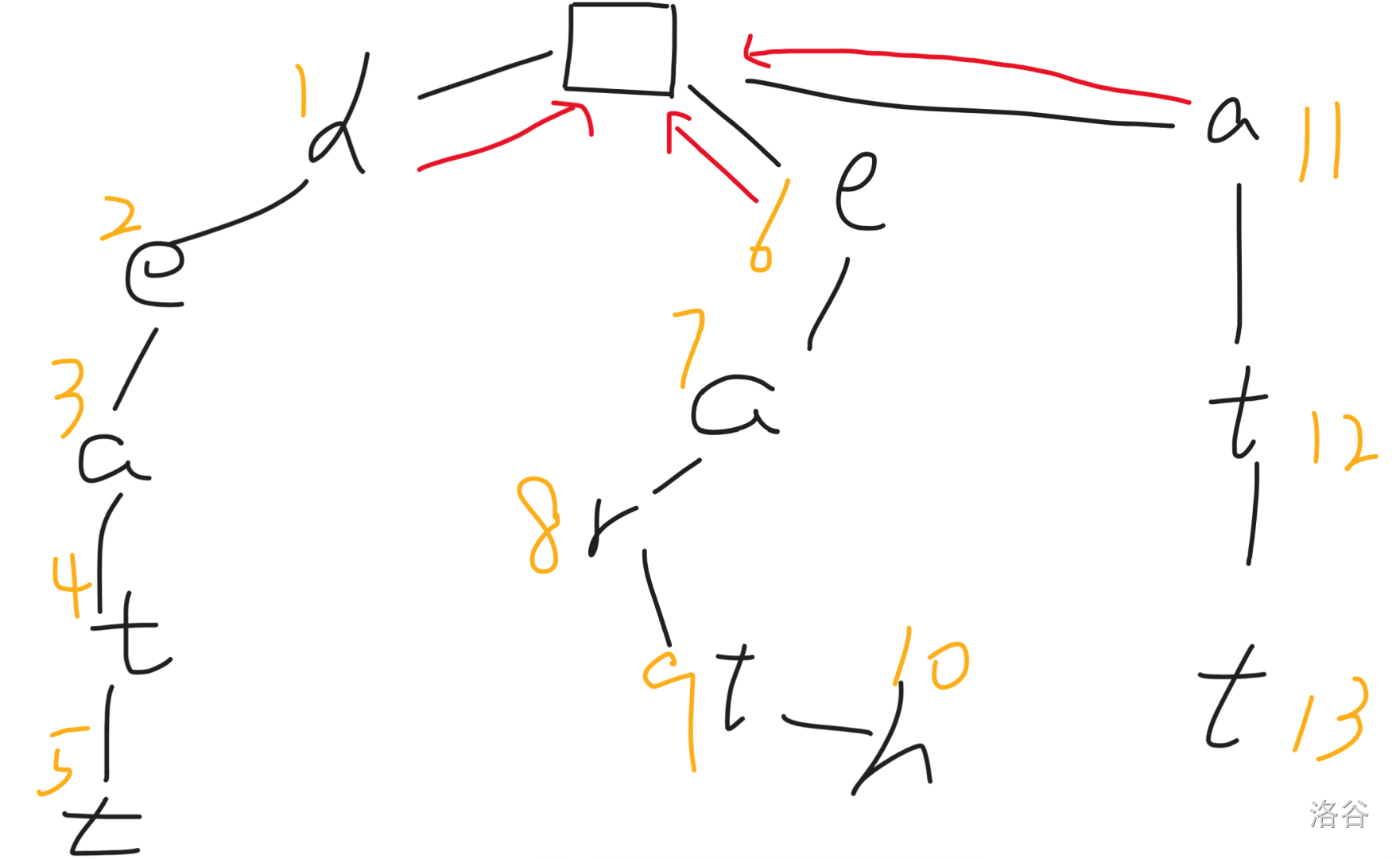
接着, 号节点的父亲的 指针指向根节点,且根节点存在字符为 e 的子节点 ,所以 ,同理,。而节点 因为没有找到存在的合法状态,所以 。即:
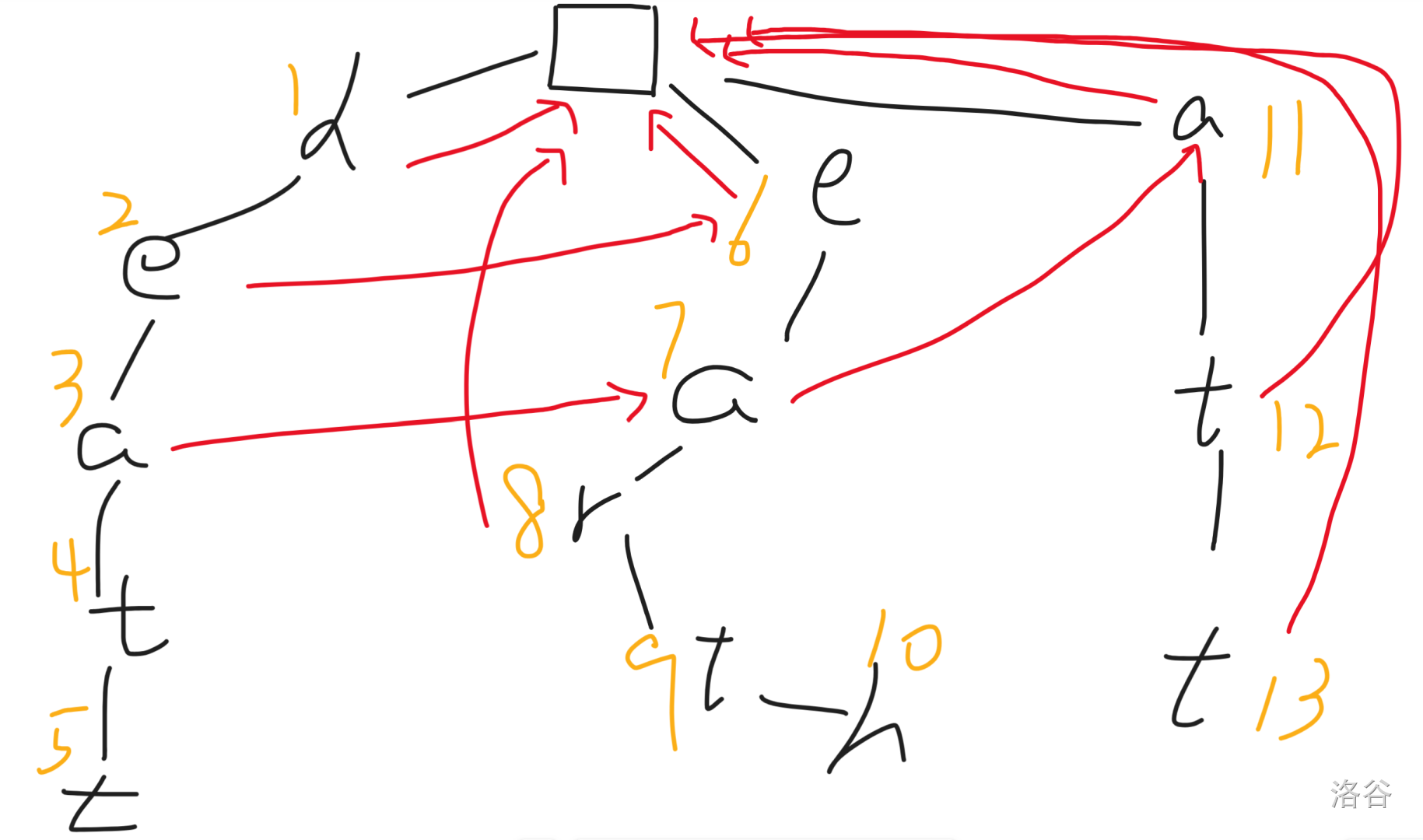
此时, 号节点对应的父亲 的 指向了 ,而 节点存在子节点满足字符为 a,所以 ,而 号节点和 号节点因为没找到合法的状态,所以指向根节点。如图(稍微画得有点乱):
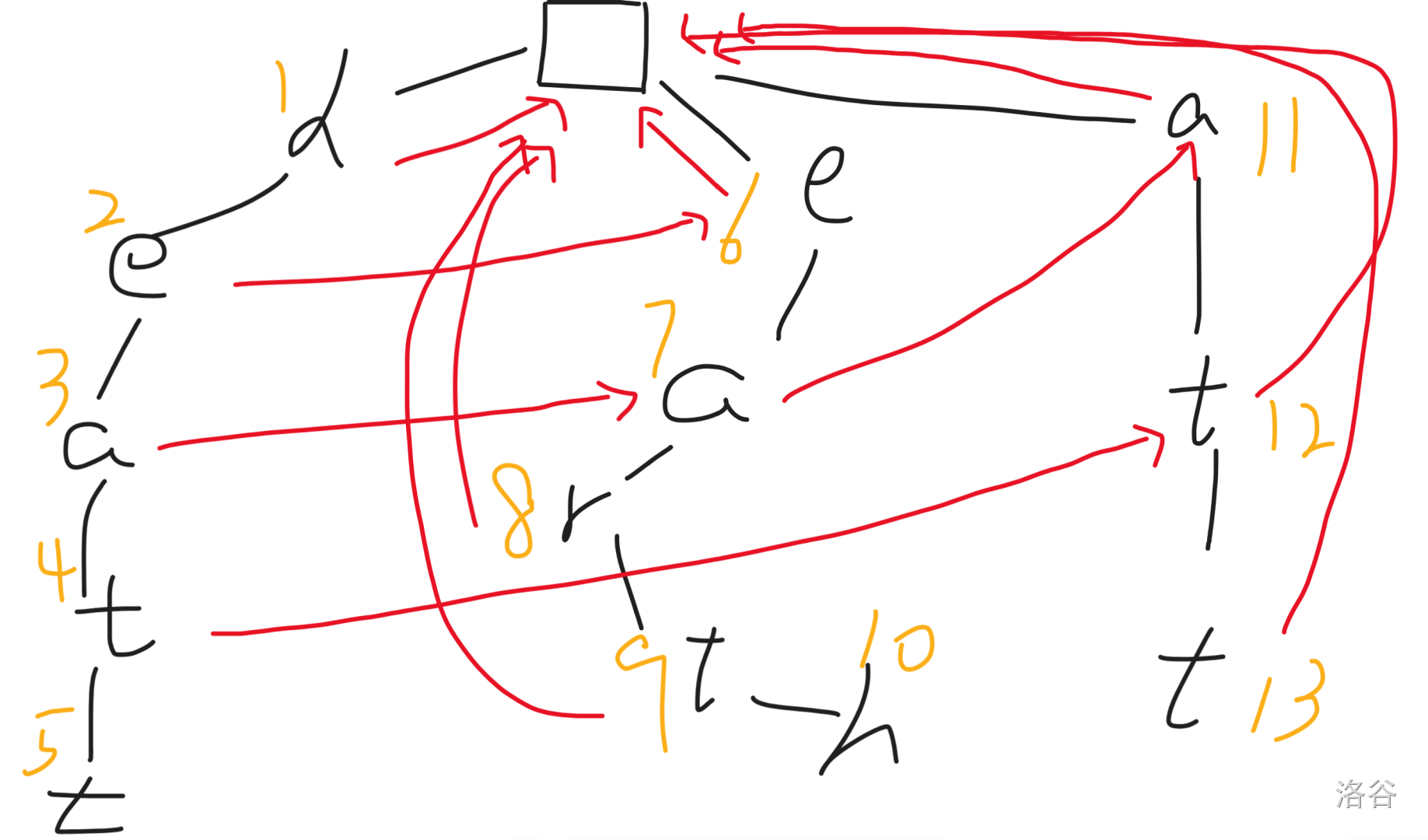
然后,当我们构建 号节点的 指针时,发现其父亲指向的节点 不存在一个字符为 t 的儿子,所以对其父亲 跳 ,令 ,此时我们再判断 是否存在。一个字符为 t 的子节点,发现是存在的,于是令 。而 则还是连向根节点:
最后的两个节点的构建都是平凡的,不赘述了。构建完成后便是这样的:
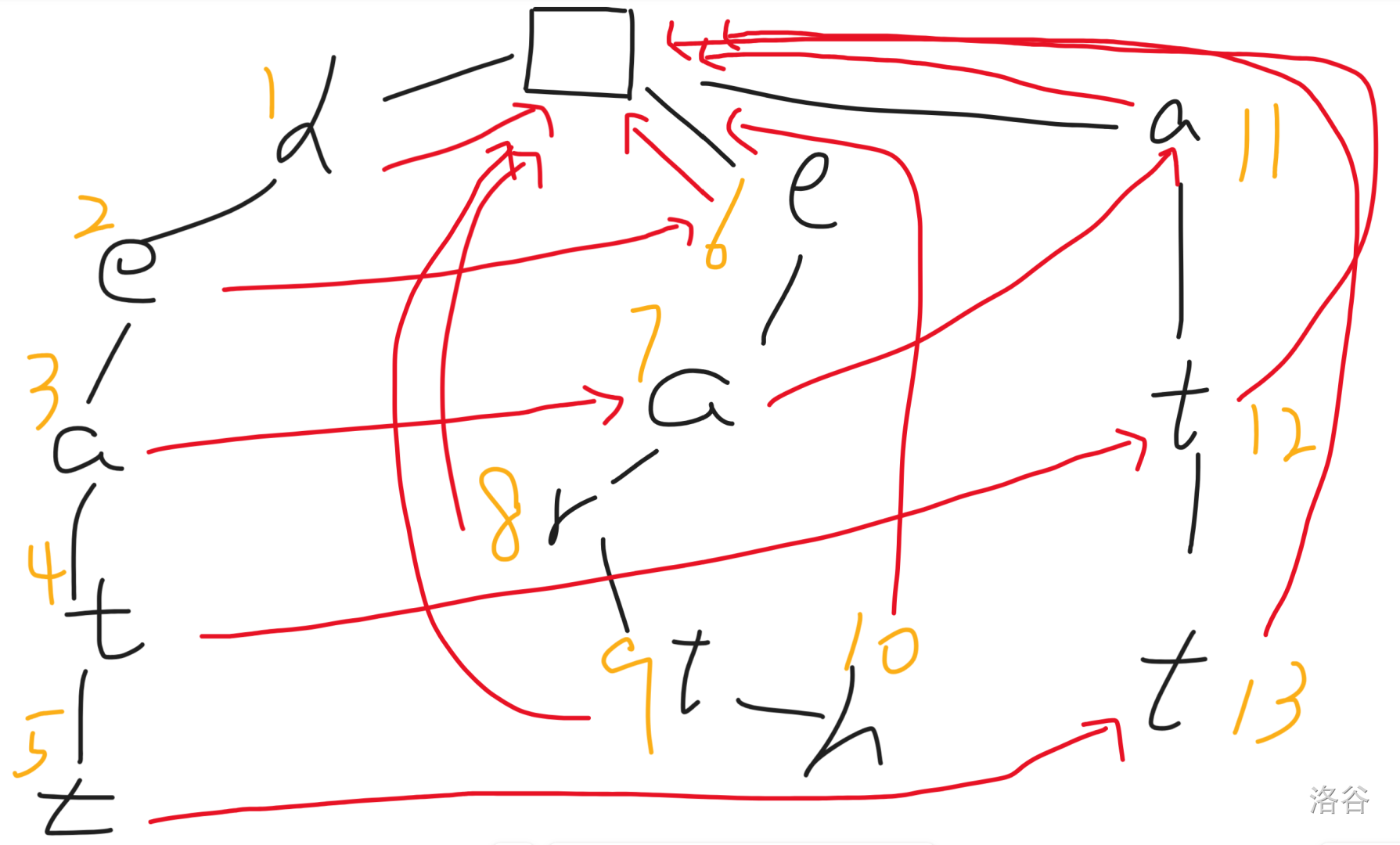
图
考虑刚刚那一个构建过程,发现如果每次都暴力跳 找是否存在合法子节点,这样的时间复杂度是 的,显然不能被接受。
此时可以使用一个类似并查集的路径压缩的优化,每次都将跳 的路径进行压缩。详细地说,若构建到状态 :
- 若不存在 ,则令 。
- 否则,直接令 。
这样便可以做到线性构建自动机。
而在这个过程中, 已经不再是原先的形态,而是新增了一些“路径压缩”的转移边。我们称此时的 为 图。
在 图中,新增的转移边其实就是指向了新增一个字符之后的最长后缀。所以在大多数多模匹配过程中,我们可以直接在 上依照文本串进行遍历,因为新增的转移边可以实现自动跳转最长后缀的功能。
例子的图太乱了,不好画,可以去看 oi-wiki 上的。
代码
下面给出构建 图的代码:
Code
struct Node {
	int c[26], fail;
} trie[N];

void build() {
	queue<int> q;
	for (int i = 0; i < 26; i++) {
		if (trie[0].c[i]) {
			q.push(trie[0].c[i]);
			trie[trie[0].c[i]].fail = 0;
		}
	}
	while (!q.empty()) {
		int p = q.front();
		q.pop();
		for (int i = 0; i < 26; i++) {
			if (!trie[p].c[i]) trie[p].c[i] = trie[trie[p].fail].c[i];
			else {
				q.push(trie[p].c[i]);
				trie[trie[p].c[i]].fail = trie[trie[p].fail].c[i];
			}
		}
	}
}
多模式串匹配
有了 ,多模匹配问题就迎刃而解了。
直接从根节点开始进行匹配,每次走到一个状态就开始跳 ,把所有未被标记的状态都标记上,遇到被标记过的状态就停止(原因在 指针那一部分有讲)。
这样的时间复杂度是线性的。
代码
引入部分的问题的代码:
Code
#include<bits/stdc++.h>
#define ll long long
#define ull unsigned long long
#define i128 __int128
#define inf (1ll << 62)
#define pb push_back
#define mp make_pair
#define PII pair<int , int>
#define fi first
#define se second
using namespace std;
const int MAXN = 1e6 + 10;
struct Node {
	int c[26] , fail , cnt;
};
Node trie[MAXN];
int tot;

inline int getnum(char c) {return c  - 'a';}

inline void insert(string s) {
	int p = 0;
	for(auto i : s) {
		if(!trie[p].c[getnum(i)]) trie[p].c[getnum(i)] = ++ tot;
		p = trie[p].c[getnum(i)];
	}
	trie[p].cnt ++;
	return;
}

inline void build() {
	queue<int>q;
	for(int i = 0;i < 26;i ++) {
		if(trie[0].c[i]) {
			trie[trie[0].c[i]].fail = 0;
			q.push(trie[0].c[i]);
		}
	}
	while(!q.empty()) {
		int u = q.front();
		q.pop();
		for(int i = 0;i < 26;i ++) {
			if(trie[u].c[i]) {
				trie[trie[u].c[i]].fail = trie[trie[u].fail].c[i];
				q.push(trie[u].c[i]);
			} else trie[u].c[i] = trie[trie[u].fail].c[i];
		}
	}
	return;
}

inline int AC(string s) {
	int ans = 0 , n = s.length() , p = 0;
	for(int i = 0;i < n;i ++) {
		p = trie[p].c[getnum(s[i])];
		for(int j = p;j && trie[j].cnt != -1;j = trie[j].fail) {
			ans += trie[j].cnt;
			trie[j].cnt = -1;
		}
	}
	return ans;
}

inline void solve() {
	int n;
	string s;
	cin >> n;
	for(int i = 1;i <= n;i ++) {
		cin >> s;
		insert(s);
	}
	build();
	cin >> s;
	cout << AC(s) << "\n";
	return;
}

int main() {
	ios::sync_with_stdio(0);
	cin.tie(0);
	cout.tie(0);
	int t = 1;
	while(t --) {
		solve();
	}
	return 0;
}树
有一个显然的结论是 中的 指针共同构成一棵树。我们称其为 树。
因为每一个状态的 指针都会指向比其深度小的状态,所以不会形成环。故会形成 树。
刚刚那一个例子的 树如下:
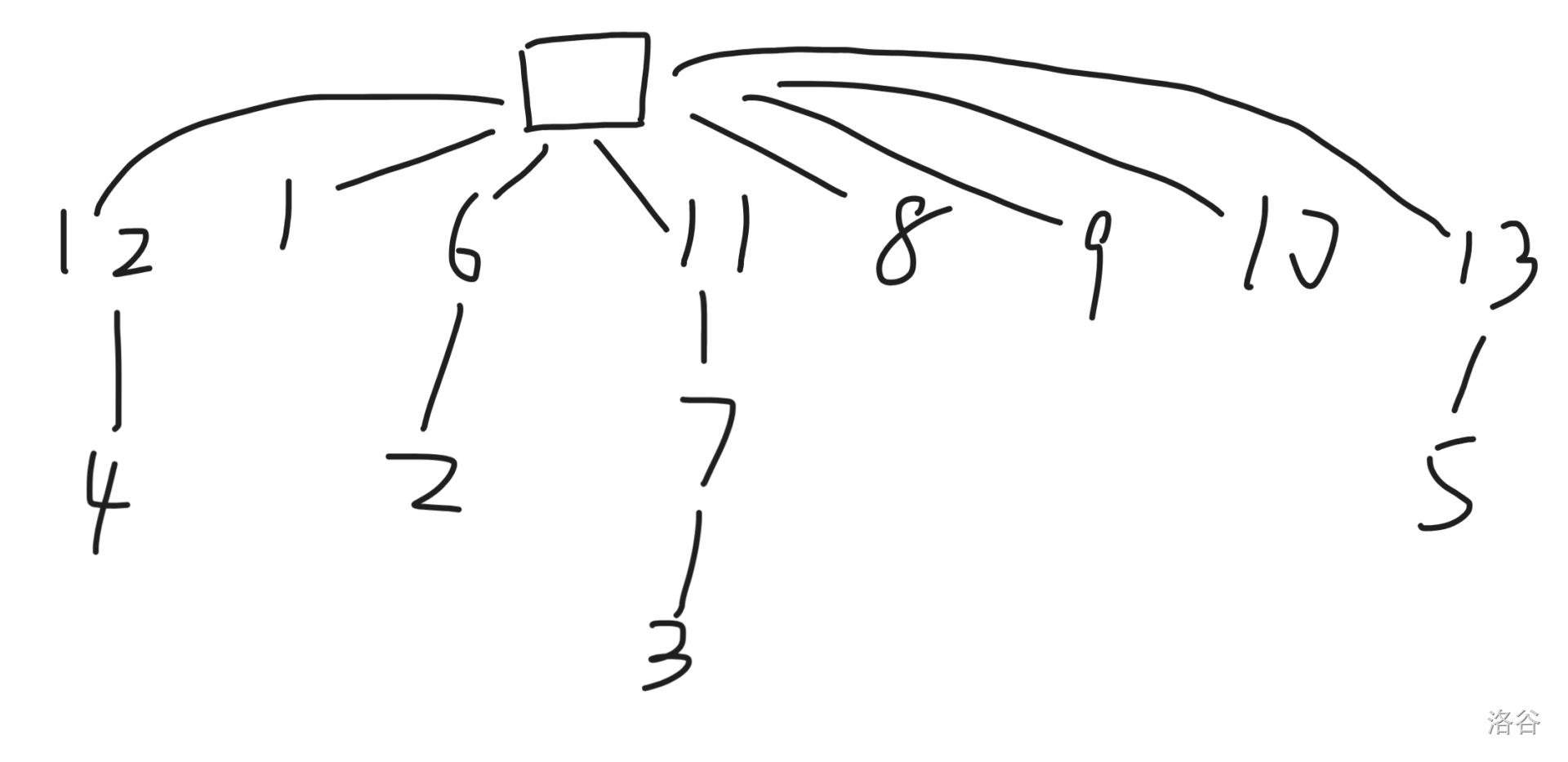
而在 树中一个很重要的性质是:以 为根的子树中所有的状态都包含状态 作为后缀。这个性质会在很多题目中发挥极其美妙的作用。
拓扑排序优化
再看一道题:
给定一个文本串 和 个模式串 ,求每个模式串 在 中的出现次数。。
在这题中,如果我们选择在匹配的过程中不断跳 然后对跳到的状态的答案进行 的时间复杂度是 的,因为我们需要把每一个 的答案都 。如何优化呢?
观察到,每次走到一个状态 ,那么会在 树中对 到根节点的路径上的所有状态的答案增加 。而因为 指针构成一棵树,所以我们可以将每次在 处增加的答案记录下来,最后做一遍拓扑排序更新其到 树根节点的答案。
代码
Code
#include <bits/stdc++.h>
using namespace std;

using ll = long long;
using ld = long double;
using ull = unsigned long long;
using i128 = __int128;

using PII = pair<int, int>;
using PLL = pair<ll, ll>;

constexpr ll inf = (1ll << 62);
constexpr int N = 2e5 + 10;

int n;
string s;

namespace acam {
	int tot = N - 1;
	struct Trie {
		int son[62], fail, cnt, deg, id, ans;
	} trie[N];
	vector<vector<int>> d(N);	//相同的模式串的映射

	void Init() {
		for (int i = 0; i < n; i++) {
			d.clear();
		}
		for (int i = 0; i <= tot; i++) {
			for (int j = 0; j < 62; j++) {
				trie[i].son[j] = 0;
			}
			trie[i].fail = trie[i].cnt = trie[i].deg = trie[i].ans = 0;
			trie[i].id = -1;
		}
		tot = 0;
	}

	int get(char c) {
		if ('0' <= c && c <= '9') return c - '0';
		else if ('A' <= c && c <= 'Z') return 10 + c - 'A';
		else if ('a' <= c && c <= 'z') return 36 + c - 'a';
	}

	void update(string s, int id) {
		int p = 0;
		for (auto i : s) {
			int x = get(i);
			if (!trie[p].son[x]) {
				trie[p].son[x] = ++tot;
			}
			p = trie[p].son[x];
		}
		if (trie[p].id == -1) trie[p].id = id;
		d[trie[p].id].push_back(id);
	}

	void build() {
		queue<int> q;
		for (int i = 0; i < 62; i++) {
			if (trie[0].son[i]) {
				trie[trie[0].son[i]].fail = 0;
				q.push(trie[0].son[i]);
			}
		}
		while (!q.empty()) {
			int u = q.front();
			q.pop();
			for (int i = 0; i < 62; i++) {
				if (!trie[u].son[i]) trie[u].son[i] = trie[trie[u].fail].son[i];
				else {
					trie[trie[u].son[i]].fail = trie[trie[u].fail].son[i];
					trie[trie[trie[u].son[i]].fail].deg++;
					q.push(trie[u].son[i]);
				}
			}
		}
	}

	void ac(string t) {
		int p = 0;
		for (auto i : t) {
			int x = get(i);
			p = trie[p].son[x];
			trie[p].ans++;
		}
	}

	void topu(vector<int>& ans) {
		int n = ans.size();
		queue<int> q;
		for (int i = 1; i <= tot; i++) {
			if (!trie[i].deg) {
				q.push(i);
			}
		}
		while (!q.empty()) {
			int u = q.front();
			q.pop();
			int p = trie[u].fail;
			trie[p].ans += trie[u].ans;
			trie[trie[u].fail].deg--;
			if (!trie[trie[u].fail].deg) {
				q.push(trie[u].fail);
			}
		}
		for (int i = 1; i <= tot; i++) {
			if (trie[i].id != -1) {
				ans[trie[i].id] = trie[i].ans;
			}
		}
		for (int i = 0; i < n; i++) {
			if (!d[i].size()) continue;
			for (auto j : d[i]) {
				ans[j] = ans[d[i][0]];
			}
		}
	}
}

using namespace acam;

void solve() {
	cin >> n;
	Init();
	for (int i = 0; i < n; i++) {
		string s;
		cin >> s;
		update(s, i);
	}
	build();
	vector<int> ans(n);
	string t;
	cin >> t;
	ac(t);
	topu(ans);
	for (int i = 0; i < n; i++) {
		cout << ans[i] << "\n";
	}
}

int main() {
	ios::sync_with_stdio(0);
	cin.tie(0);
	cout.tie(0);
	int t = 1;
	while (t--) {
		solve();
	}
	return 0;
}
例题
P3121
题意
给定一个文本串 和 个模式串 。Farmer John 每次从 中找到出现最早的模式串,然后将其删除,直到文本串中不再包含模式串。
- 保证 在 中起始位置互不相同,且 之间不存在包含关系。
- 。
做法
观察到是多模匹配,所以先对模式串建出 。
需要注意到是,在文本串中删去一个模式串后可能会产生新的模式串。但容易发现,这个删除的过程其实可以用栈来模拟。即在匹配时将到达的点的编号压入栈中,然后每次走到代表模式串 结尾的状态,就弹出 个元素,再回到栈顶的所记录的节点编号。
因为每一个 中的字符最多出栈入栈一次,所以时间复杂度是线性的。
Code
#include <bits/stdc++.h>
using namespace std;

using ll = long long;
using ld = long double;
using ull = unsigned long long;
using i128 = __int128;

using PII = pair<int, int>;
using PLL = pair<ll, ll>;

constexpr int N = 1e5 + 10;

int n, tot;
struct Trie {
	int fail, son[26], len;
} trie[N];
string s;
stack<int> st, stk;

int get(char c) {
	return c - 'a';
}

void update(string t) {
	int p = 0;
	for (auto i : t) {
		if (!trie[p].son[get(i)]) {
			trie[p].son[get(i)] = ++tot;
		}
		p = trie[p].son[get(i)];
	}
	trie[p].len = t.length();
}

void build() {
	queue<int> q;
	for (int i = 0; i < 26; i++) {
		if (trie[0].son[i]) {
			q.push(trie[0].son[i]);
			trie[trie[0].son[i]].fail = 0;
		}
	}
	while (!q.empty()) {
		int u = q.front();
		q.pop();
		for (int i = 0; i < 26; i++) {
			if (!trie[u].son[i]) trie[u].son[i] = trie[trie[u].fail].son[i];
			else {
				trie[trie[u].son[i]].fail = trie[trie[u].fail].son[i];
				q.push(trie[u].son[i]);
			}
		}
	}
}

void query() {
	int p = 0;
	for (int i = 0; i < s.length(); i++) {
		p = trie[p].son[get(s[i])];
		st.push(i);
		stk.push(p);
		if (trie[p].len) {
			int k = trie[p].len;
			while (k--) {
				st.pop();
				stk.pop();
			}
			if (!stk.empty()) {
				p = stk.top();
			} else {
				p = 0;
			}
		}
	}
}

void solve() {
	cin >> s >> n;
	for (int i = 0; i < n; i++) {
		string t;
		cin >> t;
		update(t);
	}
	build();
	query();
	vector<char> ans;
	while (!st.empty()) {
		ans.push_back(s[st.top()]);
		st.pop();
	}
	reverse(ans.begin(), ans.end());
	for (auto i : ans) {
		cout << i;
	}
	cout << "\n";
}

int main() {
	ios::sync_with_stdio(0);
	cin.tie(0);
	cout.tie(0);
	int t = 1;
	while (t--) {
		solve();
	}
	return 0;
}
AT_abc268_h
题意
给定一个字符串 ,可以对 进行任意次操作(包括 次):
- 选择一个整数 ,满足 ,将 变成
*。
请求出若想要 不再作为 的子串出现,至少需要进行多少次操作。
- 。
- 两两互不相同。
- 和 仅包含小写英文字母。
做法
容易发现,如果找出了每一个存在于文本串中的模式串,并将这些模式串的左右边界的下标标记出来,记作 与 。则问题就转变成了一个很典的区间选点,即在 中的每一个区间 中都至少有一个位置被改变。这个东西直接以右端点为第一关键字排序再贪心就行了。所以我们只需要找出文本串中每一个模式串的位置,这就是个多模式串匹配,直接上 。
假设现在在 上匹配到点 ,则由区间选点的贪心考虑,只需要选其最短真后缀且该后缀为模式串,然后放进要贪心的区间中即可。最短真后缀可以在预处理 的时候计算出来。
Code
#include <bits/stdc++.h>
using namespace std;

using ll = long long;
using ld = long double;
using ull = unsigned long long;
using i128 = __int128;

using PII = pair<int, int>;
using PLL = pair<ll, ll>;

constexpr ll inf = (1ll << 62);
constexpr int N = 5e5 + 10;

struct acam {
	int tot = 0;
	struct Node {
		int c[26], fail, depth, flag, cnt;
	};
	vector<Node> trie;

	acam(int n) {
		trie.resize(n);
		trie[0].depth = trie[0].flag = 0;
	}

	int get(char c) {
		return c - 'a';
	}

	void insert(string s) {
		int p = 0;
		for (auto i : s) {
			int x = get(i);
			if (!trie[p].c[x]) {
				trie[p].c[x] = ++tot;
				trie[tot].depth = trie[p].depth + 1;
			}
			p = trie[p].c[x];
		}
		trie[p].flag = 1;
		trie[p].cnt = trie[p].depth;
	}

	void build() {
		queue<int> q;
		for (int i = 0; i < 26; i++) {
			if (trie[0].c[i]) {
				q.push(trie[0].c[i]);
			}
		}
		while (!q.empty()) {
			int p = q.front();
			q.pop();
			for (int i = 0; i < 26; i++) {
				if (!trie[p].c[i]) trie[p].c[i] = trie[trie[p].fail].c[i];
				else {
					q.push(trie[p].c[i]);
					trie[trie[p].c[i]].fail = trie[trie[p].fail].c[i];
					trie[trie[p].c[i]].flag |= trie[trie[trie[p].c[i]].fail].flag;
					if (trie[trie[trie[p].c[i]].fail].cnt) {
						trie[trie[p].c[i]].cnt = trie[trie[trie[p].c[i]].fail].cnt;
					}
				}
			}
		}
	}

	vector<PII> calc(string t) {
		vector<PII> v;
		int p = 0;
		for (int i = 0; i < t.size(); i++) {
			int x = get(t[i]);
			p = trie[p].c[x];
			if (trie[p].cnt) {
				v.emplace_back(i - trie[p].cnt + 1, i);
			}
		}
		return v;
	}
};

void solve() {
	int n;
	string s;
	cin >> s >> n;
	acam ac(N);
	for (int i = 0; i < n; i++) {
		string t;
		cin >> t;
		ac.insert(t);
	}
	ac.build();
	vector<PII> v = ac.calc(s);
	sort(v.begin(), v.end(), [&](PII a, PII b) {
		if (a.second == b.second) return a.first < b.first;
		return a.second < b.second;
	});
	int lst = -1, ans = 0;
	for (auto [l, r] : v) {
		if (l > lst) {
			ans++;
			lst = r;
		}
	}
	cout << ans << "\n";
}

int main() {
	ios::sync_with_stdio(false);
	cin.tie(nullptr);
	int t = 1;
	// cin >> t;
	while (t--) {
		solve();
	}
	return 0;
}
P14363
题意
Replace。
做法
观察直接做似乎很困难,所以想办法对字符串进行一些变换。
容易发现,如果我们要将 替换成 ,那么一定要换的部分是除去 的最长公共前缀和 的最长公共后缀之后的中间的不同的部分。而其最长公共前缀和后缀则是可换可不换的。因此我们有了一个初步的替换方案,即:
- 记 的最长公共前缀为 ,最长公共后缀为 , 剩下的部分为 , 剩下的部分为 ,则将 与 拼成 。
我们可以对于字符串二元组 也进行这样的变换,然后进行多模匹配。
但这会引出一个问题,就是可能 变换完之后会变成 ,这样显然不满足条件。所以我们要插入特殊字符,使匹配成功当且仅当模式串包含 。此时我们可以将 变成 , 同理,这样就可以避免这个问题了。
Code
#include <bits/stdc++.h>
using namespace std;

using ll = long long;
using ld = long double;
using ull = unsigned long long;
using i128 = __int128;

using PII = pair<int, int>;
using PLL = pair<ll, ll>;

constexpr ll inf = (1ll << 62);
constexpr int N = 6e6 + 10;
constexpr char C = char('a' + 26);

int n, q;

struct acam {
	int tot = 0;
	struct Trie {
		int son[27], fail, cnt;
	};
	vector<Trie> trie;

	acam(int _n) {
		trie.resize(_n);
	}

	int get(char c) {
		return c - 'a';
	}

	void update(string s) {
		int p = 0;
		for (auto i : s) {
			int x = get(i);
			if (!trie[p].son[x]) {
				trie[p].son[x] = ++tot;
			}
			p = trie[p].son[x];
		}
		trie[p].cnt++;
	}

	void build() {
		queue<int> q;
		for (int i = 0; i < 27; i++) {
			if (trie[0].son[i]) {
				trie[trie[0].son[i]].fail = 0;
				q.push(trie[0].son[i]);
			}
		}
		while (!q.empty()) {
			int u = q.front();
			q.pop();
			for (int i = 0; i < 27; i++) {
				if (!trie[u].son[i]) trie[u].son[i] = trie[trie[u].fail].son[i];
				else {
					trie[trie[u].son[i]].fail = trie[trie[u].fail].son[i];
					trie[trie[u].son[i]].cnt += trie[trie[trie[u].son[i]].fail].cnt;
					q.push(trie[u].son[i]);
				}
			}
		}
	}

	int query(string s) {
		int p = 0, ans = 0;
		for (auto i : s) {
			int x = get(i);
			p = trie[p].son[x];
			ans += trie[p].cnt;
		}
		return ans;
	}
};

void solve() {
	cin >> n >> q;
	acam ac(N);
	for (int i = 0; i < n; i++) {
		vector<string> s(2);
		for (int j = 0; j < 2; j++) {
			cin >> s[j];
		}
		string t1 = "", t2 = "";
		int l = -1, r = -1;
		for (int j = 0; j < s[0].size(); j++) {
			if (s[0][j] != s[1][j]) {
				l = j;
				break;
			}
			t1 += s[0][j];
		}
		for (int j = s[0].size() - 1; j >= 0; j--) {
			if (s[0][j] != s[1][j]) {
				r = j;
				break;
			}
			t2 += s[0][j];
		}
		reverse(t2.begin(), t2.end());
		ac.update(t1 + C + (l != -1 ? s[0].substr(l, r - l + 1) + s[1].substr(l, r - l + 1) : "") + C + t2);
	}
	ac.build();
	while (q--) {
		vector<string> s(2);
		for (int j = 0; j < 2; j++) {
			cin >> s[j];
		}
		string t1 = "", t2 = "";
		int l = -1, r = -1;
		for (int j = 0; j < s[0].size(); j++) {
			if (s[0][j] != s[1][j]) {
				l = j;
				break;
			}
			t1 += s[0][j];
		}
		for (int j = s[0].size() - 1; j >= 0; j--) {
			if (s[0][j] != s[1][j]) {
				r = j;
				break;
			}
			t2 += s[0][j];
		}
		reverse(t2.begin(), t2.end());
		string t = t1 + C + (l != -1 ? s[0].substr(l, r - l + 1) + s[1].substr(l, r - l + 1) : "") + C + t2;
		cout << ac.query(t) << "\n";
	}
}

int main() {
	ios::sync_with_stdio(false);
	cin.tie(nullptr);
	int t = 1;
	// cin >> t;
	while (t--) {
		solve();
	}
	return 0;
}
P2444
题意
给出 个非空 串 ,判断是否存在无限长的 串 ,使 不包含任何一个 。
- 。
做法
考虑先对于 建出 ,然后因为 的本质就是将 树变成 图,所以如果把一个无限长的满足题意的字符串丢到 上取匹配。那么就会一直走不到 的结束状态且会绕着一个环走。
故我们只需要在 上找是否存在从根节点出发的环即可。
Code
#include <bits/stdc++.h>
using namespace std;

using ll = long long;
using ld = long double;
using ull = unsigned long long;
using i128 = __int128;

using PII = pair<int, int>;
using PLL = pair<ll, ll>;

constexpr ll inf = (1ll << 62);
constexpr int N = 6e7 + 10;

int n;
struct acam {
	int tot = 0;
	struct Node {
		int c[2], fail;
		bool flag;
	} trie[N];
	bitset<N> vis, flag;

	int get(char c) { return c - '0'; }

	void insert(string s) {
		int p = 0;
		for (auto i : s) {
			int x = get(i);
			if (!trie[p].c[x]) {
				trie[p].c[x] = ++tot;
			}
			p = trie[p].c[x];
		}
		trie[p].flag = true;
	}

	void build() {
		queue<int> q;
		for (int i = 0; i < 2; i++) {
			if (trie[0].c[i]) {
				q.push(trie[0].c[i]);
				trie[trie[0].c[i]].fail = 0;
			}
		}
		while (!q.empty()) {
			int u = q.front();
			q.pop();
			for (int i = 0; i < 2; i++) {
				if (!trie[u].c[i]) trie[u].c[i] = trie[trie[u].fail].c[i];
				else {
					q.push(trie[u].c[i]);
					trie[trie[u].c[i]].fail = trie[trie[u].fail].c[i];
					if (trie[trie[trie[u].c[i]].fail].flag) {
						trie[trie[u].c[i]].flag = true;
					}
				}
			}
		}
	}

	void dfs(int u) {
		vis[u] = true;
		flag[u] = true;
		for (int i = 0; i < 2; i++) {
			int x = trie[u].c[i];
			if (vis[x]) {
				cout << "TAK";
				exit(0);
			}
			if (trie[x].flag || flag[x]) continue;
			dfs(x);
		}
		vis[u] = false;
	}
} ac;

void solve() {
	cin >> n;
	for (int i = 0; i < n; i++) {
		string s;
		cin >> s;
		ac.insert(s);
	}
	ac.build();
	ac.dfs(0);
	cout << "NIE";
}

int main() {
	ios::sync_with_stdio(0);
	cin.tie(0);
	cout.tie(0);
	int t = 1;
	while (t--) {
		solve();
	}
	return 0;
}
CF1202E
题意
给定一个字符串 和 个字符串 。
令 表示字符串 作为子串在 中的出现次数。
计算 。 表示 拼接在 之后形成的字符串。
- 字符串中仅包含小写英文字母。
- 。
做法
设 。
拆贡献,然后考虑在 中枚举划分点,即枚举 ,而 是 的后缀, 则是 的前缀。
根据乘法原理,记 表示是 的后缀的字符串个数, 表示是 的前缀的字符串个数,答案就是 。
考虑如何求 ,发现在对于 建出的 上匹配到一个点时,字符串个数即为在 树上,其到根节点的的路径上有几个字符串的终止节点。这个东西直接在 build 的时候可以累加预处理出来。
的求法同理,只需要反转然后匹配就行了。
Code
#include <bits/stdc++.h>
using namespace std;

using ll = long long;
using ld = long double;
using ull = unsigned long long;
using i128 = __int128;

using PII = pair<int, int>;
using PLL = pair<ll, ll>;

constexpr ll inf = (1ll << 62);
constexpr int N = 2e5 + 10;

struct acam {
	int tot = 0;
	struct Node {
		int son[26], val, fail;
	} trie[N];

	int get(char c) { return c - 'a'; }

	void insert(string s) {
		int p = 0;
		for (auto i : s) {
			int x = get(i);
			if (!trie[p].son[x]) trie[p].son[x] = ++tot;
			p = trie[p].son[x];
		}
		trie[p].val++;
	}

	void build() {
		queue<int> q;
		for (int i = 0; i < 26; i++) {
			if (trie[0].son[i]) {
				trie[trie[0].son[i]].fail = 0;
				q.push(trie[0].son[i]);
			}
		}
		while (!q.empty()) {
			int u = q.front();
			q.pop();
			for (int i = 0; i < 26; i++) {
				if (!trie[u].son[i]) trie[u].son[i] = trie[trie[u].fail].son[i];
				else {
					trie[trie[u].son[i]].fail = trie[trie[u].fail].son[i];
					trie[trie[u].son[i]].val += trie[trie[trie[u].fail].son[i]].val;
					q.push(trie[u].son[i]);
				}
			}
		}
	}

	vector<ll> query(string s) {
		int p = 0, n = s.length();
		vector<ll> ans(n);
		for (int i = 0; i < n; i++) {
			int x = get(s[i]);
			p = trie[p].son[x];
			ans[i] = trie[p].val;
		}
		return ans;
	}
} ac1, ac2;

void solve() {
	string t;
	int n;
	cin >> t >> n;
	for (int i = 0; i < n; i++) {
		string s;
		cin >> s;
		ac1.insert(s);
		reverse(s.begin(), s.end());
		ac2.insert(s);
	}
	ac1.build();
	ac2.build();
	vector<ll> f1 = ac1.query(t);
	reverse(t.begin(), t.end());
	vector<ll> f2 = ac2.query(t);
	ll ans = 0;
	for (int i = 1; i < t.length(); i++) {
		ans += f1[i - 1] * f2[t.length() - i - 1];
	}
	cout << ans << "\n";
}

int main() {
	ios::sync_with_stdio(0);
	cin.tie(0);
	cout.tie(0);
	int t = 1;
	// cin >> t;
	while (t--) {
		solve();
	}
	return 0;
}
CF547E
题意
给定 个串串 ,设 表示 在 中出现的次数。有 次询问,给定 、 和 ,求:
- 。
做法
观察到直接做非常难,所以离线下来,想办法简化问题。
通过前缀和进行转化,每次询问可以变成:
此时我们将询问的左端点定下来了。考虑先对 建出 。然后因为 树有一个重要的性质,那就是 的子树中的状态都包含 作为后缀。所以想到把询问丢到 树上去考虑。发现对于 这个函数,我们只需要知道有多少个 的前缀在 树中的状态包含 作为后缀就能得到其值。而包含 的后缀的状态则显然都在 的终止状态的子树中,所以我们可以把 在 树中的状态都 ,然后查询 的子树和。
故考虑扫描线,从左往右扫,每次都将扫到的 的所有状态 ,然后查询只需要查终止状态的子树和即可。可以用树状数组维护 序实现。
P2414 和此题十分相似,可以做一下。
Code
#include <bits/stdc++.h>
using namespace std;

using ll = long long;
using ld = long double;
using ull = unsigned long long;
using i128 = __int128;

using PII = pair<int, int>;
using PLL = pair<ll, ll>;

constexpr ll inf = (1ll << 62);
constexpr int N = 5e5 + 10;

template <typename T> void chkmax(T& a, T b) { a = max(a, b); }
template <typename T> void chkmin(T& a, T b) { a = min(a, b); }

int n, q, tot = 0, endpos[N];
struct Node {
	int c[26], fail;
};
vector<Node> trie(N);
vector<vector<int>> G(N);

int get(char c) { return c - 'a'; }

void insert(string s, int id) {
	int p = 0;
	for (auto i : s) {
		int x = get(i);
		if (!trie[p].c[x]) {
			trie[p].c[x] = ++tot;
		}
		p = trie[p].c[x];
	}
	endpos[id] = p;
}

void build() {
	queue<int> q;
	for (int i = 0; i < 26; i++) {
		if (trie[0].c[i]) {
			q.push(trie[0].c[i]);
			G[0].emplace_back(trie[0].c[i]);
			G[trie[0].c[i]].emplace_back(0);
		}
	}
	while (!q.empty()) {
		int p = q.front();
		q.pop();
		for (int i = 0; i < 26; i++) {
			if (!trie[p].c[i]) {
				trie[p].c[i] = trie[trie[p].fail].c[i];
			} else {
				q.push(trie[p].c[i]);
				trie[trie[p].c[i]].fail = trie[trie[p].fail].c[i];
				G[trie[p].c[i]].emplace_back(trie[trie[p].c[i]].fail);
				G[trie[trie[p].c[i]].fail].emplace_back(trie[p].c[i]);
			}
		}
	}
}

int cnt, dfn[N], sz[N];

void dfs(int u, int fa) {
	dfn[u] = ++cnt;
	sz[u] = 1;
	for (auto v : G[u]) {
		if (v == fa) continue;
		dfs(v, u);
		sz[u] += sz[v];
	}
}

struct info {
	int k, id, w;
};

template <typename T>
struct BIT {
	int n;
	vector<T> bit;

	BIT(int _n) : n(_n) {
		bit.resize(n + 1);
	}

	int lowbit(int x) {
		return x & (-x);
	}

	void update(int x, T k) {
		for (int i = x; i <= n; i += lowbit(i)) {
			bit[i] += k;
		}
	}

	T sum(int x) {
		T ans = 0;
		for (int i = x; i; i -= lowbit(i)) {
			ans += bit[i];
		}
		return ans;
	}

	T query(int l, int r) {
		return sum(r) - sum(l - 1);
	}

	void clear() {
		for (int i = 1; i <= n; i++) {
			bit[i] = 0;
		}
	}
};

void solve() {
	cin >> n >> q;
	vector<string> s(n);
	for (int i = 0; i < n; i++) {
		cin >> s[i];
		insert(s[i], i);
	}
	build();
	dfs(0, -1);
	vector<vector<info>> pos(n);
	for (int i = 0; i < q; i++) {
		int l, r, k;
		cin >> l >> r >> k;
		l--;
		r--;
		k--;
		if (l) {
			pos[l - 1].emplace_back(k, i, -1);
		}
		pos[r].emplace_back(k, i, 1);
	}
	BIT<int> bit(tot + 5);
	vector<int> ans(q);
	for (int i = 0; i < n; i++) {
		string t = s[i];
		int p = 0;
		for (auto j : t) {
			int x = get(j);
			p = trie[p].c[x];
			bit.update(dfn[p], 1);
		}
		for (auto [j, id, w] : pos[i]) {
			ans[id] += w * bit.query(dfn[endpos[j]], dfn[endpos[j]] + sz[endpos[j]] - 1);
		}
	}
	for (int i = 0; i < q; i++) {
		cout << ans[i] << "\n";
	}
}

int main() {
	ios::sync_with_stdio(false);
	cin.tie(nullptr);
	int t = 1;
	while (t--) {
		solve();
	}
	return 0;
}
CF587F
题意
给定 个字符串 。设 表示 在 中出现的次数。有 次询问,每次给出 、 和 。请求出:
- 。
做法
神奇的题目。
先建出 ,然后考虑根号分治。钦定阈值 ,有:
若 ,则这样的 只有 个,可以直接对于每一个 线性暴力地去做。即直接枚举其它串串在 中的出现次数。这只需要用到 树的性质就行了。
否则,可以 处理每一次询问。所以直接扫描线,用树状数组维护 终止节点处的子树加,然后暴力在 树上查 每一个节点的贡献。这个东西放到 序上是区间加,单点查,差分维护即可。
记 ,平衡一下,当 取 时最优。总时间复杂度是 。
Code
#include <bits/stdc++.h>
using namespace std;

using ll = long long;
using ld = long double;
using ull = unsigned long long;
using i128 = __int128;

using PII = pair<int, int>;
using PLL = pair<ll, ll>;

constexpr ll inf = (1ll << 62);
constexpr int N = 1e5 + 10;

template <typename T> void chkmax(T& a, T b) { a = max(a, b); }
template <typename T> void chkmin(T& a, T b) { a = min(a, b); }

int n, q, B, endpos[N], tot, m, sum, dfn[N], sz[N], val[N];
ll ans[N];
string s[N];
vector<vector<int>> adj(N);

struct Node {
	int fail, c[26];
} trie[N];

int get(char c) { return c - 'a'; }

void insert(string s, int id) {
	int p = 0;
	for (auto i : s) {
		int x = get(i);
		if (!trie[p].c[x]) trie[p].c[x] = ++tot;
		p = trie[p].c[x];
	}
	endpos[id] = p;
}

#define fail(p) trie[p].fail

void build() {
	queue<int> q;
	for (int i = 0; i < 26; i++) {
		if (trie[0].c[i]) {
			q.push(trie[0].c[i]);
			fail(trie[0].c[i]) = 0;
			adj[0].emplace_back(trie[0].c[i]);
		}
	}
	while (!q.empty()) {
		int p = q.front();
		q.pop();
		for (int i = 0; i < 26; i++) {
			if (!trie[p].c[i]) trie[p].c[i] = trie[fail(p)].c[i];
			else {
				q.push(trie[p].c[i]);
				fail(trie[p].c[i]) = trie[fail(p)].c[i];
				adj[fail(trie[p].c[i])].emplace_back(trie[p].c[i]);
			}
		}
	}
}

#undef fail

template <typename T>
struct BIT {
	int n;
	vector<T> bit;

	BIT(int _n) : n(_n) {
		bit.resize(n + 1);
	}

	int lowbit(int x) {
		return x & (-x);
	}

	void update(int x, T k) {
		for (int i = x; i <= n; i += lowbit(i)) {
			bit[i] += k;
		}
	}

	T sum(int x) {
		T ans = 0;
		for (int i = x; i; i -= lowbit(i)) {
			ans += bit[i];
		}
		return ans;
	}

	T query(int l, int r) {
		return sum(r) - sum(l - 1);
	}

	void clear() {
		for (int i = 1; i <= n; i++) {
			bit[i] = 0;
		}
	}
};

void dfs(int u) {
	sz[u] = 1;
	dfn[u] = ++tot;
	for (auto v : adj[u]) {
		dfs(v);
		sz[u] += sz[v];
	}
}

void calc(int u) {
	for (auto v : adj[u]) {
		calc(v);
		val[u] += val[v];
	}
}

struct Query {
	int pos, w, id;
};

void solve() {
	cin >> n >> q;
	for (int i = 1; i <= n; i++) {
		cin >> s[i];
		m += s[i].size();
		insert(s[i], i);
	}
	build();
	tot = -1;
	dfs(0);
	B = m / sqrt(q * __lg(m));
	vector<vector<Query>> qry(n + 1), qry1(n + 1);
	for (int i = 0; i < q; i++) {
		int l, r, k;
		cin >> l >> r >> k;
		if (s[k].size() >= B) {
			if (l > 1) qry[k].emplace_back(l - 1, -1, i);
			qry[k].emplace_back(r, 1, i);
		} else {
			if (l > 1) qry1[l - 1].emplace_back(k, -1, i);
			qry1[r].emplace_back(k, 1, i);
		}
	}

	auto add = [&](ll w, int i) -> void {
		int p = 0;
		for (auto j : s[i]) {
			int x = get(j);
			p = trie[p].c[x];
			val[p] += w;
		}
	};

	for (int i = 1; i <= n; i++) {
		if (!qry[i].size()) continue;
		add(1, i);
		calc(0);
		vector<ll> pre(n + 1);
		for (int j = 1; j <= n; j++) {
			pre[j] = pre[j - 1] + val[endpos[j]];
		}
		for (auto [pos, w, id] : qry[i]) {
			ans[id] += pre[pos] * w;
		}
		for (int j = 0; j <= tot; j++) {
			val[j] = 0;
		}
	}
	BIT<ll> bit(tot);
	for (int i = 1; i <= n; i++) {
		bit.update(dfn[endpos[i]], 1);
		if (dfn[endpos[i]] + sz[endpos[i]] <= tot) {
			bit.update(dfn[endpos[i]] + sz[endpos[i]], -1);
		}
		for (auto [pos, w, id] : qry1[i]) {
			int p = 0;
			for (auto j : s[pos]) {
				int x = get(j); p = trie[p].c[x];
				ans[id] += w * bit.query(1, dfn[p]);
			}
		}
	}
	for (int i = 0; i < q; i++) {
		cout << ans[i] << "\n";
	}
}

int main() {
	ios::sync_with_stdio(false);
	cin.tie(nullptr);
	int t = 1;
	// cin >> t;
	while (t--) {
		solve();
	}
	return 0;
}
P8571
题意
对于字符串 ,定义 为 在 中的出现次数。
给定 个字符串 , 次询问,每次询问给定 ,求 。
- 。
做法
这题耗了我一个下午,妥妥重工业。
受到 CF587F 的启发,考虑根号分治一下。设 ,钦定阈值 ,则:
- 若 ,则将 的节点在 树上标记为 ,然后暴力枚举每一个 ,查询其终止状态在 树中子树的权值和。然后用线段树维护一下询问。则这部分的时间复杂度为:。
- 若 ,发现最终答案不会超过 且不同的答案不会超过 种。所以考虑对于每一个 建立虚树,然后如果对于一个虚树上的点 ,若存在 的一个祖先节点且该节点为询问 区间中 的终止节点,则该次询问的答案至少为 (是虚树中的 )。故考虑扫描线,把询问挂到 上去,每次枚举虚树中的点查答案就行了。判断是否存在 只需要维护当前 树中每一个节点对应的最大 。所以可以用分块维护 序,然后在扫描线的时候将扫到的串串结束位置的子树取 ,每次询问单点查询。用 分块可以做到:。
总时间复杂度为:。取 ,可以做到 。
代码太长,放剪贴板里了。
P4052
题意
给定 个字符串 ,需要计算有多少个长度为 的串串 满足 至少包含一个 作为子串。答案对 取模。
- 。
做法
上 的板子。
考虑先对 建出 ,然后在上面 。设:
- 表示 完 的前 位,当前这一位走到 上的节点 且还不包含任意一个 作为子串。
- 则表示已经包含至少一个 作为子串。
记 表示 在 中的父亲,转移是十分容易的:
注意,这里的 需要在 build 时预处理出来,因为若 的 指针指向的状态包含 ,则说明 也包含 。
Code
#include <bits/stdc++.h>
using namespace std;

using ll = long long;
using ld = long double;
using ull = unsigned long long;
using i128 = __int128;

using PII = pair<int, int>;
using PLL = pair<ll, ll>;

constexpr ll inf = (1ll << 62);
constexpr int N = 2e5 + 10;

int n, m;

struct acam {
	int tot = 0, mod;
	struct Trie {
		int son[26], fail, flag;
	};
	vector<Trie> trie;

	acam(int _n, int _mod) : mod(_mod) {
		trie.resize(_n);
	}

	int get(char c) {
		return c - 'A';
	}

	void insert(string s) {
		int p = 0;
		for (auto i : s) {
			int x = get(i);
			if (!trie[p].son[x]) {
				trie[p].son[x] = ++tot;
			}
			p = trie[p].son[x];
		}
		trie[p].flag = 1;
	}

	void build() {
		queue<int> q;
		for (int i = 0; i < 26; i++) {
			if (trie[0].son[i]) {
				trie[trie[0].son[i]].fail = 0;
				q.push(trie[0].son[i]);
			}
		}
		while (!q.empty()) {
			int u = q.front();
			q.pop();
			for (int i = 0; i < 26; i++) {
				if (!trie[u].son[i]) trie[u].son[i] = trie[trie[u].fail].son[i];
				else {
					trie[trie[u].son[i]].fail = trie[trie[u].fail].son[i];
					trie[trie[u].son[i]].flag |= trie[trie[trie[u].son[i]].fail].flag;
					q.push(trie[u].son[i]);
				}
			}
		}
	}

	void add(ll& x, ll y) {
		x += y;
		if (x >= mod) {
			x -= mod;
		}
	}

	ll calc(int len) {
		vector<vector<array<ll, 2>>> f(tot + 1);
		for (int i = 0; i <= tot; i++) {
			f[i].resize(len + 1);
		}
		for (int i = 0; i < 26; i++) {
			if (trie[trie[0].son[i]].flag) {
				add(f[trie[0].son[i]][1][1], 1);
			} else {
				add(f[trie[0].son[i]][1][0], 1);
			}
		}
		for (int i = 1; i < len; i++) {
			for (int j = 0; j <= tot; j++) {
				for (int k = 0; k < 26; k++) {
					if (trie[trie[j].son[k]].flag) {
						add(f[trie[j].son[k]][i + 1][1], f[j][i][0]);
						add(f[trie[j].son[k]][i + 1][1], f[j][i][1]);
					} else {
						add(f[trie[j].son[k]][i + 1][1], f[j][i][1]);
						add(f[trie[j].son[k]][i + 1][0], f[j][i][0]);
					}
				}
			}
		}
		ll ans = 0;
		for (int i = 0; i <= tot; i++) {
			add(ans, f[i][len][1]);
		}
		return ans;
	}
};

void solve() {
	cin >> n >> m;
	acam ac(N, 1e4 + 7);
	for (int i = 0; i < n; i++) {
		string s;
		cin >> s;
		ac.insert(s);
	}
	ac.build();
	cout << ac.calc(m) << "\n";
}

int main() {
	ios::sync_with_stdio(false);
	cin.tie(nullptr);
	int t = 1;
	// cin >> t;
	while (t--) {
		solve();
	}
	return 0;
}
;;;
CF696D
题意
给定 个字符串 和其价值 。求长度不超过 的字符串 的最大价值是多少。
- 。
做法
如果 的值域很小,则可以直接暴力 上 。但 取到了 ,所以得考虑如何进行优化。
不妨先把状态和转移方程写出来。设 表示走到 上的点 且当前处理的字符串长度为 的最大答案。转移就是刷表, 是贡献,可以在建 时顺便处理 指针算出来:
观察到,这个转移式其实等同于从 向 走过了一条边权为 的边。而求长度不超过 的字符串其实就相当于在 上从根节点开始走 步。由此联想到邻接矩阵加矩阵快速幂。但此时应使用广义矩阵乘,每次计算的是 。
时间复杂度为 。
Code
#include <bits/stdc++.h>
using namespace std;

using ll = long long;
using ld = long double;
using ull = unsigned long long;
using i128 = __int128;

using PII = pair<int, int>;
using PLL = pair<ll, ll>;

constexpr ll inf = (1ll << 62);
constexpr int N = 2e5 + 10;

template <typename T> void chkmax(T& a, T b) { a = max(a, b); }
template <typename T> void chkmin(T& a, T b) { a = min(a, b); }

template <typename T>
struct Matrix {
	int n;
	vector<vector<T>> mat;

	Matrix(int _n) : n(_n) {
		mat.resize(n + 1, vector<T> (n + 1));
		for (int i = 0; i <= n; i++) {
			mat[i][i] = 1;
		}
	}

	Matrix(int _n, T flag) : n(_n) {
		mat.resize(n + 1, vector<T> (n + 1, flag));
	}

	Matrix operator*(const Matrix& a) {
		Matrix<T> c(n, -1);
		for (int i = 0; i <= n; i++) {
			for (int j = 0; j <= n; j++) {
				for (int k = 0; k <= n; k++) {
					if (mat[i][k] < 0 || a.mat[k][j] < 0) continue;
					// cout << i << " " << k << " " << mat[i][k] << " 1\n";
					// cout << k << " " << j << " " << a.mat[k][j] << " 2\n";
					chkmax(c.mat[i][j], mat[i][k] + a.mat[k][j]);
				}
			}
		}
		return c;
	}

	Matrix qpow(ll x) const {
		Matrix<T> base = *this;
		Matrix<T> res = base;
		x--;
		while (x) {
			if (x & 1) res = res * base;
			x >>= 1;
			base = base * base;
		}
		return res;
	}
};

template <typename T>
struct ACAM {
	int tot = 0;
	struct Trie {
		int son[26], fail, ans;

		Trie() : fail(0), ans(0) {
			memset(son, 0, sizeof(son));
		}
	};
	vector<Trie> trie;
	vector<int> a;

	ACAM(int _n) {
		trie.resize(_n + 1);
		a.resize(_n + 1);
	}

	int get(char c) {
		return c - 'a';
	}

	void insert(string s, int id) {
		int p = 0;
		for (auto i : s) {
			int x = get(i);
			if (!trie[p].son[x]) {
				trie[p].son[x] = ++tot;
			}
			p = trie[p].son[x];
		}
		trie[p].ans += a[id];
	}

	void build() {
		queue<int> q;
		for (int i = 0; i < 26; i++) {
			if (trie[0].son[i]) {
				trie[trie[0].son[i]].fail = 0;
				q.push(trie[0].son[i]);
			}
		}
		while (!q.empty()) {
			int u = q.front();
			q.pop();
			for (int i = 0; i < 26; i++) {
				if (!trie[u].son[i]) trie[u].son[i] = trie[trie[u].fail].son[i];
				else {
					trie[trie[u].son[i]].fail = trie[trie[u].fail].son[i];
					trie[trie[u].son[i]].ans += trie[trie[trie[u].son[i]].fail].ans;
					q.push(trie[u].son[i]);
				}
			}
		}
	}

	T calc(ll l) {
		Matrix<T> mapp(tot, -1);
		for (int i = 0; i <= tot; i++) {
			for (int j = 0; j < 26; j++) {
				mapp.mat[i][trie[i].son[j]] = trie[trie[i].son[j]].ans;
			}
		}
		mapp = mapp.qpow(l);
		T ans = 0;
		for (int i = 0; i <= tot; i++) {
			chkmax(ans, mapp.mat[0][i]);
		}
		return ans;
	}
};

void solve() {
	int n;
	ll l;
	cin >> n >> l;
	ACAM<ll> ac(210);
	for (int i = 1; i <= n; i++) {
		cin >> ac.a[i];
	}
	for (int i = 1; i <= n; i++) {
		string s;
		cin >> s;
		ac.insert(s, i);
	}
	ac.build();
	cout << ac.calc(l) << "\n";
}

int main() {
	ios::sync_with_stdio(false);
	cin.tie(nullptr);
	int t = 1;
	// cin >> t;
	while (t--) {
		solve();
	}
	return 0;
}
后记
给两个题单:一、二。第一个是我自己做过的一些简单 ,拜谢 fjy666。
真的爆肝了数天啊,给个赞吧!