跳到正文

个人记录

万有引力定律

danielqf约 6 分钟
原文
文章信息与版本

文章信息

发布
2024年3月9日
收录
2025年12月12日
更新
2026年11月13日
篇幅
约 6 分钟
获赞
3

版本

  1. v1当前

后续来了


Kepler 第二定律:行星和太阳之间的连线,在相等时间内所扫过的面积相等。

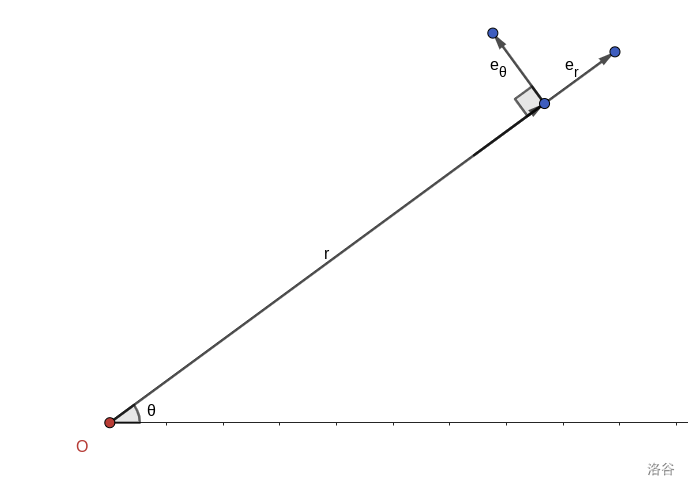
以恒星为原点建立极坐标系:
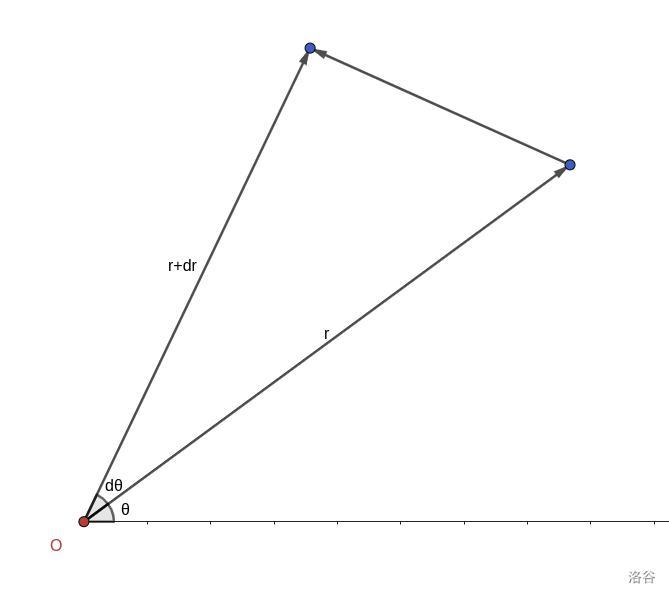
r(r+dr)sin⁡(dθ)2dt=STθ˙=2Sr2T\begin{align} \frac{r(r+\mathrm dr)\sin(\mathrm d\theta)}{2\mathrm dt}&=\frac ST\\ \dot\theta&=\frac{2S}{r^2T} \end{align}

其中 SS 为轨道面积,TT 为公转周期。

定义

er⃗: ⁣ ⁣=(cos⁡θ,sin⁡θ)eθ⃗: ⁣ ⁣=(−sin⁡θ,cos⁡θ)\begin{align} \vec{e_r}:\!\!&=(\cos\theta,\sin\theta)\\ \vec{e_\theta}:\!\!&=(-\sin\theta,\cos\theta) \end{align}

则

er⃗˙=θ˙eθ⃗eθ⃗˙=−θ˙er⃗\begin{align} \dot{\vec{e_r}}&=\dot\theta\vec{e_\theta}\\ \dot{\vec{e_\theta}}&=-\dot\theta\vec{e_r} \end{align}

行星的速度

v⃗: ⁣ ⁣=drer⃗dt=r˙er⃗+rθ˙eθ⃗=r˙er⃗+2Seθ⃗rT\begin{align} \vec v:\!\!&=\frac{\mathrm dr\vec{e_r}}{\mathrm dt}\\ &=\dot r\vec{e_r}+r\dot\theta\vec{e_\theta}\\ &=\dot r\vec{e_r}+\frac{2S\vec{e_\theta}}{rT} \end{align}

加速度

a⃗: ⁣ ⁣=v⃗˙=ddt(r˙er⃗+2Seθ⃗rT)=r¨er⃗+r˙θ˙eθ⃗+2ST⋅−θ˙er⃗r−r˙eθ⃗r2=r¨er⃗+r˙θ˙eθ⃗+θ˙(−θ˙er⃗r−r˙eθ⃗)=er⃗(r¨−(θ˙)2r)=er⃗(r¨−4S2r3T2)\begin{align} \vec a:\!\!&=\dot{\vec v}\\ &=\frac{\mathrm d}{\mathrm dt}(\dot r\vec{e_r}+\frac{2S\vec{e_\theta}}{rT})\\ &=\ddot r\vec{e_r}+\dot r\dot\theta\vec{e_\theta}+\frac{2S}T\cdot\frac{-\dot\theta\vec{e_r}r-\dot r\vec{e_\theta}}{r^2}\\ &=\ddot r\vec{e_r}+\dot r\dot\theta\vec{e_\theta}+\dot\theta(-\dot\theta\vec{e_r}r-\dot r\vec{e_\theta})\\ &=\vec{e_r}(\ddot r-(\dot\theta)^2r)\\ &=\vec{e_r}(\ddot r-\frac{4S^2}{r^3T^2}) \end{align}

所以,行星的加速度是向心的,大小为 4S2r3T2−r¨\frac{4S^2}{r^3T^2}-\ddot r.

Kepler 第一定律:行星绕太阳作椭圆运动,太阳位于椭圆的一个焦点上。

将长轴定为极轴,取左边的焦点,a,ba,b 分别为半长轴、半短轴,半焦距 c:=a2−b2c:=\sqrt{a^2-b^2},离心率 e:=cae:=\frac ca,焦参数 p=b2ap=\frac{b^2}a,根据椭圆第二定义有

r=e(rcos⁡θ−c+a2c)r=e(rcos⁡θ+a2−c2c)r=ercos⁡θ+ca⋅b2cr=p1−ecos⁡θr˙=−peθ˙sin⁡θ(1−ecos⁡θ)2r˙=−r2eθ˙sin⁡θpr˙=−2eSsin⁡θpTr¨=−2eSθ˙cos⁡θpTr¨=−4eS2cos⁡θpr2T24S2r3T2−r¨=4prS2pr2T2+4eS2cos⁡θpr2T24S2r3T2−r¨=4S2pr2T2[(1−ecos⁡θ)+ecos⁡θ]4S2r3T2−r¨=4(πab)2b2ar2T24S2r3T2−r¨=4π2r2⋅a3T2\begin{align} r&=e(r\cos\theta-c+\frac{a^2}c)\\ r&=e(r\cos\theta+\frac{a^2-c^2}c)\\ r&=er\cos\theta+\frac ca\cdot\frac{b^2}c\\ r&=\frac p{1-e\cos\theta}\\ \dot r&=\frac{-pe\dot\theta\sin\theta}{{(1-e\cos\theta)}^2}\\ \dot r&=\frac{-r^2e\dot\theta\sin\theta}p\\ \dot r&=\frac{-2eS\sin\theta}{pT}\\ \ddot r&=\frac{-2eS\dot\theta\cos\theta}{pT}\\ \ddot r&=\frac{-4eS^2\cos\theta}{pr^2T^2}\\ \frac{4S^2}{r^3T^2}-\ddot r&=\frac{4\frac prS^2}{pr^2T^2}+\frac{4eS^2\cos\theta}{pr^2T^2}\\ \frac{4S^2}{r^3T^2}-\ddot r&=\frac{4S^2}{pr^2T^2}[(1-e\cos\theta)+e\cos\theta]\\ \frac{4S^2}{r^3T^2}-\ddot r&=\frac{4{(\pi ab)}^2}{\frac{b^2}ar^2T^2}\\ \frac{4S^2}{r^3T^2}-\ddot r&=\frac{4\pi^2}{r^2}\cdot\frac{a^3}{T^2} \end{align}

Kepler 第三定律:行星公转的周期的平方和轨道半长轴的立方成正比。

用该定律即可得出万有引力定律。


另一种推导方法:由于行星受到的是向心力,所以可以通过行星的动能和 rr 来求得力的大小。

1−ecos⁡θ=pr(1−pr)2=e2cos⁡2θe2−(1−pr)2=e2sin⁡2θ\begin{align} 1-e\cos\theta&=\frac pr\\ {(1-\frac pr)}^2&=e^2\cos^2\theta\\ e^2-{(1-\frac pr)}^2&=e^2\sin^2\theta \end{align} F=d12mv2dr=m2⋅ddr[(r˙)2+(2SrT)2]=m2[ddr(4e2S2sin⁡2θp2T2)+4S2T2⋅−2r3]=2mS2T2{1p2⋅ddr[e2−(1−pr)2]−2r3}=2mS2T2[−2pr2(1−pr)−2r3]=−4mS2T2pr2\begin{align} F&=\frac{\mathrm d\frac12mv^2}{dr}\\ &=\frac m2\cdot\frac{\mathrm d}{\mathrm dr}[(\dot r)^2+(\frac{2S}{rT})^2]\\ &=\frac m2[\frac{\mathrm d}{\mathrm dr}(\frac{4e^2S^2\sin^2\theta}{p^2T^2})+\frac{4S^2}{T^2}\cdot\frac{-2}{r^3}]\\ &=\frac{2mS^2}{T^2}\lbrace\frac1{p^2}\cdot\frac{\mathrm d}{\mathrm dr}[e^2-{(1-\frac pr)}^2]-\frac2{r^3}\rbrace\\ &=\frac{2mS^2}{T^2}[\frac{-2}{pr^2}(1-\frac pr)-\frac2{r^3}]\\ &=-\frac{4mS^2}{T^2pr^2} \end{align}

结论与常规方法相同。

原文