
注意到可以进行操作:
那么我们只需要令 即可结束,于是考虑构造。
其中我们要每次选择一个合适的 ,使得最终落到要求区间即可。
我们考虑观察函数,
的性质,我们使用 GeoGebra,易得:
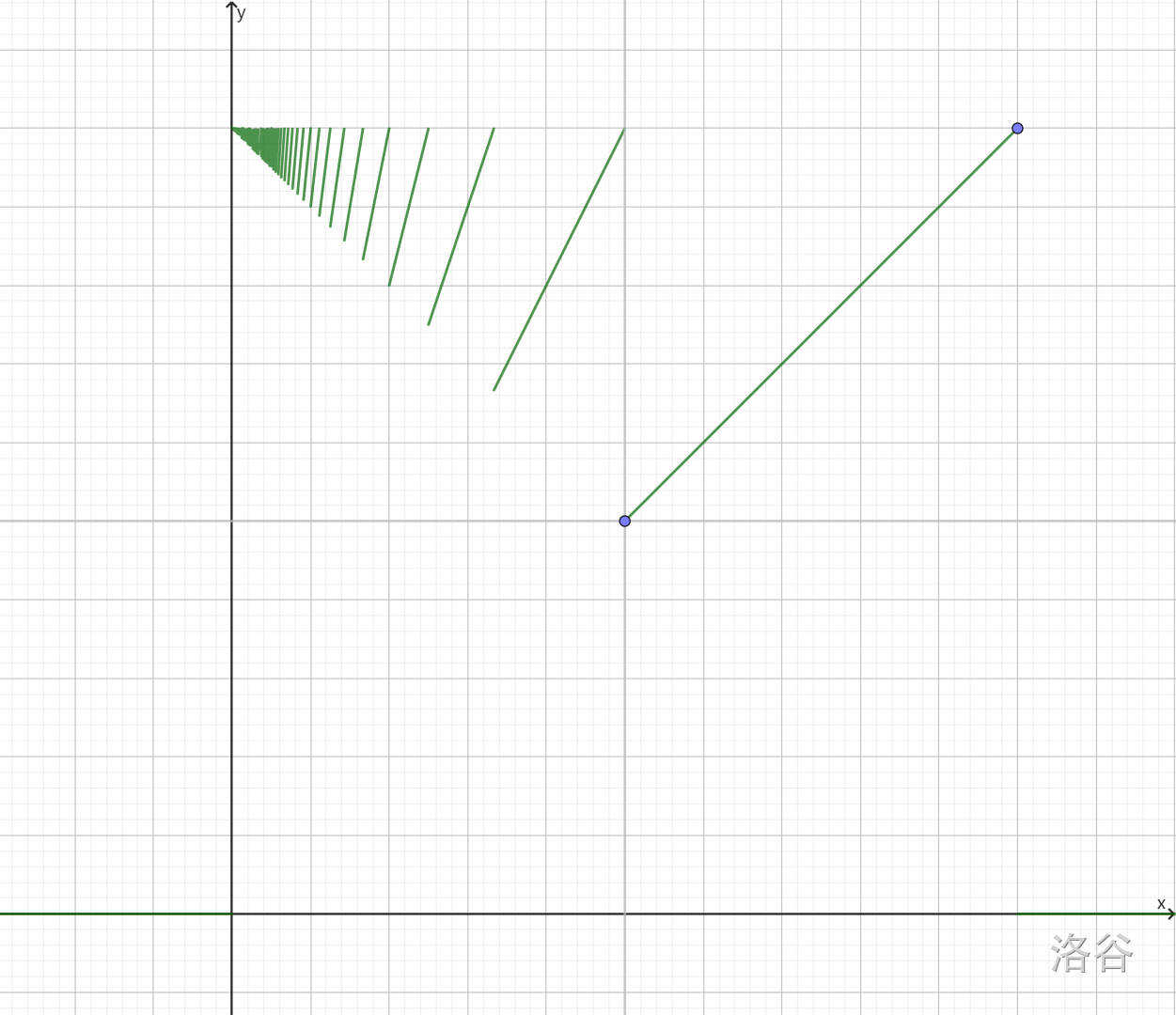
容易发现,在取 附近的时候,可以取到最小值 左右。
具体的,我们令 的时候,可以取到整数时的最小值!
考虑将函数性质带入最上面的迭代中。
注意到每次会减少略小于 的大小,这意味着我们 一定 可以取到目标区间。
这是真的吗?考虑特例!
-
:
-
此时只有 才会有解。
-
因为缩小是无法缩到上面图像描述的看似最小值的。
-
也就是说,我们在 的时候,永远无法缩到 。
-
-
:
-
注意到每次操作一定会使 减小。
-
那么,若 一定无解,因为我们没法变大了。
-
否则,一定有解,按照上面的步骤求解即可,然后你会得到 做法。
int a, b, c, d;

vector<pair<int, int>> ans;

void work(int x, int y) {
	ans.emplace_back(x, y);
	if (x == 1) {
		a /= y;
		b *= y;
	}
	else {
		b /= y;
		a *= y;
	}
}

void print() {
	cout << ans.size() << endl;
	for (auto t : ans)
		cout << t.first << " " << t.second << endl;
}

int Main(int _) {
	_ = _;
	cin >> a >> b >> c >> d;
	if (a * b < c * d)
		return -1;
	if (c * d == 1)
		return (a * b == 1) - 1;
	ans.clear(), work(1, a);
	while (b >= 2 * c * d) {
		int v = b / 2 + 1;
		work(2, v);
		work(1, v);
	}
	work(2, c * d);
	work(1, d);
	return print(), 1;
}

void Main() {
	int T;
	cin >> T;
	while (T--) {
		int res = Main(T);
		if (res != 1)
			cout << res << endl;
	}
}
考虑优化。
容易发现我们两次操作才会进行一个有效的减小,这是很浪费的。
容易想到我们直接对着一个非 的消去,否则消另外一个即可,代码:
int Main(int _) {
	_ = _;
	cin >> a >> b >> c >> d;
	if (a * b < c * d)
		return -1;
	if (c * d == 1)
		return (a * b == 1) - 1;
	ans.clear(), work(1, a);
	while (a * b >= 2 * c * d) {
		int v = a * b / 2 + 1;
		if (a != 1)
			work(1, v);
		else
			work(2, v);
	}
	if (a != 1)
		work(1, a);
	work(2, c * d);
	work(1, d);
	return print(), 1;
}