
首先考虑无修改的情况。
我们枚举排列 上的一段区间,区间内的数在排列 上存在一些位子,要求交际最大就是能覆盖这些位置。可以线段树维护。
每次修改都重复一遍的时间复杂度为 ,显然不能过。
这时我们发现题目的修改很特别,不是随便的两个位置,而是相邻的两个位置。而这会在上面做法中存在相当多重复计算相同的地方,很浪费。
如下图,当枚举的区间移动时,修改操作会影响到的只有这些。 而实际上会与修改前不同的就是框起来的两个区间。
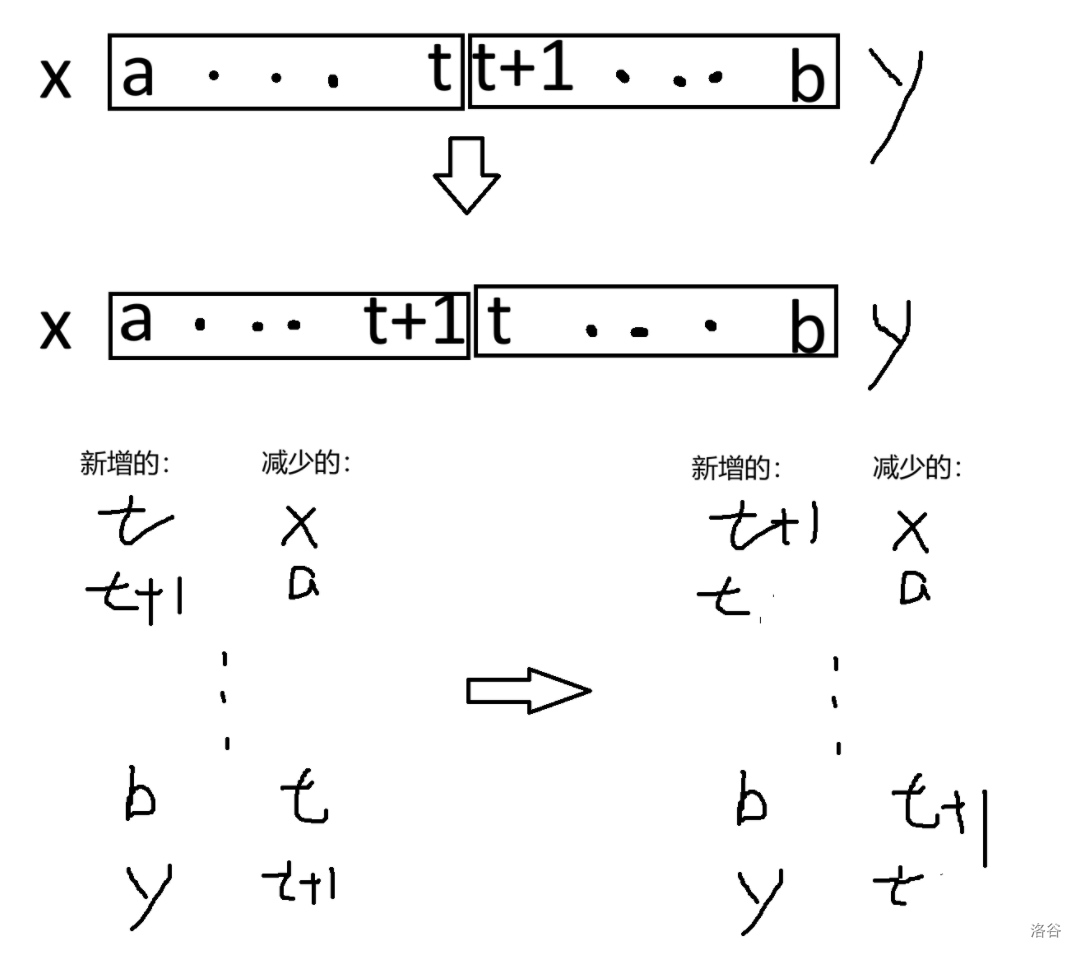
于是我们可以针对每个区间位置计算在修改后的影响,离线计算方案。而相同的结果在答案序列中是连续的,可以再用一个线段树进行区间修改。最后把线段树上的点下放到答案上输出。时间复杂度为 。
一些细节:
- 每个区间位置的影响是从没有操作时当前位置开始的,转移到下一位置时要把操作的影响清掉
- 不完整的区间不要算上否则可能会使答案第二项变大
- 线段树写函数的时候如果复制粘贴别忘改递归的地方,说这句的原因你们懂的
参考代码
#include<bits/stdc++.h>
#define int long long
namespace yycio{
inline int read(){
	char c=getchar();
	int x=0,f=1;
	while(c<'0'||c>'9'){
		if(c=='-')f=-1;
		c=getchar();
	}
	while('0'<=c&&c<='9')x=(x<<3)+(x<<1)+c-'0',c=getchar();
	return x*f;
}
inline void print(int x){
	if(x==0){putchar('0');return;}
	if(x<0)putchar('-'),x=-x;
	char num[40];
	int len=0;
	while(x)num[len++]='0'+(x%10),x/=10;
	while(len--)putchar(num[len]);
}
};
using namespace yycio;
using namespace std;
const int N=1e5+5;

struct node{
	pair<int,int> del;
	pair<int,int> add;
	int id;
	node(){}
	node(const pair<int,int> del,const pair<int,int> add,const int id):del(del),add(add),id(id){}
};
vector<node> V[N];
int a[N],b[N];
int tag[N];
int ans1[N],ans2[N];

#define ls (p<<1)
#define rs (p<<1|1)
#define m ((l+r)>>1)
struct SGT{
	int mx[N<<2],cnt[N<<2];
	int tag[N<<2];
	void build(const int p,const int l,const int r){
		cnt[p]=r-l+1;
		if(l==r)return;
		build(ls,l,m),build(rs,m+1,r);
	}
	inline void psu(const int& p){
		if(mx[ls]>mx[rs])mx[p]=mx[ls],cnt[p]=cnt[ls];
		else if(mx[rs]>mx[ls])mx[p]=mx[rs],cnt[p]=cnt[rs];
		else mx[p]=mx[ls],cnt[p]=cnt[ls]+cnt[rs];
	}
	inline void psd(const int& p){
		if(tag[p]){
			mx[ls]+=tag[p],tag[ls]+=tag[p];
			mx[rs]+=tag[p],tag[rs]+=tag[p];
			tag[p]=0;
		}
	}
	void add(const int p,const int l,const int r,const int a,const int b){
		if(r<a||l>b)return;
		if(a<=l&&r<=b){++mx[p],++tag[p];return;}
		psd(p);
		add(ls,l,m,a,b),add(rs,m+1,r,a,b);
		psu(p);
	}
	void del(const int p,const int l,const int r,const int a,const int b){
		if(r<a||l>b)return;
		if(a<=l&&r<=b){--mx[p],--tag[p];return;}
		psd(p);
		del(ls,l,m,a,b),del(rs,m+1,r,a,b);
		psu(p);
	}
	void prt(const int p,const int l,const int r){
		if(l==r){printf("%lld:{%lld,%lld}\n",l,mx[p],cnt[p]);return;}
		psd(p);
		prt(ls,l,m),prt(rs,m+1,r);
	}
}sgt;
struct SGT2{
	pair<int,int> tag[N<<2];
	void upd(const int p,const int l,const int r,const int a,const int b,const pair<int,int> x){
		if(r<a||l>b)return;
		if(a<=l&&r<=b){
			if(x.first>tag[p].first)tag[p]=x;
			else if(x.first==tag[p].first)tag[p].second+=x.second;
			return;
		}
		upd(ls,l,m,a,b,x),upd(rs,m+1,r,a,b,x);
	}
	void to_ans(const int p,const int l,const int r,pair<int,int> now){
		if(tag[p].first>now.first)now=tag[p];
		else if(tag[p].first==now.first)now.second+=tag[p].second;
		if(l==r){ans1[l]=now.first,ans2[l]=now.second;return;}
		to_ans(ls,l,m,now),to_ans(rs,m+1,r,now);
	}
}sgt2;
#undef m
#undef ls
#undef rs

signed main(){
	int n=read(),k=read(),q=read();
	if(k==1){
		for(int i=0;i<=q;i++)
			print(1),putchar(' '),print(n),putchar('\n');
		return 0;
	}
	for(int i=1;i<=n;i++)a[i]=read();
	for(int i=1;i<=n;i++)tag[b[i]=read()]=i;
	for(int t=1;t<=n;t++){
		node tt;tt.id=0;
		if(t-k>0)tt.del=make_pair(tag[a[t-k]]-k+1,tag[a[t-k]]);
		else tt.del=make_pair(-1,-1);
		tt.add=make_pair(tag[a[t]]-k+1,tag[a[t]]);
		V[t].emplace_back(tt);
	}
	for(int i=1;i<=q;i++){
		int t=read();
		node tt;tt.id=i;
		tt.del=make_pair(tag[a[t]]-k+1,tag[a[t]]);
		tt.add=make_pair(tag[a[t+1]]-k+1,tag[a[t+1]]);
		V[t].emplace_back(tt);
		if(t+k<=n){
			tt.add=make_pair(tag[a[t]]-k+1,tag[a[t]]);
			tt.del=make_pair(tag[a[t+1]]-k+1,tag[a[t+1]]);
			V[t+k].emplace_back(tt);
		}
		swap(a[t],a[t+1]);
	}
	int m=n-k+1;
	sgt.build(1,1,m);
	for(int i=1;i<=n;i++){
		node lst;
		lst.id=-1;
		for(auto j:V[i]){
			if(lst.id!=-1&&i>=k)sgt2.upd(1,0,q,lst.id,j.id-1,make_pair(sgt.mx[1],sgt.cnt[1]));
			sgt.add(1,1,m,j.add.first,j.add.second);
			sgt.del(1,1,m,j.del.first,j.del.second);
			lst=j;
		}
		if(i>=k)sgt2.upd(1,0,q,lst.id,q,make_pair(sgt.mx[1],sgt.cnt[1]));
		for(auto j:V[i])
			if(j.id){
			sgt.del(1,1,m,j.add.first,j.add.second);
			sgt.add(1,1,m,j.del.first,j.del.second);
		}
	}
	sgt2.to_ans(1,0,q,make_pair(0,0));
	for(int i=0;i<=q;i++)
		print(ans1[i]),putchar(' '),print(ans2[i]),putchar('\n');
	return 0;
}