跳到正文

学习·文化课

导数与积分

jsdw约 13 分钟
原文
文章信息与版本

文章信息

发布
2025年9月1日
收录
2025年12月12日
更新
2026年11月11日
篇幅
约 13 分钟

版本

  1. v3当前
  2. v2
  3. v1

导数基本概念

定义

定义函数 f(x)f(x) 的导数 f′(x)f'(x)

f′(x)=lim⁡Δx→0f(x+Δx)−f(x)Δxf'(x)=\lim_{\Delta x\rarr 0}\frac{f(x+\Delta x)-f(x)}{\Delta x}

除了 f′(x)f'(x),导数还常常写成 y′(x),dydx,dfdx,ddxf(x)\displaystyle y'(x),\frac{\text dy}{\text dx},\frac{\text df}{\text dx},\frac{\text d}{\text dx}f(x)。


几何定义:在函数 y=f(x)y=f(x) 的图像上取一点 AA,当自变量 xx 有一个增量 Δx\Delta x,则函数值 yy 也有一个增量 Δy\Delta y,则这时会对应一个点 B(x+Δx,y+Δy)B(x+\Delta x,y+\Delta y)。当 x→0x\rarr 0 时,直线 ABAB 会变成函数图像在 AA 点的切线,这时函数在 AA 点切线的斜率 kk 就等于函数在 AA 点的导数,即

k=lim⁡Δx→0ΔyΔx=f′(x)=dydxk=\lim_{\Delta x\rarr 0}\frac{\Delta y}{\Delta x}=f'(x)=\frac{\text dy}{\text dx}

常用函数的导数

  1. 常值函数 f(x)=Cf(x)=C,导数 f′(x)=0f'(x)=0。

  2. 幂函数 f(x)=xnf(x)=x^n,导数 f′(x)=nxn−1f'(x)=nx^{n-1}。

  3. 指数函数 f(x)=axf(x)=a^x,导数 f′(x)=axln⁡af'(x)=a^x\ln a,当 a=ea=e 时,f′(x)=exf'(x)=e^x。

  4. 对数函数 f(x)=log⁡axf(x)=\log_a x,导数 f′(x)=1xln⁡af'(x)=\displaystyle\frac{1}{x\ln a},当 a=ea=e 时,f′(x)=1xf'(x)=\displaystyle\frac{1}{x}。

  5. 三角函数 f(x)=sin⁡xf(x)=\sin x,导数 f′(x)=cos⁡xf'(x)=\cos x;三角函数 f(x)=cos⁡xf(x)=\cos x,导数 f′(x)=−sin⁡xf'(x)=-\sin x。

导数的四则运算

若 f,gf,g 都为可导函数,α,β\alpha,\beta 都为常数,则

(αf+βg)′=αf′+βg′(fg)′=f′g+fg′(\alpha f+\beta g)'=\alpha f'+\beta g'\\ (fg)'=f'g+fg'

若对于定义域内的 xx 都满足 g(x)≠0g(x)\ne 0,则

(fg)′=f′g−fg′g2\left(\frac{f}{g}\right)'=\frac{f'g-fg'}{g^2}

练习

求下列函数的导数:

(1) x3+cos⁡xx^3+\cos x ;

(2) 1x−1x\displaystyle\frac{1}{x}-\frac{1}{\sqrt x} ;

(3) xx−ln⁡xx\sqrt x-\ln x ;

(4) (2x+3)2(2x+3)^2 .


解析:

直接套表和运算法则即可。

(1) f′=3x2−sin⁡xf'=3x^2-\sin x ;

(2) f′=(x−1−x−12)′=−x−2−(−12)x−32=−1x2+1x3\displaystyle f'=(x^{-1}-x^{-\frac{1}{2}})'=-x^{-2}-(-\frac{1}{2})x^{-\frac{3}{2}}=-\frac{1}{x^2}+\frac{1}{\sqrt{x^3}} ;

(3) f′=(x32−ln⁡x)′=32x12−1x=3x2−1x\displaystyle f'=(x^{\frac{3}{2}}-\ln x)'=\frac{3}{2}x^{\frac{1}{2}}-\frac{1}{x}=\frac{3\sqrt x}{2}-\frac{1}{x} ;

(4) f′=((2x+3)2)′=(4x2+12x+9)′=8x+12f'=\left((2x+3)^2\right)'=(4x^2+12x+9)'=8x+12 .

复合函数求导

若函数 y=f[g(x)]y=f[g(x)] 是由函数 y=f(u)y=f(u) 和 u=g(x)u=g(x) 复合而成,则 f′(x)=f′(u)⋅g′(x)f'(x)=f'(u)\cdot g'(x)。

或者说 dydx=dydu⋅dudx\displaystyle\frac{\text dy}{\text dx}=\frac{\text dy}{\text du}\cdot \frac{\text du}{\text dx}。

反函数求导

对于函数 y=f(x)y=f(x),若它的反函数为 x=f−1(y)x=f^{-1}(y),则 (f−1(y))′=1f′(x)\left(f^{-1}(y)\right)'=\displaystyle\frac{1}{f'(x)}。也就是说,反函数的导数与原函数的导数互为倒数。

高阶导数

称函数 f(x)f(x) 的导数 f′(x)f'(x) 的导数 f′′(x)f''(x) 为 f(x)f(x) 的二阶导数,依此类推。为了方便,我们将 f(x)f(x) 的 nn 阶导数记作 f(n)(x)f^{(n)}(x) 或 dnfdxn\displaystyle\frac{\text d^nf}{\text dx^n}。

练习

求:

dndxneax\displaystyle\frac{\text d^n}{\text dx^n}e^{ax}.


解析:

先求 (eax)′(e^{ax})',设 f(u)=eu,g(x)=axf(u)=e^u,g(x)=ax,则 (eax)′=f(g(x))(e^{ax})'=f(g(x)),根据复合函数求导法则,f(x)′=f(u)′⋅g(x)′=eu⋅a=aeaxf(x)'=f(u)'\cdot g(x)'=e^u\cdot a=ae^{ax},所以说 (aex)(n)=a⋅(eax)(n−1)=an⋅eax(a^{ex})^{(n)}=a\cdot (e^{ax})^{(n-1)}=a^n\cdot e^{ax}。

导数的应用

求函数的极值

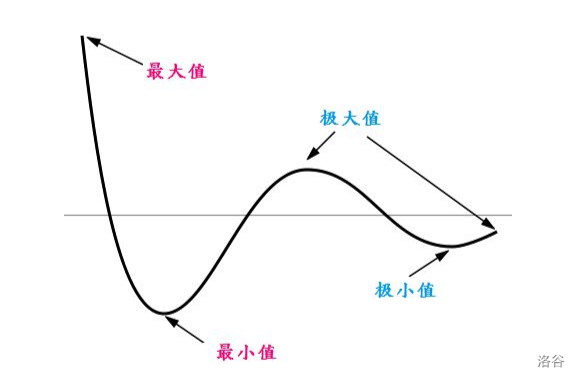
对于一个函数 f(x)f(x),若 ∃σ>0\exist \sigma>0,使得 ∀x∈(x0−σ,x0+σ)\forall x\in (x_0-\sigma,x_0+\sigma) 都有 f(x)≤f(x0)f(x)\le f(x_0),则 x0x_0 为函数 f(x)f(x) 的极大值点,反之则为极小值点,像下图这样:

不难看出,若 xx 为函数 f(x)f(x) 的极值点,则 f′(x)=0f'(x)=0。

泰勒展开

泰勒展开具体如下:

f(x)≈∑i=0n1i!f(i)(x0)⋅(x−x0)if(x)\approx\sum_{i=0}^n \frac{1}{i!}f^{(i)}(x_0)\cdot (x-x_0)^i

当 nn 越大时,值就越精确,我们通常用函数的二阶近似展开式,即

f(x)≈f(x0)+f′(x0)⋅(x−x0)+12f′′(x0)⋅(x−x0)2f(x)\approx f(x_0)+f'(x_0)\cdot (x-x_0)+\frac{1}{2}f''(x_0)\cdot (x-x_0)^2

常用泰勒展开结果:

函数泰勒展开结果
(1+x)n(1+x)^n1+nx1+nx
sin⁡x,tan⁡x\sin x,\tan xxx
cos⁡x\cos x1−x221-\displaystyle\frac{x^2}{2}
exe^x1+x1+x
ln⁡(1+x)\ln(1+x)xx

练习

将 f(x)=1+x+x2f(x)=\sqrt{1+x+x^2} 在 x=0x=0 附近展开到 xx 的二阶项 .


解析:

先求导:f′(x)=2x+12x2+x+1,f′′(x)=3x2+x+14(x4+2x3+3x2+2x+1)f'(x)=\displaystyle\frac{2x+1}{2\sqrt{x^2+x+1}},f''(x)=\frac{3\sqrt{x^2+x+1}}{4(x^4+2x^3+3x^2+2x+1)}。

然后泰勒展开:

f(x)=f(0)+f′(0)⋅(x−0)+12f′′(0)⋅(x−0)2=1+12x+12⋅34x2=1+12x+38x2f(x)=f(0)+f'(0)\cdot (x-0)+\frac{1}{2}f''(0)\cdot (x-0)^2\newline =1+\frac{1}{2}x+\frac{1}{2}\cdot \frac{3}{4}x^2\newline =1+\frac{1}{2}x+\frac{3}{8}x^2

定积分

含义

∫abf(x)dx=lim⁡Δx→0∑i=1nf(xi)Δxi\int_a^b f(x)\text dx=\lim_{\Delta x\rarr 0}\sum_{i=1}^n f(x_i)\Delta x_i

其中 f(x)f(x) 为被积函数,xx 为积分变量,f(x)dxf(x)\text dx 为被积表达式,a,ba,b 分别为积分下限与上限,定积分实际上就是小量求和。

牛顿-莱布尼兹公式

若 F(x)′=f(x)F(x)'=f(x),则

∫abf(x)dx=F(b)−F(a)\int_a^b f(x)\text dx=F(b)-F(a)

定积分运算法则

上下限相等及交换运算:

当定积分上下限相同时,即 a=ba=b 时,

∫abf(x)dx=0\int_a^b f(x)\text dx=0

当 a>ba>b 时,

∫abf(x)dx=−∫baf(x)dx\int_a^b f(x)\text dx=-\int _b^a f(x)\text dx

线性运算:

对于任意常数 α,β\alpha,\beta,αf+βg\alpha f+\beta g 也是 [a,b][a,b] 上的可积函数,且

∫ab[αf(x)+βg(x)]dx=α∫abf(x)dx+β∫abg(x)dx\int_a^b [\alpha f(x)+\beta g(x)]\text dx=\alpha\int_a^b f(x)\text dx+\beta \int_a^b g(x)\text dx

定积分拆分:

对于一个数 cc,若 a<c<ba<c<b,则

∫abf(x)dx=∫acf(x)dx+∫cbf(x)dx\int_a^b f(x)\text dx=\int _a^c f(x)\text dx+\int_c^b f(x)\text dx

练习

计算:

(1) ∫0πsin⁡xdx\displaystyle \int_0^\pi \sin x \text dx ;

(2) ∫01exdx\displaystyle \int_0^1 e^x \text dx .


解析:

套牛顿-莱布尼兹公式:

(1) ∫0πsin⁡xdx=−cos⁡π+cos⁡0=2\displaystyle \int_0^\pi \sin x\text dx=-\cos \pi +\cos 0=2 ;

(2) ∫01exdx=e1−e0=e−1\displaystyle \int_0^1 e^x \text dx=e^1-e^0=e-1 .

不定积分

基本概念

函数 f(x)f(x) 的原函数全体称作 f(x)f(x) 的不定积分,记作 ∫f(x)dx\displaystyle \int f(x)\text dx。即若 F(x)=f′(x)F(x)=f'(x),则

∫f(x)dx=F(x)+C\int f(x)\text dx=F(x)+C

其中 CC 为任意常数。由此可见,不定积分为求导的逆运算,即

(∫f(x)dx)′=f(x)∫F′(x)dx=F(x)+C\left(\int f(x)\text dx\right)'=f(x)\newline \int F'(x) \text dx=F(x)+C

基本不定积分表:

∫xαdx=1α+1xα+1+C,(α≠1)∫1xdx=ln⁡∣x∣+C∫axdx=1ln⁡aax+C,(a>0,a≠1)∫exdx=ex+C∫sin⁡xdx=−cos⁡x+C∫cos⁡xdx=sin⁡x+C∫sec⁡2xdx=tan⁡x+C∫csc⁡2xdx=−cot⁡x+C∫sec⁡xtan⁡xdx=sec⁡x+C∫csc⁡xcot⁡xdx=−csc⁡x+C∫11−x2dx=arcsin⁡x+C∫11+x2dx=arctan⁡x+C\int x^\alpha \text dx=\frac{1}{\alpha +1}x^{\alpha +1}+C,(\alpha \ne 1)\newline \int \frac{1}{x}\text dx=\ln |x|+C\newline \int a^x \text dx=\frac{1}{\ln a}a^x+C,(a>0,a\ne 1)\newline \int e^x \text dx=e^x+C\newline \int \sin x\text dx=-\cos x+C\newline \int \cos x\text dx=\sin x+C\newline \int \sec^2 x\text dx=\tan x+C\newline \int \csc^2 x\text dx=-\cot x+C\newline \int \sec x\tan x\text dx=\sec x+C\newline \int \csc x\cot x\text dx=-\csc x+C\newline \int \frac{1}{\sqrt{1-x^2}}\text dx=\arcsin x+C\newline \int \frac{1}{1+x^2}\text dx=\arctan x+C

不定积分的运算法则与求导的运算法则类似。

练习

计算:

(1) ∫x3dx\displaystyle \int \sqrt[3]{x}\text dx ;

(2) ∫1x2dx\displaystyle \int \frac{1}{x^2}\text dx ;

(3) ∫s−1ds\displaystyle \int s^{-1} \text ds ;

(4) ∫dxx2x\displaystyle \int \frac{\text dx}{x^2\sqrt x} .


解析:

直接套表即可。

(1) ∫x3dx=34x43+C\displaystyle \int \sqrt[3]{x}\text dx=\frac{3}{4} x^{\frac{4}{3}}+C ;

(2) ∫1x2dx=∫x−2dx=−x−1+C=−1x+C\displaystyle \int \frac{1}{x^2}\text dx=\int x^{-2}\text dx=-x^{-1}+C=-\frac{1}{x}+C ;

(3) ∫s−1ds=ln⁡∣s∣+C\displaystyle \int s^{-1} \text ds=\ln |s|+C ;

(4) ∫dxx2x=∫x−25dx=−23x−32+C=−23x3+C\displaystyle \int \frac{\text dx}{x^2\sqrt x}=\int x^{-\frac{2}{5}} \text dx=-\frac{2}{3}x^{-\frac{3}{2}}+C=-\frac{2}{3\sqrt{x^3}}+C .

第一类换元积分

设 F(x)′=f(x)F(x)'=f(x),令 u=φ(x)u=\varphi(x),则

∫f(φ(x))⋅φ′(x)dx=∫f(φ(x))dφ(x)=∫f(u)du=F(u)+C=F(φ(x))+C\int f(\varphi(x))\cdot \varphi'(x)\text dx=\int f(\varphi(x))\text d\varphi(x)=\int f(u)\text du=F(u)+C=F(\varphi(x))+C

此方法的关键在于凑出 ∫f(φ(x))⋅φ′(x)dx\displaystyle \int f(\varphi(x))\cdot \varphi'(x)\text dx。

练习

计算:

(1) ∫e3tdt\displaystyle \int e^{3t}\text dt ;

(2) ∫(3−5x)3dx\displaystyle \int (3-5x)^3\text dx .


解析:

(1) :

令 x=3tx=3t,则 dx=3dt\text dx=3\text dt,所以说:∫e3tdt=∫ex⋅13dx=13ex+C\displaystyle\int e^{3t}\text dt=\int e^x\cdot \frac{1}{3}\text dx=\frac{1}{3}e^x+C。

(2) :

令 t=3−5xt=3-5x,则 dt=−5dx\text dt=-5\text dx,那么: ∫(3−5x)3dx=∫t3⋅(−15)dt=−120t4+C=−120(3−5x)4+C\displaystyle \int (3-5x)^3\text dx=\int t^3\cdot \left(-\frac{1}{5}\right)\text dt=-\frac{1}{20}t^4+C=-\frac{1}{20}(3-5x)^4+C。

分步积分法

根据导数的公式,可得

∫f(x)g′(x)dx=∫(f(x)g(x))′dx−∫f(x)′g(x)dx=f(x)g(x)−∫f′(x)g(x)dx\int f(x)g'(x)\text dx=\int (f(x)g(x))'\text dx-\int f(x)'g(x)\text dx=f(x)g(x)-\int f'(x)g(x)\text dx

挖一个坑:后续打算补充微分相关知识。

原文