
Solution
长链剖分大佬们都将的很清楚了,我就来补一发左偏树吧。
我们可以每个节点建一个大根堆,然后自底向上合并。
因为每个节点对答案的贡献最多只有一次,我们可以 dfs 一遍,把 的子树合并完后,将 的权值加到左偏树的堆顶元素上即可。
其实就是将每一层的最大元素连成一条链。
最后的左偏树中取前 大求和即为解。
比如这棵树(样例),:
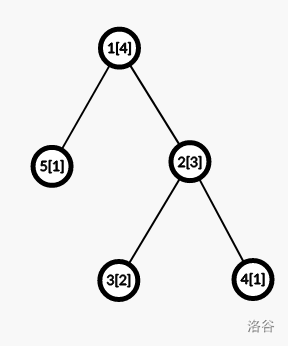
我们先将最底层的 和 合并,得到堆护的序列 。
然后将 的权值加到堆顶元素上,序列变为 。
再将 和 合并,得到序列 。
最后将 的权值加到堆顶元素上,序列变为 。
取前 个元素求和就可以得到答案 。
其中 表示 这条链, 表示 或 这条链。
Code(100 pts):
#include<bits/stdc++.h>
#define afor(x,y,z) for(int x=y;x<=z;x++)
#define bfor(x,y,z) for(int x=y;x>=z;x--)
#define cfor(x,y) for(int x=head[y];x;x=nxt[x])
using namespace std;
typedef long long ll;
typedef const int cint;
cint N=2e5+10;
ll n,k,rt,ans,v[N],w[N],d[N],lson[N],rson[N];
ll tot,head[N],to[N],nxt[N];
void add(ll x,ll y) {
	to[++tot]=y;
	nxt[tot]=head[x];
	head[x]=tot;
}
ll merge(ll x,ll y) {
	if(!x||!y) return x+y;
	if(w[x]<w[y]) swap(x,y);
	rson[x]=merge(rson[x],y);
	if(d[lson[x]]<d[rson[x]])
		swap(lson[x],rson[x]);
	d[x]=d[rson[x]]+1;
	return x;
}
ll dfs(ll x) {
	ll ret=0;
	cfor(i,x) {
		ll y=dfs(to[i]);
		if(y) ret=merge(ret,y);
		else ret=merge(ret,to[i]);
	}
	if(ret) w[ret]+=w[x];
	return ret;
}
int main() {
	scanf("%lld%lld",&n,&k);
	afor(i,1,n) scanf("%lld",&w[i]);
	afor(i,1,n-1) {
		ll x,y;
		scanf("%lld%lld",&x,&y);
		add(x,y),v[y]=1;
	}
	afor(i,1,n) if(!v[i]) rt=i;
	ll heap=dfs(rt);
	afor(i,1,k) {
		ans+=w[heap];
		heap=merge(lson[heap],rson[heap]);
	}
	printf("%lld",ans);
	return 0;
}