
这里来说明一个时间复杂度为 的算法,这个算法还能通过此题的加强版!双倍经验
显然 DFS 路径 的复杂度是无法优化的,所以具体要提高效率就得从断边入手。将原来的暴力,改为通过一次搜索来确定应该断的是哪条边。
如何找环,搜索路径,这里就不在赘述,我们具体分析如何断边:
比如这样的图
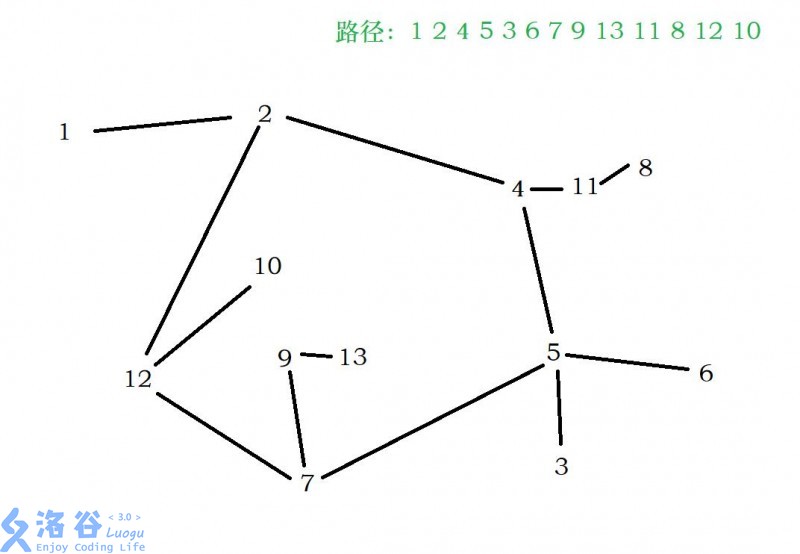
处理方法:
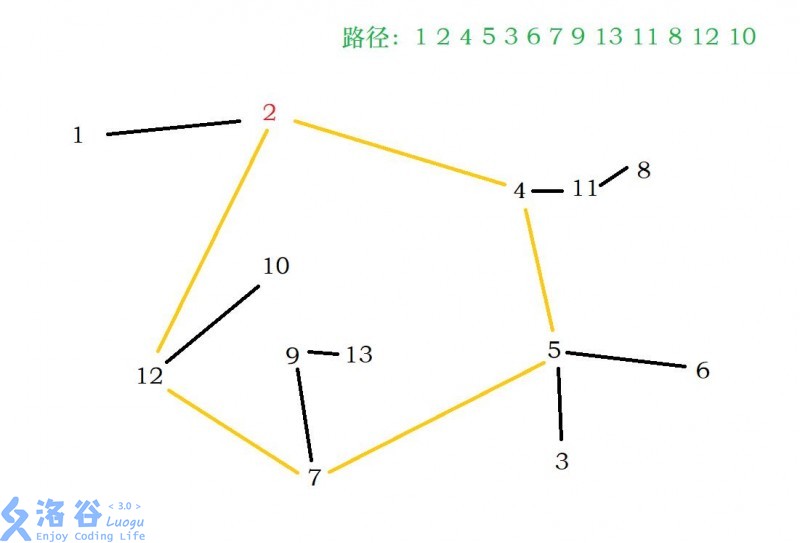
1.先找到环和环的入点(红色,橙色部分)
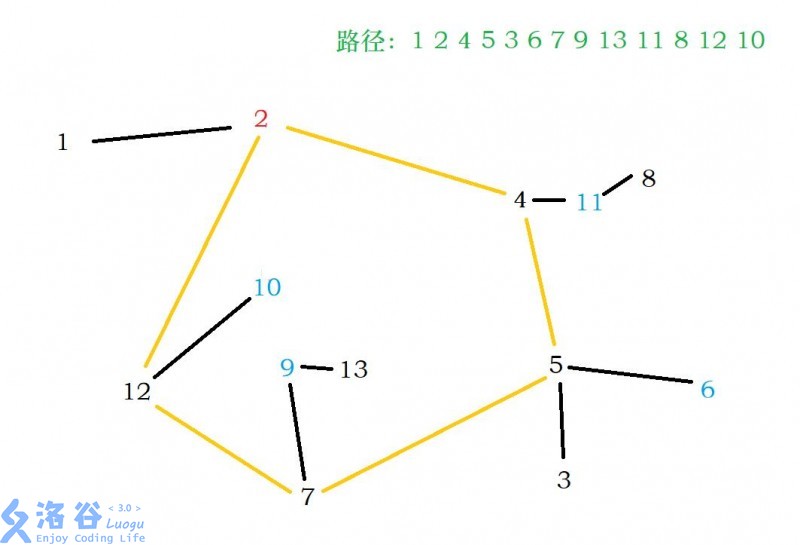
2.对环上的每个点预处理,找出其最大的子节点,入点不用处理(蓝色部分)
3.遍历整个环进行断边
设 为 节点的最大子节点, 为 的后一个节点, 为 的前一个有子节点的节点,该节点比 大的子节点中最小的那一个子节点(此处所说的节点都为环上的节点,子节点都不是环上的节点)
first. 首先判断入点的两个叶节点,选择较小的进入环
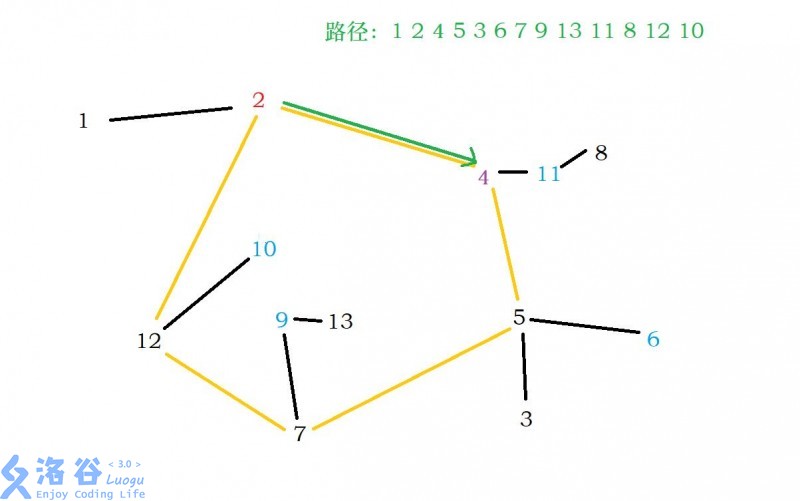
second. 若 ,则可以扩展到后一个节点
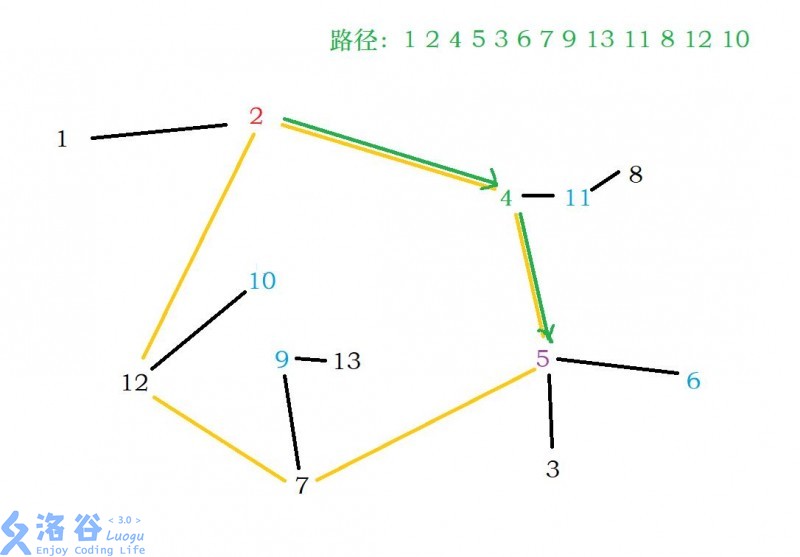
third. 若 但是 ,也可以扩展到后一个节点。
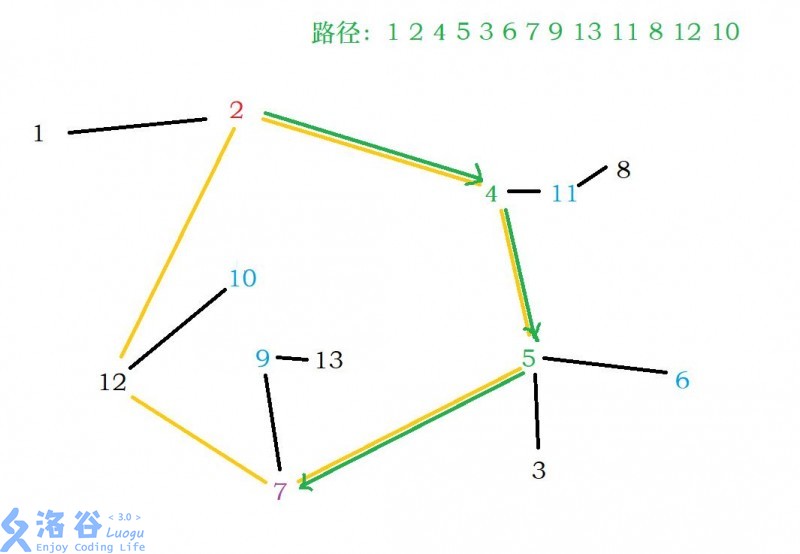
fourth. 若同时不满足second和third的条件,或 为入点,则不能继续扩展,并断开 和 之间的边
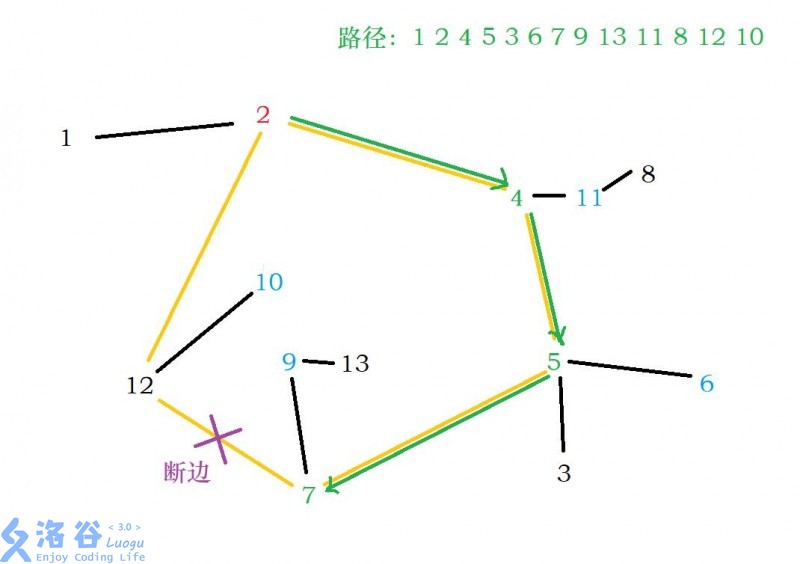
4. DFS搜索路径
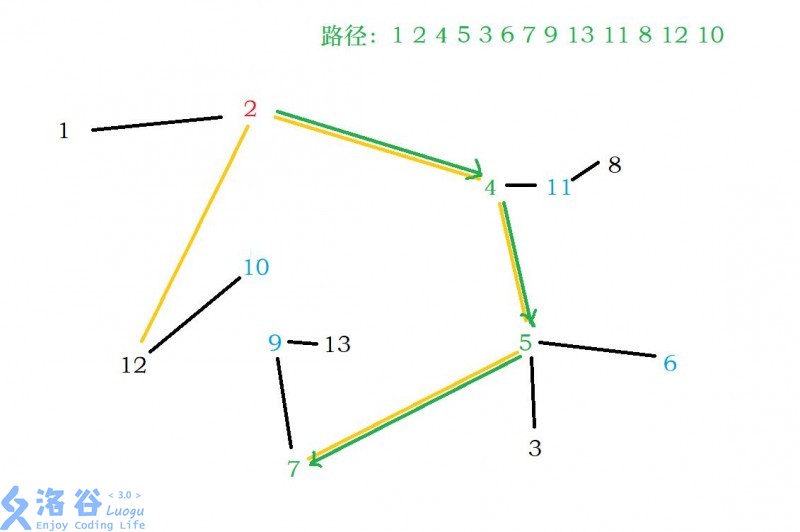
只要在断边后的图(一棵树)中用DFS搜索路径即可
5.时间复杂度
给边排序
找环
断边
搜索路径
所以总时间复杂度接近 ,可以通过此体。
6.程序(pascal)
program project1;
var
   r,path,father,son,tmax:array[0..500005]of longint;
   ttf:array[0..500005]of boolean;
   l,v,x,y:array[0..1000005]of longint;
   n,m,p,k,fat,nox,noy:longint;

function max(a,b:longint):longint;
begin
  if a>b then exit(a) else exit(b);
end;

function min(a,b:longint):longint;
begin
  if a<b then exit(a) else exit(b);
end;

procedure sc(f,fa:longint);
var i:longint;
begin
  i:=r[f];
  while i<>0 do begin
    if (v[i]<>fa) and not((f=nox) and (v[i]=noy)) and not((f=noy) and (v[i]=nox)) then begin
      inc(k);
      path[k]:=v[i];
      sc(v[i],f);
    end;
    i:=l[i];
  end;
end;

function sc2(f,fa:longint):boolean;
var i:longint;
begin
  sc2:=false;
  i:=r[f];
  while i<>0 do begin
    if v[i]<>fa then begin
      if father[v[i]]=0 then father[v[i]]:=f
        else begin
          p:=v[i];
          fat:=father[v[i]];
          father[v[i]]:=f;
          son[f]:=v[i];
          exit(true);
        end;
      if sc2(v[i],f)=true then begin
        son[f]:=v[i];
        ttf[v[i]]:=true;
        exit(true)
      end;
    end;
    i:=l[i];
  end;
end;

procedure sc3;
var i,j:longint;
begin
  i:=p;
  while father[i]<>p do begin
    i:=father[i];
    j:=r[i];
    while j<>0 do begin
      if (v[j]<>son[i]) and (v[j]<>father[i]) then tmax[i]:=max(tmax[i],v[j]);
      j:=l[j];
    end;
  end;
end;

function mmax(k,p,o:longint):longint;
var i:longint;
begin
  mmax:=10000000;
  i:=r[p];
  while i<>0 do begin
    if (v[i]<>o) and (v[i]>k) then mmax:=min(mmax,v[i]);
    i:=l[i];
  end;
end;

function cut:longint;
var i,x,y,q,s:longint;
begin
  cut:=0;
  if father[p]<son[p] then begin
    i:=father[p];
    cut:=mmax(i,p,fat);
    while ((father[i]<tmax[i]) or ((father[i]>tmax[i]) and (father[i]<cut))) and (father[i]<>p) do begin
      i:=father[i];
      s:=mmax(i,son[i],son[son[i]]);
      if s<>10000000 then cut:=s;
    end;
    nox:=i;
    noy:=father[i];
  end else begin
    i:=son[p];
    cut:=mmax(i,p,fat);
    while ((son[i]<tmax[i]) or ((son[i]>tmax[i]) and (son[i]<cut))) and (son[i]<>p) do begin
      i:=son[i];
      s:=mmax(i,father[i],father[father[i]]);
      if s<>10000000 then cut:=s;
    end;
    nox:=i;
    noy:=son[i];
  end;
end;

procedure qsort(l,r:longint);
var i,j,mid,t:longint;
begin
  i:=l;
  j:=r;
  mid:=y[(i+j) div 2];
  repeat
    while y[i]>mid do inc(i);
    while y[j]<mid do dec(j);
    if i<=j then begin
      t:=y[i];
      y[i]:=y[j];
      y[j]:=t;
      t:=x[i];
      x[i]:=x[j];
      x[j]:=t;
      inc(i);
      dec(j);
    end;
  until i>j;
  if l<j then qsort(l,j);
  if i<r then qsort(i,r);
end;

procedure re;
var i,t,xx,yy:longint;
begin
  for i:=1 to m do begin
    read(xx,yy);
    t:=2*i;
    x[t]:=xx;
    y[t]:=yy;
    x[t-1]:=yy;
    y[t-1]:=xx;
  end;
  qsort(1,2*m);
  for i:=1 to 2*m do begin
    l[i]:=r[x[i]];
    r[x[i]]:=i;
    v[i]:=y[i];
  end;
end;

procedure main;
var i:longint;
begin
  k:=0;
  inc(k);
  path[k]:=1;
  father[1]:=1;
  if m=n then begin
    sc2(1,0);
    sc3;
    cut;
  end;
  sc(1,0);
  for i:=1 to k do write(path[i],' ');  writeln;
end;

begin
  fillchar(r,sizeof(r),0);
  fillchar(l,sizeof(l),0);
  read(n,m);
  re;
  main;
end.