
题面
题解
题意
对于每条道路,求出有多少条最短路经过它。
解析
先看看数据范围,不算大。
所以我们分别以每个点为起点,用SPFA求出每个点到源点的最短距离。
不难发现对于边 ,如果 ,那么这条边一定在源点到 的最短路上。 而不满足这个条件的边,显然对答案毫无贡献,所以我们可以在跑完最短路后忽略不满足条件的这些边。
这样原图就变成了一副DAG图,因为不存在 ,且 。
在DAG图上我们就可以跑拓扑排序了。对于每个点求出从源点到达它的方案数,再按照拓扑排序的逆序求出从后面的节点到达当前节点的方案数。
原因请看下图:
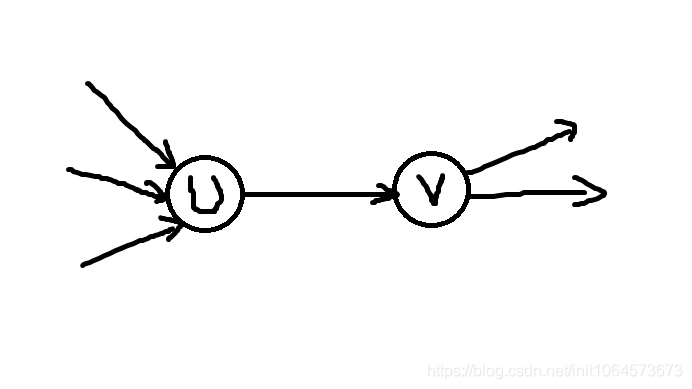 从源点到 的方案数记为 ,从后面的节点到达 的方案数记为 ,不难发现根据乘法原理,这条从 到 的边就有 条最短路经过了它。因为当前图只保留了在最短路上的边,这些方案数确实都是最短路,所以答案是正确的。
代码
不知道我按照正常的SPFA的写法为什么只能过40分,这份代码里面的SPFA的内容是参考了其它题解的写法的。
#include<cstdio>
#include<cstring>
#include<queue>
#define re register

using namespace std;

const int N = 1505,M = 5005;
const int mod = 1e9 + 7;

struct edge {
	int from,next,to,w;
}a[M];
int head[N],dis[N],ans[M],que[M << 1],n,m,a_size = 0;
bool vis[N],is[M];
inline void add(int u,int v,int w) {
	a[++a_size] = (edge){u,head[u],v,w};
	head[u] = a_size;
}
void SPFA(int s) {
    memset(dis,0x3f,sizeof(dis));
    memset(is,0,sizeof(is)); re int len;
    dis[que[len = 1] = s] = 0; vis[s] = true;
    for (re int i = 1; i <= len; i++) {
        int u = que[i]; vis[u] = 0;
        for (re int e = head[u],v; e; e = a[e].next)
            if (dis[u] + a[e].w < dis[v = a[e].to]) {
                dis[v] = dis[u] + a[e].w;
                if (!vis[v]) vis[que[++len] = v] = 1;
            }
    }
    for (re int i = 1; i <= m; i++)
        if (dis[a[i].from] + a[i].w == dis[a[i].to])
            is[i] = 1;
}
int deg[N],cnt1[N],cnt2[N],ord[N],len;
queue<int> q;
void tuopu(int s) {
	while(!q.empty()) q.pop();
	memset(deg,0,sizeof(deg));
	memset(cnt1,0,sizeof(cnt1));
	memset(cnt2,0,sizeof(cnt2)); len = 0;
	for(re int i = 1; i <= m; i++) if(is[i]) deg[a[i].to]++;
	q.push(s); cnt1[s] = 1;
	while(!q.empty()) {
		int x = q.front();
		q.pop(); ord[++len] = x;
		for(int i = head[x]; i; i = a[i].next) {
			if(!is[i]) continue;
			int y = a[i].to;
			cnt1[y] = (cnt1[y] + cnt1[x]) % mod;
			if(--deg[y] == 0) q.push(y);
		}
	}
	for(re int j = len; j >= 1; j--) {
		re int x = ord[j]; cnt2[x]++;
		for(re int i = head[x]; i; i = a[i].next) {
			if(!is[i]) continue;
			cnt2[x] = (cnt2[x] + cnt2[a[i].to]) % mod;
		}
	}
}
inline int read() {
	re int x = 0,flag = 1;
	char ch = getchar();
	while(ch < '0' || ch > '9'){if(ch == '-')flag = -1;ch = getchar();}
	while(ch >='0' && ch <='9'){x = (x << 3) + (x << 1) + ch - 48;ch = getchar();}
	return x * flag;
}
int main() {
	n = read(),m = read();
	for(re int i = 1,u,v,w; i <= m; i++) {
		u = read(),v = read(),w = read();
		add(u,v,w);
	}
	for(re int i = 1; i <= n; i++) {
		SPFA(i); tuopu(i);
		for(re int j = 1; j <= m; j++)
			if(is[j]) ans[j] = (ans[j] + 1ll * cnt1[a[j].from] * cnt2[a[j].to] % mod) % mod;
	}
	for(re int i = 1; i <= m; i++) printf("%d\n",ans[i]);
	return 0;
}