
更新
2023/12/31 更新:
- 增加了
sqrt函数
2024/01/01 更新:
- 更正了
compare函数中关于负数讨论的问题(感谢 @Alex_Wei 巨佬) - 增加了
to_vint函数 - 更正了 FFT 乘法负数的问题
- 更正了减法关于负数讨论的问题(感谢 @Alex_Wei 巨佬 & 谢罪)
2024/02/05 更新:
- 经过对拍,除法负数有锅。其他暂没有发现问题。
2024/02/23 更新:
- 开学前打了乘积最大,发现板子还有锅。由于马上开学,没有时间 debug,本版子暂时作废。
保证
已通过所有高精度模板题(包括 FFT 板子)。
与 python 在 的数据下进行过对拍,结果正确,除取余外遥遥领先于 python。
详情见 性能测试 部分。
实现细节
对于高精度运算 ,以下均用 代表 的位数, 代表 的位数。
压位位数 ,可修改。
由于 FFT 做压位的上限太低,且朴素乘法有 的常数,故 在 以内的数据采用朴素高精乘法。除法使用二分。
复杂度:
| 操作 | 函数名 | 时间 | 空间 |
|---|---|---|---|
| 字符串初始化 | / | ||
| 整型初始化 | / | ||
| 复制初始化 | / | ||
| 清空(置 ) | clear | ||
| 预先分配空间 | reserve | ||
| 读入 | / | ||
| 输出 | / | ||
| 取绝对值 | abs | ||
| 取反 | / | ||
| 判断是否为 | iszero | ||
| 乘 | mul2 | ||
| 除 | div2 | ||
| 比较运算符 | / | ||
| 加 | / | ||
| 减 | / | ||
| 自增 | / | ||
| 自减 | / | ||
| 乘高精(朴素) | / | ||
| 乘高精(FFT) | / | ||
| 乘单精 | / | ||
| 除高精(朴素) | / | ||
| 除高精(FFT) | / | ||
| 除单精 | / | ||
| 取余(朴素) | / | ||
| 取余(FFT) | / | ||
| 乘方(朴素) | pow | ||
| 乘方(FFT) | pow | ||
| 进制乘方 | pow_base | ||
| 模 | mod2 | ||
| 平方根(朴素) | sqrt | ||
| 平方根(FFT) | sqrt |
性能测试
统计图( 次测试取平均值):
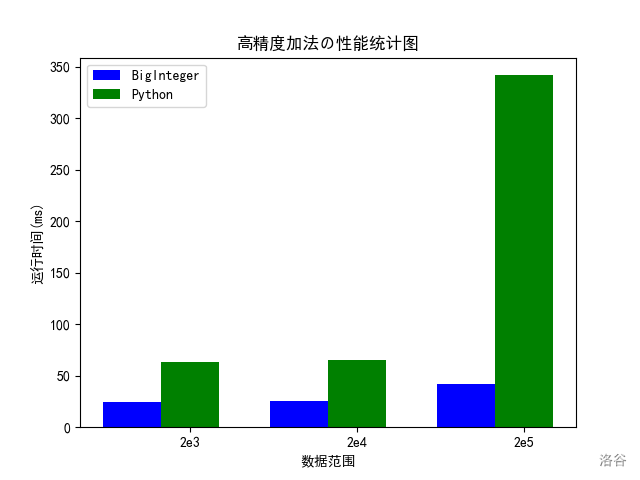
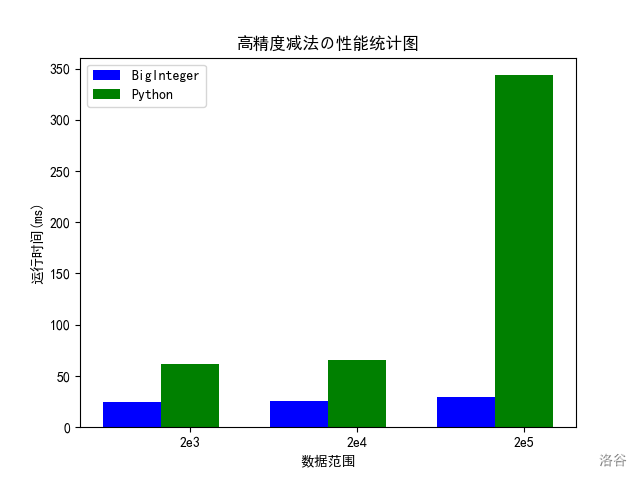
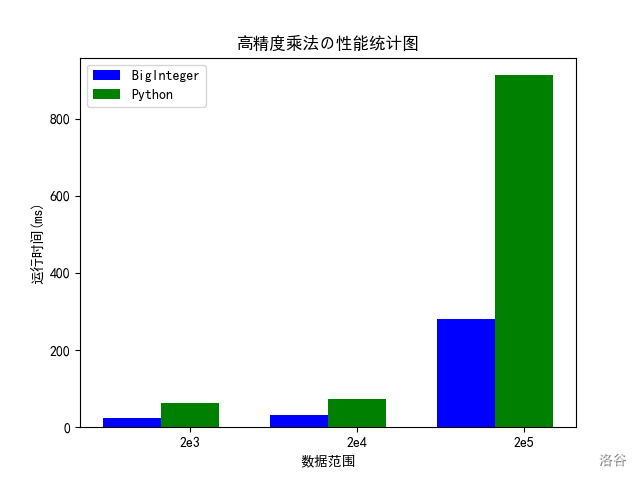
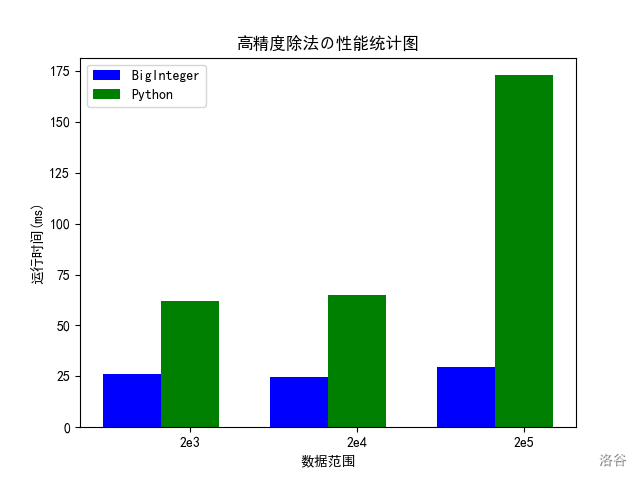
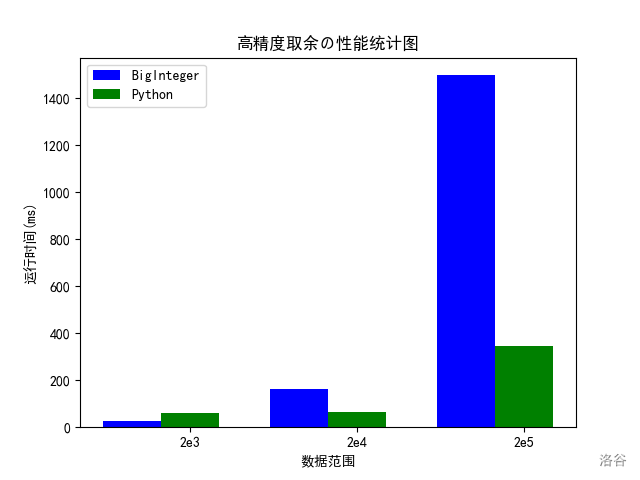
附上性能测试代码:
//对拍&测试
#include <bits/stdc++.h>
#include <windows.h>
using namespace std;

random_device rd;
mt19937 ran(rd());

const int DATA = 2e4;

void gen() {
	int n = ran() % DATA;
	putchar((ran() % 9 + 1) ^ 48);
	for (int i = 1; i < n; i++) {
		putchar((ran() % 10) ^ 48);
	}
	putchar(' ');
	putchar((ran() % 9 + 1) ^ 48);
	for (int i = 1; i < n; i++) {
		putchar((ran() % 10) ^ 48);
	}
}

double aaa, bbb;
#define _begin aaa = clock()
#define _end bbb = clock()
#define _time (bbb - aaa)

int main() {
	freopen("result/result-2e4-div.csv", "w", stderr);
	cerr << "State,Python-time,BigInteger-time" << endl;
	int T = 1000;
	while (T--) {
		freopen("data.in", "w", stdout);
		gen();
		freopen("details.out", "w", stdout);

		_begin; system("python std.py"); _end;
		double py = _time;
		_begin; system("BigInteger.exe < data.in > biginteger.out"); _end;
		double big = _time;

		if (system("fc py.out biginteger.out")) {
			cerr << "WA,0.0,0.0" << endl;
			break;
		}

		cerr << "AC," << py << "," << big << endl;
	}
	return 0;
}# 画图
import matplotlib.pyplot as plt
plt.rcParams['font.sans-serif'] = ['SimHei']
NAME = ['add', 'sub', 'div', 'mul', 'mod']
FILE = 'result-{data}-{name}.csv'
DATA = ['2e3', '2e4', '2e5']
from collections import defaultdict
import numpy as np
k = defaultdict(list)
for n in NAME:
for d in DATA:
f = FILE.replace('{data}', d).replace('{name}', n)
with open(f, 'r', encoding='utf-8') as fp:
c = fp.read()
a = c.split('\n')[1001]
x, y = map(float, a.split(',')[1:])
k[n].append([x, y])
K = 'mod'
xtick = ['2e3', '2e4', '2e5']
py = np.array([i[0] for i in k[K]])
big = np.array([i[1] for i in k[K]])
print(x, py, big)
n_groups = 3
index = np.arange(n_groups)
bar_width = 0.35
r1 = plt.bar(index, big, bar_width, color='b', label='BigInteger')
r2 = plt.bar(index + bar_width, py, bar_width, color='g', label='Python')
plt.title('高精度取余の性能统计图')
plt.xlabel('数据范围')
plt.ylabel('运行时间(ms)')
plt.xticks(index + bar_width, xtick)
plt.legend(loc='upper left')
plt.show()以及高精板子题的测试结果作为参考(测试点平均运行时间/最大运行时间):
| 题目 | 平均运行时间/ms | 最大运行时间/ms |
|---|---|---|
| P1601 (加法) | 3.4 | 4 |
| P2142 (减法) | 3.6 | 4 |
| P1303 (朴素乘法) | 3.0 | 3 |
| P1919 (FFT) | 915.0 | 948 |
| P1480 (高精除单精) | 3.0 | 3 |
| P2005 (高精除高精) | 194.5 | 727 |
| P1932 (全套) | 75.7 | 481 |
大模板
400 行,写了半个月。
#ifndef BIGINTEGER_H
#define BIGINTEGER_H

#include <vector>
#include <string>
#include <climits>
#include <iomanip>
#include <sstream>

#ifndef BIGINTEGER_DISABLE_FFTMUL

#include <cmath>
namespace BigInteger_FFT {
	const double PI = std::acos(-1.0);

	class complex {
	public:
		double real, imag;

		complex(double x = 0.0, double y = 0.0) : real(x), imag(y) {}

		complex operator + (const complex& other) const {
			return complex(real + other.real, imag + other.imag);
		}
		complex operator - (const complex& other) const {
			return complex(real - other.real, imag - other.imag);
		}
		complex operator * (const complex& other) const {
			return complex(real * other.real - imag * other.imag, real * other.imag + other.real * imag);
		}
	};

	std::vector<complex> f, g;

	void fft(std::vector<complex>& a, int len, double type) {
		if (len == 1) return;
		std::vector<complex> fl((len >> 1) + 1), fr((len >> 1) + 1);
		for (int i = 0; i <= len; i++) {
			if (i & 1) fr[i >> 1] = a[i];
			else fl[i >> 1] = a[i];
		}
		fft(fl, len >> 1, type), fft(fr, len >> 1, type);
		complex w1 = complex(cos(2.0 * PI / len), sin(2.0 * PI / len) * type), w = complex(1.0, 0.0);
		for (int i = 0; i < (len >> 1); i++, w = w * w1) {
			a[i] = fl[i] + fr[i] * w;
			a[i + (len >> 1)] = fl[i] - fr[i] * w;
		}
	}

	std::vector<int> mul(const std::vector<int>& a, const std::vector<int>& b) {
		int n = a.size() - 1, m = b.size() - 1;
		int len = 1;
		while (len <= n + m) len <<= 1;
		f.clear(), f.resize(len + 1);
		g.clear(), g.resize(len + 1);
		for (int i = 0; i <= n; i++) f[i] = complex(a[i], 0.0);
		for (int i = 0; i <= m; i++) g[i] = complex(b[i], 0.0);

		fft(f, len, 1.0), fft(g, len, 1.0);
		for (int i = 0; i <= len; i++) f[i] = f[i] * g[i];
		fft(f, len, -1.0);

		std::vector<int> res;
		res.reserve(n + m + 1);
		for (int i = 0; i <= n + m; i++) res.emplace_back(f[i].real / len + 0.5);
		return res;
	}
} // namespace BigInteger_FFT

#endif // BIGINTEGER_DISABLE_FFTMUL

class BigInteger {
private:
	using digit_t = long long;

	static const int WIDTH = 8;
	static const digit_t BASE = 1e8;
	static const long long FFT_LIMIT = 65536;
	//static const long long NEWTON_LIMIT = 65536;

	std::vector<digit_t> digits;
	bool sign;

	int compare(const BigInteger& x) const {
		if (sign && !x.sign) return 1;
		if (!sign && x.sign) return -1;
		if (iszero() && x.iszero()) return 0;

		if (iszero()) return x.sign ^ 1;
		if (x.iszero()) return sign;

		int sgn = (sign && x.sign ? 1 : -1);
		if (digits.size() > x.digits.size()) return sgn;
		if (digits.size() < x.digits.size()) return sgn ^ 1;

		for (int i = digits.size() - 1; i >= 0; i--) {
			if (digits[i] > x.digits[i]) return sgn;
			if (digits[i] < x.digits[i]) return sgn ^ 1;
		}
		return 0;
	}

#ifndef BIGINTEGER_DISABLE_FFTMUL
	BigInteger fft_mul(const BigInteger& other) const {
		std::string astr = to_str(), bstr = other.to_str();
		int n = astr.size() - 1, m = bstr.size() - 1;
		std::vector<int> a, b;
		a.resize(n + 1), b.resize(m + 1);
		for (int i = 0; i <= n; i++) a[n - i] = astr[i] ^ 48;
		for (int i = 0; i <= m; i++) b[m - i] = bstr[i] ^ 48;

		std::vector<int> mul = BigInteger_FFT::mul(a, b);
		int lim = mul.size() - 1;
		for (int i = 0; i < lim; i++) mul[i + 1] += mul[i] / 10, mul[i] %= 10;
		for (; mul[lim]; lim++) mul.emplace_back(mul[lim] / 10), mul[lim] %= 10;

		std::string s;
		s.reserve(lim);
		for (int i = lim - 1; i >= 0; i--) s.push_back(mul[i] ^ 48);
		BigInteger res(s);
		res.sign = !(sign ^ other.sign);
		return res;
	}
#endif // BIGINTEGER_DISABLE_FFTMUL

public:
	BigInteger() : sign(true) {}
	BigInteger(const std::string& s)  {*this = s;}
	BigInteger(const long long& x)  {*this = x;}
	BigInteger(const BigInteger& x) {*this = x;}

	void clear() {sign = true, digits.clear();}
	void reserve(std::size_t k) {digits.reserve(k);}

	BigInteger& operator = (const std::string& s) {
		digits.clear(), sign = true;
		if (s.size() == 0) return *this;
		if (s == "-") return *this;
		int i = 0;
		if (s[0] == '-') sign = false, i++;
		digits.reserve(s.size() / WIDTH + 1);
		for (int j = s.size() - 1; j >= i; j -= WIDTH) {
			int start = std::max(i, j - WIDTH + 1), len = j - start + 1;
			digits.emplace_back(std::stoi(s.substr(start, len)));
		}
		if (digits.size() == 1 && digits[0] == 0) digits.pop_back(), sign = true;
		return *this;
	}
	BigInteger& operator = (const long long& x) {
		digits.clear(), sign = (x >= 0);
		if (x == 0) return *this;
		if (x == LONG_LONG_MIN) return *this = "-9223372036854775808";
		long long n = (x < 0 ? -x : x);
		do {
			digits.emplace_back(n % BASE);
			n /= BASE;
		} while (n);
		return *this;
	}
	BigInteger& operator = (const BigInteger& x) = default;
	~BigInteger() = default;

	friend std::ostream& operator << (std::ostream& out, const BigInteger& x) {
		if (x.digits.empty()) {out << 0; return out;}
		if (!x.sign) out << '-';

		out << x.digits.back();
		for (int i = x.digits.size() - 2; i >= 0; i--) out << std::setw(WIDTH) << std::setfill('0') << x.digits[i];
		return out;
	}
	friend std::istream& operator >> (std::istream& in, BigInteger& x) {
		std::string s; in >> s; x = s; return in;
	}

	std::string to_str() const {
		std::stringstream ss;
		ss << *this;
		return ss.str();
	}
	std::vector<int> to_vint() const {
		if (iszero()) return {0};
		std::string str = to_str();
		std::vector<int> res(str.size());
		for (int i = str[0] == '-' ? 1 : 0;
			i < (int) str.size(); i++) res[i] = str[i] ^ 48;
		return res;
	}

	BigInteger abs() const {
		BigInteger res = *this; res.sign = true; return res;
	}
	BigInteger operator - () const {
		BigInteger res = *this; res.sign = sign ^ 1; return res;
	}
	bool iszero() const {
		return digits.empty() || (digits.size() == 1 && digits.back() == 0);
	}

	BigInteger mul2() const {
		BigInteger res;
		int n = digits.size();
		res.digits.resize(n + 1);
		for (int i = 0; i < n; i++) {
			res.digits[i] = digits[i] << 1;
			if (i != 0 && res.digits[i - 1] >= BASE) {
				res.digits[i - 1] -= BASE;
				res.digits[i]++;
			}
		}
		while (!res.digits.empty() && res.digits.back() == 0) res.digits.pop_back();
		return res;
	}
	BigInteger div2() const {
		BigInteger res = *this;
		int n = digits.size();
		for (int i = n - 1; i >= 0; i--) {
			if (i > 0 && (res.digits[i] & 1)) res.digits[i - 1] += BASE;
			res.digits[i] >>= 1;
		}
		while (!res.digits.empty() && res.digits.back() == 0) res.digits.pop_back();
		return res;
	}

	bool operator < (const BigInteger& x) const {return compare(x) < 0;}
	bool operator > (const BigInteger& x) const {return compare(x) > 0;}
	bool operator == (const BigInteger& x) const {return compare(x) == 0;}
	bool operator != (const BigInteger& x) const {return compare(x) != 0;}
	bool operator <= (const BigInteger& x) const {return compare(x) <= 0;}
	bool operator >= (const BigInteger& x) const {return compare(x) >= 0;}

	BigInteger operator + (const BigInteger& x) const {
		if (sign && !x.sign) return *this - x.abs();
		if (!sign && x.sign) return x - abs();
		BigInteger res;
		res.sign = !(sign ^ x.sign);
		digit_t carry = 0;
		int n = std::max(digits.size(), x.digits.size()) + 1;
		res.digits.reserve(n);
		for (int i = 0; i < n; i++) {
			digit_t d1 = i < (int) digits.size() ? digits[i] : 0,
			d2 = i < (int) x.digits.size() ? x.digits[i] : 0;
			res.digits.emplace_back(d1 + d2 + carry);
			carry = res.digits[i] / BASE;
			res.digits[i] %= BASE;
		}
		while (!res.digits.empty() && res.digits.back() == 0) res.digits.pop_back();
		return res;
	}

	BigInteger operator - (const BigInteger& x) const {
		if (!x.sign) return *this + x.abs();
		if (!sign) return -(*this + x);
		BigInteger res;
		if (*this < x) res.sign = false;
		digit_t carry = 0;
		int n = std::max(digits.size(), x.digits.size());
		res.digits.reserve(n);
		for (int i = 0; i < n; i++) {
			digit_t d1 = i < (int) digits.size() ? digits[i] : 0,
			d2 = i < (int) x.digits.size() ? x.digits[i] : 0;
			if (res.sign) res.digits.emplace_back(d1 - d2 - carry);
			else res.digits.emplace_back(d2 - d1 - carry);
			if (res.digits[i] < 0) res.digits[i] += BASE, carry = 1;
			else carry = 0;
		}
		while (!res.digits.empty() && res.digits.back() == 0) res.digits.pop_back();
		return res;
	}

	BigInteger operator ++ () {return *this = *this + 1LL;}
	BigInteger operator -- () {return *this = *this - 1LL;}

	BigInteger operator * (const BigInteger& x) const {
		if (iszero() || x.iszero()) return BigInteger(0);
		int n = digits.size(), m = x.digits.size();
#ifndef BIGINTEGER_DISABLE_FFTMUL
		if ((long long) n * m >= FFT_LIMIT) return fft_mul(x);
#endif

		BigInteger res;
		res.sign = !(sign ^ x.sign);
		res.digits.resize(n + m + 2);
		for (int i = 0; i < n; i++) {
			for (int j = 0; j < m; j++) {
				res.digits[i + j] += digits[i] * x.digits[j];
				res.digits[i + j + 1] += res.digits[i + j] / BASE;
				res.digits[i + j] %= BASE;
			}
		}
		for (int i = 0; i <= n + m; i++) {
			res.digits[i + 1] += res.digits[i] / BASE;
			res.digits[i] %= BASE;
		}
		while (!res.digits.empty() && res.digits.back() == 0) res.digits.pop_back();
		return res;
	}

	BigInteger operator * (const int& x) const {
		if (x >= BASE * 10) return *this * BigInteger(x);

		BigInteger res;
		res.sign = !(sign ^ (x >= 0));
		int c = x >= 0 ? x : -x;
		int n = digits.size();
		res.digits.resize(n + 1);
		for (int i = 0; i < n; i++) {
			res.digits[i] = digits[i] * c;
			if (res.digits[i] >= BASE) {
				res.digits[i + 1] += res.digits[i] / BASE;
				res.digits[i] %= BASE;
			}
		}
		while (!res.digits.empty() && res.digits.back() == 0) res.digits.pop_back();
		return res;
	}

	BigInteger operator / (const long long& x) const {
		if (x == 0) throw -1;
		if (iszero()) return BigInteger(0);
		BigInteger res;
		res.sign = !(sign ^ (x >= 0));

		digit_t cur = 0, div = x >= 0 ? x : -x;
		int n = digits.size();
		res.digits.resize(n);
		for (int i = n - 1; i >= 0; i--) {
			cur = cur * BASE + digits[i];
			res.digits[i] = cur / div;
			cur %= div;
		}
		while (!res.digits.empty() && res.digits.back() == 0) res.digits.pop_back();
		return res;
	}

	BigInteger operator / (const BigInteger& x) const {
		bool sgn = !(sign ^ x.sign);
		if (x == *this) return sgn ? 1 : -1;
		if (x > *this) return 0;
		BigInteger a = abs(), b = x.abs();
		int n = a.digits.size(), m = b.digits.size();
		BigInteger l = pow_base(std::max(0, n - m - 1)),
		           r = std::min(pow_base(n - m + 1), *this);
		while (l <= r) {
			BigInteger mid = (l + r).div2();
			BigInteger now = mid * b;
			if (now <= a && now + b > a) {
				mid.sign = sgn;
				return mid;
			}
			if (now > a) r = mid - 1;
			else l = mid + 1;
		}
		l.sign = sgn;
		return l;
	}
	BigInteger operator % (const BigInteger& x) const {
		BigInteger c = *this / x * x;
		return *this - c;
	}

	BigInteger pow(const BigInteger& x) const {
		BigInteger res(1);
		BigInteger a = *this, b = x;
		for (; !b.iszero(); b = b.div2()) {
			if (b.mod2()) res *= a;
			a *= a;
		}
		return res;
	}
	BigInteger pow(const BigInteger& x, const BigInteger& p) const {
		BigInteger res(1);
		BigInteger a = *this, b = x;
		for (; !b.iszero(); b = b.div2()) {
			if (b.mod2()) res = res * a % p;
			a = a * a % p;
		}
		return res % p;
	}

	static BigInteger pow_base(const BigInteger& x) {
		BigInteger t; t = t.BASE;
		return t.pow(x);
	}

	int mod2() {
		if (iszero()) return 0;
		return digits[0] & 1;
	}

	long long log2() const {
		BigInteger two(2);
		for (long long res = 0; ; res <<= 1)
			if (two.pow(res) > *this) return res - 1;
		return -1;
	}
	BigInteger sqrt() const {
		if (*this < 0) throw -1;
		BigInteger x = *this;
		if (x <= 1) return x;
		BigInteger l = 1, r = x, res = 0;
		while (l <= r) {
			BigInteger mid = (l + r).div2();
			if (mid * mid <= x) l = mid + 1, res = mid;
			else r = mid - 1;
		}
		return res;
	}

	BigInteger& operator += (const BigInteger& x) {return *this = *this + x;}
	BigInteger& operator -= (const BigInteger& x) {return *this = *this - x;}
	BigInteger& operator *= (const BigInteger& x) {return *this = *this * x;}
	BigInteger& operator /= (const BigInteger& x) {return *this = *this / x;}
	BigInteger& operator %= (const BigInteger& x) {return *this = *this % x;}

	BigInteger& operator *= (const int& x) {return *this = *this * x;}
	BigInteger& operator /= (const long long& x) {return *this = *this / x;}
};

#endif //BIGINTEGER_H