
ABC197F
前言
update 24/5/28:添加前言部分,修改 bfs 部分代码定义问题,增加 vis 数组的定义及作用。
分析
从头开始分析一遍。
回文串要满足头对头,尾对尾的特性,并且题目要求以 开始, 节点结尾。加上要求最短路,我们就可以使用广搜进行处理。
思路
广搜是从 节点和 节点开始搜索,如果发现以 与 为出发节点的两条边 颜色相同时,就继续搜索。于是 bfs 程序就是这样的:
const int N = 1e3 + 5;
struct O {
	int u;// 节点编号
	char r;// 节点颜色
};
vector<O> g[N];// vector存图
struct node {
	int front;// 从1出发的搜索路线
	int end;// 从n出发的搜索路线
	int stp;// 搜索步数
};
int n, m;// 如题

bool cg[N][N];// 邻接表存图
bool vis[N][N];// rtj

void bfs() {
	queue<node> q;
	q.push({1, n, 0});
	while(!q.empty()) {
		node t = q.front();
		q.pop();
		int s = t.stp + 1;
		for(auto x : g[t.front]) {
			for(auto y : g[t.end]) {
				if(x.r == y.r && !vis[x.u][y.u]) { // 是同一个颜色
					vis[x.u][y.u] = 1;
					q.push(node {x.u, y.u, s});
				}
			}
		}
	}
}其中,node 数据结构的定义比较讲究。懂的人知道是双端广搜,不懂的人像我一样就当是普通的广搜就好了。front 表示从 开始搜索的路线 的末端点(通俗的讲就是搜到哪了),end 表示从 开始搜索的路线 的末端点。stp 表示从两端开始搜的步数。
关于 vis 数组的设定,我们发现当左端搜索路线和右端搜索路线已经重复时,肯定已经处理过了,所以要保证搜索路线最短(因为是 bfs),就不用再重复搜索。
里面的 vis[x][y] 数组表示点 和点 有没有同时作为结尾搜索过。所以,对于搜索,一共有 个点。
再来考虑答案。看这个图:
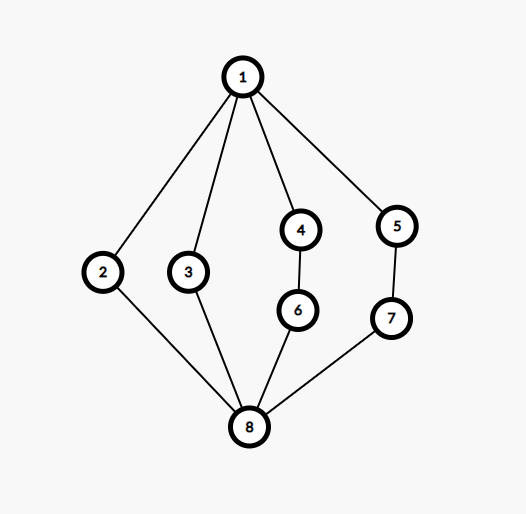
其中,。
很显然,对于左边,当从 和 开始搜索搜到同一个点时,它肯定是一个答案。对于右边,我们发现当步数为奇时,front 与 end 连通也是一种情况。
所以就有了答案判断:
if(t.front == t.end)	ans = min(ans, t.stp * 2);
if(cg[t.front][t.end])	ans = min(ans, t.stp * 2 + 1);
cg[x][y] 是邻接表存图法。
时间复杂度
对于思路,肯定不难想,也最多只有绿的难度。真正的时间复杂度证明才让题目成了蓝题。
设 表示 的出边, 时间复杂度暂设 。
所以,这题的时间复杂度就是 了。
Code
#include <bits/stdc++.h>
using namespace std;
const int N = 1e3 + 5;
struct O {
	int u;// 节点
	char r;// 颜色
};
struct node {
	int front;// rtj
	int end;
	int stp;
};

int n, m;
vector<O> g[N];// vector存图
bool cg[N][N];// 邻接表
bool vis[N][N];
int ans = INT_MAX;

void bfs() {
	queue<node> q;
	q.push({1, n, 0});
	while(!q.empty()) {
		node t = q.front();
		q.pop();
		if(t.front == t.end)	ans = min(ans, t.stp * 2);
		if(cg[t.front][t.end])	ans = min(ans, t.stp * 2 + 1);
		int s = t.stp + 1;
		for(auto x : g[t.front]) {
			for(auto y : g[t.end]) {
				if(x.r == y.r && !vis[x.u][y.u]) { // 是同一个颜色
					vis[x.u][y.u] = 1;
					q.push(node {x.u, y.u, s});
				}
			}
		}
	}
}

int main() {
	cin>>n>>m;
	for(int i = 1; i <= m; i++) {
		int x, y;
		char r;
		cin>>x>>y>>r;
		g[x].push_back({y,r});
		g[y].push_back({x,r});
		cg[x][y] = cg[y][x] = 1;
	}
	bfs();
	if(ans == INT_MAX)	cout<<-1;
	else cout<<ans<<"\n";
	return 0;
}
关于 c++ 的 auto 语法,可以自行百度一下。