
Unit 1 - Kinematics: Lab 1 Determining Acceleration
Guiding Question:
How can you determine the acceleration of an object using only measurable quantities?
Objective:
Design an experiment to determine acceleration using linearization.
I. Experiment Design:
Material List:
Definitions:
- : Height of the drop on this specific trial, decreases from meters down to meter on an interval of centimeters every time.
- : Current trial number, starts from and increases by up to .
Procedures:
- Stack the two meter sticks one on top of the other against the wall so that the top of the second meter stick is exactly meters from the ground.
- For each trial:
- Hold the marble at precisely (unit: meters) using the meter sticks markings as a reference.
- Drop the marble and simultaneously start the timer, stop the timer when the ball reaches the ground.
- Copy down the recorded time on the data table on trial number .
- Stop the experiment stage if . If not, increase by and move on to the next trial.
II. Variables & Linearization Plan:
-
Independent Variable:
at which the ball is dropped.
-
Dependent Variable:
taken for the ball reaches a certain point.
-
Control variable:
The (surface area, surface roughness, things that change coefficient of air friction, etc…), the (compared to ground).
-
Linearization Strategy:
Express time as time squared (unit ) since acceleration is measured as .
-
Slope Meaning:
- Slope = Rise/Run
- Rise (-axis: distance traveled): (unit: m), since
- Run (-axis: time): (unit: )
- Slope =
III. Data Table:
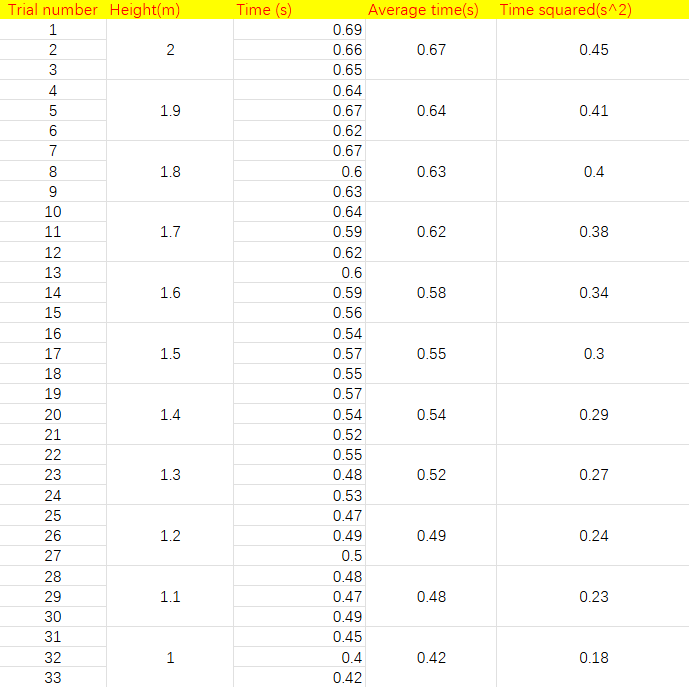
Disclaimer: This is made entirely by hand by Harry Wang using markdown, no AI involved!