
图是强联通图,因此对于两点 有路径 和 。
考虑我们连额外边的时候,
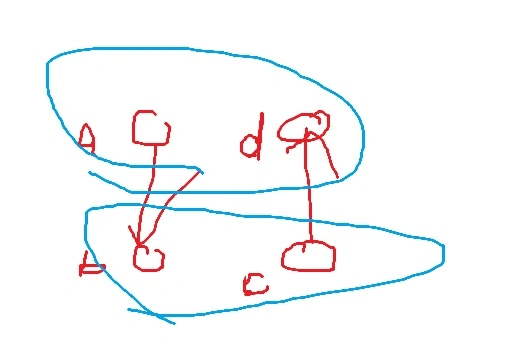
如图上,因为 之间一定有路径, 之间一定有路径所以此时一定会形成一个环。
怎样快速判断?首先想一下如何快速确定两点之间距离。
- 距离 才有用。
- 考虑固定一个点(比如 号点),一对
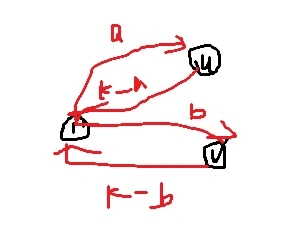
如图上,可以得出 。
设 为 。
接下来,可以就可以得出对于第一个图,要求为:
那么也就是说,所有的两个图间建的同向边 有 相等。
设 ,那么 。
统计数组 , 表示有多少个 。
可以同时算出 。
然后对其做哈希匹配。
对于一对需要形如 匹配的 ,需要满足:
也就是说在 固定的时候对于 的每一个值(设为 )有图一 的个数等于图二 的个数。
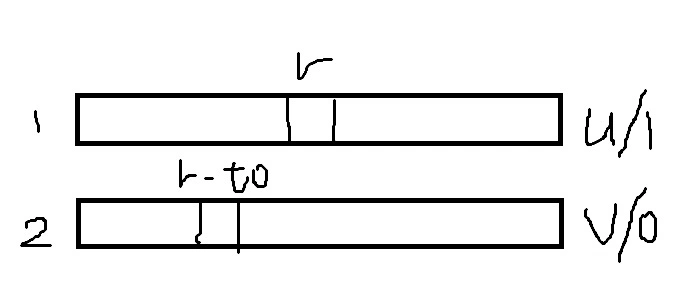
所以应该是把 右移 次和 做匹配。对于两个方向的边都是这样,因为对称, 可以直接推出。
#include<bits/stdc++.h>
#define ull unsigned long long
#define ul unsigned int
using namespace std;
const int N = 200010;
const ul bs = 13331;
int n, k, tp[2][N], w[2][N], cnt[2][2][N];
vector <int> g[2][N];
bool vis[N];
struct node{
	ull a;ul b;
	bool operator == (const node &s)const{
		return (a == s.a) && (b == s.b);
	}
	node operator * (const ul &v)const{
		return {a * v, b * v};
	}
	node operator * (const node &s)const{
		return {a * s.a, b * s.b};
	}
	node operator + (const node &s)const{
		return {a + s.a, b + s.b};
	}
	node operator + (const ul &v)const{
		return {a + v, b + v};
	}
	node operator - (const node &s)const{
		return {a - s.a, b - s.b};
	}
}h[2][2][N], mi[N];
void bfs(bool t){
	queue <int> q;
	for(int i = 1;i <= n;i++){
		vis[i] = 0;
	}
	vis[1] = 1;
	q.push(1);
	while(!q.empty()){
		int p = q.front();
		q.pop();
		for(auto x : g[t][p]){
			if(vis[x])continue;
			w[t][x] = (w[t][p] + 1) % k;
			q.push(x);vis[x] = 1;
		}
	}
	for(int i = 1;i <= n;i++){
		cnt[t][tp[t][i]][w[t][i]]++;
	}
}
node get_v(bool t0, bool t1, int x){
	// x 在前
	node v0 = h[t0][t1][k] - h[t0][t1][k - x] * mi[x];
	// k - x 在后
	node v1 = h[t0][t1][k - x];
	return (v0 * mi[k - x] + v1);
}
void solve(){
	scanf("%d%d", &n, &k);
	for(int j = 0;j <= 1;j++){
		for(int i = 1;i <= n;i++){
			scanf("%d", &tp[j][i]);
			w[j][i] = 0, cnt[j][0][i - 1] = 0, cnt[j][1][i - 1] = 0;
			g[j][i].clear();
		}
		int m;
		scanf("%d", &m);
		for(int i = 1;i <= m;i++){
			int x, y;
			scanf("%d%d", &x, &y);
			g[j][x].push_back(y);
		}
		bfs(j);
	}
	int tmp0 = 0, tmp1 = 0;
	for(int i = 1;i <= n;i++){
		tmp0 += (int)tp[0][i];
		tmp1 += (int)tp[1][i];
	}
	if(tmp0 + tmp1 != n){
		printf("NO\n");
		return;
	}
	if(tmp0 == 0 || tmp0 == n){
		printf("YES\n");
		return;
	}
	for(int j0 = 0;j0 <= 1;j0++){
		for(int j1 = 0;j1 <= 1;j1++){
			for(int i = 1;i <= k;i++){
				ul v = cnt[j0][j1][i - 1];
				h[j0][j1][i] = h[j0][j1][i - 1] * bs + v;
//				printf("%d ", h[j0][j1][i].b);
			}
//			printf("\n");
		}
//		printf("\n");
	}
	for(int t0 = 0; t0 < k; t0++){
	    int t1 = ((-2 - t0) % k + k) % k;
//	    printf("%d %d\n", t0, t1);
	    // 图2 outgoing -> 图1 incoming
	    bool ok0 = (h[1][1][k] == get_v(0, 0, t0));
	    // 图1 outgoing -> 图2 incoming
	    bool ok1 = (h[0][1][k] == get_v(1, 0, t1));
	    if(ok0 && ok1){
	        printf("YES\n");
	        return;
	    }
	}
	printf("NO\n");
}
void init(){
	mi[0] = {1, 1};
	for(int i = 1;i <= N - 5;i++){
		mi[i] = mi[i - 1] * bs;
	}
}
int main(){
	int t;init();
	scanf("%d", &t);
	while(t--){
		solve();
	}
	return 0;
}