
Preface
Suggested rating: Yellow.
Problem Statement
Find the global minimum cut of graph .
Analysis
Conclusion first
Proof of the Conclusion
First observe that when there is no nontrivial cut, so the global minimum cut is .
The graph has vertices, numbered .
Simplify
If , then the lower bound for the cut capacity is (because every partition where both sides have size at least 2 contains at least two crossing edges, which can be proved by divisibility). When , we have (equality holds only for ), so the minimum cut must be a single‑vertex cut. For the conclusion can be verified directly.
Graph definition
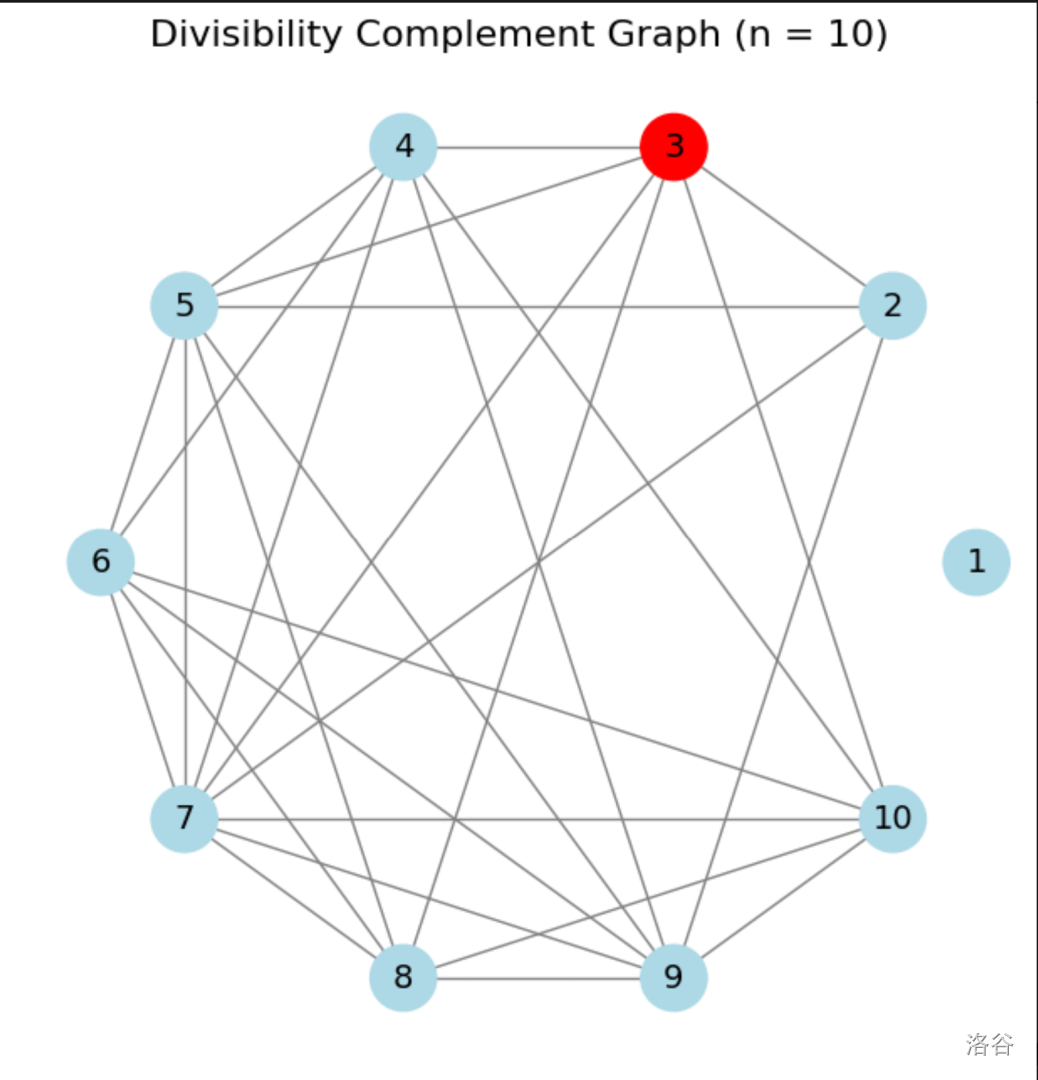
The figure shows the divisibility complement graph for . Vertex is marked in red; the edges between it and other vertices are exactly the candidate minimum cut.
Vertices ; if or , they are not connected.
Degree formula
(It is not connected to multiples of .)
Vertex with minimum degree
decreases as increases vertex has the smallest degree (for ; when it ties with other vertices but this does not affect the conclusion).
Global minimum cut
As shown in the figure:
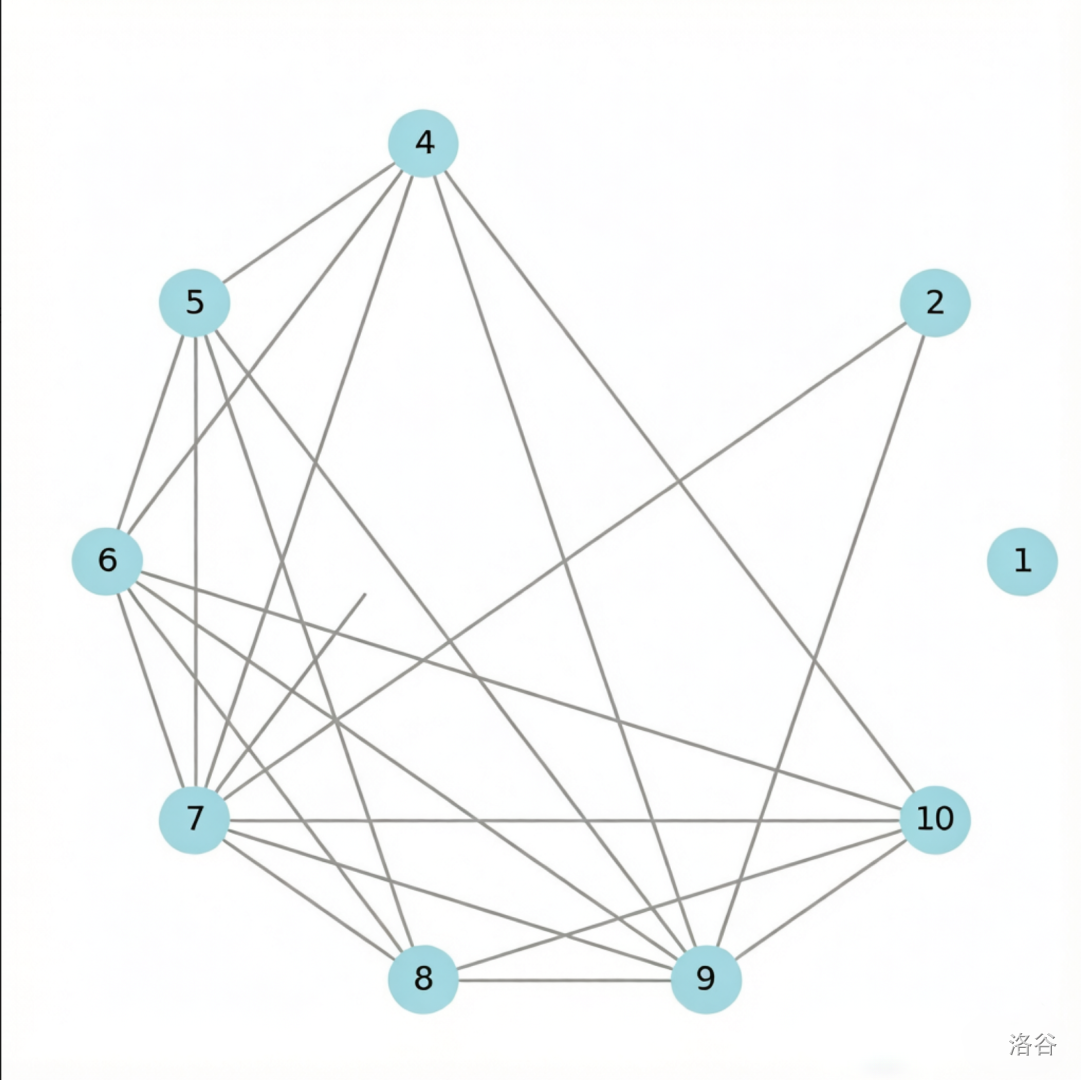 After deleting vertex , the capacity is:
This completes the proof of the conclusion.
Code
#include<bits/stdc++.h>
using namespace std;
long long n;
int main() {
	cin >> n;
	if (n <= 2) cout << 0;
	else cout << n - 2 - n / 3;
	return 0;
}