
0x00 What is Trie?
Actually the word “Trie” is pronounced /tri:/.
“Trie” is short for “reTrieval”(n.search for).It is a tree data structure which can maintain a set of strings, providing a wonderful time complexity of searching a specific pattern in the set by using more(most of the time) space.
0x01 Understanding Trie
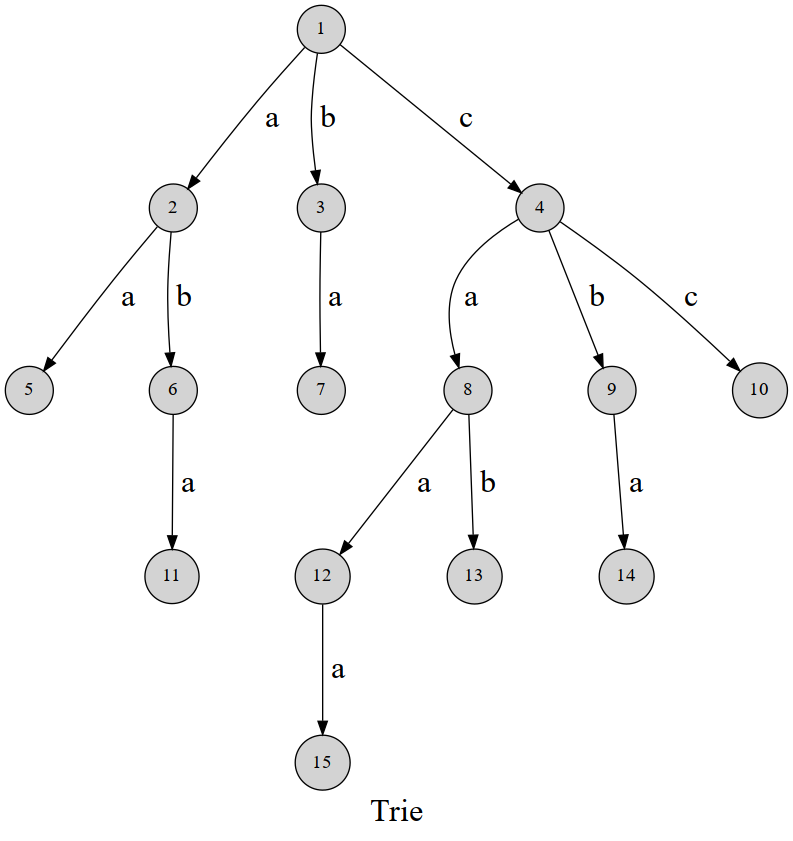
In this trie, we stored:
aa
aba
ba
caaa
cab
cba
cc
When we build a Trie, we merge a “chain of characters” with a Trie already exists, removing duplicated parts of the chains’ prefix.
For example, merging “character” and “challenge”.
character + challenge
cha racter
    llenge
By removing the prefix we can save some space (which sometimes repairs the huge pointer space for each node) , and by putting the characters on the edge we can speed up locating a pattern by locating step by turning each character to an array subscript.This is the key of Trie,
0x02 Writing Trie
By Trie’s definition we can write the following statement:
struct node
{
	int count;
	node* son[26]; //The size of charset as 26
}*root;
In this structure, stands for the amount of words crossing over it, and stands for the characters appears after this node. E.g. for string , node has a son: node . So the son[0] of node should be 1.
We should notice that the size of in each node is , which is very huge, according to the text above.
For adding a new string to the trie, we create a pointer, sequentially access their longest common prefix, and add new nodes to store the rest of the new string.
Here’s the code.
void add(string s)
{
	node *t=root;
   	for(int i=0;i<s.length();i++)
   	{
    		if(t->son[s[i]]!=NULL)
         	{
           		t=t->son[s[i]];
           	}
    		else
            	{
           		t->son[s[i]]=(trie*)malloc(sizeof(struct node));
                	memset(t->son[s[i],0,sizeof(t->son[s[i]]));
              		t=t->son[s[i]];
           	}
            	t.count++;//a new word passing this node

   	}
}
To remove a word from the Trie, we only need to remove 1 from each node’s .
void add(string s)
{
	node *t=root;
   	for(int i=0;i<s.length();i++)
   	{
           	t=t->son[s[i]];
            	t->count--;
   	}
}
In order to try to find whether a pattern exists in the Trie, we sequentially access the nodes in order, return when found and return when failed to search.
int query(string s)
{
    node *t=root;
    for(int i=0;i<s.length();i++)
    {
    	if(!t->son[s[i]])
        	return NULL;
        t=t->son[s[i]];
    }
    return t->count;
}
And also there is a way to implement Trie by simulating linked list by using arrays. Here is the code of AcCoders Contest 4590 A.
#include <bits/stdc++.h>
#define N 1000001
using namespace std;
int trie[N][26],cnt=0;
int tag[N];
void add(string s)
{
	int p=0;
	for(int i=0;i<s.length();i++)
	{
		if(!trie[p][s[i]-'a'])
		{
			trie[p][s[i]-'a']=++cnt;
		}
		p=trie[p][s[i]-'a'];
		//tag[p]++;
	}
	tag[p]++;
}
int query(string s)
{
	int p=0;
	int i;
	for(i=0;i<s.length();i++)
	{
		if(!trie[p][s[i]-'a'])
			return 0;
		p=trie[p][s[i]-'a'];
	}
	return tag[p];
}

int main()
{
	int n;
	cin>>n;
	for(int i=0;i<n;i++)
	{
		string a,b;
		cin>>a>>b;
		if(a=="I") add(b);
		else cout<<query(b)<<endl;
	}
	return 0;
}
0x03 0-1 Trie
0-1 Trie is a special kind of Trie which its charset includes only . By processing 32(64)-bit integers as 0-1 binary strings, the 0-1 Trie can maintain the maximum values in an integer set.
When we two integers, it means we compare their bits, the result is 0 when the same and 1 when not.
For example:
    1100110101
xor 0101111001
=   1001001100
When we want to find the maximum value of an integer with each integers in the set, we only need to reverse it by bits(~ in C++), and access the 0-1 Trie by the reversed value to maximize the result.
Here is the code from AcCoders Contest 4590 C, which asks you to maintain the maximum pair value in a set of integers.
Implemented by arrays.
#include <bits/stdc++.h>
#define N 100001
using namespace std;
int trie[N*32][2],cnt;//Notice that here is N*32.
void add(int k)
{
	int p=0;
	for(int i=31;i>=0;i--)
	{
		bool c=(k>>i)&1;//taking out the bits
		if(!trie[p][c]) trie[p][c]=++cnt;
		p=trie[p][c];
	}
}
int query(int k)
{
	int p=0,ans=0;
	for(int i=31;i>=0;i--)
	{
		bool c=!((k>>i)&1);//reversing by bits.
		if(trie[p][c])
		{
			p=trie[p][c];
			ans=(ans<<1)|1;
		}
		else
		{
			p=trie[p][!c];
			ans<<=1;
		}
	}
	return ans;
}
int main()
{
	int n,a[N];
	cin>>n;
	for(int i=0;i<n;i++)
		cin>>a[i],add(a[i]);
	int ans=INT_MIN;
	for(int i=0;i<n;i++)
		ans=max(ans,query(a[i]));
	cout<<ans;
	return 0;
}