
分成三(四?)个部分。
前言
最近学链分治,感觉难度比较大,想来想去查阅了不少资料搞懂了。想写一篇笔记。
造福后人谈不上吧,就讲讲心得喵。
谨此,与诸君共勉。
重链剖分
约定
- 重儿子:儿子中子树大小最大的所在儿子。
- 轻儿子:不是重儿子的儿子。
- 重边:连向重儿子的边称为重边。
- 轻边:不是重边的边。
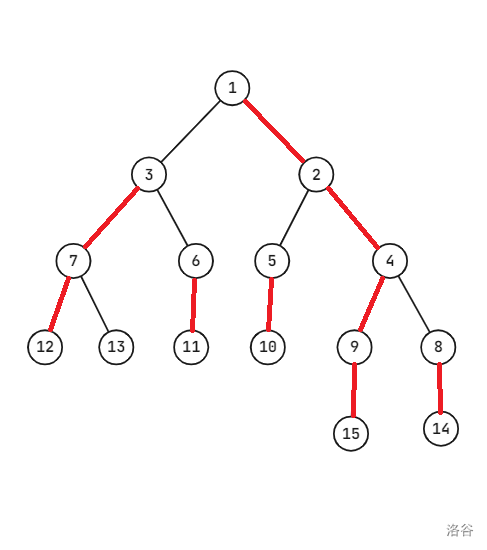
- 重链:全是重边祖先 - 儿子链。
贴一张图:
思想
- 引理 : 子树所有结点的 dfs 序连续,具体的,为 。
proof
简单结论不证了吧。=)
感性理解。
- 引理 :一条路径中的重链条数(也即轻边条数)是 量级的。
proof
一条路径可以拆成 、 两部分,二者又能差分。只需证明祖先连轻边条数是 量级的。
我们假设祖先链上一条 是轻边,因为拥有轻边所以 的儿子数量不少于 ,则 有一个重儿子 满足 。可以推出 。
那么每经过一条轻边子树大小至少会变为 ,而整棵树大小为 ,所以至多经过 条轻边。
先来构想一个问题吧!你需要维护一个树上数据结构,支持树链修改、查询与子树修改、查询。
看看子树修改、查询,放到 dfs 序上,这就是一个区修区查,可以用某数据结构。
再来看树链修改、查询,根据引理 ,可以拆成 条重链,我们为了继续使用某数据结构,希望这些重链的 dfs 序连续。这不难实现,直接每次首先进入重儿子即可。然后每次查询就交替跳即可。
dsu on tree
树上启发式合并。同样,来看一道题。
暴力做法是枚举每一个点并枚举其子树计算占据主导地位的颜色。
我们发现这里有很多部分都被重复计算了,故考虑在做的时候(也可以理解为合并的时候)保留一部分计算答案,即启发式合并。
对于计算结点 的答案,有以下具体步骤:
- 计算 的所有轻儿子的答案,并清空计算过程的变量。
- 计算 的重儿子的答案,并不清空过程中的变量。
- 再次遍历所有 的轻子树,统计答案并合并到尚未清空的重子树答案。
正确性比较好想,最后保留的恰好不重不漏的是 的子树所有结点。时间复杂度 。感兴趣可以看下证明。
proof
其实可以做一个小小的转化。
观察到,每一个点只会被祖先链上的轻边的父亲方向结点计算一次,转化为祖先链轻边数量。
而根据引理 ,祖先链上的轻边数量是 级别的。故而每个点只会计入 次,均摊时间复杂度 。
例题
P3384 【模板】重链剖分 / 树链剖分
模板。远古构式码风,见谅。
#include <bits/stdc++.h>
#define ios                  \
ios::sync_with_stdio(0); \
cin.tie(0);              \
cout.tie(0)
// #pragma GCC optimize(2)
#define int long long
#define pll pair<ll, ll>
#define pii pair<int, int>
#define il inline
#define p_q priority_queue
#define u_m unordered_map
#define r_g register
#define NR Nothing::read
#define NW Nothing::write
#define endl '\n'
using namespace std;

namespace Nothing {}  // namespace Nothing

const int Maxn = 1000005;

int a[Maxn], tmp[Maxn];
int p;

struct SegmentTree {
#define ls (id << 1)
#define rs (id << 1 | 1)
	struct Segment {
		int Left;
		int Right;
		int valMax;
		int tag;
		int valSum;
	} seg[Maxn << 2];
	il void PushUp(int id) {
		seg[id].valMax = max(seg[ls].valMax, seg[rs].valMax) % p;
		seg[id].valSum = (seg[ls].valSum + seg[rs].valSum) % p;
		return;
	}
	il void PushDown(int id) {
		if (seg[id].tag) {
			seg[ls].tag += seg[id].tag;
			seg[ls].tag %= p;
			seg[ls].valSum += seg[id].tag * (seg[ls].Right - seg[ls].Left + 1);
			seg[ls].valSum %= p;
			seg[rs].tag += seg[id].tag;
			seg[rs].tag %= p;
			seg[rs].valSum += seg[id].tag * (seg[rs].Right - seg[rs].Left + 1);
			seg[rs].valSum %= p;
			seg[id].tag = 0;
		}
		return;
	}
	il void Build(int id, int Left, int Right) {
		seg[id] = {Left, Right, 0, 0, 0};
		if (Left == Right) {
			seg[id].valMax = a[Left] % p;
			seg[id].valSum = a[Left] % p;
			return;
		}
		int mid = (Left + Right) >> 1;
		Build(ls, Left, mid);
		Build(rs, mid + 1, Right);
		PushUp(id);
		return;
	}
	il int QuerySum(int id, int Left, int Right) {
		PushDown(id);
		if (seg[id].Right < Left || seg[id].Left > Right) {
			return 0;
		}
		if (Left <= seg[id].Left && seg[id].Right <= Right) {
			return seg[id].valSum % p;
		}
		return (QuerySum(ls, Left, Right) + QuerySum(rs, Left, Right)) % p;
	}
	il void Change(int id, int Left, int Right, int val) {
		PushDown(id);
		if (seg[id].Right < Left || seg[id].Left > Right) {
			return;
		}
		if (seg[id].Left >= Left && Right >= seg[id].Right) {
			seg[id].tag += val;
			seg[id].tag %= p;
			seg[id].valSum += val * (seg[id].Right - seg[id].Left + 1) % p;
			seg[id].valSum %= p;
			return;
		}
		Change(ls, Left, Right, val);
		Change(rs, Left, Right, val);
		PushUp(id);
		return;
	}
};

vector<int> G[Maxn];
int n, m, root;

struct Qtree {
	struct treeNode {
		int fa;
		int son;
		int dep;
		int size;
		int top;
		int tid;
	} tn[Maxn];
	SegmentTree SEG;
	int tot = 0;
	void dfs1(int step, int fa) {
		tn[step].fa = fa;
		tn[step].dep = tn[fa].dep + 1;
		tn[step].size = 1;
		int Max = 0;
		for (auto x : G[step]) {
			if (x == fa) {
				continue;
			}
			dfs1(x, step);
			tn[step].size += tn[x].size;
			if (tn[x].size > Max) {
				Max = tn[x].size;
				tn[step].son = x;
			}
		}
		return;
	}
	void dfs2(int step, int top) {
		tn[step].top = top;
		tn[step].tid = ++tot;
		a[tot] = tmp[step];
		if (tn[step].son)
			dfs2(tn[step].son, top);
		for (auto x : G[step]) {
			if (x == tn[step].fa || x == tn[step].son) {
				continue;
			}
			dfs2(x, x);
		}
	}
	void Build() {
		dfs1(root, 0);
		dfs2(root, root);
		SEG.Build(1, 1, n);
		return;
	}
	void Change(int u, int v, int w) {
		while (tn[u].top != tn[v].top) {
			if (tn[tn[u].top].dep < tn[tn[v].top].dep) {  // 每次只跳链顶深度更低的,以免跳错(类似爬树法)
				swap(u, v);
			}
			SEG.Change(1, tn[tn[u].top].tid, tn[u].tid, w % p);  // 操作
			u = tn[tn[u].top].fa;  // 跳
		}
		if (tn[u].tid > tn[v].tid) {
			swap(u, v);
		}
		SEG.Change(1, tn[u].tid, tn[v].tid, w % p);  // 位于同一条重链上
		return;
	}
	int QuerySum(int u, int v) {
		int Max = 0;
		while (tn[u].top != tn[v].top) {
			if (tn[tn[u].top].dep < tn[tn[v].top].dep) {
				swap(u, v);
			}
			Max += SEG.QuerySum(1, tn[tn[u].top].tid, tn[u].tid);
			Max %= p;
			u = tn[tn[u].top].fa;
		}
		if (tn[u].tid > tn[v].tid) {
			swap(u, v);
		}
		return Max + SEG.QuerySum(1, tn[u].tid, tn[v].tid);
	}
} Qt;

signed main() {
	ios;
	cin >> n >> m >> root >> p;
	for (int i = 1; i <= n; i++) {
		cin >> tmp[i];
		tmp[i] %= p;
	}
	for (int i = 1; i < n; i++) {
		int x, y;
		cin >> x >> y;
		G[x].push_back(y);
		G[y].push_back(x);
	}
	Qt.Build();
	while (m--) {
		int Type;
		cin >> Type;
		if (Type == 1) {
			int x, y, z;
			cin >> x >> y >> z;
			Qt.Change(x, y, z);
		} else if (Type == 2) {
			int x, y;
			cin >> x >> y;
			cout << Qt.QuerySum(x, y) % p << endl;
		} else if (Type == 3) {
			int x, z;
			cin >> x >> z;
			z %= p;
			Qt.SEG.Change(1, Qt.tn[x].tid, Qt.tn[x].tid + Qt.tn[x].size - 1, z);
		} else {
			int x;
			cin >> x;
			cout << Qt.SEG.QuerySum(1, Qt.tn[x].tid,
			                        Qt.tn[x].tid + Qt.tn[x].size - 1) %
			     p
			     << endl;
		}
	}
	return 0;
}
SP6779 GSS7 - Can you answer these queries VII
题目大意:树链覆盖,树链查最大子段和。
直接用内层线段树维护最大子段和,类似 GSS1,注意一下顺序。
#include <bits/stdc++.h>
#define int long long
#define pii pair<int, int>
#define inf 0x3f3f3f3f3f3f3f3f
#define F(x, v) for (auto x : (v))
#define ALL(x) (x).begin(), (x).end()
#define L(i, a, b) for (register int i = (a); i <= (b); i++)
#define R(i, a, b) for (register int i = (a); i >= (b); i--)
#define FRE(x) freopen(x ".in", "r", stdin), freopen(x ".out", "w", stdout)
using namespace std;

inline int cmax(int& x, int c) { return x = max(x, c); }
inline int cmin(int& x, int c) { return x = min(x, c); }

bool bgmem;
int _test_ = 1, cas;

namespace zrh {
	const int N = 1e5 + 5;
	int n, q, a[N], b[N], dfn[N], tot;
	vector< int > g[N];
	// segment tree
	#define ls (u << 1)
	#define rs (u << 1 | 1)
	struct V {
		int lsu, rsu, msu, sum;
		V() { lsu = rsu = msu = sum = 0; }
		V(int a, int b, int c, int d) { lsu = a, rsu = b, msu = c, sum = d; }
	} tr[N << 2]; int cov[N << 2];
	V operator+(V x, V y) { V ret;
		ret.lsu = max(x.lsu, x.sum + y.lsu);
		ret.rsu = max(y.rsu, y.sum + x.rsu);
		ret.msu = max(max(x.msu, y.msu), x.rsu + y.lsu);
		ret.sum = x.sum + y.sum;
		return ret;
	}
	void up(int u) { tr[u] = tr[ls] + tr[rs]; }
	void modi(int u, int L, int R, int v) {
		tr[u].lsu = tr[u].rsu = tr[u].msu = max(0ll, v * (R - L + 1));
		tr[u].sum = v * (R - L + 1), cov[u] = v;
	}
	void down(int u, int L, int R) {
		if (cov[u] == inf) return;
		int mid = (L + R) >> 1;
		modi(ls, L, mid, cov[u]), modi(rs, mid + 1, R, cov[u]), cov[u] = inf;
	}
	void bui(int u, int L, int R) {
		cov[u] = inf;
		if (L == R) return modi(u, L, R, b[L]);
		int mid = (L + R) >> 1;
		bui(ls, L, mid), bui(rs, mid + 1, R), up(u);
	}
	void cha(int u, int L, int R, int l, int r, int c) {
		if (L > r || R < l) return;
		if (l <= L && R <= r) return modi(u, L, R, c);
		int mid = (L + R) >> 1; down(u, L, R);
		cha(ls, L, mid, l, r, c), cha(rs, mid + 1, R, l, r, c), up(u);
	}
	V que(int u, int L, int R, int l, int r) {
		if (l <= L && R <= r) return tr[u];
		int mid = (L + R) >> 1; down(u, L, R);
		if (r <= mid) return que(ls, L, mid, l, r);
		if (l > mid) return que(rs, mid + 1, R, l, r);
		return que(ls, L, mid, l, mid) + que(rs, mid + 1, R, mid + 1, r);
	}
	// tree divide
	int dep[N], FA[N], top[N], hea[N], siz[N];
	void dfs0(int u, int fa) {
		dep[u] = dep[FA[u] = fa] + 1, siz[u] = 1;
		int mx = 0;
		F(v, g[u]) if (v != fa) {
			dfs0(v, u), siz[u] += siz[v];
			if (mx < siz[v]) mx = siz[v], hea[u] = v;
		}
	}
	void dfs1(int u, int tp) {
		top[u] = tp, dfn[u] = ++tot, b[tot] = a[u];
		if (hea[u]) dfs1(hea[u], tp);
		F(v, g[u]) if (v != FA[u] && v != hea[u]) dfs1(v, v);
	}
	void tdc(int u, int v, int w) {
		while (top[u] != top[v]) {
			if (dep[top[u]] < dep[top[v]]) swap(u, v);
			cha(1, 1, n, dfn[top[u]], dfn[u], w), u = FA[top[u]];
		}
		cha(1, 1, n, min(dfn[u], dfn[v]), max(dfn[u], dfn[v]), w);
	}
	int tdq(int u, int v) {
		V anl, anr;
		while (top[u] != top[v]) {
			if (dep[top[u]] < dep[top[v]]) {
                swap(u, v);
                swap(anl, anr);
			}
			V p = que(1, 1, n, dfn[top[u]], dfn[u]);
			anl = p + anl;
            u = FA[top[u]];
		}
		if (dep[u] > dep[v]) {
            swap(u, v);
            swap(anl, anr);
		}
        swap(anl.lsu, anl.rsu);
		V p = que(1, 1, n, dfn[u], dfn[v]);
		anl = anl + p;
		return (anl + anr).msu;
	}
    void init() {}
    void clear() {}
    void solve() {
		cin >> n; L(i, 1, n) cin >> a[i];
		L(i, 1, n - 1) {
			int u, v; cin >> u >> v;
			g[u].push_back(v), g[v].push_back(u);
		}
		dfs0(1, 0), dfs1(1, 1), bui(1, 1, n);
		cin >> q; L(_, 1, q) {
			int op, u, v, w; cin >> op >> u >> v;
			if (op == 1) cout << tdq(u, v) << "\n";
			else cin >> w, tdc(u, v, w);
		}
	}
}  // namespace zrh

bool edmem;
signed main() {
    ios::sync_with_stdio(0);
    cin.tie(0), cout.tie(0);
    //	cin >> _test_;
    zrh::init();
    while (++cas <= _test_) zrh::clear(), zrh::solve();
    cerr << "memory: " << fabs(&edmem - &bgmem) / 1024 / 1024 << "MB\n";
    cerr << "time  : " << (double)clock() * CLOCKS_PER_SEC / 1000 << "ms\n";
    return 0;
}
一道不知道来源的题目
题目大意:一棵有根树,以 为根。每个点只有一个颜色,请你求出每个点的子树的出现次数最多的颜色。有多个颜色出现次数相同时,输出最小的解。
直接上 dsu on tree,注意遍历顺序。
#include <bits/stdc++.h>
// #define fastio
#define int long long
#define bw(x) (1 << (x))
#define eb emplace_back
#define pii pair<int, int>
#define inf (0x3f3f3f3f3f3f3f3f)
#define F(x, v) for (auto x : (v))
#define ALL(x) (x).begin(), (x).end()
#define L(i, a, b) for (register int i = (a); i <= (b); ++i)
#define R(i, a, b) for (register int i = (a); i >= (b); --i)
#define FRE(i, o) freopen(i, "r", stdin), freopen(o, "w", stdout)
#define debug(a) cerr << "\033[32m[DEBUG] " << #a << " = " << (a) << " at line " << __LINE__ << "\033[0m\n"
using namespace std; bool bgmem;
#ifdef fastio
struct IO {
	#define ion bw(20)
	char i[ion], o[ion], *icl = i, *icr = i, *oc = o;
	char gc() { return (icl == icr && (icr = (icl = i) + fread(i, 1, ion, stdin), icl == icr)) ? EOF : *icl++; }
	void pc(char c) { if (oc - o == ion) fwrite(o, 1, ion, stdout), oc = o; *oc++ = c; }
	void rd(auto &x) { char c; int f = 1; x = 0; while (c = gc(), c < '0' || c > '9') if (c == '-') f = -1; while ('0' <= c && c <= '9') x = (x << 1) + (x << 3) + (c ^ 48), c = gc(); x *= f; }
	void pr(auto x) { int a[64], p = 0; if (x < 0) x = -x, pc('-'); do a[p++] = x % 10; while (x /= 10); while (p--) pc(a[p] + '0'); }
	IO& operator>>(char &c) { return c = gc(), *this; }
	IO& operator<<(char c) { return pc(c), *this; }
	IO& operator<<(const char *c) { while (*c) pc(*c++); return *this; }
	IO& operator>>(auto &x) { return rd(x), *this; }
	IO& operator<<(auto x) { return pr(x), *this; }
} io;
#define cin io
#define cout io
#endif
template < const int P > class modint { public:
	int x;
	modint(int _ = 0) { x = (_ % P + P) % P; }
	explicit operator int() { return x; }
	friend modint operator+(modint x, modint y) { return x.x + y.x < P ? x.x + y.x : x.x + y.x - P; }
	friend modint operator-(modint x, modint y) { return x.x - y.x < 0 ? x.x - y.x + P : x.x - y.x; }
	friend modint operator*(modint x, modint y) { return modint((__int128)(x.x * y.x)); }
	modint& operator+=(modint x) { return (*this) = (*this) + x; }
	modint& operator-=(modint x) { return (*this) = (*this) - x; }
	modint& operator*=(modint x) { return (*this) = (*this) * x; }
};
inline int cmax(int& x, int c) { return x = max(x, c); }
inline int cmin(int& x, int c) { return x = min(x, c); }
int tes = 1, cas;
namespace qwq {
    const int N = 3e5 + 5;
    int n, a[N], tmp[N], dep[N], fa[N], hea[N], siz[N], cnt[N], ans, ret[N]; vector< int > g[N];
    void dfs(int u, int f) {
        fa[u] = f, dep[u] = dep[f] + 1, siz[u] = 1;
        F(v, g[u]) if (v != f) {
            dfs(v, u);
            siz[u] += siz[v];
            if (siz[hea[u]] < siz[v]) hea[u] = v;
        }
    } void sol1(int u, int w, int p = 0) {
        cnt[a[u]] += w;
        if (cnt[a[u]] > cnt[ans]) ans = a[u];
        if (cnt[a[u]] == cnt[ans]) cmin(ans, a[u]);
        F(v, g[u]) if (v != fa[u] && v != p) sol1(v, w, p);
    } void sol2(int u, bool fl) {
        F(v, g[u]) if (v != fa[u] && v != hea[u]) sol2(v, 0);
        if (hea[u]) sol2(hea[u], 1), sol1(u, 1, hea[u]);
        else sol1(u, 1);
        ret[u] = tmp[ans];
        if (!fl) sol1(u, -1), ans = 0;
    }
    void init() {}
    void clear() {}
    void solve() {
        cin >> n; L(i, 1, n) cin >> a[i], tmp[i] = a[i];
        sort(tmp + 1, tmp + n + 1);
        int cnt = unique(tmp + 1, tmp + n + 1) - tmp - 1;
        L(i, 1, n) a[i] = lower_bound(tmp + 1, tmp + cnt + 1, a[i]) - tmp;
        L(i, 1, n - 1) {
            int u, v; cin >> u >> v;
            g[u].eb(v), g[v].eb(u);
        }
        dfs(1, 0), sol2(1, 1);
        L(i, 1, n) cout << ret[i] << "\n";
    }
} bool edmem; signed main() {
    // FRE("", "");
#ifndef fastio
    ios::sync_with_stdio(0), cin.tie(0), cout.tie(0);
#endif
	// cin >> tes;
    qwq::init(); while (++cas <= tes) qwq::clear(), qwq::solve();
#ifdef fastio
	fwrite(io.o, 1, io.oc - io.o, stdout);
#endif
    cerr << "time  : " << (double)clock() / CLOCKS_PER_SEC * 1000 << "ms\n";
    cerr << "memory: " << fabs(&edmem - &bgmem) / 1024 / 1024 << "mb\n";
    return 0;
}
// 其实是不能说来源。qwq
优缺点
优
- 祖先链重链条数优秀, 的量级。对应的可以快速维护树上数据结构题。
- 带一个 倍常数,极小。不知道咋出来的。1
缺
- 你说得对但是加上线段树就是 了,还没 LCT 优秀(不过实际跑起来快多了就是了)。
长链剖分
约定
类似重链剖分,定义长儿子为结点儿子中子树深度最大的那一个。
思想
- 引理 :一个结点祖先中长链条数(也即短边数量)是 量级的。
proof
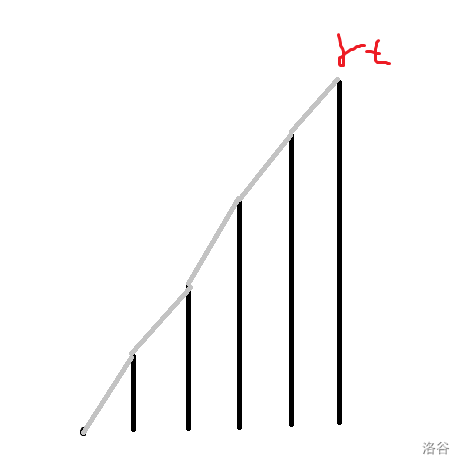
考虑构造一种最坏情况,也即每个短儿子的长链长度都比父亲恰好大 。
显然此时祖先链长链条数最多的是图中右下角的点,设其为 。
满足 ,则 是 量级的。
- 引理 : 的 级祖先所在长链的长度不小于 。
proof
设 的 级祖先是 , 的链顶是 。
,而 到它的子树存在一条不小于 的链,显然 的长链不会小于 。
长链剖分一般用于解决树上 级祖先问题,它以它的查询 复杂度著称。
jzp 曾经说过,这种问题想做到 只能打表。不过先不管这些,先来看常规解法。
倍增,记 为 向上爬 的祖先。
分析一下效率,我们发现第一次倍增就跳了超过 的深度,相当优秀;不过后面的就不那么优秀了。
择其善者,我们同样预处理一个倍增数组,不过每一次只跳一次,假设我们跳了 步从 到达了 。
根据引理 ,我们发现 的链顶 所在长链的长度大于 ,更直接的,大于 。
也就是说 的 级祖先要么在 的路径上,要么在 到 的 级祖先的路径上。
我们只需要对于任意长链,都打一个长度为长链长度的表 代表链顶的 级祖先即可。
时间复杂度 。
广告拓展阅读:树上 k 级祖先。
Splay 的复杂度证明
看到后面就知道为什么要插个这个了。
定义
Splay 是一种旋转平衡树,旨在通过不断旋转保证树的平衡。
因为本文的重点不是 Splay 所以不做多余的解释。
时间复杂度
Splay 的时间复杂度是严格 ,常数大于 SGT,略大于无旋 Treap。
另外由于 Splay 的复杂度均摊,故不支持可持久化。
不严谨的 proof
这很难呐,不想看严谨证明就用一些不那么严谨的语言吧。
打个比方,你可以理解平衡树的根是器材室的门。操作就是去找器材。
每次操作我们都在结尾加上了 splay(x) 这样的语句。这就类似于你使用器材后把它放在了门口。
两种情况:
若这个“器材”很常用:
- 会在第一次使用的时候被提到门口。
- 每次取用的成本都很低。
若这只是一个冷门的“器材”:
- 它在提到门口的同时“裹挟”了部分其他并不是那么冷门的“器材”上来,使得它们被优化了一小部分。整体看还是更优秀。
整体看很优秀,但每次肯定有成本,不可能到 ,所以大概就是 (什么鬼)。
比较严谨的 proof
看不懂的话只能看详细证明了。其实是抄的 OI wiki,加了一点自己的理解。不过建议还是去看 OI wiki,链接位于参考文献。
定义一个结点 的势能 ,子树 的势能 ,其中 在 的子树中。
势能就类似于熵混乱度的一个概念吧。
定义成本 ,其中 为操作后子树势能、 为操作代价。我们所谓时间复杂度即 。
有性质:
- 因为 ,所以 。
- 若 ,则 。
单旋操作
双旋操作
成本都有式子:
最后化简分别是 和 倍的 。
因为我们每次操作结尾都会 Splay 一下,故 满足 finger-search 的条件。
即 。
那么就有一个神奇的事情:
它抵消了!并根据定义化简为了 !【颤音】
故,时间复杂度:
代码
P3369 【模板】普通平衡树
#include <bits/stdc++.h>
// #define int long long
#define pii pair<int, int>
#define FRE(x) freopen(x ".in", "r", stdin), freopen(x ".out", "w", stdout)
#define ALL(x) x.begin(), x.end()
using namespace std;

inline void cmax(int &x, int c) {
	x = max(x, c);
}
inline void cmin(int &x, int c) {
	x = min(x, c);
}

int _test_ = 1;

const int N = 1e5 + 5;

struct Splay {
	int rt, son[N][2], val[N], siz[N], fa[N], tot = 0;
	inline void pushup(int u) {
		siz[u] = siz[son[u][0]] + siz[son[u][1]] + 1;
	}
	inline int nwnode(int v) {
		val[++tot] = v;
		siz[tot]++;
		return tot;
	}
	inline bool get(int u) {
		return (son[fa[u]][1] == u);
	}
	inline void rotate(int u) {
		int d = get(u);
		int v = fa[u], w = fa[v];
		fa[son[u][d ^ 1]] = v;
		son[v][d] = son[u][d ^ 1];
		son[u][d ^ 1] = v;
		son[w][get(v)] = u;
		fa[v] = u;
		fa[u] = w;
		pushup(v), pushup(u);
	}
	inline void splay(int u, int F) {
		for (int f = fa[u]; f != F; rotate(u), f = fa[u]) if (fa[f] != F) rotate(get(f) == get(u) ? f : u);
		if (!F) rt = u;
	}
	inline int find(int v) {
		int p = rt;
		while (p) {
			if (val[p] == v) return p;
			if (val[p] > v) p = son[p][0];
			else p = son[p][1];
		}
	}
	inline void ins(int v) {
		int p = rt;
		while (p) {
			if (v <= val[p] && son[p][0]) siz[p]++, p = son[p][0];
			else if (v > val[p] && son[p][1]) siz[p]++, p = son[p][1];
			else break;
		}
		int g = nwnode(v);
		if (!rt) return rt = g, void();
		fa[g] = p;
		siz[p]++;
		if (v <= val[p]) {
			son[p][0] = g;
			siz[son[p][0]]++;
		} else {
			son[p][1] = g;
			siz[son[p][1]]++;
		}
		splay(g, 0);
	}
	inline void del(int v) {
		int p = find(v);
		splay(p, 0);
		p = rt;
		if (son[p][0]) {
			int t = son[p][0];
			while (t) {
				if (son[t][1]) t = son[t][1];
				else break;
			}
			splay(t, p);
			fa[t] = 0;
			son[t][1] = son[p][1];
			fa[son[p][1]] = t;
			rt = t;
			pushup(t);
		} else {
			fa[son[p][1]] = 0;
			rt = son[p][1];
		}
	}
	inline int kth(int k) {
		int p = rt;
		while (p) {
			if (siz[son[p][0]] + 1 == k) return val[p];
			if (siz[son[p][0]] >= k) p = son[p][0];
			else k -= siz[son[p][0]] + 1, p = son[p][1];
		}
		return val[p];
	}
	inline int thk(int v) {
		int p = rt, ans = 0;
		while (p) {
			if (val[p] >= v) ans = p, p = son[p][0];
			else if (val[p] < v) p = son[p][1];
		}
		splay(ans, 0);
		return siz[son[ans][0]] + 1;
	}
	inline int pre(int v) {
		int p = rt, ans = 0;
		while (p) {
			if (val[p] >= v) p = son[p][0];
			else if (val[p] < v) ans = p, p = son[p][1];
		}
		return val[ans];
	}
	inline int nxt(int v) {
		int p = rt, ans = 0;
		while (p) {
			if (val[p] > v) ans = p, p = son[p][0];
			else if (val[p] <= v) p = son[p][1];
		}
		return val[ans];
	}
} spy;

void init() {}

void clear() {}

void solve() {
	int q;
	cin >> q;
	while (q--) {
		int op, x;
		cin >> op >> x;
		if (op == 1) spy.ins(x);
		if (op == 2) spy.del(x);
		if (op == 3) cout << spy.thk(x) << "\n";
		if (op == 4) cout << spy.kth(x) << "\n";
		if (op == 5) cout << spy.pre(x) << "\n";
		if (op == 6) cout << spy.nxt(x) << "\n";
	}
}

signed main() {
	ios::sync_with_stdio(0);
	cin.tie(0), cout.tie(0);
//	cin >> _test_;
	init();
	while (_test_--) {
		clear();
		solve();
	}
	return 0;
}
实链剖分
实剖用于解决动态树(Link-Cut Tree,lct)问题,但我们也简称它为 LCT。
思想
类比重剖与长剖,我们也为每一个结点设计一个实儿子(当然每个结点只能有一个实儿子,这是默认的)。然而无论实儿子是谁都有可能被删掉,故最好的方法就是让实链可以动态变化。
我们考虑给所有的实链开一个深度 Splay(即中序遍历按深度从小到大排列),结点一一对应,虚边则对应在 Splay 上也连一条虚边(认父不认子)。这样就构成了一棵辅助树(Auxiliary Tree,aux tree),我们的操作就在这棵辅助树上进行。
上文说过,我们想让实链可以动态变化,所以来看一个重要的操作。
Access:定义为打通 到根,把原树 的祖先链上全部改成实链。
打通可以看作从下往上的操作:
- 把 旋转到辅助树上实链的根。由于比 深度大的在实链上的点要摒弃,故将 的右儿子置成 。
- 同样的道理,把 的父亲(虚边) 也旋转到它那条实链的根。比 深度大的不在 的祖先链上,也要摒弃,故将 的右儿子置成 。
- 以此类推……
直到 与 在同一个实链上。
参考实现
void access(int u) {
    for (int v = 0; u; v = u, u = fa[u])  // 比较简便的写法
        splay(u), son[u][1] = v, pushup(u);
}
再来说说其他重要的操作。
makeroot:定义为将 换成原树的根。
首先,把 与 打通。而换根操作就是把 到 的所有父亲边方向反转。
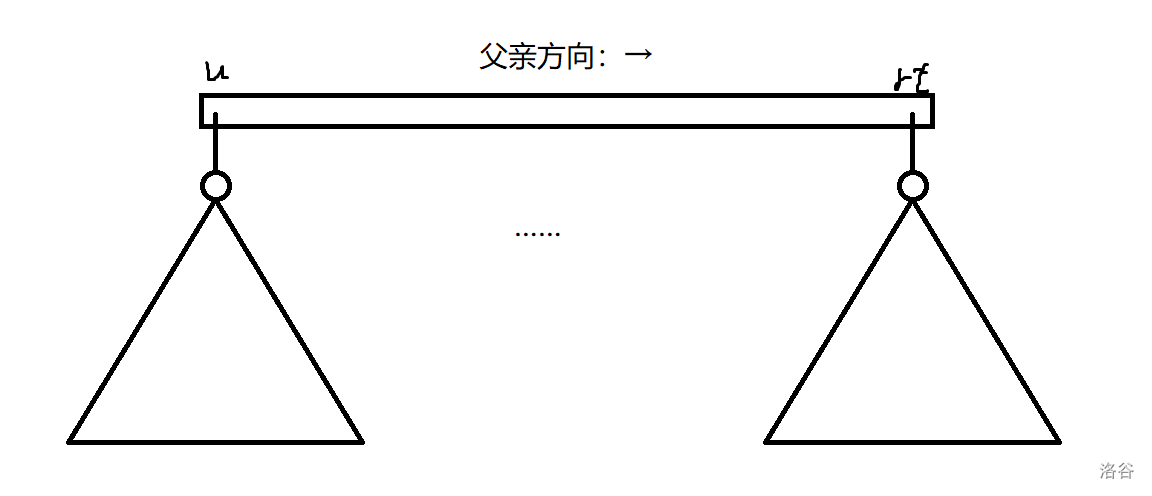
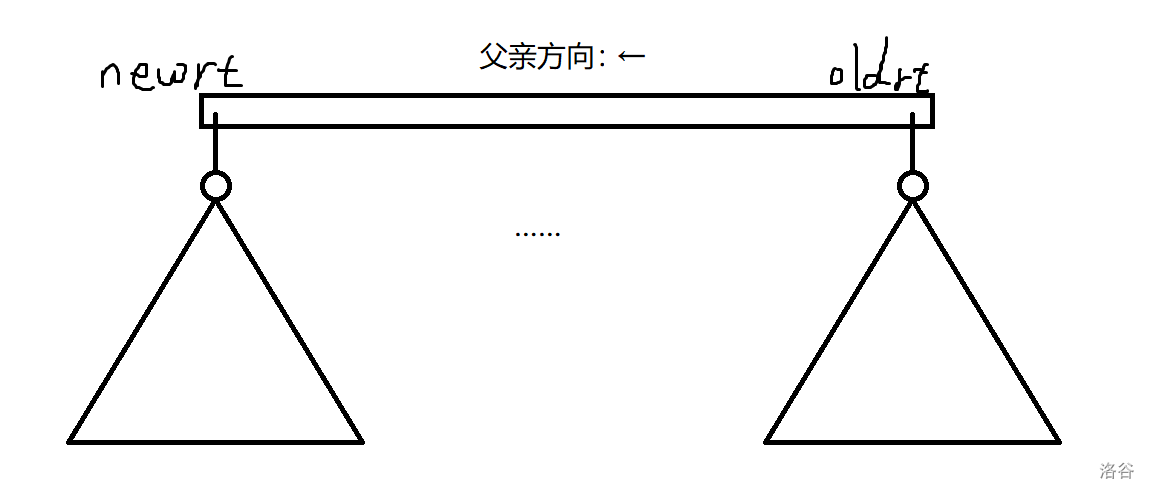
应该比较好理解。
反转父亲边同样也能看做翻转(reverse)深度,也就是说只需要翻转辅助树中 所在 Splay 即可。
参考实现
void modify(int u) {  // 不怕影响到其它实链,因为认父不认子,下传标记传不下去
    swap(son[u][0], son[u][1]), tag[u] ^= 1;
}
void mak(int u) {
    access(u), modify(u);
}
没了,具体见模板题代码注释。
例题
P3690 【模板】动态树(LCT)
模板。
#include <bits/stdc++.h>
// #define fastio
#define int long long
#define bw(x) (1 << (x))
#define eb emplace_back
#define pii pair<int, int>
#define inf (0x3f3f3f3f3f3f3f3f)
#define F(x, v) for (auto x : (v))
#define ALL(x) (x).begin(), (x).end()
#define L(i, a, b) for (register int i = (a); i <= (b); ++i)
#define R(i, a, b) for (register int i = (a); i >= (b); --i)
#define FRE(i, o) freopen(i, "r", stdin), freopen(o, "w", stdout)
#define debug(a) cerr << "\033[32m[DEBUG] " << #a << " = " << (a) << " at line " << __LINE__ << "\033[0m\n"
using namespace std; bool bgmem;
#ifdef fastio
struct IO {
	#define ion bw(20)
	char i[ion], o[ion], *icl = i, *icr = i, *oc = o;
	char gc() { return (icl == icr && (icr = (icl = i) + fread(i, 1, ion, stdin), icl == icr)) ? EOF : *icl++; }
	void pc(char c) { if (oc - o == ion) fwrite(o, 1, ion, stdout), oc = o; *oc++ = c; }
	void rd(auto &x) { char c; int f = 1; x = 0; while (c = gc(), c < '0' || c > '9') if (c == '-') f = -1; while ('0' <= c && c <= '9') x = (x << 1) + (x << 3) + (c ^ 48), c = gc(); x *= f; }
	void pr(auto x) { int a[64], p = 0; if (x < 0) x = -x, pc('-'); do a[p++] = x % 10; while (x /= 10); while (p--) pc(a[p] + '0'); }
	IO& operator>>(char &c) { return c = gc(), *this; }
	IO& operator<<(char c) { return pc(c), *this; }
	IO& operator<<(const char *c) { while (*c) pc(*c++); return *this; }
	IO& operator>>(auto &x) { return rd(x), *this; }
	IO& operator<<(auto x) { return pr(x), *this; }
} io;
#define cin io
#define cout io
#endif
template < const int P > class modint { public:
	int x;
	modint(int _ = 0) { x = (_ % P + P) % P; }
	explicit operator int() { return x; }
	friend modint operator+(modint x, modint y) { return x.x + y.x < P ? x.x + y.x : x.x + y.x - P; }
	friend modint operator-(modint x, modint y) { return x.x - y.x < 0 ? x.x - y.x + P : x.x - y.x; }
	friend modint operator*(modint x, modint y) { return modint((__int128)(x.x * y.x)); }
	modint& operator+=(modint x) { return (*this) = (*this) + x; }
	modint& operator-=(modint x) { return (*this) = (*this) - x; }
	modint& operator*=(modint x) { return (*this) = (*this) * x; }
};
inline int cmax(int& x, int c) { return x = max(x, c); }
inline int cmin(int& x, int c) { return x = min(x, c); }
int tes = 1, cas;
namespace qwq {
    const int N = 3e5 + 5;
    int n, m, op, x, y, a[N];
    namespace lct {
        int son[N][2], siz[N], fa[N], val[N], xo[N], tag[N], tot = 0;
        #define dir(u) (son[fa[u]][1] == u)
        #define chk(u) (fa[u] == 0 || (son[fa[u]][0] != u && son[fa[u]][1] != u))
        void modify(int u) { swap(son[u][0], son[u][1]), tag[u] ^= 1; }
        void up(int u) {
            siz[u] = siz[son[u][0]] + siz[son[u][1]] + 1;
            xo[u] = xo[son[u][0]] ^ xo[son[u][1]] ^ val[u];
        }
        void down(int u) {
            if (tag[u]) modify(son[u][0]), modify(son[u][1]), tag[u] = 0;
        }
        void push(int u) {  // 从根一直下传到 u
            if (!chk(u))
                push(fa[u]);
            down(u);
        }
        void rotate(int u) {
            int v = fa[u], w = fa[v], d = dir(u);
            if (!chk(v)) son[w][dir(v)] = u;  // 区别于正常 Splay,这里需要判 v 的虚实。
            fa[u] = w, son[v][d] = son[u][d ^ 1];
            if (son[u][d ^ 1]) fa[son[u][d ^ 1]] = v;
            son[u][d ^ 1] = v, fa[v] = u, up(v), up(u);
        } void splay(int u) {
            push(u);
            for (int v = fa[u]; !irt(u); rotate(u), v = fa[u]) if (!chk(v))  // 同理,这里默认旋转到根
                rotate(dir(u) == dir(v) ? v : u);
        }
        void access(int u) {
            for (int v = 0; u; v = u, u = fa[u])
                splay(u), son[u][1] = v, up(u);
        }
        void mak(int u) {
            access(u), splay(u), modify(u);
        }
        int frt(int u) {   // 查询结点 u 在原树上的根
            access(u), splay(u);
            while (son[u][0]) u = son[u][0], down(u);  // 根深度最小所以直接全部找左儿子
            splay(u);  // 使其满足 finger-search
            return u;
        }
        void split(int u, int v) {  // 把 u、v 转到相邻
            mak(u);
            access(v);
            splay(v);
        }  // 此时所有 u 到 v 的路径信息就在 v 的子树里
        void link(int u, int v) {  // 连边
            mak(u);  // 换个根
            if (frt(v) != u) fa[u] = v;  // 判一下是否在同一棵树上
        }
        void cut(int u, int v) {
            mak(u);  // 换根
            if (frt(v) == u && fa[v] == u && !son[v][0])  // 判一下
                son[u][1] = fa[v] = 0, up(u);
        }
        int que(int u, int v) {  // 查询
            return split(u, v), xo[v];
        }
    }
    void init() {}
    void clear() {}
    void solve() {
        cin >> n >> m;
        L(i, 1, n) {
            cin >> lct::val[i];
            lct::siz[i] = 1;
            lct::xo[i] = lct::val[i];
        }
        L(_, 1, m) {
            cin >> op >> x >> y;
            if (op == 0) cout << lct::que(x, y) << "\n";
            else if (op == 1) lct::link(x, y);
            else if (op == 2) lct::cut(x, y);
            else if (op == 3) lct::access(x), lct::splay(x), lct::val[x] = y, lct::up(x);
        }
    }
} bool edmem; signed main() {
    // FRE("", "");
#ifndef fastio
    ios::sync_with_stdio(0), cin.tie(0), cout.tie(0);
#endif
	// cin >> tes;
    qwq::init(); while (++cas <= tes) qwq::clear(), qwq::solve();
#ifdef fastio
	fwrite(io.o, 1, io.oc - io.o, stdout);
#endif
    cerr << "time  : " << (double)clock() / CLOCKS_PER_SEC * 1000 << "ms\n";
    cerr << "memory: " << fabs(&edmem - &bgmem) / 1024 / 1024 << "mb\n";
    return 0;
}
// I will never love You Know Who again. =(
P6664 [清华集训 2016] 温暖会指引我们前行
不难发现,温度最低的尽量高,是一棵支持动态加边的最大生成树,用 lct 解决。
假设我们要连接 ,具体步骤为:
- 若 不属于同一连通块,直接 link 即可。
- 否则找到 温度最低的点,如果 温度高于它,则 更优,删掉那条边加入 。否则不管。
一个常用的 trick,lct 不方便维护边权,可以在两个点之间建一个虚点转成点权。
#include <bits/stdc++.h>
// #define fastio
#define int long long
#define bw(x) (1 << (x))
#define eb emplace_back
#define pii pair<int, int>
#define inf (0x3f3f3f3f3f3f3f3f)
#define F(x, v) for (auto x : (v))
#define ALL(x) (x).begin(), (x).end()
#define L(i, a, b) for (register int i = (a); i <= (b); ++i)
#define R(i, a, b) for (register int i = (a); i >= (b); --i)
#define FRE(i, o) freopen(i, "r", stdin), freopen(o, "w", stdout)
#define debug(a) cerr << "\033[32m[DEBUG] " << #a << " = " << (a) << " at line " << __LINE__ << "\033[0m\n"
using namespace std; bool bgmem;
#ifdef fastio
struct IO {
	#define ion bw(20)
	char i[ion], o[ion], *icl = i, *icr = i, *oc = o;
	char gc() { return (icl == icr && (icr = (icl = i) + fread(i, 1, ion, stdin), icl == icr)) ? EOF : *icl++; }
	void pc(char c) { if (oc - o == ion) fwrite(o, 1, ion, stdout), oc = o; *oc++ = c; }
	void rd(auto &x) { char c; int f = 1; x = 0; while (c = gc(), c < '0' || c > '9') if (c == '-') f = -1; while ('0' <= c && c <= '9') x = (x << 1) + (x << 3) + (c ^ 48), c = gc(); x *= f; }
	void pr(auto x) { int a[64], p = 0; if (x < 0) x = -x, pc('-'); do a[p++] = x % 10; while (x /= 10); while (p--) pc(a[p] + '0'); }
	IO& operator>>(char &c) { return c = gc(), *this; }
	IO& operator<<(char c) { return pc(c), *this; }
	IO& operator<<(const char *c) { while (*c) pc(*c++); return *this; }
	IO& operator>>(auto &x) { return rd(x), *this; }
	IO& operator<<(auto x) { return pr(x), *this; }
} io;
#define cin io
#define cout io
#endif
template < const int P > class modint { public:
	int x;
	modint(int _ = 0) { x = (_ % P + P) % P; }
	explicit operator int() { return x; }
	friend modint operator+(modint x, modint y) { return x.x + y.x < P ? x.x + y.x : x.x + y.x - P; }
	friend modint operator-(modint x, modint y) { return x.x - y.x < 0 ? x.x - y.x + P : x.x - y.x; }
	friend modint operator*(modint x, modint y) { return modint((__int128)(x.x * y.x)); }
	modint& operator+=(modint x) { return (*this) = (*this) + x; }
	modint& operator-=(modint x) { return (*this) = (*this) - x; }
	modint& operator*=(modint x) { return (*this) = (*this) * x; }
};
inline int cmax(int& x, int c) { return x = max(x, c); }
inline int cmin(int& x, int c) { return x = min(x, c); }
int tes = 1, cas;
namespace qwq {
    const int N = 4e5 + 5;
    int n, m, op, x, y, a[N], pos[N]; pii e[N];
    namespace lct {
        int son[N][2], siz[N], fa[N], vlen[N], vtem[N], slen[N], stem[N], sid[N], tag[N], tot = 0;
        #define dir(u) (son[fa[u]][1] == u)
        #define irt(u) (fa[u] == 0 || (son[fa[u]][0] != u && son[fa[u]][1] != u))
        void modify(int u) { swap(son[u][0], son[u][1]), tag[u] ^= 1; }
        void up(int u) {
            siz[u] = siz[son[u][0]] + siz[son[u][1]] + 1;
            slen[u] = slen[son[u][0]] + slen[son[u][1]] + vlen[u];
            stem[u] = vtem[u], sid[u] = u;
            if (son[u][0] && stem[u] > stem[son[u][0]]) stem[u] = stem[son[u][0]], sid[u] = sid[son[u][0]];
            if (son[u][1] && stem[u] > stem[son[u][1]]) stem[u] = stem[son[u][1]], sid[u] = sid[son[u][1]];
        }
        void down(int u) { if (tag[u]) modify(son[u][0]), modify(son[u][1]), tag[u] = 0; }
        void all(int u) { if (!irt(u)) all(fa[u]); down(u); }
        void rotate(int u) {
            int v = fa[u], w = fa[v], d = dir(u);
            if (!irt(v)) son[w][dir(v)] = u;
            fa[u] = w, son[v][d] = son[u][d ^ 1];
            if (son[u][d ^ 1]) fa[son[u][d ^ 1]] = v;
            son[u][d ^ 1] = v, fa[v] = u, up(v), up(u);
        } void splay(int u) {
            all(u);
            for (int v = fa[u]; !irt(u); rotate(u), v = fa[u]) if (!irt(v))
                rotate(dir(u) == dir(v) ? v : u);
        }
        void access(int u) { for (int v = 0; u; v = u, u = fa[u]) splay(u), son[u][1] = v, up(u); }
        void mkrt(int u) { access(u), splay(u), modify(u); }
        int frt(int u) {
            access(u), splay(u);
            while (son[u][0]) u = son[u][0], down(u);
            splay(u);
            return u;
        }
        void split(int u, int v) { mkrt(u), access(v), splay(v); }
        void link(int u, int v) { mkrt(u); if (frt(v) != u) fa[u] = v; }
        void cut(int u, int v) {
            split(u, v);
            if (son[v][0] == u && !son[u][1]) son[v][0] = fa[u] = 0, up(v);
        }
        pii ask(int u, int v) { split(u, v); return make_pair(stem[v], sid[v]); }
        int length(int u, int v) { split(u, v); return slen[v]; }
    }
    void init() {}
    void clear() {}
    void solve() {
        cin >> n >> m;
        L(i, 1, n) lct::vtem[i] = lct::stem[i] = inf;
        lct::tot = n;
        L(_, 1, m) {
            string op;
            cin >> op;
            if (op == "find") {
                int id, u, v, t, l;
                cin >> id >> u >> v >> t >> l;
                u++, v++;
                pos[id] = ++lct::tot, e[lct::tot] = {u, v};
                lct::vtem[lct::tot] = lct::stem[lct::tot] = t;
                lct::vlen[lct::tot] = lct::slen[lct::tot] = l;
                lct::sid[lct::tot] = lct::tot;
                if (lct::frt(u) != lct::frt(v)) lct::link(u, lct::tot), lct::link(lct::tot, v);
                else {
                    auto [w, d] = lct::ask(u, v);
                    if (w > t) continue;
                    lct::cut(e[d].first, d), lct::cut(d, e[d].second);
                    lct::link(u, lct::tot), lct::link(lct::tot, v);
                }
            } else if (op == "move") {
                int u, v;
                cin >> u >> v;
                u++, v++;
                if (lct::frt(u) != lct::frt(v)) {
                    cout << "-1\n";
                } else {
                    cout << lct::length(u, v) << "\n";
                }
            } else {
                int id, l;
                cin >> id >> l;
                lct::mkrt(pos[id]);
                lct::vlen[pos[id]] = l;
                lct::up(pos[id]);
            }
        }
    }
} bool edmem; signed main() {
    // FRE("", "");
#ifndef fastio
    ios::sync_with_stdio(0), cin.tie(0), cout.tie(0);
#endif
	// cin >> tes;
    qwq::init(); while (++cas <= tes) qwq::clear(), qwq::solve();
#ifdef fastio
	fwrite(io.o, 1, io.oc - io.o, stdout);
#endif
    cerr << "time  : " << (double)clock() / CLOCKS_PER_SEC * 1000 << "ms\n";
    cerr << "memory: " << fabs(&edmem - &bgmem) / 1024 / 1024 << "mb\n";
    return 0;
}
// I will never love You Know Who again. =(
时间复杂度证明
参考文献
- jzp 的课件(出于某种特殊原因无法给链接)
- 5t0_0r2 - 【学习笔记】重链剖分
- OI wiki - 树上启发式合并
- OI wiki - Splay 树
- OI wiki - Link Cut Tree
鸣谢
感谢教练 jzp 的悉心教诲。
感谢 AI deepseek 对于 Splay 时间复杂度证明的解释。
感谢洛谷用户 T7_Daniel 与用户 pies_0x 的催更鼓励。
脚注
听说有证明,感觉很强,到时候问问。 回到正文↩