
求值是简单的,只需得到表达式。这是一个单行不定长文本识别问题,下面将使用一个有 个float参数的神经网络模型解决这道题。模型是 CRNN+CTC 模型1的简化版本。
我在测试集上验证了(多次提交并根据评测结果调整超参数和模型结构)。
模型结构
模型依次含有如下层:
- 输入是一个 的矩阵,每个元素是 或 。
- 一个卷积层,包含 个 卷积核,
ReLu激活。 - 一个池化层,大小为 。
- 一个卷积层,包含 个 卷积核,
ReLu激活。 - 一个池化层,大小为 。
- 一个卷积层,包含 个 卷积核,
ReLu激活。 - 一个池化层,大小为 。池化层输出 个 的矩阵。
- 一个双向 RNN 层, 维输入, 维输出, 维隐藏状态。
- 一个 CTC 层。
下面简单介绍神经网络。
神经网络
神经网络是一种机器学习程序或模型,它以类似于人脑的方式做出决策,通过使用模仿生物神经元协同工作方式的过程来识别现象、权衡利弊并得出结论。
每个神经网络都由多个节点层或人工神经元组成 – 一个输入层、一个或多个隐藏层和一个输出层。每个节点都与其他节点相连,具有一个关联的权重和阈值。如果任何单个节点的输出高于指定的阈值,那么该节点将被激活,并将数据发送到网络的下一层。否则,不会将数据传递到网络的下一层。
神经网络依靠训练数据来学习并随着时间的推移提高其准确性。一旦对其准确性进行微调,它们就会成为计算机科学和人工智能领域的强大工具,使我们能够高速对数据进行分类和聚类。与人类专家的人工识别相比,人工智能进行语音识别或图像识别只需几分钟,而人工识别则需要几小时。神经网络最著名的例子之一就是 Google 的搜索算法。
神经网络有时被称为人工神经网络 (ANN) 或模拟神经网络 (SNN)。它们是机器学习的一个子集,是深度学习模型的核心。2
神经网络是带有一些参数的函数,训练时根据数据和标签调整网络中的参数,从而使网络可以拟合目标函数。
例如在本题中,函数的输入是图像,输出是表达式。训练结束后,网络应该能根据图像正确预测表达式。
神经网络可以视为一个有向无环图(计算图),其中每一个节点是一个数(可能是参数/输入/输出/中间结果),每一条边是一种运算。神经网络按照拓扑序依次计算每个节点的值。网络通常由很多层组成,预测时依次计算网络的每一层,每一层的输出就是下一层的输入。这种情况下计算图是每一层的计算图的拼接。
梯度下降
为了调整参数使得网络尽可能拟合目标函数,首先需要定义“拟合的错误程度”。用一个数即 loss 函数的值表示它。loss 函数有很多种定义方式。
这样问题就转化为使函数 尽量小。由于网络非常复杂,不可能精确求解。求近似最小值的基本方法是梯度下降:首先求出全部的 ,然后对每个 ,令 ,其中 是学习率。实际训练时会对这个方法进行一些优化。
反向传播
为了求出 ,利用全微分和链式法则:
假设在计算图中 连向 。则有
由于计算图中每条边都是一些简单的运算,所以 容易求,只需要求出 。按照计算图的拓扑序(即神经网络的计算顺序)的相反方向 dp 即可,因此称为反向传播。
模型介绍
激活函数
神经网络中大部分的计算都是关于输入的线性变换,但线性变换的复合仍然是线性的。为了防止网络退化为线性,会在网络中加入非线性的激活函数层,将激活函数作用于每一个输入上。常用激活函数有 ReLU、tanh 等。
CNN
卷积神经网络(Convolutional Neural Networks, CNN)通常由若干卷积层和池化层组成(最后可能还有一个全连接层)。
卷积层的参数包括若干卷积核及偏置。这一层会将图像分别与每个卷积核进行卷积,然后分别加上对应的偏置。最后将激活函数作用于卷积结果。本文的 CNN 网络采用 ReLU 函数 。
池化层将一个区域内的所有数替换为一个数,用于缩小图像大小以及扩大卷积核的作用范围。最大池化比较常用,把这些数换成最大值。在本文的网络中,池化层将 的矩阵变为 的矩阵,其中每个数代表原矩阵中对应范围的最大值。
两个或多个 CNN 网络堆叠时,下一层的每个输出是上一层的每个输出分别被卷积后对应相加之和。
由于接下来是 CNN 或 RNN,CRNN 网络中 CNN 没有全连接层。
RNN
正常应该在这里用多层双向 LSTM。考虑到代码长度限制了参数量,并且本题的场景不需要长距离信息,用更简单的普通双向 RNN 代替。
循环神经网络(Recurrent Neural Network, RNN)的输入是一个序列,输出是和输入等长的序列。RNN 用于处理第 个输出和第 个附近的(比如第 个)输入有关,而不是只和第 个输入有关的问题。例如在本题中一个字符宽度是 ,而一个输入只包含宽度为 的范围内的信息,所以使用 RNN。
本文的模型中 RNN 使用 tanh 激活函数。为了传递附近的信息,RNN 含有隐藏状态 ,其中编码了第 个输入时网络获取的信息。在本文的网络中, 是一个长度为 的向量。设 是输入, 是输出,具体的计算方法为:
其中 都是矩阵, 是向量,它们的值是需要学习的参数。 表示对这个向量的每个元素进行 得到的结果。
softmax
softmax 层对 RNN 的输出进行归一化。RNN 输出的第 个向量 被归一化为 。 可以看作第 个输出是字符 的概率。
CTC
联结主义时间分类算法(Connectionist Temporal Classification, CTC) 3是一种算法,用于解决不定长序列的对齐问题。对 CTC 的介绍可以参看4。在 CRNN 中,一个字符变为多个输出,例如3*3-4可能被识别为333**33---44。合并相邻的相同字符可以部分解决这个问题,但1+22会被识别为1+2。为了解决这个问题,CTC 引入了空白字符,用于分隔相邻字符。
定义解码函数 ,其中 是字符集,( 表示空白字符), 是输入长度:先删去相邻的相同字符,然后删去空白。例如 ,。
定义 CTC loss 为 RNN 的输出解码后得到正确结果的概率的对数的相反数 ,其中 是正确标签, 是 softmax 的输出。显然有
其中 是一个可能的序列。
要计算 loss 和 loss 关于各个 的偏导数。
考虑 dp。首先在 的每两个字符间和首尾插入一个空白字符,得到的字符串记为 。如果 ,那么 。定义
的含义是 的前 个字符“等于” 的前 个字符的概率,“等于”的精确意思是 的结果相等并且最后一个字符相同。
容易证明有递推关系
于是可以 计算 在各个 和 上的值。显然 。
定义
对 有类似的递推关系。
不难看出 和 都是关于 的正比例函数,并且 对任意 恒成立。于是有 ,再根据 就算出了 loss 关于 的偏导数。
实现
注意到 Atcoder 的评测环境中没有常用的深度学习库,因此用c++实现上述模型。
头文件和常量
#include <array>
#include <cmath>
#include <iostream>
#include <random>
#include <ranges>
#include <stack>
#include <string>
#include <vector>
const int height=65,width_of_char=38,num_of_chars=16;
const std::array<std::string,height> char_image_list[num_of_chars]={/*复制 https://img.atcoder.jp/data/other/birthday0410/X_umekomi.txt 到这里*/};
const char char_list[num_of_chars+1]={'0','1','2','3','4','5','6','7','8','9','(',')','+','-','*','/','?'};
参数
std::mt19937 gen(3407);
class ARG{
public:
    float x;
    ARG()=default;
    explicit ARG(float x_):x(x_){}
};
class GRAD_ARG:public ARG{
public:
    float x_grad;
    GRAD_ARG()=default;
    explicit GRAD_ARG(float x_):ARG(x_),x_grad(0){}
};
class BP_ARG:public GRAD_ARG{
public:
    static constexpr float eps=1e-8,beta_m=0.9,beta_v=0.999;
    float m,v,grad_sum,bmk,bvk;
    BP_ARG():GRAD_ARG(std::normal_distribution<float>(0,0.1)(gen)),m(0),v(0),bmk(1),bvk(1){};
    BP_ARG(float x):GRAD_ARG(x),m(0),v(0),bmk(1),bvk(1){};
    void learn(float learning_rate){
        m=beta_m*m+(1-beta_m)*grad_sum;
        v=beta_v*v+(1-beta_v)*grad_sum*grad_sum;
        bmk*=beta_m;
        bvk*=beta_v;
        x-=learning_rate*m/((1-bmk)*(eps+std::sqrt(v/(1-bvk))));
    }
};
template<typename T>
concept IS_ARG=requires(T& t){t.x;};
template<typename T>
concept WITH_GRAD=requires(T& t){t.x_grad;};
template<typename T>
concept WITH_BP=requires(T& t,float l){t.learn(l);};
template<typename T1,typename T2>
concept CAN_TRAIN=IS_ARG<T1>&&WITH_GRAD<T1>&&IS_ARG<T2>&&WITH_BP<T2>;- 随机数种子设为
3407是因为5。 - 使用 Adam 优化器。
- 参数初始化为均值 ,标准差 的正态分布。
grad_sum保存一个 batch 中的梯度之和。
参数保存
const char used_chars[93]="!#$%&'()*+,-./0123456789:;<=>?@ABCDEFGHIJKLMNOPQRSTUVWXYZ[]^_`abcdefghijklmnopqrstuvwxyz{|}~";
std::string to_s(float x){
    bool f=x<0;
    x=std::abs(x);
    x=std::ldexp(x,18);
    int y;
    if(x<1){
        y=static_cast<int>(x*16928);
    }else{
        if(x>=(1<<22)){
            x=4194303.75f;
        }
        x=std::frexp(x,&y)*2-1;
        y=y*16928+static_cast<int>(x*16928);
    }
    y=y*2+f;
    std::string res="";
    for(int i=0;i<3;i++){
        res+=used_chars[y%92];
        y/=92;
    }
    return res;
}
template<IS_ARG T>
std::string to_s(T* a,int n){
    std::string res="";
    for(int i=0;i<n;i++){
        res+=to_s(a[i].x);
    }
    return res;
}
float from_s(std::string_view s){
    int y=0;
    for(int i=2;i>=0;i--){
        y*=92;
        y+=s[i]-33-(s[i]>'"')-(s[i]>'\\');
    }
    bool f=y%2;
    y/=2;
    float x;
    if(y<16928){
        x=(static_cast<float>(y)+0.5)/16928;
    }else{
        x=std::ldexp(1+(static_cast<float>(y%16928)+0.5)/16928,y/16928-1);
    }
    return std::ldexp((f?-x:x),-18);
}
template<IS_ARG T>
void from_s(T* a,std::string_view s){
    for(int i=0;i<s.size();i+=3){
        a[i/3].x=from_s(s.substr(i,3));
    }
}- 假设所有参数都在 中。
- 用 个字符保存一个参数。
训练数据生成
class IMAGE{
    using IMAGE_TO_TRANSFORM=std::vector<std::pair<float,float>>;
    using IMAGE_FOR_NET=std::array<std::vector<std::array<GRAD_ARG,height>>,1>;
    std::vector<bool> v[height];
    void append(IMAGE img,int pad){
        pad=(pad<0)?0:pad;
        for(int i=0;i<height;i++){
            v[i].insert(v[i].end(),img.v[i].begin(),img.v[i].end());
            v[i].insert(v[i].end(),pad,0);
        }
    }
public:
    IMAGE()=default;
    explicit IMAGE(const std::array<std::string,height>& char_img){
        for(int i=0;i<height;i++){
            v[i].resize(width_of_char);
            for(int j=0;j<width_of_char;j++){
                v[i][j]=(char_img[i][j]=='#');
            }
        }
    }
    explicit IMAGE(const auto& pixel_set){
        auto [min_i,max_i]=std::ranges::minmax(pixel_set|std::views::transform([](const auto& p){return p.first;}));
        auto [min_j,max_j]=std::ranges::minmax(pixel_set|std::views::transform([](const auto& p){return p.second;}));
        int shift_i=(-min_i+5>height-1-max_i-5)?0:std::uniform_int_distribution<int>(-min_i+5,height-1-max_i-5)(gen);
        int shift_j=-min_j;
        for(int i=0;i<height;i++){
            v[i].resize(max_j+1+shift_j);
        }
        for(auto p:pixel_set){
            int i,j;
            std::tie(i,j)=p;
            if(static_cast<unsigned int>(i+shift_i)<height){
                v[i+shift_i][j+shift_j]=1;
            }
        }
    }
    IMAGE_FOR_NET to_net(){
        IMAGE_FOR_NET res;
        res[0].resize(v[0].size());
        for(int i=0;i<height;i++){
            for(int j=0;j<v[i].size();j++){
                res[0][j][i].x=v[i][j];
            }
        }
        return res;
    }
    static std::vector<int> random_vector(int R=3,int L=200){
        std::uniform_int_distribution<> u(R,L),c(0,15);
        int l=u(gen);
        std::vector<int> res(l);
        for(int i=0;i<l;i++){
            res[i]=c(gen);
        }
        return res;
    }
    explicit IMAGE(std::vector<int> data){
        std::uniform_real_distribution<float> Md(0.9,1),Mhd(0.8,1),Mwd(0.8,1),Rd(-25,25),Sxd(-0.2,0.2),Syd(-0.2,0.2);
        int padl=std::discrete_distribution<int>({1,2,1,2,3,5,3,7,6,5,1})(gen)+1;
        for(int i=0;i<height;i++){
            v[i].resize(padl);
        }
        for(int i=0;i<data.size();i++){
            float M=Md(gen),Mh=Mhd(gen),Mw=Mwd(gen),R=Rd(gen)*M_PI/180,Sx=Sxd(gen),Sy=Syd(gen);
            IMAGE img(char_image_list[data[i]]);
            std::vector<std::pair<int,int>> pixel_set;
            for(int p=-50;p<50;p++){
                for(int q=-30;q<30;q++){
                    float x=p,y=q;
                    std::tie(x,y)=std::make_tuple(x+Sy*y,y+Sx*x);
                    std::tie(x,y)=std::make_tuple(x/(1-Sx*Sy),y/(1-Sx*Sy));
                    std::tie(x,y)=std::make_tuple(x*std::cos(R)-y*std::sin(R),x*std::sin(R)+y*std::cos(R));
                    std::tie(x,y)=std::make_tuple(x/M/Mh,y/M/Mw);
                    auto [m,n]=std::make_tuple(std::lround(x+height/2),std::lround(y+width_of_char/2));
                    if(0<=m&&m<height&&0<=n&&n<img.v[0].size()){
                        if(img.v[m][n]){
                            pixel_set.push_back(std::make_pair(p,q));
                        }
                    }
                }
            }
            img=IMAGE(pixel_set);
            if(i+1<data.size()){
                append(img,static_cast<int>(std::normal_distribution<float>(19.7,3.08)(gen)));
            }else{
                append(img,std::discrete_distribution<int>({1,2,2,3,4,5,8,7,2,1})(gen)+10);
            }
        }
        std::uniform_real_distribution<float> u(0,1);
        float p=std::uniform_real_distribution<float>(0.04,0.06)(gen);
        for(int i=0;i<height;i++){
            for(int j=0;j<v[i].size();j++){
                if(u(gen)<p){
                    v[i][j]=!v[i][j];
                }
            }
        }
    }
};IMAGE::random_vector生成随机字符串。- 代码中看起来奇怪的概率分布是统计 号点的输入数据(这些数据可以在题目描述中的链接里下载)得到的。
- 生成数据的参数比题目中会产生更大的变形,但到训练后期会改成题目中的参数(具体内容在“模型训练”一节)。
- 使用向后映射和最近邻插值计算变形后的图像。
CNN
template<IS_ARG T1,IS_ARG T2,int depth,int input_height,int conv_num,int conv_size,int pad,int pool_size>
class CNN{
    static const int conv_res_height=input_height+2*pad+1-conv_size;
    static const int pool_res_height=conv_res_height/pool_size;
    static float activation_func(float x){
        return (x>0)?x:0;
    }
    static float activation_func_deriv(float x){
        return (x>0)?1:0;
    }
    T2 weight[conv_num][depth][conv_size][conv_size];
    T2 bias[conv_num];
    std::vector<std::array<T1,conv_res_height>> convolution_res[conv_num];
    std::vector<std::array<T1,input_height+2*pad>> input[depth];
    void padding(const auto& in){
        for(int c=0;c<depth;c++){
            input[c].resize(in[c].size()+2*pad);
            for(int i=0;i<pad;i++){
                input[c][i].fill(T1(0));
                input[c][in[c].size()+i+pad].fill(T1(0));
            }
            for(int i=0;i<in[c].size();i++){
                for(int j=0;j<pad;j++){
                    input[c][i+pad][j].x=0;
                    input[c][i+pad][j+input_height+pad].x=0;
                }
                for(int j=0;j<input_height;j++){
                    input[c][i+pad][j+pad]=in[c][i][j];
                }
            }
        }
    }
    void convolution(const auto& in){
        padding(in);
        int conv_res_width=input[0].size()+1-conv_size;
        for(int i=0;i<conv_num;i++){
            convolution_res[i].resize(conv_res_width);
            for(int j=0;j<conv_res_width;j++){
                for(int k=0;k<conv_res_height;k++){
                    convolution_res[i][j][k].x=bias[i].x;
                }
            }
            for(int c=0;c<depth;c++){
                std::array<std::array<float,conv_size>,conv_size> wgt;
                for(int x=0;x<conv_size;x++){
                    for(int y=0;y<conv_size;y++){
                        wgt[x][y]=weight[i][c][x][y].x;
                    }
                }
                for(int j=0;j<conv_res_width;j++){
                    for(int k=0;k<conv_res_height;k++){
                        float cvr=0;
                        for(int x=0;x<conv_size;x++){
                            for(int y=0;y<conv_size;y++){
                                cvr+=input[c][j+x][k+y].x*wgt[x][y];
                            }
                        }
                        convolution_res[i][j][k].x+=cvr;
                    }
                }
            }
        }
    }
    void activate(){
        for(int i=0;i<conv_num;i++){
            int conv_res_width=convolution_res[i].size();
            for(int j=0;j<conv_res_width;j++){
                for(int k=0;k<conv_res_height;k++){
                    convolution_res[i][j][k].x=activation_func(convolution_res[i][j][k].x);
                }
            }
        }
    }
    void pool(){
        for(int i=0;i<conv_num;i++){
            const int conv_res_width=convolution_res[i].size();
            const int filled_width=(conv_res_width+pool_size-1)/pool_size;
            convolution_res[i].resize(filled_width*pool_size);
            result[i].resize(filled_width);
            for(int j=conv_res_width;j<filled_width*pool_size;j++){
                convolution_res[i][j].fill(T1(0));
            }
            for(int j=0;j<filled_width;j++){
                result[i][j].fill(T1(0));
                for(int x=0;x<pool_size;x++){
                    for(int k=0;k<pool_res_height;k++){
                        for(int y=0;y<pool_size;y++){
                            if(convolution_res[i][j*pool_size+x][k*pool_size+y].x>result[i][j][k].x){
                                result[i][j][k].x=convolution_res[i][j*pool_size+x][k*pool_size+y].x;
                            }
                        }
                    }
                }
            }
        }
    }
    void bp_padding(auto& in)requires CAN_TRAIN<T1,T2>{
        for(int c=0;c<depth;c++){
            for(int i=0;i<in[c].size();i++){
                for(int j=0;j<input_height;j++){
                    in[c][i][j].x_grad=input[c][i+pad][j+pad].x_grad;
                }
            }
        }
    }
    void bp_convolution(auto& in)requires CAN_TRAIN<T1,T2>{
        int conv_res_width=input[0].size()+1-conv_size;
        for(int i=0;i<conv_num;i++){
            for(int j=0;j<conv_res_width;j++){
                for(int k=0;k<conv_res_height;k++){
                    bias[i].x_grad+=convolution_res[i][j][k].x_grad;
                }
            }
            for(int c=0;c<depth;c++){
                std::array<std::array<T1,conv_size>,conv_size> wgt;
                for(int x=0;x<conv_size;x++){
                    for(int y=0;y<conv_size;y++){
                        wgt[x][y].x=weight[i][c][x][y].x;
                        wgt[x][y].x_grad=weight[i][c][x][y].x_grad;
                    }
                }
                for(int j=0;j<conv_res_width;j++){
                    for(int k=0;k<conv_res_height;k++){
                        float cvg=convolution_res[i][j][k].x_grad;
                        for(int x=0;x<conv_size;x++){
                            for(int y=0;y<conv_size;y++){
                                wgt[x][y].x_grad+=input[c][j+x][k+y].x*cvg;
                                input[c][j+x][k+y].x_grad+=wgt[x][y].x*cvg;
                            }
                        }
                    }
                }
                for(int x=0;x<conv_size;x++){
                    for(int y=0;y<conv_size;y++){
                        weight[i][c][x][y].x_grad=wgt[x][y].x_grad;
                    }
                }
            }
        }
        bp_padding(in);
    }
    void bp_activate()requires CAN_TRAIN<T1,T2>{
        for(int i=0;i<conv_num;i++){
            int conv_res_width=convolution_res[i].size();
            for(int j=0;j<conv_res_width;j++){
                for(int k=0;k<conv_res_height;k++){
                    convolution_res[i][j][k].x_grad*=activation_func_deriv(convolution_res[i][j][k].x);
                }
            }
        }
    }
    void bp_pool()requires CAN_TRAIN<T1,T2>{
        for(int i=0;i<conv_num;i++){
            int conv_res_width=convolution_res[i].size();
            int filled_width=(conv_res_width+pool_size-1)/pool_size;
            for(int j=0;j<filled_width;j++){
                for(int x=0;x<pool_size;x++){
                    for(int k=0;k<pool_res_height;k++){
                        for(int y=0;y<pool_size;y++){
                            if(convolution_res[i][j*pool_size+x][k*pool_size+y].x>=result[i][j][k].x){
                                convolution_res[i][j*pool_size+x][k*pool_size+y].x_grad=result[i][j][k].x_grad;
                            }
                        }
                    }
                }
            }
        }
    }
    void clear_grad()requires CAN_TRAIN<T1,T2>{
        for(int i=0;i<conv_num;i++){
            for(int c=0;c<depth;c++){
                for(int j=0;j<conv_size;j++){
                    for(int k=0;k<conv_size;k++){
                        weight[i][c][j][k].x_grad=0;
                    }
                }
            }
            bias[i].x_grad=0;
            for(auto& j:convolution_res[i]){
                for(auto& a:j){
                    a.x_grad=0;
                }
            }
        }
        for(auto& c:input){
            for(auto& j:c){
                for(auto& k:j){
                    k.x_grad=0;
                }
            }
        }
    }
public:
    std::array<std::vector<std::array<T1,pool_res_height>>,conv_num> result;
    CNN()=default;
    CNN(std::string_view s){
        from_s(&weight[0][0][0][0],s.substr(0,3*conv_num*depth*conv_size*conv_size));
        from_s(&bias[0],s.substr(3*conv_num*depth*conv_size*conv_size,3*conv_num));
    }
    std::string to_str(){
        return to_s(&weight[0][0][0][0],conv_num*depth*conv_size*conv_size)+to_s(&bias[0],conv_num);
    }
    void forward_propagation(const auto& in){
        convolution(in);
        activate();
        pool();
    }
    void apply_to_all_bp_arg(const auto& f){
        for(int i=0;i<conv_num;i++){
            for(int c=0;c<depth;c++){
                for(int j=0;j<conv_size;j++){
                    for(int k=0;k<conv_size;k++){
                        f(weight[i][c][j][k]);
                    }
                }
            }
            f(bias[i]);
        }
    }
    void backward_propagation(auto& in)requires CAN_TRAIN<T1,T2>{
        clear_grad();
        bp_pool();
        bp_activate();
        bp_convolution(in);
        apply_to_all_bp_arg([](T2& x){x.grad_sum+=x.x_grad;});
    }
};- 在图像周围填充
0。 - 用合理的顺序循环,并且将常用的数据提前取出,这样可以提高缓存命中率从而加速卷积。
RNN
template<IS_ARG T1,IS_ARG T2,int depth,int input_size,int state_size,int output_size>
class RNN{
    static float activation_func(float x){
        return std::tanh(x);
    }
    static float activation_func_deriv(float x){
        return 1-x*x;
    }
    T2 input_weight[2][state_size][depth][input_size];
    T2 state_weight[2][state_size][state_size];
    T2 state_bias[2][state_size];
    T2 full_connect_weight[2][state_size][output_size];
    std::vector<std::array<T1,state_size>> state[2];
    void rnn_one_layer(int flag,int i,std::array<std::vector<std::array<T1,input_size>>,depth>& input){
        int b=1-2*flag;
        state[flag][i+b].fill(T1(0));
        for(int j=0;j<state_size;j++){
            for(int c=0;c<depth;c++){
                for(int k=0;k<input_size;k++){
                    state[flag][i+b][j].x+=input_weight[flag][j][c][k].x*input[c][i-flag][k].x;
                }
            }
            for(int k=0;k<state_size;k++){
                state[flag][i+b][j].x+=state_weight[flag][j][k].x*state[flag][i][k].x;
            }
            state[flag][i+b][j].x+=state_bias[flag][j].x;
            state[flag][i+b][j].x=activation_func(state[flag][i+b][j].x);
            for(int k=0;k<output_size;k++){
                result[i-flag][k].x+=state[flag][i+b][j].x*full_connect_weight[flag][j][k].x;
            }
        }
    }
    void bp_rnn_one_layer(int flag,int i,std::array<std::vector<std::array<T1,input_size>>,depth>& input)requires CAN_TRAIN<T1,T2>{
        int b=1-2*flag;
        for(int j=0;j<state_size;j++){
            for(int k=0;k<output_size;k++){
                full_connect_weight[flag][j][k].x_grad+=result[i-flag][k].x_grad*state[flag][i+b][j].x;
                state[flag][i+b][j].x_grad+=result[i-flag][k].x_grad*full_connect_weight[flag][j][k].x;
            }
            state[flag][i+b][j].x_grad*=activation_func_deriv(state[flag][i+b][j].x);
            for(int c=0;c<depth;c++){
                for(int k=0;k<input_size;k++){
                    input_weight[flag][j][c][k].x_grad+=state[flag][i+b][j].x_grad*input[c][i-flag][k].x;
                    input[c][i-flag][k].x_grad+=state[flag][i+b][j].x_grad*input_weight[flag][j][c][k].x;
                }
            }
            for(int k=0;k<state_size;k++){
                state_weight[flag][j][k].x_grad+=state[flag][i+b][j].x_grad*state[flag][i][k].x;
                state[flag][i][k].x_grad+=state[flag][i+b][j].x_grad*state_weight[flag][j][k].x;
            }
            state_bias[flag][j].x_grad+=state[flag][i+b][j].x_grad;
        }
    }
    void clear_grad()requires CAN_TRAIN<T1,T2>{
        for(int i:{0,1}){
            for(int j=0;j<state_size;j++){
                for(int c=0;c<depth;c++){
                    for(auto& k:input_weight[i][j][c]){
                        k.x_grad=0;
                    }
                }
                for(auto& k:state_weight[i][j]){
                    k.x_grad=0;
                }
                state_bias[i][j].x_grad=0;
                for(auto& k:full_connect_weight[i][j]){
                    k.x_grad=0;
                }
            }
            for(auto& j:state[i]){
                for(auto& k:j){
                    k.x_grad=0;
                }
            }
        }
    }
public:
    std::vector<std::array<T1,output_size>> result;
    RNN()=default;
    RNN(std::string_view s){
        from_s(&input_weight[0][0][0][0],s.substr(0,6*state_size*depth*input_size));
        from_s(&state_weight[0][0][0],s.substr(6*state_size*depth*input_size,6*state_size*state_size));
        from_s(&state_bias[0][0],s.substr(6*state_size*(depth*input_size+state_size),6*state_size));
        from_s(&full_connect_weight[0][0][0],s.substr(6*state_size*(depth*input_size+state_size+1),6*state_size*output_size));
    }
    std::string to_str(){
        return
            to_s(&input_weight[0][0][0][0],2*state_size*depth*input_size)
            +to_s(&state_weight[0][0][0],2*state_size*state_size)
            +to_s(&state_bias[0][0],2*state_size)
            +to_s(&full_connect_weight[0][0][0],2*state_size*output_size);
    }
    void forward_propagation(std::array<std::vector<std::array<T1,input_size>>,depth>& input){
        result.resize(input[0].size());
        for(auto& i:result){
            i.fill(T1(0));
        }
        state[0].resize(input[0].size()+1);
        state[0][0].fill(T1(0));
        for(int i=0;i<input[0].size();i++){
            rnn_one_layer(0,i,input);
        }
        state[1].resize(input[0].size()+1);
        state[1][input[0].size()].fill(T1(0));
        for(int i=input[0].size();i>0;i--){
            rnn_one_layer(1,i,input);
        }
    }
    void apply_to_all_bp_arg(const auto& f){
        for(int i:{0,1}){
            for(int j=0;j<state_size;j++){
                for(int c=0;c<depth;c++){
                    for(auto& k:input_weight[i][j][c]){
                        f(k);
                    }
                }
                for(auto& k:state_weight[i][j]){
                    f(k);
                }
                f(state_bias[i][j]);
                for(auto& k:full_connect_weight[i][j]){
                    f(k);
                }
            }
        }
    }
    void backward_propagation(std::array<std::vector<std::array<T1,input_size>>,depth>& input)requires CAN_TRAIN<T1,T2>{
        clear_grad();
        for(int c=0;c<depth;c++){
            for(auto& i:input[c]){
                for(auto& j:i){
                    j.x_grad=0;
                }
            }
        }
        for(int i=input[0].size()-1;i>=0;i--){
            bp_rnn_one_layer(0,i,input);
        }
        for(int i=1;i<=input[0].size();i++){
            bp_rnn_one_layer(1,i,input);
        }
        apply_to_all_bp_arg([](T2& x){x.grad_sum+=x.x_grad;});
    }
};- 各数组的第一个下标为
0表示正向 RNN,为1表示反向 RNN。 - 。
CTC
template<IS_ARG T1,IS_ARG T2,int input_size>
class CTC{
    std::vector<std::vector<float>> alpha_hat;
    std::vector<std::vector<float>> beta_hat;
    std::vector<int> l;
    std::vector<std::array<float,input_size>> log_of_res;
    float sum,max_x;
    int L,T;
    static float log_sum_exp(float a,float b){
        if(std::isinf(a)&&std::isinf(b)){
            return -HUGE_VALF;
        }
        return std::max(a,b)+std::log(1+std::exp(-std::abs(a-b)));
    }
    void softmax(std::vector<std::array<T1,input_size>>& input){
        log_of_res.resize(input.size());
        for(int i=0;i<input.size();i++){
            sum=0;
            max_x=input[i][0].x;
            for(T1& j:input[i]){
                if(j.x>max_x){
                    max_x=j.x;
                }
            }
            for(int j=0;j<=num_of_chars;j++){
                log_of_res[i][j]=input[i][j].x-max_x;
                input[i][j].x=std::exp(log_of_res[i][j]);
                sum+=input[i][j].x;
            }
            for(int j=0;j<=num_of_chars;j++){
                log_of_res[i][j]-=std::log(sum);
                input[i][j].x/=sum;
            }
        }
    }
    float bp_ctc_loss(std::vector<int>&data,std::vector<std::array<T1,input_size>>& input)requires CAN_TRAIN<T1,T2>{
        L=data.size()*2+1,T=input.size();
        alpha_hat.assign(T,std::vector<float>(L,-HUGE_VALF));
        beta_hat.assign(T,std::vector<float>(L,-HUGE_VALF));
        l.assign(L,num_of_chars);
        for(int i=0;i<L;i++){
            if(i%2==1){
                l[i]=data[i/2];
            }
        }
        float loss=0;
        alpha_hat[0][0]=log_of_res[0][l[0]];
        alpha_hat[0][1]=log_of_res[0][l[1]];
        for(int t=1;t<T;t++){
            alpha_hat[t][0]=alpha_hat[t-1][0]+log_of_res[t][l[0]];
            alpha_hat[t][1]=log_sum_exp(alpha_hat[t-1][0],alpha_hat[t-1][1])+log_of_res[t][l[1]];
            for(int s=2;s<L;s++){
                alpha_hat[t][s]=log_sum_exp(alpha_hat[t-1][s],alpha_hat[t-1][s-1]);
                if(!(l[s]==l[s-2])){
                    alpha_hat[t][s]=log_sum_exp(alpha_hat[t][s],alpha_hat[t-1][s-2]);
                }
                alpha_hat[t][s]+=log_of_res[t][l[s]];
            }
        }
        beta_hat[T-1][L-1]=log_of_res[T-1][l[L-1]];
        beta_hat[T-1][L-2]=log_of_res[T-1][l[L-2]];
        for(int t=T-2;t>=0;t--){
            beta_hat[t][L-1]=beta_hat[t+1][L-1]+log_of_res[t][l[L-1]];
            beta_hat[t][L-2]=log_sum_exp(beta_hat[t+1][L-1],beta_hat[t+1][L-1])+log_of_res[t][l[L-2]];
            for(int s=L-3;s>=0;s--){
                beta_hat[t][s]=log_sum_exp(beta_hat[t+1][s],beta_hat[t+1][s+1]);
                if(!(l[s]==l[s+2])){
                    beta_hat[t][s]=log_sum_exp(beta_hat[t][s],beta_hat[t+1][s+2]);
                }
                beta_hat[t][s]+=log_of_res[t][l[s]];
            }
        }
        loss-=log_sum_exp(alpha_hat[T-1][L-1],alpha_hat[T-1][L-2]);
        return loss;
    }
    void bp_softmax(std::vector<std::array<T1,input_size>>& input)requires CAN_TRAIN<T1,T2>{
        for(int t=0;t<T;t++){
            float Z=alpha_hat[t][0]+beta_hat[t][0]-log_of_res[t][l[0]];
            for(int s=1;s<L;s++){
                Z=log_sum_exp(Z,alpha_hat[t][s]+beta_hat[t][s]-log_of_res[t][l[s]]);
            }
            for(int k=0;k<=num_of_chars;k++){
                input[t][k].x_grad=-HUGE_VALF;
            }
            for(int s=0;s<L;s++){
                input[t][l[s]].x_grad=log_sum_exp(input[t][l[s]].x_grad,alpha_hat[t][s]+beta_hat[t][s]);
            }
            for(int k=0;k<=num_of_chars;k++){
                input[t][k].x_grad-=log_of_res[t][k]+Z;
                input[t][k].x_grad=-std::exp(input[t][k].x_grad);
            }
        }
        for(auto& i:input){
            for(auto& j:i){
                j.x_grad+=j.x;
            }
        }
    }
public:
    std::vector<int> result;
    void forward_propagation(std::vector<std::array<T1,input_size>>& input){
        int l=input_size;
        result.clear();
        for(int i=0;i<input.size();i++){
            float max_p=-1;
            int opt_j=input_size;
            for(int j=0;j<input_size;j++){
                if(input[i][j].x>max_p){
                    opt_j=j;
                    max_p=input[i][j].x;
                }
            }
            if(opt_j!=input_size-1&&opt_j!=l){
                result.push_back(opt_j);
            }
            l=opt_j;
        }
        softmax(input);
    }
    float backward_propagation(std::vector<int>&data,std::vector<std::array<T1,input_size>>& input)requires CAN_TRAIN<T1,T2>{
        float loss=bp_ctc_loss(data,input);
        bp_softmax(input);
        return loss;
    }
};- 由于精度问题,采用 LSE 技巧:存储对数而非原值。例如
alpha_hat是 ,beta_hat同理。原来的0用-HUGE_VALF表示。 log_sum_exp(a,b)返回 。softmax函数原地进行 softmax。input变为 softmax 结果,log_of_res是结果的对数。forward_propagation选取每个位置上概率最大的字符并计算 的结果。
模型
template<IS_ARG T1,IS_ARG T2>
class CRNN_CTC_MODEL{
public:
    CNN<T1,T2,1,65,8,4,1,2> cnn1;
    CNN<T1,T2,8,32,8,3,1,2> cnn2;
    CNN<T1,T2,8,16,4,3,1,2> cnn3;
    RNN<T1,T2,4,8,24,num_of_chars+1> rnn;
    CTC<T1,T2,num_of_chars+1> ctc;
    float tot_loss;
    int correct_predict;
    void forward_propagation(auto& input){
        cnn1.forward_propagation(input);
        cnn2.forward_propagation(cnn1.result);
        cnn3.forward_propagation(cnn2.result);
        rnn.forward_propagation(cnn3.result);
        ctc.forward_propagation(rnn.result);
    }
    void train_one_sample(auto& input,std::vector<int> data)requires CAN_TRAIN<T1,T2>{
        forward_propagation(input);
        float loss=ctc.backward_propagation(data,rnn.result);
        tot_loss+=loss;
        rnn.backward_propagation(cnn3.result);
        cnn3.backward_propagation(cnn2.result);
        cnn2.backward_propagation(cnn1.result);
        cnn1.backward_propagation(input);
        if(ctc.result==data){
            correct_predict++;
        }
    }
    void apply_to_all_bp_arg(const auto& f){
        cnn1.apply_to_all_bp_arg(f);
        cnn2.apply_to_all_bp_arg(f);
        cnn3.apply_to_all_bp_arg(f);
        rnn.apply_to_all_bp_arg(f);
    }
    CRNN_CTC_MODEL()=default;
    CRNN_CTC_MODEL(std::string cnn1_str,std::string cnn2_str,std::string cnn3_str,std::string rnn_str):cnn1(cnn1_str),cnn2(cnn2_str),cnn3(cnn3_str),rnn(rnn_str){}
    void train(int batchs,auto data_gen,float learning_rate=0.001,int batch_size=8)requires CAN_TRAIN<T1,T2>{
        correct_predict=0;
        tot_loss=0;
        std::cout<<"[>";
        for(int i=0;i<batchs;i++){
            apply_to_all_bp_arg([](T2& x){x.grad_sum=0;});
            for(int j=0;j<batch_size;j++){
                std::vector<int> data=data_gen();
                auto input=IMAGE(data).to_net();
                train_one_sample(input,data);
            }
            apply_to_all_bp_arg([=](T2& x){x.grad_sum/=batch_size;if(std::abs(x.x)>=16){x.x=(x.x>0)?15.99999905f:-15.99999905f;}x.learn(learning_rate);});
            for(int t=static_cast<int>(i*100/batchs);t<static_cast<int>((i+1)*100/batchs);t++){
                std::cout<<"\b=>"<<std::flush;
            }
        }
        std::cout<<"\b] loss: "<<tot_loss/batch_size/batchs<<", acc: "<<static_cast<float>(correct_predict)/batch_size/batchs<<std::endl;
    }
    void print_model(){
        std::cout
            <<"const std::string cnn1_arg=\""<<cnn1.to_str()
            <<"\";\nconst std::string cnn2_arg=\""<<cnn2.to_str()
            <<"\";\nconst std::string cnn3_arg=\""<<cnn3.to_str()
            <<"\";\nconst std::string rnn_arg=\""<<rnn.to_str()<<"\";\n";
    }
};- 由于最后只能输出绝对值不小于 的参数,每次训练完成后将绝对值太大的参数改小。
- 每次输出进度条、loss、准确率。
print_model输出定义四个表示模型参数的常量字符串的语句。
计算
int prec(char op){
    switch(op){
        case '+':
            return 1;
        case '-':
            return 1;
        case '*':
            return 2;
        case '/':
            return 2;
    }
    return 0;
}
int apply_op(int a,int b,char op){
    switch(op){
        case '+':
            return a+b;
        case '-':
            return a-b;
        case '*':
            return a*b;
        case '/':
            return a/b;
    }
    return 0;
}
int eval(std::string exp){
    std::stack<int> numbers;
    std::stack<char> operators;
    for(int i=0;i<exp.length();i++){
        if(std::isdigit(exp[i])){
            int val=0;
            while(i<exp.length()&&std::isdigit(exp[i])){
                val=val*10+exp[i]-'0';
                i++;
            }
            i--;
            numbers.push(val);
        }else if(exp[i]=='('){
            operators.push(exp[i]);
        }else if(exp[i]==')'){
            while(!operators.empty() && operators.top() !='('){
                int val2=numbers.top();
                numbers.pop();
                int val1=numbers.top();
                numbers.pop();
                char op=operators.top();
                operators.pop();
                numbers.push(apply_op(val1,val2,op));
            }
            if(!operators.empty())
                operators.pop();
        }else{
            while(!operators.empty()&&prec(operators.top())>=prec(exp[i])){
                int val2=numbers.top();
                numbers.pop();
                int val1=numbers.top();
                numbers.pop();
                char op=operators.top();
                operators.pop();
                numbers.push(apply_op(val1, val2, op));
            }
            operators.push(exp[i]);
        }
    }
    while(!operators.empty()){
        int val2=numbers.top();
        numbers.pop();
        int val1=numbers.top();
        numbers.pop();
        char op=operators.top();
        operators.pop();
        numbers.push(apply_op(val1, val2, op));
    }
    return numbers.top();
}- 用两个栈计算表达式。
训练过程
第一步
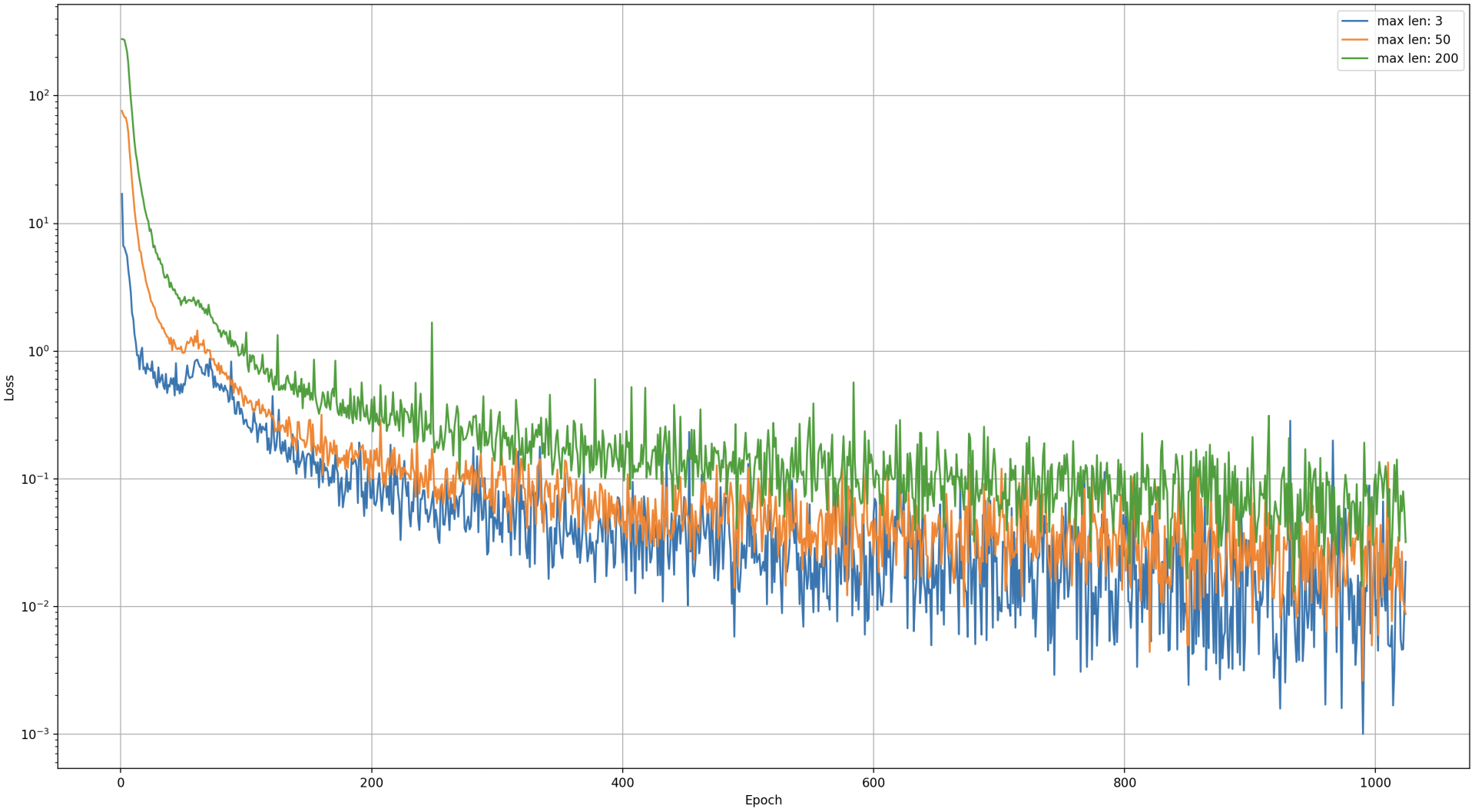
用上述的数据生成和训练参数训练模型。
int main(){
    CRNN_CTC_MODEL<GRAD_ARG,BP_ARG> model;
    for(int i=0;i<1024;i++){
        std::cout<<"epoch "<<i+1<<"/1024"<<std::endl;
        std::cout<<"max len: 3"<<std::endl;
        model.train(45,[]()->auto{return IMAGE::random_vector(1,3);});
        std::cout<<"max len: 50"<<std::endl;
        model.train(90,[]()->auto{return IMAGE::random_vector(1,50);});
        std::cout<<"max len: 200"<<std::endl;
        model.train(75,[]()->auto{return IMAGE::random_vector(1,200);});
    }
    model.print_model();
    return 0;
}编译运行程序,得到一个模型。这个模型对上述参数生成的数据的准确率超过 。它可以获得 分。
第二步
按照题目描述生成数据,用这些数据微调模型。
具体地,将第一步得到的模型复制到int main(){}前,然后作如下更改:
- 将
IMAGE::IMAGE()中std::uniform_real_distribution<float> Md(0.9,1),Mhd(0.8,1),Mwd(0.8,1),Rd(-25,25),Sxd(-0.2,0.2),Syd(-0.2,0.2);改为std::uniform_real_distribution<float> Md(0.9,1),Mhd(0.9,1),Mwd(0.9,1),Rd(-15,15),Sxd(-0.1,0.1),Syd(-0.1,0.1); - 删除
IMAGE::IMAGE()中的float p=std::uniform_real_distribution<float>(0.04,0.06)(gen);,将if(u(gen)<p){改为if(u(gen)<0.05){ - 将
CRNN_CTC_MODEL::train(...)中...,float learning_rate=0.001,...改为...,float learning_rate=0.00001,... - 将
main中CRNN_CTC_MODEL<GRAD_ARG,BP_ARG> model;改为CRNN_CTC_MODEL<GRAD_ARG,BP_ARG> model(cnn1_arg,cnn2_arg,cnn3_arg,rnn_arg); - 将
main中两处1024改为8
编译运行程序,得到一个新的模型。
第三步
将第二步得到的模型复制到程序中,并且删除不必要的代码,得到最终提交的代码。它可以通过此题。