
前言
很好的一道题,写了两个小时,还看了题解,直接退役,所以写篇题解理理思路。
思路
可以将 轴和 轴的正负半轴单独取出来成为新的“象限”,操作过后总共就有 个象限了。然后将每个点排序,我是以 轴的正半轴为起点逆时针排的序,就是这样:
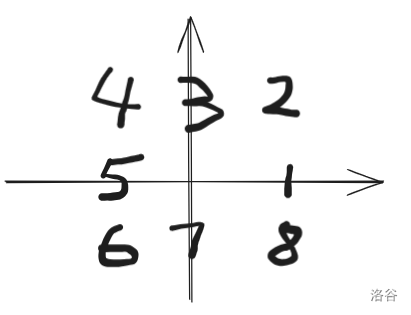
可以算出第一象限到任意一个点可以扫过多少个点,然后差分一下就好了。
然后问题变成了如何求第一象限到任意一个点(询问的点,可以不在 星星 中)可以扫过多少个点。排序后的点具有单调性,所以可以用二分处理,直接用 lower_bound 和 upperbound 就行了。
代码
#include <bits/stdc++.h>
#define int long long
using namespace std;

const int M = 1e5 + 5;

int n, m;

struct node {
	int x, y, q;

	bool operator< (const node &t) const {
		if(q != t.q) return q < t.q;
		if(q & 1) return 0;
		if(q == 2 || q == 6) return x * t.y > y * t.x;
		else return x * t.y < y * t.x;
		// 其实就是 y / x 和 t.y / t.x 的变形,因为直接求斜率精度会爆
	}
} a[M];

int get_q(dou x, int y) { // 获取点的象限
	if(x > 0 && y == 0) return 1;
	if(x > 0 && y > 0) return 2;
	if(x == 0 && y > 0) return 3;
	if(x < 0 && y > 0) return 4;
	if(x < 0 && y == 0) return 5;
	if(x < 0 && y < 0) return 6;
	if(x == 0 && y < 0) return 7;
	if(x > 0 && y < 0) return 8;
}

node type(int x, int y) { return {abs(x), abs(y), get_q(x, y)}; }

struct line { int s, t, w; };

line count(node t) {
	line res;
	// s 表示小于等于 t 的第一个点,因为重载了 <,所以可以直接用 lower_bound
	res.s = lower_bound(a + 1, a + n + 1, t) - a;

	// t 表示最后一个等于 t 的点
	res.t = upper_bound(a + 1, a + n + 1, t) - a - 1;

	// w 表示与这个点在同一直线上的点数
	res.w = res.t - res.s + 1;
	return res;
}

int main() {
	scanf("%lld%lld", &n, &m);
	int x, y;
	for(int i = 1; i <= n; i++) {
		scanf("%lld%lld", &x, &y);
		a[i] = type(x, y);
	}
	sort(a + 1, a + n + 1);
	line now = count(type(1, 0));
	while(m--) {
		scanf("%lld%lld", &x, &y);
		line to = count(type(x, y));
		int tmp = to.s - now.t - 1;
		// tmp 表示的是 now 到 to 之间的星星数,不包括 now 和 to 所在的直线
		if(tmp < 0) tmp += n;
		printf("%lld\n", max(n - tmp, tmp + now.w + to.w));
		// 可以从两个方向转
		now = to;
	}
	return 0;
}