前置知识
正负环
spfa 能在最长路判正环,最短路判负环
如果这张图里有负环,最短路 spfa 会出现什么情况?
对,会死循环,一直停在那几个形成负环的点上。
那我们就给更新一个限度,如果一个点被更新的次数超过了这个次数,就判为有负环。但多少合适呢?
是 n 次,我们可以把每一层松弛看作在原路线的基础上多加了一个点,最多有 n 个点,超过 n 个点就说明他至少到一个点两次,即形成了一个环。这个环的边权总和一定小于 0 ,不然其重复更新的那个点不可能会变得更小。
Code
bool spfa(){
	queue<ll> q;
	for(int i = 1;i <= n;i++){
		dis[i] = 1e18;
		vis[i] = 0;
		in[i] = 0;
	}
	q.push(s);
	dis[s] = 0;
	vis[s] = 1;
	while(q.size() > 0){
		ll x = q.front();
		q.pop();
		vis[x] = 0;
		for(auto nx:G[x]){
			if(dis[nx.e] > dis[x] + nx.x){
				dis[nx.e] = dis[x] + nx.x;
				if(vis[nx.e] == 0){
				    vis[nx.e] = 1;
					in[nx.e]++;
					if(in[nx.e] == n) return 1;
			    	q.push(nx.e);
				}
			}
		}
	}
	return 0;
}
Johnson
一种全源最短路算法。
参考:
- OI-Wiki Johnson(也许陈老师上课的图和正确性证明是从这里偷的?)
- 洛谷巨佬StudyingFather所写
- OI-Wiki最短路 ,目前学的所有算法,证明,优缺点都有了
Johnson 算法是一种能够在 O(nm log m) 的时间内求出全员最短路的算法,在稀疏图中比 Floyd 快。
我们写过一道题,叫做 公路通行税 我们就可以用 n 遍 Dij 过掉。
Johnson 算法两个核心第二个就是用 n 次 Dij 来求出全源最短路。
但是某些毒瘤题会给你负边权,这时候又该怎么办呢?我们就想办法把边权变为正的同时不影响答案。
如果直接加数的话,可以看看下面:
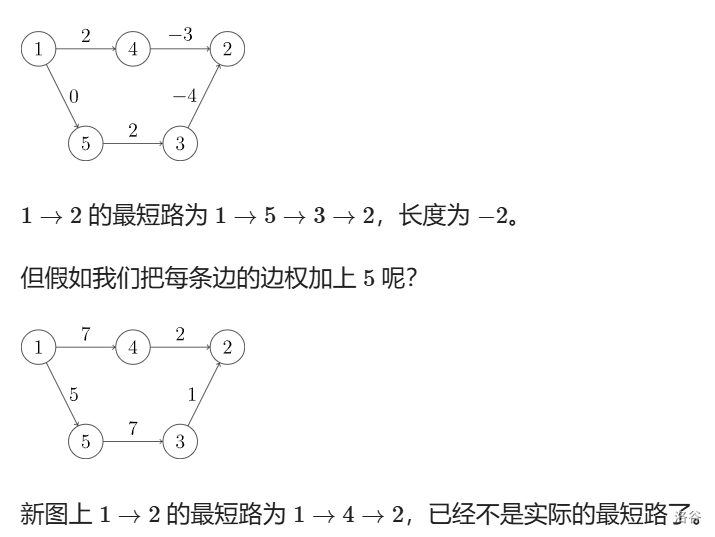 我们用一个超级原点
0 ,链接所有的点。接着用 spfa 求出从 0 到其他所有点的最短路。从 0 到 i 点的最短路设为 h[i]
若一条边边权原本为 w 起点和终点分别为 s 和 e,现在把它改为 w + h[s] - h[e]
因为 h[i] 是从 0 到 i 点的最短路,所以一定有 h[s] + w >= h[e] ,将 h[e] 移到左边去,得到 w + h[s] - h[e] >= 0 ,即新边权非负 。
接下来可以放心大胆的跑 Dij 了,注意跑完之后的结果还要加上 h[e] - h[s]
P10110 [GESP202312 七级] 商品交易 - 洛谷 | 计算机科学教育新生态
典型的负边权变正边权。
首先,很明显,这一题如果用 SPFA ,就很有可能超时( O(nm) 会 TLE )。那么只能用 Dij 或者某种奇奇怪怪的算法。
但是 Dij 无法处理负边权啊。这个时候就要分析一下题目。
假设我要拿 i 换 j :
- 若
v[i] > v[j],那么我就赚了v[i] - v[j] - 1块钱,即亏了v[j] - v[i] + 1 - 若
v[i] < v[j],那么我就亏了v[j] - v[i] + 1块钱
若我的交换过程是这样的: A[1]->A[2]->A[3]->A[4]->...->A[n]
则我亏了:
 (A[2] - A[1] + 1) + (A[3] - A[2] + 1) + ... + (A[n] - A[n - 1] + 1)
= A[n] - A[1] + (n - 1)最后我亏的钱中,A[n] - A[1] 是固定的,只有 n - 1 不固定,所以只要交换的次数最少,我亏的钱就越少。
此时跑一遍 Dij/BFS 即可
Code
#include <iostream>
#include <cstdio>
#include <algorithm>
#include <cmath>
#include <queue>
#include <vector>
using namespace std;
typedef long long ll;
struct node{
	ll id,x;
	bool operator < (const node& a) const{
		return a.x < x;
	}
};
ll n,m,a,b,v[100005],dis[100005];
vector<ll> G[100005];
bool vis[100005];

void dij(){
	for(int i = 1;i <= n;i++){
		dis[i] = 1e18;
		vis[i] = 0;
	}
	priority_queue<node> pq;
	pq.push({a,0});
	dis[a] = 0;
	while(pq.size() > 0){
		node x = pq.top();
		pq.pop();
		if(vis[x.id] == 1) continue;
		vis[x.id] = 1;
		for(auto nx:G[x.id]){
			if(vis[nx] == 0 && dis[nx] > dis[x.id] + 1){
				dis[nx] = dis[x.id] + 1;
				pq.push({nx,dis[nx]});
			}
		}
	}
	return ;
}

int main(){
	ios::sync_with_stdio(0);
	cin.tie(0),cout.tie(0);
	cin >> n >> m >> a >> b;
	a++,b++;
	for(int i = 1;i <= n;i++) cin >> v[i];
	for(int i = 1;i <= m;i++){
		ll s,e;
		cin >> s >> e;
		s++,e++;
		G[s].push_back(e);
	}
	dij();
	if(dis[b] == 1e18) cout << "No solution";
	else cout << dis[b] + v[b] - v[a];
	return 0;
}
主要是想办法把边权抵消,抵消到答案是一个定值加上一个变值(变值的求法能够使用时间复杂度可以过的算法)
[ABC237E] Skiing - 洛谷 | 计算机科学教育新生态
这一题和上一题一样的,直接跑 SPFA 会炸…
继续分析一下,虽然说这一题也有减法,但是不能够像上次一样消消乐。
那我们能不能构造出来一个和上一题差不多的?还真能!
我们对所有边权减去一个 (H_X - H_Y) ,边权变成下面了:
- H_X > H_Y 时,幸福感会增加 0
- H_X < H_Y 时,幸福感会增加 H_X - H_Y
- H_X < H_Y 时,幸福感会增加 -(H_X - H_Y) , 即 0
这样这个边权就可以抵消了,减去的 (H_X - H_Y) 仍然可以抵消。
问题是这个边权仍然是负的啊。没关系,我们要求的幸福值要求最大,那么这些负的就要最大,他们的绝对值就要最小!我们把它转化为正的跑 Dij 最短路就可以了。
至于减去的,后面需要加上,会发现这是个定值 H[起点] - H[终点]
Code
#include <iostream>
#include <cstdio>
#include <algorithm>
#include <cmath>
#include <queue>
#include <vector>
using namespace std;
typedef long long ll;
struct node{
	ll id,x;
	bool operator < (const node& a) const{
		return a.x < x;
	}
};
struct edge{
	ll e,x;
};
ll n,m,h[200005],dis[200005];
vector<edge> G[200005];
bool vis[200005];

void dij(){
	for(int i = 1;i <= n;i++){
		dis[i] = 1e18;
		vis[i] = 0;
	}
	priority_queue<node> pq;
	pq.push({1,0});
	dis[1] = 0;
	while(pq.size() > 0){
		node x = pq.top();
		pq.pop();
		if(vis[x.id] == 1) continue;
		vis[x.id] = 1;
		for(auto nx:G[x.id]){
			if(vis[nx.e] == 0 && dis[nx.e] > dis[x.id] + nx.x){
				dis[nx.e] = dis[x.id] + nx.x;
				pq.push({nx.e,dis[nx.e]});
			}
		}
	}
	return ;
}

int main(){
	cin >> n >> m;
	for(int i = 1;i <= n;i++){
		cin >> h[i];
	}
	for(int i = 1;i <= m;i++){
		ll s,e;
		cin >> s >> e;
		if(h[s] > h[e]){
			G[s].push_back({e,0});
			G[e].push_back({s,h[s] - h[e]});
		}else{
			G[s].push_back({e,h[e] - h[s]});
			G[e].push_back({s,0});
		}
	}
	dij();
	ll ans = -1e18;
	for(int i = 1;i <= n;i++){
		ans = max(ans,h[1] - h[i] - dis[i]);
	}
	cout << ans;
	return 0;
}
当题目没给时,想办法自己构造。
P3385 【模板】负环 - 洛谷 | 计算机科学教育新生态
负环模板,不多讲
多组数据,记得清空
Code
#include <iostream>
#include <cstdio>
#include <algorithm>
#include <cmath>
#include <vector>
#include <queue>
using namespace std;
typedef long long ll;
struct node{
	ll e,x;
};
ll n,m,s,dis[2005],in[2005];
vector<node> G[2005];
bool vis[2005];

bool spfa(){
	queue<ll> q;
	for(int i = 1;i <= n;i++){
		dis[i] = 1e18;
		vis[i] = 0;
		in[i] = 0;
	}
	q.push(s);
	dis[s] = 0;
	vis[s] = 1;
	while(q.size() > 0){
		ll x = q.front();
		q.pop();
		vis[x] = 0;
		for(auto nx:G[x]){
			if(dis[nx.e] > dis[x] + nx.x){
				dis[nx.e] = dis[x] + nx.x;
				if(vis[nx.e] == 0){
				    vis[nx.e] = 1;
					in[nx.e]++;
					if(in[nx.e] == n) return 1;
			    	q.push(nx.e);
				}
			}
		}
	}
	return 0;
}

int main(){
	ll T;
	cin >> T;
	while(T--){
		cin >> n >> m;
		s = 1;
		for(int i = 1;i <= m;i++){
			ll s,e,x;
			cin >> s >> e >> x;
			if(x < 0) G[s].push_back({e,x});
			else G[s].push_back({e,x}),G[e].push_back({s,x});
		}
		if(spfa()){
			cout << "YES\n";
		}else{
			cout << "NO\n";
		}
		for(int i = 1;i <= n;i++){
			G[i].clear();
		}
	}
	return 0;
}
P1931 套利 - 洛谷 | 计算机科学教育新生态
暴力枚举每一个货币,尝试从他开始有没有正环(乘法)
多组数据,记得清空
Code
#include <iostream>
#include <cstdio>
#include <algorithm>
#include <cmath>
#include <vector>
#include <queue>
#include <string>
#include <map>
using namespace std;
typedef long long ll;
struct edge{
	ll e;
	double x;
};
ll n,m,cnt,in[35];
double dis[35];
map<string,ll> id;
vector<edge> G[35];
bool vis[35];

bool spfa(ll s){
	for(int i = 1;i <= n;i++){
		dis[i] = 0;
		vis[i] = 0;
		in[i] = 0;
	}
	queue<ll> q;
	q.push(s);
	dis[s] = 1;
	vis[s] = 1;
	while(q.size() > 0){
		ll x = q.front();
		q.pop();
		vis[x] = 0;
		for(auto nx:G[x]){
			if(dis[nx.e] < dis[x] * nx.x){
				dis[nx.e] = dis[x] * nx.x;
				// cout << nx.e << " " << dis[nx.e] << " " << x << "\n";
				if(vis[nx.e] == 0){
					vis[nx.e] = 1;
					q.push(nx.e);
					in[nx.e]++;
					if(in[nx.e] == n) return 1;
				}
			}
		}
	}
	return 0;
}

int main(){
	ll T = 0;
	while(1){
		T++;
		cnt = 0;
		id.clear();
		cin >> n;
		if(n == 0) return 0;
		for(int i = 1;i <= n;i++){
			string x;
			cin >> x;
			id[x] = ++cnt;
			G[i].clear();
		}
		cin >> m;
		for(int i = 1;i <= m;i++){
			string S,E;
			ll s,e;
			double x;
			cin >> S >> x >> E;
			s = id[S],e = id[E];
			G[s].push_back({e,x});
		}
		bool f = 1;
		for(int i = 1;i <= n;i++){
			if(spfa(i)){
				cout << "Case "<< T << ": " << "Yes\n";
				f = 0;
				break;
			}
		}
		if(f) cout << "Case "<< T << ": " << "No\n";
	}
	return 0;
}
P5905 【模板】全源最短路(Johnson) - 洛谷 | 计算机科学教育新生态
模板 Johnson ,只不过在跑 spfa 时还要判下负环。
Code
#include <iostream>
#include <cstdio>
#include <algorithm>
#include <cmath>
#include <vector>
#include <queue>
using namespace std;
typedef long long ll;
struct edge{
    ll e,x;
};
struct node{
    ll id,x;
    bool operator < (const node& a) const{
        return a.x < x;
    }
};
ll n,m,h[3005],dis[3005][3005],in[3005];
vector<edge> G[3005];
bool vis[3005];

bool spfa(){
    for(ll i = 1;i <= n;i++){
        h[i] = 1e9;
    }
    queue<ll> q;
    q.push(0);
    h[0] = 0;
    vis[0] = 1;
    while(q.size() > 0){
        ll x = q.front();
        q.pop();
        vis[x] = 0;
        for(auto nx:G[x]){
            if(h[nx.e] > h[x] + nx.x){
                h[nx.e] = h[x] + nx.x;
                if(vis[nx.e] == 0){
                    vis[nx.e] = 1;
                    q.push(nx.e);
                    in[nx.e]++;
                    if(in[nx.e] == n) return 1;
                }
            }
        }
    }
    return 0;
}

void dij(ll s){
    for(ll i = 1;i <= n;i++){
        dis[s][i] = 1e18;
        vis[i] = 0;
    }
    priority_queue<node> pq;
    pq.push({s,0});
    dis[s][s] = 0;
    while(pq.size() > 0){
        node x = pq.top();
        pq.pop();
        if(vis[x.id] == 1) continue;
        vis[x.id] = 1;
        for(auto nx:G[x.id]){
            if(vis[nx.e] == 0 && dis[s][nx.e] > dis[s][x.id] + nx.x){
                dis[s][nx.e] = dis[s][x.id] + nx.x;
                pq.push({nx.e,dis[s][nx.e]});
            }
        }
    }
    return ;
}

int main(){
    cin >> n >> m;
    for(ll i = 1;i <= m;i++){
        ll s,e,x;
        cin >> s >> e >> x;
        G[s].push_back({e,x});
        // G[e].push_back({s,x});
    }
    for(ll i = 1;i <= n;i++){
        G[0].push_back({i,0});
        // G[i].push_back({0,0});
    }
    if(spfa()){
        cout << "-1";
        return 0;
    }
    for(ll i = 1;i <= n;i++){
        for(auto &nx:G[i]){
            nx.x += (h[i] - h[nx.e]);
        }
    }
    for(ll i = 1;i <= n;i++){
        dij(i);
    }
    for(ll i = 1;i <= n;i++){
        ll ans = 0;
        for(ll j = 1;j <= n;j++){
            if(dis[i][j] == 1e18){
                ans += j * ll(1e9);
            }else{
                ans += j * ll(dis[i][j] + h[j] - h[i]);
            }
        }
        cout << ans << "\n";
    }
    return 0;
}