
导数
基本初等函数的导数公式
运算法则
-
-
-
-
-
-
-
复合函数 的导数,与 的关系:
即 对 的导数等于 对 的导数乘 对 的导数。
-
在 处取极值时,.
-
在 处的切线斜率 ,切线方程 .
-
多个函数乘积的求导法则:
重要不等式
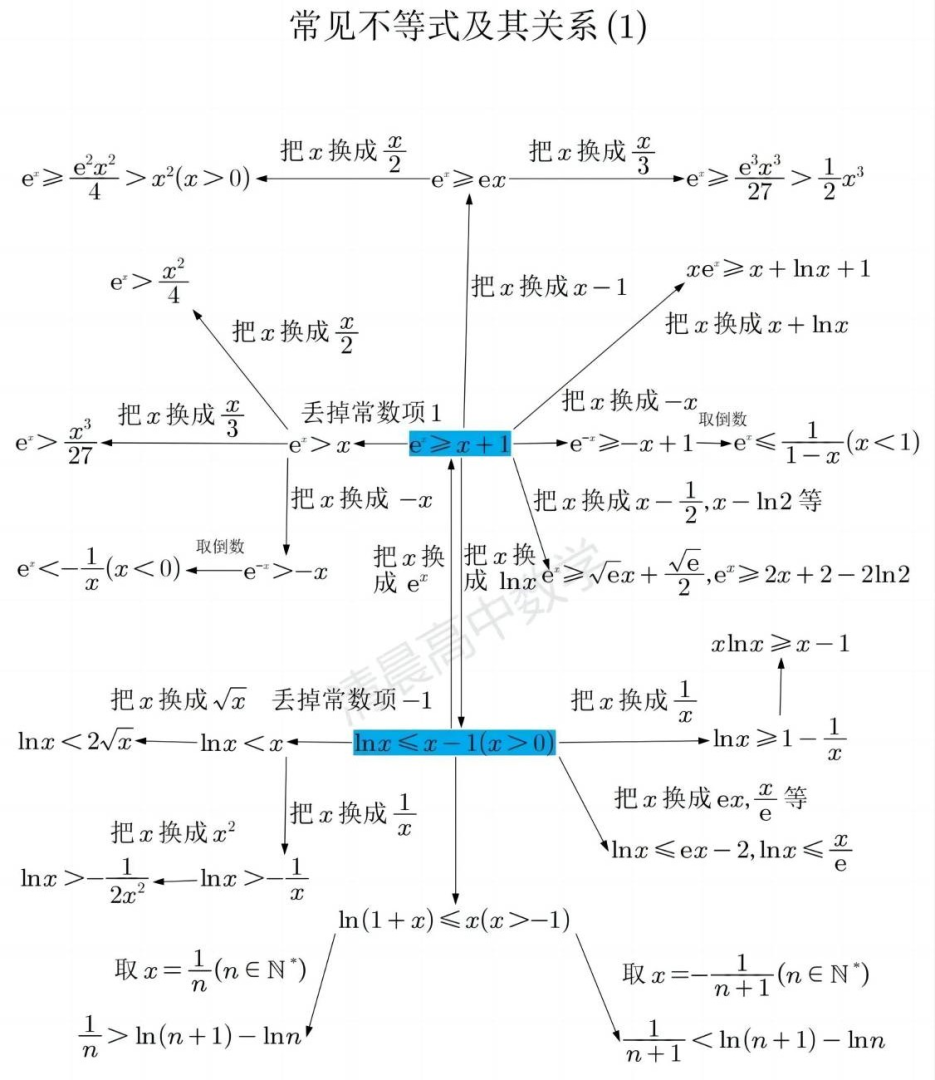
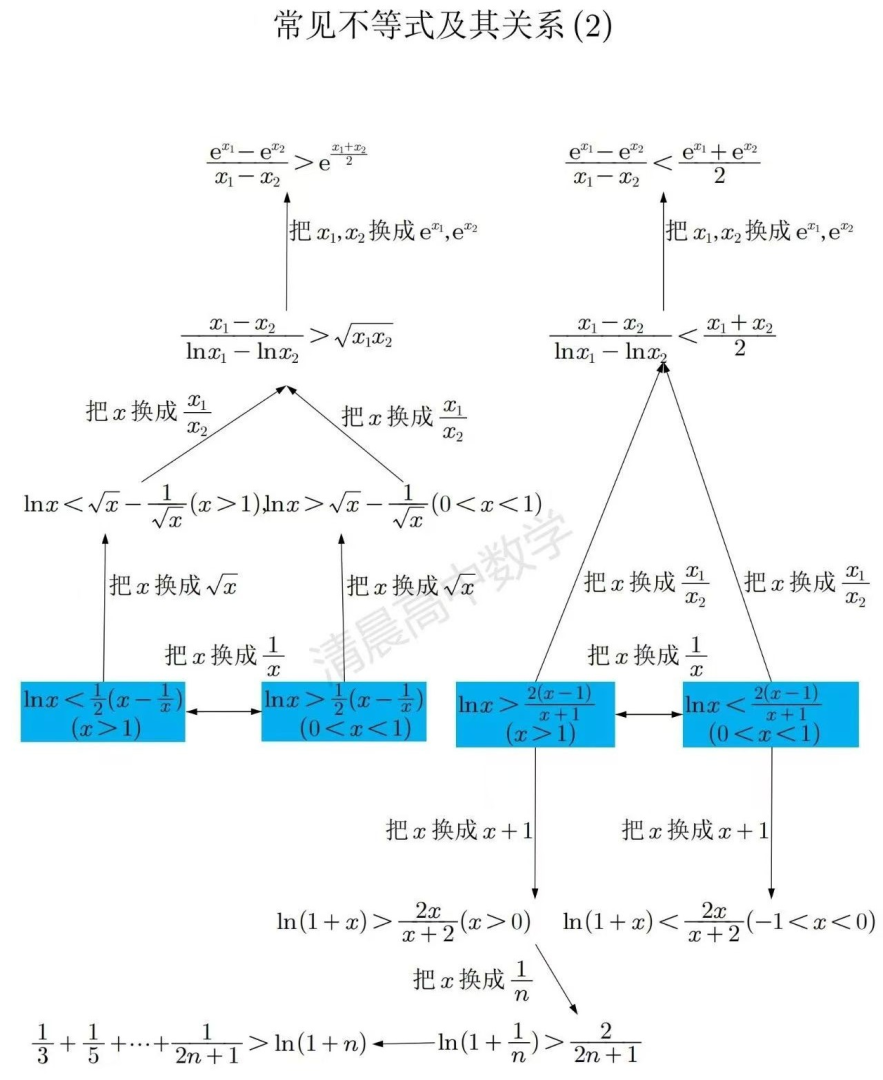
一些例题:
- 已知 .
若 恒成立,求 的值。
证明:.
解:,得到 .
由 得到 ,令 得到 ,于是
- 设 .
若 恒成立,求 范围。
设 ,比较 与 的大小,并加以证明。
解:.
只用证
只用证 ( 这是个很重要的不等式,会经常用到!)由 即证。
也可以这样:由 ,代入 即证。
- 证明:,
n\in\N^*.
只用证 \displaystyle\sqrt{\frac{n+1}{n}}-\sqrt{\frac{n}{n+1}}>\ln\frac{n+1}{n},也就是 \displaystyle\red{\boxed{\frac{1}{\sqrt{n^2+n}}>\ln\frac{n+1}{n}}}
我们设 u=\displaystyle\frac{n+1}{n} 换元,只用证 \sqrt{u}-\displaystyle\frac{1}{\sqrt{u}}>\ln u,求导很容易证。
- 已知
\displaystyle f(x)=x^2-e^{\lambda x-\frac{1}{x}}.(1)\ x\geq 1时f(x)\leq 0,求\lambda范围。(2)求证:\displaystyle e^{\frac{1}{n+1}+\frac{1}{n+2}+\dots+\frac{1}{4n}}>2e^{-\frac{1}{4n}}.
(1)\ \lambda\in[1,+\infty)\ \ \ \ \ \ \ \ \ \ \ \ \ (2) 即证 \displaystyle\frac{1}{n+1}+\frac{1}{n+2}+\dots+\frac{1}{2n}>\ln 2-\frac{1}{4n}
由 (1) 得 \displaystyle e^{x-\frac{1}{x}}\geq x^2\implies\ln x\leq \frac{1}{2}\left(x-\frac{1}{x}\right)\implies \ln\frac{n+1}{n}\leq\frac{1}{2}\left(\frac{1}{n}+\frac{1}{n+1}\right)
\begin{aligned}\ln 2&=\ln\frac{n+1}{n}+\ln\frac{n+2}{n+1}+\dots+\ln\frac{2n}{2n-1}\\&<\frac{1}{2}\left(\frac{1}{n}+\frac{1}{n+1}+\frac{1}{n+1}+\frac{1}{n+2}+\dots+\frac{1}{2n-1}+\frac{1}{2n}\right)\\&=\frac{1}{2n}+\frac{1}{n+1}+\frac{1}{n+2}+\dots+\frac{1}{2n-1}+\frac{1}{4n}\end{aligned}
原题得证。此外,笔者在初次做这道题时,是通过构造函数 \displaystyle \frac{1}{n+1}>\ln\frac{n+1}{n}-\frac{1}{2n(n+1)} 做的,十分麻烦并且花费了大约 1 个小时的时间,还是利用 (1) 的结论最好。并且提醒:此题不能直接数学归纳法。
三次函数
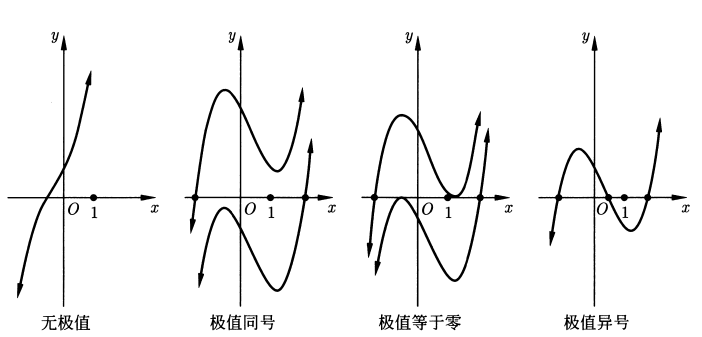
设 f(x)=ax^3+bx^2+cx+d,则 f'(x)=3ax^2+2bx+c. 对于方程 f'(x)=0,我们记它的根的判别式 \Delta=4b^2-12ac. 当 \Delta >0 时,记 x_1,x_2 为方程的根,即 f(x) 的极值点。
-
f(x)=0有1个根\xleftrightarrow{}\Delta\leq 0或\begin{cases}\Delta>0 \\ f(x_1)f(x_2)>0\end{cases} -
f(x)=0有2个根\xleftrightarrow{}\begin{cases}\Delta>0 \\ f(x_1)f(x_2)=0\end{cases} -
f(x)=0有3个根\xleftrightarrow{}\begin{cases}\Delta>0 \\ f(x_1)f(x_2)<0\end{cases}
练习题:
(1) 若 \displaystyle f(x)=\frac{1}{3}x^3+\frac{1}{2}ax^2+1 有一个零点,求实数 a 的取值范围。
(2) 若 \displaystyle f(x)=\frac{1}{3}x^3+ax+1 有两个零点,求实数 a 的取值范围。
(3) 若 f(x)=x^3-3a^2x+2(a>0) 有三个零点,求实数 a 的取值范围。
答案分别为 \displaystyle \left(-\sqrt[3]{6},+\infty\right),\set{-\sqrt[3]{\frac{9}{4}}},(1,+\infty)
【2014 北京文 T20】f(x)=2x^3-3x.
(1) 若过 P(1,m) 存在 3 条直线与曲线 y=f(x) 相切,求 m 的取值范围。
(2) 问过点 A(-1,2),B(2,10),C(0,2) 分别存在多少条直线与曲线 y=f(x) 相切 ?直接写出答案。
f'(x)=6x^2-3,设切点 (t,f(t)),则切线方程 y-(2t^2-3t)=(6t^2-3)(x-t). 设切线过 (a,b),则 4t^3-6at^2+3a+b=0,令 g(t)=4t^3-6at^2+3a+b,g'(t)=12t^2-12at=0\implies t_1=0,t_2=a.
(1) (a,b)=(1,m),g(t)_{\max}=g(0)=m+3>0,g(t)_{\min}=g(1)=m+1<0\implies m\in(-3,-1).
(2) 答案分别为 3,2,1.
整体代换
【2018 II 卷文 T21】证明 \displaystyle f(x)=\frac{1}{3}x^3-a(x^2+x+1) 只有 1 个零点。
f'(x)=x^2-2ax-a,\Delta=4a^2+4a
(1) 当 -1\leq a\leq 0 时,f'(x)\geq 0 恒成立,故 f(x) 在 \R 上 \uparrow,只有 1 个零点。
(2) 当 a>0 或 a<-1 时,f'(x)=0 有两个根 x_1,x_2,由题意 f(x_1)f(x_2)>0. 由 f'(x_1)=x_1^2-2ax_1-a=0 得 x_1^2=2ax_1+a,则
\begin{aligned}f(x_1)&=\frac{1}{3}x_1^3-a(x_1^2+x_1+1)=\frac{1}{3}x_1(2ax_1+a)-a(x_1^2+x_1+a)\\&=-\frac{a}{3}x_1^2-\frac{2a}{3}x_1-a=-\frac{2}{3}a(a+1)x_1-\left(\frac{a^2}{3}+a\right)\end{aligned}
同理 \displaystyle f(x_2)=-\frac{2}{3}a(a+1)x_2-\left(\frac{a^2}{3}+a\right),由韦达定理 x_1+x_2=2a,x_1x_2=-a,得到 \displaystyle f(x_1)f(x_2)=\frac{1}{9}a^2\left[\left(3a+\frac{7}{3}\right)^2+\frac{32}{9}\right]>0
对称中心
- 已知
f(x)=ax^3+bx^2+cx+d,则f(x)的对称中心为\displaystyle\red{\boxed{\left(-\frac{b}{3a},f\left(-\frac{b}{3a}\right)\right)}},此时f''(x)=0. 若x_1,x_2是f(x)的极值点或x_1,x_2关于\displaystyle x=-\frac{b}{3a}对称,则\displaystyle \frac{f(x_1)+f(x_2)}{2}=f\left(\frac{x_1+x_2}{2}\right)=f\left(-\frac{b}{3a}\right).
why 对称中心为 \displaystyle\left(-\frac{b}{3a},f\left(-\frac{b}{3a}\right)\right):对任意 x,存在 \displaystyle f(x)+f\left(-\frac{2b}{3a}-x\right)=2\left(-\frac{b}{3a}\right).
【2012 大纲卷文 T21】设 \displaystyle f(x)=\frac{1}{3}x^3+x^2+ax 有两个极值点 (x_1,x_2),若过两点 (x_1,f(x_1)),(x_2,f(x_2)) 的直线 l 与 x 轴的交点在曲线 y=f(x) 上,求 a 的值。
f'(x)=x^2+2x+a=0 有两根 x_1,x_2,由 \Delta=4-4a>0\implies a<1.
由韦达定理 \begin{cases}x_1+x_2=-2\\x_1x_2=a\end{cases},斜率 \displaystyle k=\frac{f(x_2)-f(x_1)}{x_2-x_1}=\frac{2}{3}(a-1)。
直线 l 必过中点 \displaystyle \left(-1,\frac{2}{3}-a\right). 所以直线方程 \displaystyle y-\left(\frac{2}{3}-a\right)=\frac{2}{3}(a-1)(x+1),令 y=0 得 \displaystyle x=\frac{a}{2(a-1)},代入 f(x) 得 a=0 或 \displaystyle\frac{2}{3} 或 \displaystyle\frac{3}{4}.
复合函数方程有解问题
这部分高一上学期应该有所涉及,方法是画出图像然后分析。先来两道入门题。
- 已知
f(x)=|x^2-4x|,求方程f^2(x)-3f(x)+2=0的实数根的个数。 - 已知
f(x)=|x^2-4x|,求方程f^2(x)-3af(x)+2a^2=0的实数根的个数。
答案:
-
f^2(x)-3f(x)+2=[f(x)-1][f(x)-2]=0\implies x=1\ \text{or}\ 2,画图得共8个实数根。 -
f^2(x)-3af(x)+2a^2=[f(x)-a][f(x)-2a]=0\implies x=a\ \text{or}\ 2a,接下来分类讨论即可。
这两题都可因式分解,换个难点的:
- 已知
f(x)=\begin{cases} x^2 & x\leq 0 \\ 4\sin x & 0< x\leq \pi \end{cases},方程f(f(x))=0有多少个解 ?
要让 f(t)=0,那么解得 t=0/\pi,只要统计满足 f(x)=t 的 x 个数即可。答案是 5.
太简单了。上导数。
\displaystyle f(x)=\frac{x}{e^{x-1}},若关于x的方程f^2(x)-m|f(x)|-2m-3=0有三个不同实数根,求m范围。
f'(x)=\frac{1-x}{e^{x-1}}=0\implies x=1,x<1,f(x)\uparrow,x>1,f(x)\downarrow,f(x)_{\max}=f(1)=1.
显然 \displaystyle f(0)=0,\lim_{x\to-\infty}f(x)=-\infty,\lim_{x\to+\infty}f(x)=0,于是可以做出 t=|f(x)| 图像。
原题变为 g(t)=t^2-mt-2m-3=0(t\geq 0),接下来分类讨论:
① 只有一个根 t_0,\begin{cases}\Delta=m^2+8m+12=0\\ \displaystyle 0<t_0=\frac{m}{2}<1\end{cases},此时无解。
② 两个根 t_1,t_2,\Delta>0\implies m<-6/m>-2,继续分类讨论。这时候要根据图像推范围。
(1)\ t_1<0,0<t_2<1,即 g(0)<0,g(1)>0,解得 \displaystyle -\frac{3}{2}<m<-\frac{2}{3}.
(2)\ t_1=0,t_2=1,容易验证无解。
(3)\ t_1=1,t_2>1,得 \displaystyle m=-\frac{2}{3},\displaystyle t_2=-\frac{5}{3},排除。
所以答案 \displaystyle\left(-\frac{3}{2},-\frac{2}{3}\right).
- 【2019 GD 二模理 T12】
f(x)=\begin{cases}1-x & x\leq 0 \\ \log_2x & x>0\end{cases},若关于x的方程f(f(x))=m有两个不同根x_1,x_2,求x_1+x_2范围。
答案:[2,3). m 的范围是 [0,1).
- 【2024 HB 八市联考】已知函数
f(x)=ax^3+bx^2+cx+d存在两个极值点x_1,x_2(x_1<x_2),且f(x_1)=-x_1,f(x_2)=x_2. 设f(x)的零点个数为m,方程3af^2(x)+2bf(x)+c=0的实根个数为n,则
\text{A.} 当 a>0 时,n=3 \ \ \ \ \ \text{B.} 当 a<0 时,m+2=n
\text{C.}\ nm 一定能被 3 整除 \ \ \ \ \ \ \text{D.}\ m+n 的取值集合为 \set{4,5,6,7}
答案:\text{AB}.
解析:显然 x_1,x_2 是 f'(x)=3ax^2+2bx+c 的零点,而 f(f'(x))=3af^2(x)+2bf(x)+c=0,因此 f(x)=x_1 或 x_2.
当 a>0 时,f(x) 在 (-\infty,x_1),(x_2,+\infty)\uparrow,(x_1,x_2)\downarrow,f(x)_{\max}=f(x_1)=-x_1,f(x)_{\min}=f(x_2)=x_2,显然 -x_1>x_2,所以 x_1<0,x_2>0,f(x)=x_1 有 1 个根,f(x)=x_2 有 2 个根,n=3,故 \text{A} 正确。( 以下建议画图理解 )
f(x_2)=x_2>0,m=1,nm=3,n+m=4f(x_2)=x_2=0,m=2,nm=6,n+m=5f(x_2)=x_2<0,m=3,nm=9,n+m=6
当 a<0 时,f(x) 在 (-\infty,x_1),(x_2,+\infty)\downarrow,(x_1,x_2)\uparrow,f(x)_{\max}=f(x_2)=x_2,f(x)_{\min}=f(x_1)=-x_1,显然 x_2>-x_1,所以 x_2>0.
f(x_1)=-x_1>0,x_1<0,m=1,n=3,nm=3,n+m=4f(x_1)=-x_1=0,x_1=0,m=2,n=4,nm=8,n+m=6f(x_1)=-x_1<0,x_1>0,m=3,n=5,nm=15,n+m=8
或 型
-
若
f(x)单调,则f(f(x))=x的解与f(x)=x的解相同 -
f(f(x))=x有解\iff\ f(x)=x有解。 -
f(f(x))=x无解\iff\ f(x)=x无解。 -
f(g(x))=x有解\iff\ g(f(x))=x有解。
两道练习题:
- 【2013 SC 理 T10】
f(x)=\sqrt{e^x+x-a}. 若曲线y=\sin x上存在(x_0,y_0)使得f(f(y_0))=y_0,求a的范围。
答案:[1,e]. 问题等价于 f(x)=x 在 [0,1] 上有解,答案即 a=-x^2+x+e^x 在 [0,1] 上的值域。
\displaystyle f(x)=\ln x+\frac{1}{2}x-a,若存在b\in[1,e]使得f(f(b))=b,求a的范围。
答案:\displaystyle\left[-\frac{1}{2},\ln 2-1\right]。问题等价于 f(x)=x 在 [1,e] 上有解,即 \displaystyle a=\ln x -\frac{x}{2} 在 [1,e] 上的值域。
简单的恒成立问题
-
f(x)\geq 0在定义域内恒成立等价于f(x)_{\min}\geq 0. -
f(x)\leq 0在定义域内恒成立等价于f(x)_{\max}\leq 0.
来一道简单题:【2013 全国理 T9】f(x)=x^2+ax+\frac{1}{x} 在 (\frac{1}{2},+\infty) 是增函数,求 a 的取值范围。
答案:[3,+\infty). 参数分离即可。
当涉及指数函数或对数函数并且难以直接求导数零点时,就要考虑以下这种方法。( 新高掌 P112 )
- 指数找队友:形如
\boxed{e^xf(x)}或\boxed{e^{-x}f(x)}求导后是\boxed{e^x[f(x)+f'(x)]}和\boxed{-e^{-x}[f(x)-f'(x)]},显然 其导数的零点和指数函数毫无关系! 因此可以将函数变形成e^{\pm x}f(x)的形式再求导数零点。 注意:- 不一定需要变形。
- 若要求
f(x)的最值、极值、单调性就不能使用这个方法。
【2013 I 理 T21】f(x)=x^2+4x+2,g(x)=e^x(2x+2),若 x\geq -2 时,f(x)\leq kg(x),求 k 取值范围。
分离参数得 \displaystyle\begin{cases}
\displaystyle k\leq \frac{e^{-x} (x^2+4x+2)}{2x+2} & x\in[-2,-1) \\
\displaystyle k\geq \frac{e^{-x} (x^2+4x+2)}{2x+2} & x\in[-1,+\infty)
\end{cases} 令 h(x)=\frac{e^{-x}(x^2+4x+2)}{2x+2},则问题转化为求 h(x) 在 [-2,-1) 上最小值,(-1,+\infty) 上最大值。
由 \displaystyle h'(x)=\frac{e^{-x}\cdot -2x(x+2)^2}{(2x+2)^2} 得 [-2,-1)\cup(-1,0) 上 h'(x)\geq 0,(0,+\infty) 上 h'(x)<0. 故在 [-2,-1) 上 h(x)_{\min}=h(-2)=e^2,(-1,+\infty) 上 h(x)_{\max}=h(0)=1. 即 k\in[1,e^2].
- 对数单身狗:形如
\boxed{f(x)+\ln g(x)}的函数求导后是\boxed{f'(x)+\frac{g'(x)}{g(x)}},显然 其导数的零点和对数函数毫无关系! 因此可以将函数变形成f(x)+\ln g(x)的形式再求导数零点。 也有另外一种形式:y=f(x)(\ln f(x)+C),y'=f'(x)(\ln f(x)+C+1),其中C为常数。
已知 f(x)=x\ln x,g(x)=-x^2+ax-3,\forall x\in(0,+\infty),2f(x)\leq g(x) 恒成立,求 a 范围。
原问题等价于 \displaystyle a\leq 2\ln x+x+\frac{3}{x},令 \displaystyle h(x)=2\ln x+x+\frac{3}{x},h'(x)=\frac{2}{x}+1-\frac{3}{x^2}=\frac{(x+3)(x-1)}{x^2}=0\implies x=1\ \text{or}\ -3( 舍去 )。所以 h(x) 在 (0,1] 上 \downarrow,在 [1,+\infty) 上 \uparrow。得到 a\leq h(x)_{\min}=h(1)=4。
关于任意与存在:相当于求函数值域问题,分类讨论慢慢分析即可。
零点问题
参考《新高中数学:你真的掌握了吗? 函数》难度由 A\to C 依次上升。
A
-
零点存在定理:若函数
f(x)在区间[a,b]上连续,且f(a)f(b)<0,则f(x)在[a,b]上必存在零点。注意这一定理不具备必要性。 -
若
f(x)在(a,b)上有零点且单调,则零点唯一。 -
若
f(x)在(a,b)上有唯一零点x_0且f(a)f(b)>0,则f'(x_0)=0.
\displaystyle 0<a<\frac{4}{\pi},若f(x)=e^x-\cos x-ax在\displaystyle\left(-\frac{\pi}{2},\frac{\pi}{2}\right)上有唯一零点,求a.
f(0)=0\implies f'(0)=0,a=1.
- 【2012 FJ 文 T22】求
\displaystyle f(x)=x\sin x-\frac{3}{2}在(0,\pi)上的零点个数。
聪明的同学可以直接泰勒展开,但是现在我们要求朴素求导。
显然 \displaystyle f(0)=f(\pi)=-\frac{3}{2}<0,f'(x)=\sin x+x\cos x,知 f'(x) 在 \displaystyle\left(0,\frac{\pi}{2}\right)>0,f'\left(\frac{\pi}{2}\right)>0,f'(\pi)<0,因此需要继续研究 f'(x) 在 \displaystyle\left(\frac{\pi}{2},\pi\right) 的单调性。
f''(x)=2\cos x-x\sin x 得 f''(x) 在 \displaystyle\left(\frac{\pi}{2},\pi\right)<0\implies f'(x)\downarrow,所以 f'(x)=0 在 \displaystyle\left(\frac{\pi}{2},\pi\right) 上有唯一零点 x_0,所以 f(x) 在 (0,x_0) \uparrow,(x_0,\pi)\downarrow.
即 \displaystyle f(x)_{\max}=f(x_0)>f\left(\frac{\pi}{2}\right)=\frac{\pi-3}{2}>0,结合 \displaystyle f(0)=f(\pi)=-\frac{3}{2}<0 得 f(x) 在 (0,x_0),(x_0,\pi) 各有一零点。
练习:求 \displaystyle f(x)=\frac{1}{2}\sqrt{x}-\cos x 在 (1,\infty) 上的零点个数。答案:1.
- 已知
f(x)=e^x-ex-a(x^2-x)在(0,1)上有零点,求a范围。
f'(x)=e^x-e-a(2x-1),f''(x)=e^x-2a,f(0)=1,f(1)=0,所以 f(x) 不单调,f'(x) 有零点。
接下来分 5 类讨论:\displaystyle a<0,0\leq a\leq\frac{1}{2},\frac{1}{2}<a<\frac{e}{2},\frac{e}{2}\leq a\leq e-1,a>e-1,对每一类求出 f'(x) 单调性,跟上一题一样判断即可。
答案:(-\infty,0)
为什么是这 5 类:来自 f'(0)=0,f'(1)=0,f''(0)=0,f''(1)=0,分别求得 \displaystyle e-1,0,\frac{1}{2},\frac{e}{2}.
其中前 2 个是由 f'(x) 有零点的临界条件得来,后 2 个由 f'(x) 的单调性得来,即 f''(x)>0.
练习:【2014 SC 理 T21】已知 f(x)=e^x-ax^2-(e-a-1)x-1 在 (0,1) 上有零点,求 a 范围。
有 f(0)=f(1)=0,f'(x)=e^x-2ax-(e-a-1),f''(x)=e^x-2a,f'''(x)=e^x>0,同样得出分段点 \displaystyle e-2,1,\frac{1}{2},\frac{e}{2},答案 (e-2,1).
- 因此我们得出结论:若
f(x)在 闭区间[a,b]上有m个不同的零点,则f'(x)至少m-1个零点,f''(x)至少m-2个零点,\dots。也就是说,每求一次导其零点的个数至多减少1个。注意此结论不可逆推。 如果题目给开区间:判断端点是否是零点! 如第3题,f(1)=0,f(0)\neq 0,所以f(x)在[0,1]至少2个零点,f'(x)至少1个零点。
B
以下给出一个约定:不管 f(x) 在区间的端点 a 处是否有意义,也不管 a 是否为 \pm\infty,都记 f(a) 为 x\to a 时的值。
- 广义零点存在定理:如果
f(x)在(a,b)上连续,且在区间端点不一定有意义,若f(a)f(b)<0,则f(x)在(a,b)上有零点。
f(x)=\ln x+\sin x,找出一个x_0\in(0,+\infty)使得f(x_0)<0.
\ln x+\sin x<0\implies \ln x<-\sin x\implies \ln x<-1<\sin x\implies 0<x<e^{-1}
因此,x=e^{-1} 满足题意。此外,中间插入的数不但可以是 1,也可以是 \displaystyle-\frac{1}{2} 等。
如果这是一道解答题,只需把分析倒过来写即可。也就是所谓的“放缩”。
练习题:已知 \displaystyle f(x)=\ln x-\frac{x+1}{x-1},找出一个 x_0\in(0,1),使得 f(x_0)>0.
我们将题目变为 \displaystyle\ln x>a>\frac{x+1}{x-1}\implies\begin{cases}\ln x>-1 \\ \displaystyle -1>\frac{x+1}{x-1}\end{cases}\implies \begin{cases}x>e^{-1}\\ 0<x<1\end{cases} 即可。
答案:[e^{-1},1) 之间任意数。
- 内点效应:函数
f(x),g(x)定义在(a,b)上。
(1) 若 f(a)>g(a),则任选 t\in(g(a),f(a)),不等式组 \begin{cases}f(x)>t\\t>g(x)\end{cases} 都有解,而且这个解集中的任意一点都满足 f(x)>g(x).
(2) 若 f(a)<g(a),则任选 t\in(g(a),f(a)),不等式组 \begin{cases}f(x)<t\\t<g(x)\end{cases} 都有解,而且这个解集中的任意一点都满足 f(x)<g(x).
- 已知
\displaystyle a>0,f(x)=x^2+\frac{3}{x}-a,找到一个x_0\in(-\infty,0)使得f(x_0)>0.
答案:x_0<\min\set{-\sqrt{a+1},-3}.
练习题:设 \displaystyle 0<a<\frac{1}{e},f(x)=\frac{1}{x}-axe^x,找到一个 x_0\in(0,+\infty) 使得 f(x_0)<0.
答案:可取 -\ln a. ( 不唯一 )
- 已知
f(x)=(2-a)(x-1)-2\ln x在\displaystyle\left(0,\frac{1}{2}\right)上无零点,求a范围。
【分析】因为 f(0^+)=+\infty 且 f(x) 在 \displaystyle\left(0,\frac{1}{2}\right) 上无零点,所以 \displaystyle f\left(\frac{1}{2}\right)\geq 0\implies a\geq 2-4\ln 2.
\displaystyle f'(x)=2-a-\frac{2}{x}\ \uparrow\implies f'(x)\leq f'\left(\frac{1}{2}\right)=-2-a<0,即此时 f(x)\downarrow,无零点。
现在我们再分析 a<2-4\ln 2 的情况。
我们有 (2-a)(x-1)>2\ln x,x\to 0 时,左边趋于 a-2,右边趋于 -\infty. 令 \begin{cases}(2-a)(x-1)>a-3\\a-3>2\ln x\end{cases},当 a>2 时,解得 \displaystyle 0<x<\min\set{\frac{1}{a-2},e^{\frac{a-3}{2}}},当 a\geq 2 时,解得 \displaystyle x<e^{\frac{a-3}{2}}.
【解析】
因为 f(x) 在 \displaystyle \left(0,\frac{1}{2}\right) 上无零点,所以 \displaystyle f\left(\frac{1}{2}\right)\geq 0 得 a\geq 2-4\ln 2.
(1) 当 a\leq 2 时,取 \displaystyle x_1=e^{\frac{a-3}{2}},则 a-3=2\ln x_1 且 (2-a)(x_1-1)>a-3,即 f(x_1)>0,解得 2-4\ln 2\leq a\leq 2.
(2) 当 a>2 时,取 \displaystyle x_2=\min\set{\frac{1}{a-2},e^{\frac{a-3}{2}}},则 a-3>2\ln x_2 且 (2-a)(x_2-1)>a-3,即 f(x_2)>0,解得 a>2.
综上 a\in[2-4\ln 2,+\infty).
C
To Be Done.
分离变量
含有参数的函数图像极难画出,因此这时候就需要尽可能将参数分离出去,转化为水平直线与曲线交点问题。
例题:【2023 HB 文 T10】已知函数 f(x)=x(\ln x-ax) 有 2 个极值点,求 a 的取值范围。
首先明确定义域 x\in(0,+\infty).
由题意得 f'(x)=\ln x-2ax+1=0 有 2 个零点,则把 a 分离出来得 \displaystyle a=\frac{\ln x+1}{2x}.
令 \displaystyle g(x)=\frac{\ln x +1}{x},g'(x)=-\frac{\ln x}{x^2}\implies\begin{cases}
0 < x<1 & g'(x) > 0 & \ \ \ \ g(x) \uparrow \\
x>1 & g'(x)<0 & \ \ \ \ g(x) \downarrow
\end{cases}
所以 g(x) 在 x=1 处取得最大值 g(1)=1.
要使 f(x) 有 2 个极值点,相当于使直线 y=a 与 \displaystyle\frac{1}{2}g(x) 有 2 个交点。
那么很明显 0<2a<1,答案是 \displaystyle\left(0,\frac{1}{2}\right).
练习题:函数 \displaystyle f(x)=\frac{1}{4}x^4+x^3-\frac{9}{2}x^2+cx 有 3 个极值点,证明:-27<c<5.
同构
先来一些简单题。
【2025 T8 联考 T17】设 \displaystyle f(x)=\frac{1}{2}x^2-\frac{5}{2}x+\ln x,证明:\displaystyle f(x)-\frac{1}{2}x^2+\frac{7}{2}x\leq xe^{x+1}-2.
也就是证明 x+\ln x\leq xe^{x+1}-2,变为
x+\ln x+1\leq e^{x+\ln x+1}-1
e^{x+\ln x+1}\leq x+\ln x+1
显然上述成立。
已知 k>0,若对任意的 \displaystyle x\in\left[\frac{1}{e},+\infty\right),不等式 e^{kx}(kx-\ln 2)-2x\ln x\geq 0 恒成立,则实数 k 的最小值为 ?
e^{kx-\ln 2}(kx-\ln 2)\geq e^{\ln x}\ln x\implies k_{\min}=\frac{2}{e}
若关于 x 的方程 \displaystyle\frac{x}{e^x}+\frac{e^{x+1}}{x+e^x}+m=0 有三个不等实数解 x_1,x_2,x_3,且 x_1<0<x_2<x_3,则 \displaystyle \left(\frac{x_1}{e^{x_1}}+1\right)^2\left(\frac{x_2}{e^{x_2}}+1\right)\left(\frac{x_3}{e^{x_3}}+1\right) 的值为 ?
\frac{x}{e^x}+\frac{e^{x+1}}{x+e^x}=\frac{x}{e^x}+\frac{e}{\frac{x}{e^x}+1}
构造函数
| 序号 | 模型 | 构造函数 |
|---|---|---|
1 | f'(x)>k\ (k\neq 0) | g(x)=f(x)-kx+b |
2 | xf'(x)\pm nf(x)>0 | g(x)=x^{\pm n}f(x) |
3 | f'(x)+\ln a\cdot f(x)>0 | g(x)=a^xf(x) |
4 | \displaystyle\frac{f'(x)}{f(x)}>0 | g(x)=\ln \|f(x)\| |
这 4 种模型是基本要掌握的,其他的一般可以盯出来。
极值点偏移
左偏:图像左陡右缓,f(x_1)=f(x_2)\implies x_1+x_2>2x_0
右偏:图像左缓右陡,f(x_1)=f(x_2)\implies x_1+x_2<2x_0
4 种题型:x_1+x_2>2x_0,x_1+x_2<2x_0,x_1x_2<x_0^2,x_1x_2>x_0^2
3 种方法:
- 差值 / 比值代换,令
t=x_2-x_1>0或\displaystyle t=\frac{x_2}{x_1}>1,把其他的量都以t表示。 - 对均不等式:
\red{\boxed{\sqrt{x_1x_2}<\frac{x_1-x_2}{\ln x_1-\ln x_2}<\frac{x_1+x_2}{2}}}\ \ \ \ \ \ \ \ \ \ x_1>x_2>0 - 构造对称“差函数”:
F(x)=f(x)-f(2x_0-x)或\displaystyle F(x)=f(x)-f\left(\frac{x_0^2}{x}\right)
- 对均不等式证明:
左边:令 \displaystyle t=\frac{x_1}{x_2},x_1=tx_2,原式化为 \displaystyle\sqrt{tx_1x_2}<\frac{tx_2-x_2}{\ln(tx_2)-\ln x_2}\implies \sqrt{t}<\frac{t-1}{\ln t},只要证明 \displaystyle f(t)=\ln t-\frac{t-1}{\sqrt{t}}<0 即可。\displaystyle f'(t)=-\frac{(\sqrt{t}-1)^2}{2t\sqrt{t}}<0,f(t)<f(1)=0.
右边:令 \displaystyle t=\frac{x_1}{x_2},x_1=tx_2,原式化为 \displaystyle\frac{tx_2-x_2}{\ln(tx_2)-\ln x_2}<\frac{tx_2+x_2}{2}\implies \frac{t-1}{\ln t}<\frac{t+1}{2},只要证明 \displaystyle g(t)=\ln t-\frac{2(t-1)}{t+1}>0 即可。\displaystyle g'(t)=\frac{(t-1)^2}{t(t+1)^2}>0,g(t)>g(1)=0.
例 1:f(x)=e^x-ax 有两个零点 x_1,x_2,证明 x_1+x_2>2.
- 差值代换:
x_1>x_2,t=x_1-x_2>0,x_1=x_2+t,\displaystyle\because\begin{cases}e^{x_1}=ax_1\\e^{x_2}=ax_2\end{cases}\\\therefore\begin{cases}a(x_1+x_2)=e^{x_1}+e^{x_2}\\a(x_1-x_2)=e^{x_1}-e^{x_2}\end{cases}\implies x_1+x_2=\frac{(x_1-x_2)(e^{x_1}+e^{x_2})}{e^{x_1}-e^{x_2}}=\frac{(x_1-x_2)(e^{x_1-x_2}+1)}{e^{x_1-x_2}-1}=\frac{t(e^t+1)}{e^t-1}
只要证 \displaystyle\frac{t(e^t+1)}{e^t-1}>2 即可,导两次可证,亦可用不等式 \displaystyle t>\frac{2(e^t-1)}{e^t+1} 得到。
-
比值代换:
\displaystyle x_1>x_2,t=\frac{x_1}{x_2}>1,x_1=tx_2,\displaystyle\because\frac{e^{x_1}}{x_1}=\frac{e^{x_2}}{x_2},\therefore x_1=\frac{t\ln t}{t-1},x_2=\frac{\ln t}{t-1}\\x_1+x_2=\frac{(t+1)\ln t}{t-1},只要证\displaystyle\frac{(t+1)\ln t}{t-1}>2即可。 -
对均不等式:由
\begin{cases}e^{x_1}=ax_1\\e^{x_2}=ax_2\end{cases}得\begin{cases}x_1=\ln a+\ln x_1\\x_2=\ln a+\ln x_2\end{cases}得x_1-x_2=\ln x_1-\ln x_2. -
构造差函数:
\displaystyle f(x)=0\implies a=\frac{e^x}{x}=g(x),g(x_1)=g(x_2),g'(x)=\frac{(x-1)e^x}{x^2}
g(x) 在 (0,1)\downarrow(1,+\infty)\uparrow,设 0<x_1<1<x_2,则
x_1+x_2>2\iff x_2>2-x_1>1\iff g(x_2)>g(2-x_1)\iff g(x_1)>g(2-x_1)
h(x)=g(x)-g(2-x)\ (0<x<1),h'(x)=g'(x)+g'(2-x)<0
h(x) 在 (0,1)\downarrow,h(x)>h(1)=0,即 g(x_1)>g(2-x_1) 恒成立。
练 1:证明 x_1+x_2<2\ln a,0<x_1x_2<1.
例 2:f(x)=\ln x-ax 有两个零点 x_1,x_2(x_1<x_2),证明 \displaystyle \frac{2}{a}<x_1+x_2<\frac{2}{a^2e}.
解:首先 \displaystyle a\in\left(0,\frac{1}{e}\right),然后
\begin{cases}\ln x_1=ax_1\\\ln x_2=ax_2\end{cases}\implies \ln x_2-\ln x_1=a(x_2-x_1)\implies\frac{1}{a}=\frac{x_2-x_1}{\ln x_2-\ln x_1}<\frac{x_1+x_2}{2}
令 \boxed{F(x)=e\ln^2x-2x} 为单调减函数,
F(x_1)>F(x_2)\iff e(\ln x_1+\ln x_2)(\ln x_2-\ln x_1)<2(x_2-x_1)\\\implies\frac{2}{a}>e(\ln x_1+\ln x_2)=ea(x_1+x_2)\implies x_1+x_2<\frac{2}{a^2e}
练 2:证明 x_1x_2>e^2. 更难的:证明 \displaystyle x_1+x_2>\frac{10}{3a}-\frac{4e}{3}>\frac{3}{a}-e>\frac{2}{a}.
( 切线夹 + 极值点偏移 )例 3:【2021 I 卷 T22】已知函数 f(x)=x(1-\ln x).
(1) 讨论 f(x) 的单调性。
(2) 设 a,b 是两个不相等的正数,且 b\ln a-a\ln b=a-b,证明:\displaystyle 2<\frac{1}{a}+\frac{1}{b}<e.
解:(1)\ f'(x)=-\ln x,f(x) 在 (0,1)\uparrow,(1,+\infty)\downarrow
(2) b\ln a-a\ln b=a-b\implies\displaystyle\frac{1}{a}\left(1-\ln\frac{1}{a}\right)=\frac{1}{b}\left(1-\ln\frac{1}{b}\right)\iff f\left(\frac{1}{a}\right)=f\left(\frac{1}{b}\right)
显然,题目转化为 g(x)=x\ln x-x-m 有两个零点 x_1,x_2,证明 2<x_1+x_2<e。
设 x_1>x_2,令 \displaystyle \boxed{h(x)=x\ln x-\frac{x^2}{2}},h'(x)=\ln x+1-x\leq 0\implies h(x_1)<h(x_2)。
x_1\ln x_1-\frac{x_1^2}{2}<x_2\ln x_2-\frac{x_2^2}{2}\implies x_1\ln x_1-x_2\ln x_2<\frac{1}{2}(x_1+x_2)(x_1-x_2)
由已知 x_1\ln x_1-x_2\ln x_2=x_1-x_2>1,故 x_1+x_2>2。
令 \displaystyle i(x)=x+f(x)=2x-x\ln x,i'(x)=1-\ln x 得 i(x)<i(e)=e 得 x_2+f(x_2)<e.
因 x_1\in(0,1),所以 x_1<x_1(1-\ln x_1)=f(x_1)=f(x_2),所以 x_1+x_2<f(x_2)+x_2<e.
类似方框中的增强函数:
| 序号 | f(x) | f'(x) |
|---|---|---|
1 | \displaystyle x\ln x-\frac{x^2}{2} | \displaystyle \ln x+1-x\leq 0 |
2 | \displaystyle x\ln x+\ln x-2x | \displaystyle \ln x-1+\frac{1}{x}\geq 0 |
3 | \displaystyle \frac{1}{2}x^2\ln x+x-\frac{3x^2}{4} | \displaystyle x\ln x-x+1\geq 0 |
4 | \displaystyle e\ln^2x-2x | \displaystyle \frac{2(e\ln x-x)}{x}\leq 0 |
5 | \displaystyle ex-\ln x-ex\ln x | \displaystyle -\frac{ex\ln x+1}{x}\leq 0 |
练 3:已知 x\ln x=m 有两根 x_1,x_2,证明 \displaystyle x_1+x_2>\frac{2}{e}.
练 4:已知 \displaystyle x^2\ln x-\frac{x^2}{2}=m 有两根 x_1,x_2,证明 \displaystyle x_1+x_2<2.( 增强函数 3 )
练 5:已知 x^2\ln x=m 有两根 x_1,x_2,证明 \displaystyle x_1+x_2<\frac{2}{\sqrt{e}}.
例 4:【ZJ 9+1 联盟】x-\ln x=a 有两根 x_1,x_2,证明 x_1+x_2>a+1.
目标变成
(x_1+x_2)(x_1-x_2)>(a+1)(x_1-x_2)\iff x_1^2-(a+1)x_1>x_2^2-(a+1)x_2\\ \iff x_1(x_1-a-1)>x_2(x_2-a-1)\iff x_1(\ln x_1-1)>x_2(\ln x_2-1)
选用增强函数 2,令 F(x)=x\ln x-x-(x-\ln x)=x\ln x+\ln x-2x 为单调增函数,由 F(x_1)>F(x_2) 即得答案。
为什么这样构造 ?“极值点偏移”及其衍生问题的本质,就是在一个增强函数中拆分出两个或多个极值点相同的单峰子函数,对其中一个子函数赋予一个等式条件,要求证明另一个子函数的相关不等关系。这个母函数应满足如下要求:
-
在定义域内单调
-
导数有零点,且与子函数的极值点一致( 这样能够保证增强函数在导数零点附近的增减趋势极其平缓,使不等式的精度达到最大 )
我们随便出一题:
- 确定一个常用不等式:
\displaystyle x^2\ln x\geq -\frac{1}{2e}\ \ \ \ (\ x=\frac{1}{\sqrt{e}}取等) - 适当变形构造函数:
\displaystyle F'(x)=\frac{2ex^2\ln x+1}{x^2}\geq 0 - 求原函数( 增强函数 ):
\displaystyle F(x)=2ex\ln x-2ex-\frac{1}{x} - 在增强函数中剔除
f(x)=2ex\ln x-ex,极值点为\displaystyle x=\frac{1}{\sqrt{e}},\displaystyle F(x)=2ex\ln x-ex-(ex+\frac{1}{x}). 那么\displaystyle g(x)=ex+\frac{1}{x}极值点也为\displaystyle x=\frac{1}{\sqrt{e}}! - 给
f(x)赋予等式:2x_1\ln x_1-x_1=2x_2\ln x_2-x_2,由x_1>x_2,F(x_1)>F(x_2)得g(x_1)<g(x_2),变成\displaystyle x_1x_2<\frac{1}{e}. - 简单包装变为:设
\displaystyle f(x)=2\ln x-\frac{m}{x}-1有两个零点x_1,x_2,证明:\displaystyle x_1x_2<\frac{1}{e}.
对于本题,设 \displaystyle F(x)=x\ln x-x-k(x-\ln x),F'(x)=\ln x-k\left(1-\frac{1}{x}\right),F''(x)=\frac{1}{x}-\frac{k}{x^2},由 F'(1)=0 得 F''(1)=0 得 k=1.
那么怎么构造增强函数呢 ?我们需要先知道一个定理:here
若给定函数 f(x),g(x) 使得 \exist x_0\ s.t.\ f'(x_0)=g'(x_0)=0,f''(x_0)\neq 0,g''(x_0)\neq 0
\exist x_1\neq x_2\ s.t.\ f(x_1)=f(x_2),\forall x,\displaystyle\frac{f'''(x)}{f''(x_0)}>\frac{g'''(x)}{g''(x_0)},则 \displaystyle\frac{g(x_1)-g(x_2)}{x_1-x_2}g''(x_0)<0
证明通过设 \displaystyle L(x)=\frac{f(x)}{f''(x_0)}-\frac{g(x)}{g''(x_0)},求三阶导证。
若我们取 g(x)=h^2(x)-2h(x_0)h(x),则最后的不等式变为
[h(x_1)+h(x_2)-2h(x_0)]\frac{h(x_1)-h(x_2)}{x_1-x_2}<0
通常最后一项的正负是确定的,这正是极值点偏移的形式。
例题:已知 x_1-\ln x_1=x_2-\ln x_2=m,x_1>x_2,证 x_1+x_2>m+1.
首先 \displaystyle f(x)=x-\ln x,f'(x)=1-\frac{1}{x},f''(x)=\frac{1}{x^2},x_0=1
要证 (x_1+x_2)(x_1-x_2)>(m+1)(x_1-x_2)\implies x_1^2-(m+1)x_1>x_2^2-(m+1)x_2
设 g(x)=x^2-(m+1)x,g'(x)=2x-(m+1),g''(x)=2,得出 \displaystyle L(x)=\frac{f(x)}{f''(x_0)}-\frac{g(x)}{g''(x_0)}=2x-x\ln x-\ln x,L'(x)=1-\ln x-\frac{1}{x}\leq 0\implies L(x)\downarrow,L(x_1)>L(x_2)
即 2x_1-x_1\ln x_1-\ln x_1>2x_2-x_2\ln x_2-\ln x_2,稍加变换即得到答案。
练习 1:同样是上面的等式关系,证明 ①x_1+x_2+2x_1x_2>4\ ②x_1+x_2<\frac{4m+2}{3}\ ③\displaystyle x_1x_2<\frac{2}{m+1}
需要构造的函数中 \displaystyle ②L(x)=x-\ln x+\frac{1}{2}x(x-4\ln x+2)
练习 2:已知 x\ln x=m 的两根 x_1,x_2,证明 \displaystyle x_1+x_2>\frac{2}{e}
需要构造的函数为 \displaystyle L(x)=\frac{x(\ln x+1)}{e}-\frac{x^2}{2}
例 5:f(x)=x\ln x-ax-a,若存在 0<x_1<x_2 使得 f(x_1)=f(x_2),证明:x_1+x_2+\sqrt{x_1x_2}<3e^{a-1}.
x_1\ln x_1-ax_1=x_2\ln x_2-ax_2\implies\frac{x_1}{e^a}\ln\frac{x_1}{e^a}=\frac{x_2}{e^a}\ln\frac{x_2}{e^a}\xRightarrow{\frac{x}{e^a}\to x}x_1\ln x_1=x_2\ln x_2
只用证 \displaystyle x_1+x_2+\sqrt{x_1x_2}<\frac{3}{e} 即可,设 x_2=t^2x_1(t>1),得到 \displaystyle \ln x_1=\frac{2t^2\ln t}{1-t^2},要证 \displaystyle x_1(1+t+t^2)<\frac{3}{e},即证 \displaystyle (t^2-1)\ln\frac{t^2+t+1}{3}<2t^2\ln t-t^2+1,二阶导证明即可,得到海伦幂平均不等式。
一些常用结论:
- 海伦幂平均不等式:
\forall a,b\in\R^+,a\neq b,
\frac{1}{e}\cdot\left(\frac{a^a}{b^b}\right)^{\displaystyle\frac{1}{a-b}}>\frac{a+b+\sqrt{ab}}{3}
两边取对数得到
\frac{a\ln a-b\ln b}{a-b}-1>\ln\frac{a+b+\sqrt{ab} }{3}
取 b=1 得到
\frac{x\ln x}{x-1}-1\geq \ln\frac{x+1+\sqrt{x} }{3}
好题
已知函数,f(x)=e^{-x}+\cos x-ax,g(x) 为 f(x) 的导函数。
(1) 证明:当 a=0 时,函数 g(x) 在区间 \displaystyle\left[0,\frac{\pi}{2}\right] 内存在唯一的极值点 x_0;
(2) 若 \displaystyle H(x)=f(x)-\sqrt{2}\cos\left(x+\frac{\pi}{4}\right),且 H(x) 在 (0,2\pi) 上单调递减,求 a 范围。
解:(1)\ f(x)=e^{-x}+\cos x,f'(x)=-e^{-x}-\sin x,f''(x)=e^{-x}-\cos x,f'''(x)=-e^{-x}+\sin x
f'''(x) 在 \displaystyle\left[0,\frac{\pi}{2}\right]\uparrow,f'''(0)=-1,f'''\left(\frac{\pi}{4}\right)>0,故 f'''(x) 在 \displaystyle\left[0,\frac{\pi}{4}\right] 上存在零点 x_1 且 e^{-x_1}=\sin x_1.
f''(x) 先 \downarrow 后 \uparrow,f''(x_1)=e^{-x_1}-\cos x_1=\sin x_1-\cos x_1<0,而 \displaystyle f''(0)=0,f''\left(\frac{\pi}{2}\right)>0,故 f''(x) 在 \displaystyle\left[0,\frac{\pi}{2}\right] 上存在零点,故得证。
(2)\ H(x)=e^{-x}+\cos x-ax-\cos x+\sin x=e^{-x}+\sin x-ax,H'(x)=-e^{-x}+\cos x-a 要在 (0,2\pi)<0,只用 a\geq \varphi(x)=-e^{-x}+\cos x 即可。 \varphi'(x)=e^{-x}-\sin x,\varphi''(x)=-e^{-x}-\cos x.
\varphi'(x) 在 (\pi,2\pi)>0,\varphi(x)\uparrow,在 (0,\pi) 存在零点 \displaystyle x_1\in\left(0,\frac{3\pi}{4}\right) 满足 \varphi''(x_1)=0\to e^{-x_1}+\cos x_1=0,\varphi'(0)=1>0,\varphi'(\pi)>0,故必存在 x_2\in(0,x_1),x_3\in(x_1,\pi) 使得 \varphi'(x_2)=\varphi'(x_3)=0.
\varphi(x) 在 (0,x_2)\uparrow,(x_2,x_3)\downarrow,(x_3,2\pi)\uparrow,而 \varphi(x_2)=-e^{-x_2}+\cos x_2<\varphi(2\pi)=-e^{-2\pi}+1,故答案为 \displaystyle a\in[1-e^{-2\pi},+\infty).
\displaystyle f(x)=\frac{\sin x}{2+\cos x},如果对 \forall x\geq 0,都有 f(x)\leq ax,求 a 范围。
即 a\geq\displaystyle\frac{\sin x}{x(2+\cos x)}=g(x),g'(x)=\frac{2x\cos x-2\sin x-\sin x\cos x+x}{x^2(2+\cos x)^2}.
令 h(x)=2x\cos x-2\sin x-\sin x\cos x+x,h'(x)=2\sin x(\sin x-x) 在 (0,\pi) 时 <0,故 \varphi(x)<\varphi(0)=0,h(x)\downarrow。我们利用洛必达法则,
\lim_{x\to 0}\frac{\sin x}{x(2+\cos x)}=\lim_{x\to 0}\frac{\cos x}{2+\cos x-x\sin x}=\frac{1}{3}
所以在 (0,\pi] 内 \displaystyle a\geq \frac{1}{3},在 (\pi,+\infty) 内,\displaystyle\frac{\sin x}{2+\cos x}<1,g(x)\leq \frac{1}{x}\leq \frac{1}{\pi}<\frac{1}{3}.
所以 \displaystyle a\in\left[\frac{1}{3},+\infty\right).
设函数 f(x)=\ln x-a(x-1)e^x,其中 a\in\R 且 \displaystyle 0<a<\frac{1}{4},x_0 为 f(x) 极值点,x_1 为 f(x) 零点,且 x_1>x_0,证明:3x_0-x_1>2.
\displaystyle f'(x)=\frac{1}{x}-axe^x\implies x_0^2e^{x_0}=\frac{1}{a},\ln x_1=a(x_1-1)e^{x_1}=\frac{x_1-1}{x_0^2}e^{x_1-x_0}\\\implies e^{x_1-x_0}=\frac{x_0^2\ln x_1}{x_1-1}<x_0^2,两边取对数即证。
当 x\in(0,1) 时,证明:\displaystyle x^2+x-\frac{1}{x}-1<e^x\ln x.
由 \ln x\leq x-1 得 \displaystyle -\ln x\leq\frac{1}{x}-1,只用证 \displaystyle LHS<(1-\frac{1}{x})e^x,变为 (x+1)^2>e^x.
设 n\in\N^*,证明 \displaystyle\sum_{k=1}^n\frac{1}{(n+k)\tan\frac{1}{n+k}}>n-\frac{1}{4n+2}.
\frac{\cos\frac{1}{n+k}}{(n+k)\sin\frac{1}{n+k}}>\cos\frac{1}{n+k}>1-\frac{1}{2(n+k)^2}
只用证
\sum_{k=1}^n\frac{1}{(n+k)^2}<\frac{1}{2n+1}
由以下得证:
\frac{1}{(n+k)^2}<\frac{1}{(n+k-1)(n+k+1)}=\frac{1}{2}\left(\frac{1}{n+k-1}-\frac{1}{n+k+1}\right)