
叫法好像不少,我就按字面意思翻译成 Global Balanced Binary Tree 了,取首字母缩写 GBBT。
建议先了解重链剖分算法。
我写过一篇笔记,也可以看 OI Wiki。
下面默认读者已经了解了重链剖分。
无特殊说明时,可以简单认为维护的信息合并是 的。
引入
先考虑一个树上问题:
- 路径加
- 路径覆盖
- 路径最大值
我们知道,通过树链剖分可以把树上的一条路径转化成 dfs 序上 个区间,再使用维护区间数据结构做这些操作即可。
以本题为例,把边权转到点上,使用线段树维护,一次操作的复杂度可以做到时间 ,同时空间是 的。
如果你还会一个常数优化技巧:由于线段树只需要维护链,可以对每一条链单独开一棵线段树,做到 ,其中 是路径上一条重链的长度。
显然这样常数会变小,但是复杂度还是 的。
卡满复杂度的数据构造
建立一棵 个结点的二叉树。
对于每个结点到其儿子的边,我们将其替换成一条长度为 长度的链。
这样一个节点到根平均会有 个重链,每一个重链的长度至少是 的,线段树一次操作复杂度是 的。
这样就被卡到了 的复杂度。
不过还是可以看出来,常数比直接在全局的线段树上查询要小。
使用这一种卡常方法,我们可以在一个线段树形成的“树”上描述一次操作的过程。
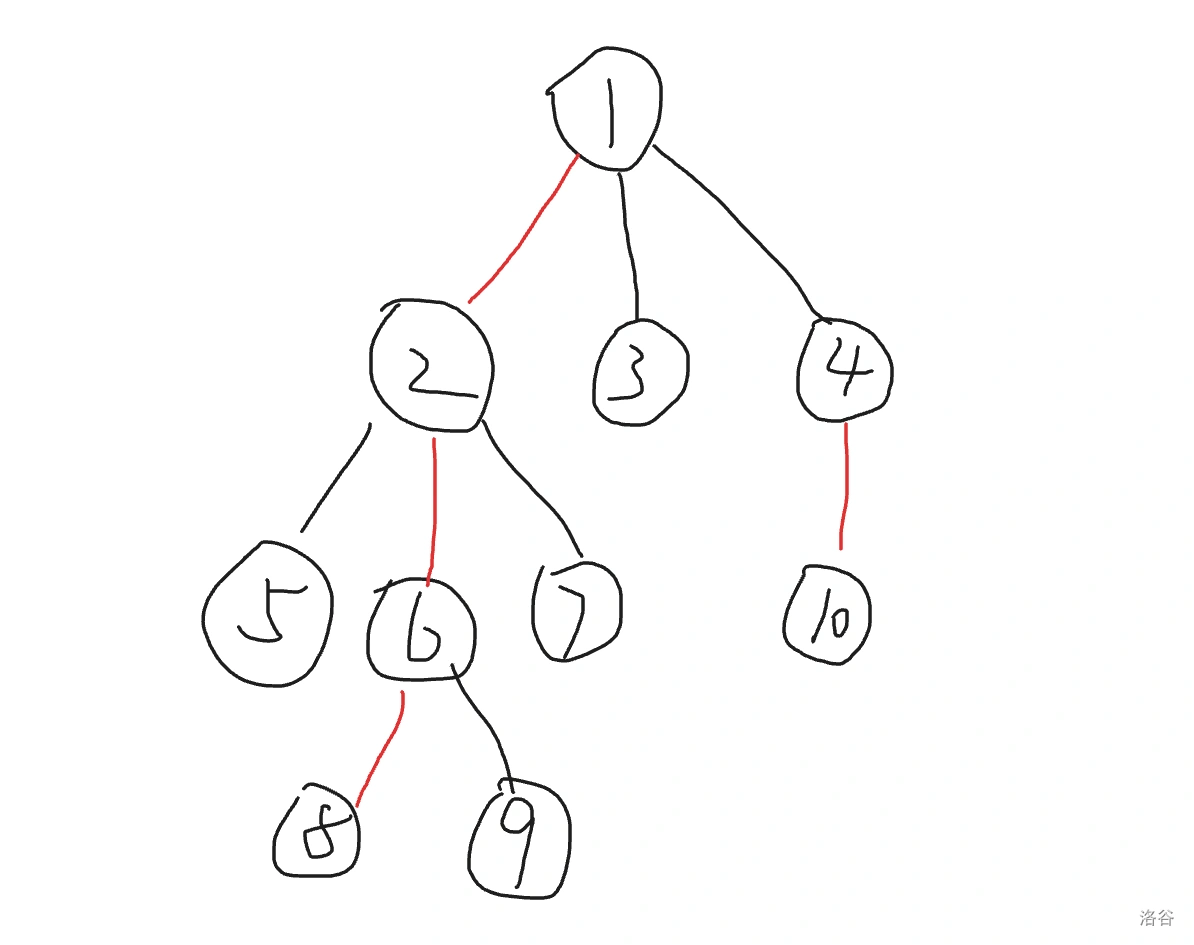
比如下图为一棵树和它的树链剖分,其中红边是重边,黑边是轻边。
下图是线段树形成的树。
其中一个线段树叶子上的数字是该位置对应原树上的节点编号。
重链链顶的轻边用虚线表示。
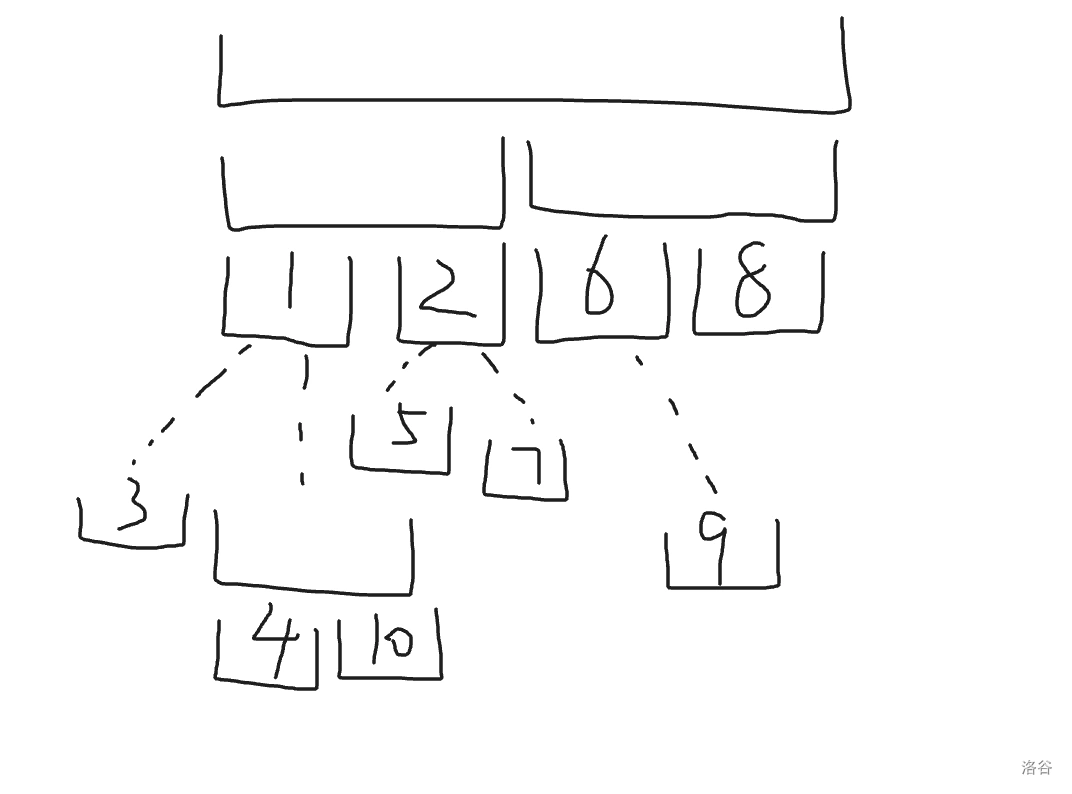
考虑操作的过程。
在路径 上面操作,就需要从 向上跳,做 次重链上面的前缀操作,和 所在重链上面的区间操作。
做一次 的前缀操作,时间是 ,其中 是 在维护 重链的线段树上的深度,值是 。
做一次区间操作,时间是 ,其中 是 所在重链的线段树的高度,值是 。
考虑利用这个性质进行优化。
全局平衡二叉树 / Global Balanced Binary Tree (GBBT)
GBBT 是对每个重链开一棵线段树的改进,或者说是静态化的 LCT。
GBBT 的改进在于,对于每一条重链同样使用了二叉树维护,但是二叉树对链上区间根据权值进行划分,做到按照引入中方法连接起来的总体树高是 的,并可以支持 的建树和 的路径操作。
GBBT 中,一棵重链的二叉树维护这条重链按照深度从小到大排序的所有节点,并且按照权值划分子树。
GBBT 的二叉树可以选择 nodey 和 leafy,两种各有优劣。
什么是 nodey 和 leafy
nodey-tree 的每一个节点维护节点本身的信息和子树的信息,每一个位置对应着一个节点的值和一个区间的值。
常见的 Treap、Splay 等一般也都是 nodey-tree。
leafy-tree 的每一个非叶子节点代表一个区间,只在叶子节点存值。
常见的线段树、WBLT 等都是 leafy-tree。
nodey 的好处是空间是 倍的,坏处是一次 pushup 需要做两次信息合并,并且比较难写。
leafy 的好处是 pushup 只需要做一次合并,而且好写,坏处是空间 倍,并且高度也是 倍。
综合来看其实 nodey 更优秀一点(时空常数上),但是 leafy 很好写。
如果是特殊的操作(例如路径有一个端点是根),可以写 nodey,代码可以做到比较简洁。
nodey 的实现可以参考 OI wiki,这里介绍 leafy 的写法。
注:下文中 leafy-tree 指的是维护一条重链的二叉树,GBBT 指全局的二叉树。
在 GBBT 中,一个节点 的权值是 ,即 的轻子树大小和加上 本身的大小。
(这里认为 ,叶子的重儿子为 。)
对于一条重链,按照权值不断将链划分。
每次取带权中点将当前的区间划分成两个区间,使得两个区间的权值都在总权值的一半左右,最后得到一棵 leafy-tree。
下图为引入中图示树的每个节点的权值。
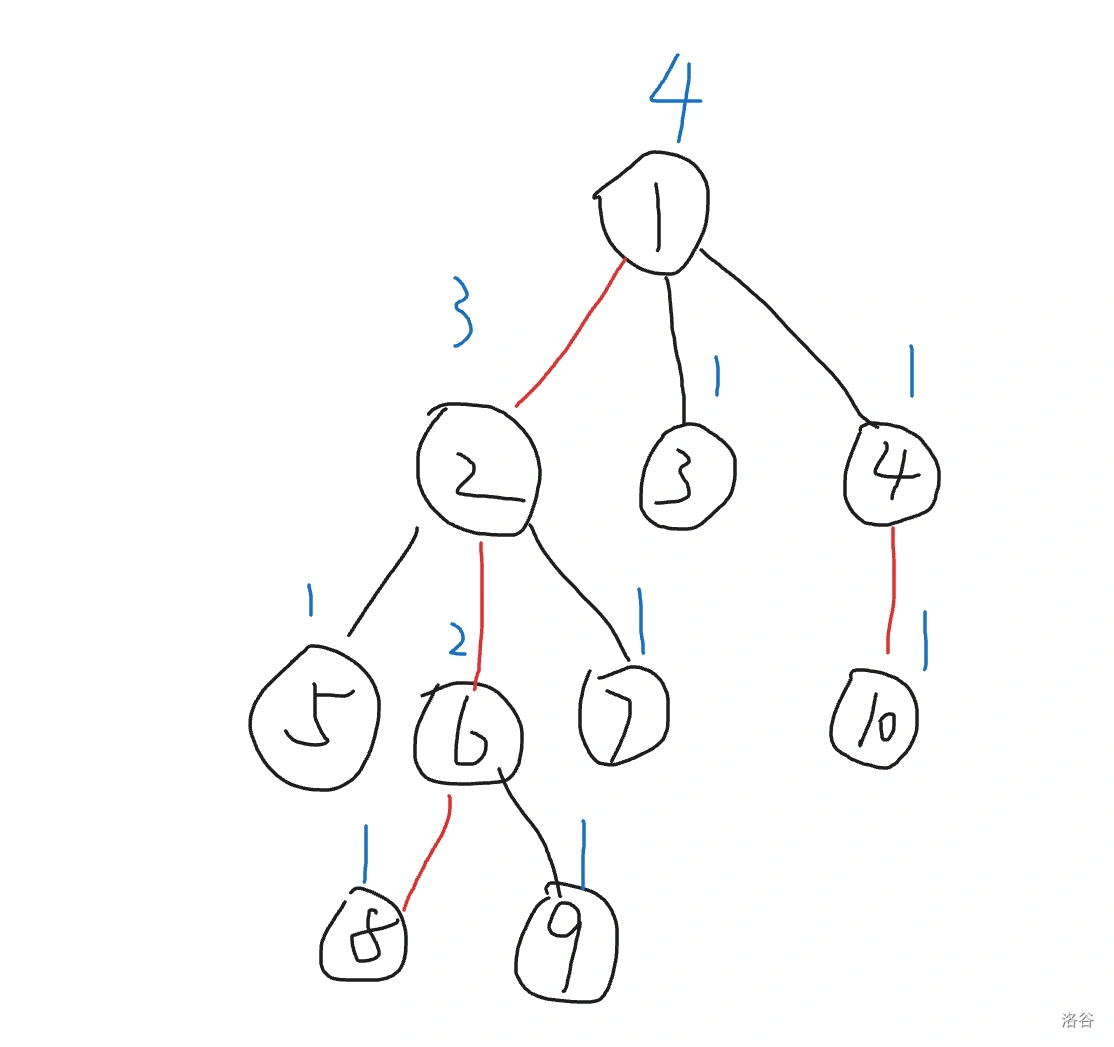
这棵树按照权值划分和线段树一致,但是只是特殊情况。
可以证明,如果把这些二叉树按照引入中的方式连接起来,全局的树高是 的。
这里记二叉树上面的边是实边,连接重链二叉树之间的边(原树上的轻边)是虚边。
证明
记 为当前 leafy-tree 上节点 子树中叶子的权值之和。
从这个二叉树上向上跳,如果是跳了一条实边,那么 会翻倍。
如果跳了一条虚边, 不会下降。
为什么跳虚边权值不会下降
跳之前的 是一条重链上的权值之和,其值等于链顶的子树大小。
的权值是 的所有轻子树大小之和 ,由于虚边对应轻边,所以 是 的轻儿子,也就有 的权值 ,所以权值不降。
由于一个 leafy-tree 点的 最多是 (根所在重链的 leafy-tree 的根),那么经过的实边最多会有 条。
又由于轻边的性质,虚边最多有 条。
所以这棵树的高度是 的。
这里给出建树的实现和解释。
预处理
vector<pair<int, int>> g[N];
int fa[N], wt[N], dep[N], sz[N], son[N];
void dfs1(int u, int pr){
	fa[u] = pr;
	dep[u] = dep[pr] + 1;
	sz[u] = 1;
	for (auto [v, w] : g[u]) if (v != pr){
		wt[v] = w;
		dfs1(v, u);
		sz[u] += sz[v];
		if (sz[son[u]] < sz[v]) son[u] = v;
	}
}
和重链剖分一致,不多介绍。
建树
struct node {
	int ls, rs;//左右儿子的编号
	int mid;//区间中点
	int mx;//区间最大值
	int t1, t2;//t1 为加标记,t2 为赋值标记
	void add(int x){//区间加
		mx += x;
		t1 += x;
	}
	void chg(int x){//区间赋值
		mx = x;
		t1 = 0;
		t2 = x;
	}
} t[N<<1];//注意 leafy-tree 需要两倍空间
int rt[N], tot;
//rt[u] 是 u 所在重链的 leafy-tree 的根节点编号,tot 为目前 GBBT 的总节点数
#define lc t[p].ls
#define rc t[p].rs
int top[N], pos[N], len[N];
//top[u] 为 u 所在链顶
//pos[u] 是 u 在重链的 leafy-tree 上的位置(中序遍历的序号,或深度排名)
//len[u] 是 u 所在重链的长度
void up(int p){//pushup
	t[p].mx = max(t[lc].mx, t[rc].mx);//由于没有的儿子编号是 0,而 t[0].mx=0,所以计算 0 不会影响信息正确性
}
这部分用来存 GBBT,需要注意 leafy-tree 需要两倍空间。
建树时,从根开始 dfs,先对 重链上所有节点的轻儿子递归建树,再把 的重链拿出来建树。
同时需要计算出 重链上的信息。
int nod[N], cnt;
//nod[i] 用于临时保存 u 所在的重链,cnt 是当前重链长度
void dfs2(int u){
	for (int x = u; x; x = son[x]) for (auto [y, w] : g[x]) if (y != fa[x] && y != son[x]) dfs2(y);//递归重链上节点的轻儿子
	cnt = 0;
	for (int x = u; x; x = son[x]) nod[++cnt] = x, pos[x] = cnt;//按照深度顺序加入重链节点,更新 pos[x]
	nod[cnt + 1] = 0;//重置哨兵
	int root = build(1, cnt);
	for (int x = u; x; x = son[x]) rt[x] = root, top[x] = u, len[x] = cnt;//更新信息
}
其中 build(l,r) 用于建出 这一段链的二叉树,返回根节点的编号。
下面是 build(l,r) 的实现。
int build(int l, int r){
	if (l == r){//leafy-tree 上叶子
		int p = ++tot;
		t[p].mid = l;
		t[p].mx = wt[nod[l]];//构建叶子
		t[p].t2 =-1;//覆盖标记初始化为特殊值
		return p;
	}
	int L = l, R = r;
	while (L < R){
		int mid = (L + R) >> 1;
		if (2 * (sz[nod[l]] - sz[nod[mid + 1]]) < sz[nod[l]] - sz[nod[r + 1]]) L = mid + 1;
		else R = mid;
	}
	if (L == r)--L;//注意特判,不能有空区间
	int p = ++tot;
	t[p].mid = L;
	lc = build(l, L), rc = build(L + 1, r);//递归左右区间建树
	up(p);//更新信息
	t[p].t2 =-1;//覆盖标记初始化为特殊值
	return p;
}
注意二分的写法,由于一个结点的权值是 ,所以 其实是重链上权值的后缀和。
全局数组 sz[0] 被初始化为 ,所以需要重置 nod[cnt+1]=0。
可以简化一点代码。
这样写的话,一条重链的操作就是简单的,和线段树几乎一模一样,只需要把 改成 leafy-tree 的带权中点即可。
例题实现
#define mid t[p].mid
void add(int p, int pl, int pr, int l, int r, int x){
	if (l <= pl && pr <= r) return t[p].add(x);
	down(p);
	if (l <= mid) add(lc, pl, mid, l, r, x);
	if (r > mid) add(rc, mid + 1, pr, l, r, x);
	up(p);
}
void cov(int p, int pl, int pr, int l, int r, int x){
	if (l <= pl && pr <= r) return t[p].chg(x);
	down(p);
	if (l <= mid) cov(lc, pl, mid, l, r, x);
	if (r > mid) cov(rc, mid + 1, pr, l, r, x);
	up(p);
}
int query(int p, int pl, int pr, int l, int r){
	if (l <= pl && pr <= r) return t[p].mx;
	int res = 0;
	down(p);
	if (l <= mid) res = max(res, query(lc, pl, mid, l, r));
	if (r > mid) res = max(res, query(rc, mid + 1, pr, l, r));
	return res;
}
路径操作和重链剖分也几乎一样,只需要更改查询的参数,在 leafy-tree 上面查询。
例题实现
void add_link(int u, int v, int x){
	while (top[u] != top[v]){
		if (dep[top[u]] < dep[top[v]]) swap(u, v);
		add(rt[u], 1, len[u], 1, pos[u], x);
		u = fa[top[u]];
	}
	if (dep[u] > dep[v]) swap(u, v);
	if (u != v) add(rt[u], 1, len[u], pos[u] + 1, pos[v], x);
}
void cov_link(int u, int v, int x){
	while (top[u] != top[v]){
		if (dep[top[u]] < dep[top[v]]) swap(u, v);
		cov(rt[u], 1, len[u], 1, pos[u], x);
		u = fa[top[u]];
	}
	if (dep[u] > dep[v]) swap(u, v);
	if (u != v) cov(rt[u], 1, len[u], pos[u] + 1, pos[v], x);
}
int qry_link(int u, int v){
	int res = 0;
	while (top[u] != top[v]){
		if (dep[top[u]] < dep[top[v]]) swap(u, v);
		res = max(res, query(rt[u], 1, len[u], 1, pos[u]));
		u = fa[top[u]];
	}
	if (dep[u] > dep[v]) swap(u, v);
	if (u != v) res = max(res, query(rt[u], 1, len[u], pos[u] + 1, pos[v]));
	return res;
}
以下给出例题的完整实现:
Code
#include<bits/stdc++.h>
using namespace std;
#define rep(a,b,c) for(int a=(b);a<=(c);++a)
const int N = 1e5 + 5, INF = 0x3f3f3f3f;
int n;
int eu[N], ev[N];
vector<pair<int, int>> g[N];
int fa[N], wt[N], dep[N], sz[N], son[N];
//这部分和重剖一致
void dfs1(int u, int pr){
	fa[u] = pr;
	dep[u] = dep[pr] + 1;
	sz[u] = 1;
	for (auto [v, w] : g[u]) if (v != pr){
		wt[v] = w;
		dfs1(v, u);
		sz[u] += sz[v];
		if (sz[son[u]] < sz[v]) son[u] = v;
	}
}
struct node {
	int ls, rs;
	//左右儿子的编号
	int mid;
	//区间中点
	int mx;
	//区间最大值
	int t1, t2;
	//t1 为加标记,t2 为赋值标记
	void add(int x){//区间加
		mx += x;
		t1 += x;
	}
	void chg(int x){//区间赋值
		mx = x;
		t1 = 0;
		t2 = x;
	}
}
t[N << 1];
//注意 leafy-tree 需要两倍空间
int rt[N], tot;
//rt[u] 是 u 所在重链的 leafy-tree 的根节点编号,tot 为目前 GBBT 的总节点数
#define lc t[p].ls
#define rc t[p].rs
int top[N], pos[N], len[N];
//top[u] 为 u 所在链顶
//pos[u] 是 u 在重链的 leafy-tree 上的位置(中序遍历的序号,或深度排名)
//len[u] 是 u 所在重链的长度
void up(int p){//pushup
	t[p].mx = max(t[lc].mx, t[rc].mx);  //由于没有的儿子编号是 0,而 t[0].mx=0,所以计算 0 不会影响信息正确性
}
void down(int p){//pushdown,注意这里 lazy-tag 是先赋值再加的形式
	if (t[p].t2 !=-1){
		if (lc) t[lc].chg(t[p].t2);
		if (rc) t[rc].chg(t[p].t2);
		t[p].t2 =-1;
	}
	if (t[p].t1){
		if (lc) t[lc].add(t[p].t1);
		if (rc) t[rc].add(t[p].t1);
		t[p].t1 = 0;
	}
}
int nod[N], cnt;
//nod[i] 用于临时保存 u 所在的重链,cnt 是当前重链长度
int build(int l, int r){
	if (l == r){//leafy-tree 上叶子
		int p = ++tot;
		t[p].mid = l;
		t[p].mx = wt[nod[l]];
		//构建叶子
		t[p].t2 =-1;
		//覆盖标记初始化为特殊值
		return p;
	}
	int L = l, R = r;
	while (L < R){
		int mid = (L + R) >> 1;
		if (2 * (sz[nod[l]] - sz[nod[mid + 1]]) < sz[nod[l]] - sz[nod[r + 1]]) L = mid + 1;
		else R = mid;
	}
	if (L == r)--L;  //注意特判,不能有空区间
	int p = ++tot;
	t[p].mid = L;
	lc = build(l, L), rc = build(L + 1, r);  //递归左右区间建树
	up(p);  //更新信息
	t[p].t2 =-1;
	//覆盖标记初始化为特殊值
	return p;
}
void dfs2(int u){
	for (int x = u; x; x = son[x]) for (auto [y, w] : g[x]) if (y != fa[x] && y != son[x]) dfs2(y);  //递归重链上节点的轻儿子
	cnt = 0;
	for (int x = u; x; x = son[x]) nod[++cnt] = x, pos[x] = cnt;  //按照深度顺序加入重链节点,更新 pos[x]
	nod[cnt + 1] = 0;
	//重置哨兵
	int root = build(1, cnt);
	for (int x = u; x; x = son[x]) rt[x] = root, top[x] = u, len[x] = cnt;  //更新信息
}
#define mid t[p].mid//mid 是区间带权中点,同时是左区间右端点
//以下的实现和普通的线段树几乎一致
void add(int p, int pl, int pr, int l, int r, int x){
	if (l <= pl && pr <= r) return t[p].add(x);
	down(p);
	if (l <= mid) add(lc, pl, mid, l, r, x);
	if (r > mid) add(rc, mid + 1, pr, l, r, x);
	up(p);
}
void cov(int p, int pl, int pr, int l, int r, int x){
	if (l <= pl && pr <= r) return t[p].chg(x);
	down(p);
	if (l <= mid) cov(lc, pl, mid, l, r, x);
	if (r > mid) cov(rc, mid + 1, pr, l, r, x);
	up(p);
}
int query(int p, int pl, int pr, int l, int r){
	if (l <= pl && pr <= r) return t[p].mx;
	int res = 0;
	down(p);
	if (l <= mid) res = max(res, query(lc, pl, mid, l, r));
	if (r > mid) res = max(res, query(rc, mid + 1, pr, l, r));
	return res;
}
//以下的实现和树剖+线段树也几乎一致
void add_link(int u, int v, int x){
	while (top[u] != top[v]){
		if (dep[top[u]] < dep[top[v]]) swap(u, v);
		add(rt[u], 1, len[u], 1, pos[u], x);
		u = fa[top[u]];
	}
	if (dep[u] > dep[v]) swap(u, v);
	if (u != v) add(rt[u], 1, len[u], pos[u] + 1, pos[v], x);
}
void cov_link(int u, int v, int x){
	while (top[u] != top[v]){
		if (dep[top[u]] < dep[top[v]]) swap(u, v);
		cov(rt[u], 1, len[u], 1, pos[u], x);
		u = fa[top[u]];
	}
	if (dep[u] > dep[v]) swap(u, v);
	if (u != v) cov(rt[u], 1, len[u], pos[u] + 1, pos[v], x);
}
int qry_link(int u, int v){
	int res = 0;
	while (top[u] != top[v]){
		if (dep[top[u]] < dep[top[v]]) swap(u, v);
		res = max(res, query(rt[u], 1, len[u], 1, pos[u]));
		u = fa[top[u]];
	}
	if (dep[u] > dep[v]) swap(u, v);
	if (u != v) res = max(res, query(rt[u], 1, len[u], pos[u] + 1, pos[v]));
	return res;
}
int main(){
	ios::sync_with_stdio(0);
	cin.tie(0), cout.tie(0);
	cin >> n;
	rep(i, 1, n - 1){
		int u, v, w;
		cin >> u >> v >> w;
		eu[i] = u, ev[i] = v;
		g[u].push_back({v, w});
		g[v].push_back({u, w});
	}
	dfs1(1, 0);
	dfs2(1);
	string op;
	int x, y, z;
	while (cin >> op){
		if (op ==  "Stop") break;
		if (op ==  "Change"){
			cin >> x >> y;
			cov_link(eu[x], ev[x], y);
		}
		else if (op ==  "Cover"){
			cin >> x >> y >> z;
			cov_link(x, y, z);
		}
		else if (op ==  "Add"){
			cin >> x >> y >> z;
			add_link(x, y, z);
		}
		else {
			cin >> x >> y;
			cout << qry_link(x, y) <<  '\n';
		}
	}
	return 0;
}
复杂度证明
以上面例题的代码为例,nodey-tree 的证明也是类似的。
建树
如果设 是当前区间的长度, 是左区间的长度,那么有 。
由于 的值没有保证,但是 是减半的,所以最多只会递归 层。
记每一层的若干个区间长度是 。
那么一层的复杂度就是 。
所以建立一条重链的 leafy-tree 是 的。
所以复杂度最坏 。
路径操作
记 为 GBBT 上节点 的深度, 为节点 所在重链的 leafy-tree 的根节点编号。
那么重链上一次 前缀操作的时间复杂度就是 。
因为如果 在当前左区间内,那么会直接递归左区间;否则递归的左区间会被完全包含,直接返回,然后再递归右区间。
这样经过的节点总数就是 和 对应叶子的距离,就是 。
本质上就是从 走到 对应的叶子。
而对于 到 上面的所有重链(不包含 ),这部分的复杂度是 的。
其中 是 GBBT 的树高,根据上文可以得到为 。
根据上面的分析,得到一次前缀查询是从 对应的叶子走到 的过程,而所有走过的路径在 GBBT 上面组成了一条从一个节点向根方向的链,长度不超过树的高度,所以是 的。
因此这一部分的时间复杂度是 。
到 上面的所有重链同理。
的重链做一次区间查询,复杂度是 的。
因此一次路径操作的时间复杂度是 。
拓展
子树操作
在 GBBT 上进行子树操作是很复杂的,一般不建议用 GBBT 写同时有路径操作和子树操作的题。
但是理论上 GBBT 是可以同时维护简单的路径 / 子树操作的,例如树剖模板题。
可以阅读文章了解。
可持久化
参考该文章。
习题
见题单,大部分路径操作题都可以拿来练手。
GBBT 优化动态 DP
对于路径类 DDP 的实现,其实和维护路径信息是一样的,不再介绍。
对于子树类 DDP 的实现,其实是一个只有到根路径修改的特化,本质仍然和维护路径信息相同。
只有到根路径修改的情况下,可以直接使用迭代式的修改,使用 nodey 和 leafy 都很简单。
这里以 P4751 【模板】动态 DP(加强版) 为例。
如果你没有学过动态 DP,可以在我的重链剖分学习笔记中了解。
建树部分和维护普通信息是一致的,因此只介绍修改部分。
这里给出 nodey-tree 和 leafy-tree 的实现。
nodey-tree
struct node {
	int ls, rs, pr;//左右儿子和父节点
	mat val, mul;//该节点的矩阵和 nodey-tree 的子树乘积
} t[N];
#define lc t[p].ls
#define rc t[p].rs
inline void up(int p){t[p].mul = rc || lc ? t[rc].mul * t[p].val * t[lc].mul : t[p].val;}//pushup需要计算节点本身的值和左右子树的值
//pushup 特判叶子节点可以减小常数inline void get(int & x, int & y, const mat & ma){
x = max(ma.a[0][0], ma.a[1][0]);
y = max(ma.a[0][1], ma.a[1][1]);
}//x,y 分别为初始状态矩阵与 ma 相乘结果矩阵 M 的 M[0][0] 和 M[0][1]
void updt(int u, int x){//这里记录父节点可以直接一直向上跳直到跳到全局的根,实现会简单很多
t[u].val.a[1][0] += x - a[u];//更新 u 的转移矩阵
a[u] = x;//更新 a[u]
while (u){
int p = t[u].pr; //p 为 u 在 GBBT 上的父亲
if (p && lc != u && rc != u){//向上跳了一条轻边,需要更新父节点的值
int f1, f0, nf1, nf0;
get(f1, f0, t[u].mul);//旧的贡献值
up(u);//更新 u
get(nf1, nf0, t[u].mul);//新的贡献值
int d0 = max(nf1, nf0) - max(f1, f0), d1 = nf0 - f0;
t[p].val.a[0][1] = t[p].val.a[1][1] += d0;
t[p].val.a[1][0] += d1;//更新 p 的转移矩阵
}
else up(u);//更新信息
u = p;
}
}完整代码
#include<bits/stdc++.h>
using namespace std;
#define rep(a,b,c) for(int a=(b);a<=(c);++a)
const int N = 1e6 + 5, INF = 0x3f3f3f3f;
int n, m;
int a[N];
vector<int> e[N];
int fa[N], sz[N], dep[N], son[N];
int f[N][2];
void dfs1(int u, int pr){
	fa[u] = pr;
	sz[u] = 1;
	dep[u] = dep[pr] + 1;
	f[u][1] = a[u];
	for (int v : e[u]) if (v != pr){
		dfs1(v, u);
		sz[u] += sz[v];
		if (sz[son[u]] < sz[v]) son[u] = v;
		f[u][1] += f[v][0];
		f[u][0] += max(f[v][0], f[v][1]);
	}
}
struct mat {
	int a[2][2];
};
const mat I = {{{0,-INF}, {-INF, 0}}};
//单位矩阵
const mat E = {{{-INF,-INF}, {-INF,-INF}}};
//空矩阵
const mat F0 = {{{0, 0}, {-INF,-INF}}};
//初始的转移矩阵
inline mat operator * (const mat & x, const mat & y){
	return {{
			{max(x.a[0][0] + y.a[0][0], x.a[0][1] + y.a[1][0]), max(x.a[0][0] + y.a[0][1], x.a[0][1] + y.a[1][1])},
			{max(x.a[1][0] + y.a[0][0], x.a[1][1] + y.a[1][0]), max(x.a[1][0] + y.a[0][1], x.a[1][1] + y.a[1][1])}
		}
	};
}
//使用了矩乘展开以减小常数
struct node {
	int ls, rs, pr;
	//左右儿子和父节点
	mat val, mul;
	//该节点的矩阵和 nodey-tree 的子树乘积
} t[N];
#define lc t[p].ls
#define rc t[p].rs
inline void up(int p){t[p].mul = rc || lc ? t[rc].mul * t[p].val * t[lc].mul : t[p].val;}//pushup需要计算节点本身的值和左右子树的值
//pushup 特判叶子节点可以减小常数
int nod[N], cnt;
int build(int l, int r){
	if (l > r) return 0;
	int L = l, R = r;
	while (L < R){
		int mid = (L + R) >> 1;
		if (2 * (sz[nod[l]] - sz[nod[mid + 1]]) < sz[nod[l]] - sz[nod[r + 1]]) L = mid + 1;
		else R = mid;
	}
	int x = L, p = nod[x];
	lc = build(l, x - 1), rc = build(x + 1, r);
	if (lc) t[lc].pr = p;
	if (rc) t[rc].pr = p;
	up(p);
	return p;
}
int dfs2(int u){//需要处理轻儿子对 dp 的贡献,这里直接在节点的矩阵上面修改
	for (int x = u; x; x = son[x]) t[x].val.a[1][0] = a[x], t[x].val.a[0][0] =-INF;
	for (int x = u; x; x = son[x]) for (int y : e[x]) if (y != fa[x] && y != son[x]){
		t[dfs2(y)].pr = x;
		t[x].val.a[0][1] = t[x].val.a[1][1] += max(f[y][0], f[y][1]);
		t[x].val.a[1][0] += f[y][0];
	}
	cnt = 0;
	for (int x = u; x; x = son[x]) nod[++cnt] = x;
	nod[cnt + 1] = 0;
	return build(1, cnt);
}
inline void get(int & x, int & y, const mat & ma){
	x = max(ma.a[0][0], ma.a[1][0]);
	y = max(ma.a[0][1], ma.a[1][1]);
}
//x,y 分别为初始状态矩阵与 ma 相乘结果矩阵 M 的 M[0][0] 和 M[0][1]
void updt(int u, int x){//这里记录父节点可以直接一直向上跳直到跳到全局的根,实现会简单很多
	t[u].val.a[1][0] += x - a[u];
	//更新 u 的转移矩阵
	a[u] = x;
	//更新 a[u]
	while (u){
		int p = t[u].pr;
		//p 为 u 在 GBBT 上的父亲
		if (p && lc != u && rc != u){//向上跳了一条轻边,需要更新父节点的值
			int f1, f0, nf1, nf0;
			get(f1, f0, t[u].mul);  //旧的贡献值
			up(u);  //更新 u
			get(nf1, nf0, t[u].mul);  //新的贡献值
			int d0 = max(nf1, nf0) - max(f1, f0), d1 = nf0 - f0;
			t[p].val.a[0][1] = t[p].val.a[1][1] += d0;
			t[p].val.a[1][0] += d1;
			//更新 p 的转移矩阵
		}
		else up(u);  //更新信息
		u = p;
	}
}
int main(){
	ios::sync_with_stdio(0);
	cin.tie(0), cout.tie(0);
	cin >> n >> m;
	rep(i, 1, n) cin >> a[i];
	rep(i, 2, n){
		int u, v;
		cin >> u >> v;
		e[u].push_back(v);
		e[v].push_back(u);
	}
	dfs1(1, 0);
	t[0].mul = I;
	int rt = dfs2(1);
	int ans = 0;
	while (m--){
		int u, x;
		cin >> u >> x;
		u ^= ans;
		updt(u, x);
		int f1, f0;
		get(f1, f0, t[rt].mul);
		ans = max(f1, f0);
		cout << ans <<  '\n';
	}
	return 0;
}
leafy-tree
struct node {
	int ls, rs, pr;//左右儿子和父节点
	mat mul;//leafy-tree 的子树乘积
} t[N<<1];
int tot;// GBBT 的叶子编号为节点编号,新增节点编号由 tot 记录
#define lc t[p].ls
#define rc t[p].rs
inline mat getmat(int u){return {{{-INF, g[u][0]}, {g[u][1], g[u][0]}}};}
inline void up(int p){t[p].mul = rc || lc ? t[rc].mul * t[lc].mul : getmat(p);}//需要特判 p 是否为叶子inline void get(int & x, int & y, const mat & ma){
x = max(ma.a[0][0], ma.a[1][0]);
y = max(ma.a[0][1], ma.a[1][1]);
}//x,y 分别为初始状态矩阵与 ma 相乘结果矩阵 M 的 M[0][0] 和 M[0][1],写这个函数是为了减少常数
void updt(int u, int x){//这里记录父节点可以直接一直向上跳直到跳到全局的根,实现会简单很多
g[u][1] += x - a[u];//更新 u 的转移矩阵
a[u] = x;//更新 a[u]
while (u){
int p = t[u].pr;//p 为 u 在 GBBT 上的父亲
if (p && lc != u && rc != u){//向上跳了一条轻边,需要更新父节点的值
int f1, f0, nf1, nf0;
get(f1, f0, t[u].mul);//旧的贡献值
up(u);//更新 u
get(nf1, nf0, t[u].mul);//新的贡献值
g[p][0] += max(nf1, nf0) - max(f1, f0), g[p][1] += nf0 - f0;//更新 p 的转移矩阵
}
else up(u);//更新信息
u = p;
}
}完整代码
#include<bits/stdc++.h>
using namespace std;
#define rep(a,b,c) for(int a=(b);a<=(c);++a)
const int N = 1e6 + 5, INF = 0x3f3f3f3f;
int n, m;
int a[N];
vector<int> e[N];
int fa[N], sz[N], dep[N], son[N];
int f[N][2], g[N][2];
void dfs1(int u, int pr){
	fa[u] = pr;
	sz[u] = 1;
	dep[u] = dep[pr] + 1;
	f[u][1] = a[u];
	for (int v : e[u]) if (v != pr){
		dfs1(v, u);
		sz[u] += sz[v];
		if (sz[son[u]] < sz[v]) son[u] = v;
		f[u][1] += f[v][0];
		f[u][0] += max(f[v][0], f[v][1]);
	}
}
struct mat {
	int a[2][2];
};
const mat I = {{{0,-INF}, {-INF, 0}}};
//单位矩阵
const mat E = {{{-INF,-INF}, {-INF,-INF}}};
//空矩阵
const mat F0 = {{{0, 0}, {-INF,-INF}}};
//初始的转移矩阵
inline mat operator * (const mat & x, const mat & y){
	return {{
			{max(x.a[0][0] + y.a[0][0], x.a[0][1] + y.a[1][0]), max(x.a[0][0] + y.a[0][1], x.a[0][1] + y.a[1][1])},
			{max(x.a[1][0] + y.a[0][0], x.a[1][1] + y.a[1][0]), max(x.a[1][0] + y.a[0][1], x.a[1][1] + y.a[1][1])}
		}
	};
}
//使用了矩乘展开以减小常数
struct node {
	int ls, rs, pr;
	//左右儿子和父节点
	mat mul;
	//leafy-tree 的子树乘积
} t[N<<1];
int tot;
// GBBT 的叶子编号为节点编号,新增节点编号由 tot 记录
#define lc t[p].ls
#define rc t[p].rs
inline mat getmat(int u){return {{{-INF, g[u][0]}, {g[u][1], g[u][0]}}};}
inline void up(int p){t[p].mul = rc || lc ? t[rc].mul * t[lc].mul : getmat(p);}//需要特判 p 是否为叶子
int nod[N], cnt;
int build(int l, int r){
	if (l == r){
		int p = nod[l];
		t[p].mul = getmat(p);
		return p;
	}
	int L = l, R = r;
	while (L < R){
		int mid = (L + R) >> 1;
		if (2 * (sz[nod[l]] - sz[nod[mid + 1]]) < sz[nod[l]] - sz[nod[r + 1]]) L = mid + 1;
		else R = mid;
	}
	if (L == r)--L;
	int x = L, p = ++tot;
	lc = build(l, x), rc = build(x + 1, r);
	if (lc) t[lc].pr = p;
	if (rc) t[rc].pr = p;
	up(p);
	return p;
}
int dfs2(int u){
	for (int x = u; x; x = son[x]) g[x][1] = a[x];
	for (int x = u; x; x = son[x]) for (int y : e[x]) if (y != fa[x] && y != son[x]){
		t[dfs2(y)].pr = x;
		g[x][0] += max(f[y][0], f[y][1]);
		g[x][1] += f[y][0];
	}
	cnt = 0;
	for (int x = u; x; x = son[x]) nod[++cnt] = x;
	nod[cnt + 1] = 0;
	return build(1, cnt);
}
inline void get(int & x, int & y, const mat & ma){
	x = max(ma.a[0][0], ma.a[1][0]);
	y = max(ma.a[0][1], ma.a[1][1]);
}
//x,y 分别为初始状态矩阵与 ma 相乘结果矩阵 M 的 M[0][0] 和 M[0][1],写这个函数是为了减少常数
void updt(int u, int x){//这里记录父节点可以直接一直向上跳直到跳到全局的根,实现会简单很多
	g[u][1] += x - a[u];
	//更新 u 的转移矩阵
	a[u] = x;
	//更新 a[u]
	while (u){
		int p = t[u].pr;
		//p 为 u 在 GBBT 上的父亲
		if (p && lc != u && rc != u){//向上跳了一条轻边,需要更新父节点的值
			int f1, f0, nf1, nf0;
			get(f1, f0, t[u].mul); //旧的贡献值
			up(u); //更新 u
			get(nf1, nf0, t[u].mul); //新的贡献值
			g[p][0] += max(nf1, nf0) - max(f1, f0), g[p][1] += nf0 - f0; //更新 p 的转移矩阵
		}
		else up(u); //更新信息
		u = p;
	}
}
int main(){
	ios::sync_with_stdio(0);
	cin.tie(0), cout.tie(0);
	cin >> n >> m;
	rep(i, 1, n) cin >> a[i];
	rep(i, 2, n){
		int u, v;
		cin >> u >> v;
		e[u].push_back(v);
		e[v].push_back(u);
	}
	dfs1(1, 0);
	t[0].mul = I;
    tot = n;
	int rt = dfs2(1);
	int ans = 0;
	while (m--){
		int u, x;
		cin >> u >> x;
		u ^= ans;
		updt(u, x);
		int f1, f0;
		get(f1, f0, t[rt].mul);
		ans = max(f1, f0);
		cout << ans <<  '\n';
	}
	return 0;
}
可以发现,实现都很简单,但是 nodey-tree 更加简洁。
并且从评测结果来看,nodey-tree 的时空常数都比 leafy-tree 小(也有可能是我的实现问题),所以 nodey-tree 是比较推荐的写法。
根据代码很容易分析,单次修改的复杂度是 的。
习题
见题单。
附录:性能对比
下面是本地的测试结果对比。
使用的是 DDP 数据加强版,为了方便去掉了强制在线,但是代码都是在线的。
为了体现常数和复杂度差异,测试数据为 ,。
树的结构是完全二叉树套链。
Gen
#include<bits/stdc++.h>
#include <chrono>
using namespace std;
#define ll long long
#define rep(a,b,c) for(int a=(b);a<=(c);++a)
#define per(a,b,c) for(int a=(b);a>=(c);--a)
struct io {
  #define ll long long
  #define lll __int128
  #define SZ 1<<21
	char buf[SZ],*p1,*p2;
	char pbuf[SZ],*pp;
	io() : p1(buf), p2(buf), pp(pbuf){}
	~io(){fwrite(pbuf, 1, pp - pbuf, stdout);}
	inline char gc(){
		if (p1 == p2) p2 = (p1 = buf) + fread(buf, 1, SZ, stdin);
		return p1 == p2 ? EOF :*p1++;
	}
  #define isdigit(ch) (ch>47&&ch<58)
	inline io & operator >>(int & x){
		x = 0;
		bool neg = 0;
		char ch = gc();
		for (; !isdigit(ch); ch = gc()) if (ch ==  '-') neg = 1;
		if (neg) for (; isdigit(ch); ch = gc()) x = (x << 1) + (x << 3) - (ch ^ 48);
		else for (; isdigit(ch); ch = gc()) x = (x << 1) + (x << 3) + (ch ^ 48);
		return * this;
	}
	inline io & operator >>(ll & x){
		x = 0;
		bool neg = 0;
		char ch = gc();
		for (; !isdigit(ch); ch = gc()) if (ch ==  '-') neg = 1;
		if (neg) for (; isdigit(ch); ch = gc()) x = (x << 1) + (x << 3) - (ch ^ 48);
		else for (; isdigit(ch); ch = gc()) x = (x << 1) + (x << 3) + (ch ^ 48);
		return * this;
	}
	inline io & operator >>(lll & x){
		x = 0;
		bool neg = 0;
		char ch = gc();
		for (; !isdigit(ch); ch = gc()) if (ch ==  '-') neg = 1;
		if (neg) for (; isdigit(ch); ch = gc()) x = (x << 1) + (x << 3) - (ch ^ 48);
		else for (; isdigit(ch); ch = gc()) x = (x << 1) + (x << 3) + (ch ^ 48);
		return * this;
	}
	inline io & operator >>(char & c){
		c = gc();
		for (; isspace(c);) c = gc();
		return * this;
	}
	inline io & operator >>(string & s){
		s =  "";
		char c = gc();
		for (; isspace(c);) c = gc();
		for (; !isspace(c) && c != EOF; c = gc()) s += c;
		return * this;
	}
	inline void push(const char & c){
		if (pp - pbuf == SZ) fwrite(pbuf, 1, SZ, stdout), pp = pbuf;
		*pp++ = c;
	}
	int stk[45], top;
	inline io & operator << (int x){
		if (!x){push('0'); return * this;}
		if (x < 0){push('-'); x =-x;}
		while (x) stk[++top] = x % 10, x /= 10;
		while (top) push(stk[top--] ^ 48);
		return * this;
	}
	inline io & operator << (ll x){
		if (!x){push('0'); return * this;}
		if (x < 0){push('-'); x =-x;}
		while (x) stk[++top] = x % 10, x /= 10;
		while (top) push(stk[top--] ^ 48);
		return * this;
	}
	inline io & operator << (lll x){
		if (!x){push('0'); return * this;}
		if (x < 0){push('-'); x =-x;}
		while (x) stk[++top] = x % 10, x /= 10;
		while (top) push(stk[top--] ^ 48);
		return * this;
	}
	inline io & operator << (const char & c){
		push(c);
		return * this;
	}
	inline io & operator << (const string & s){
		for (char c : s) push(c);
		return * this;
	}
} IO;
mt19937 rng(chrono::steady_clock::now().time_since_epoch().count());
int rnd(int l, int r){
	return rng() % (r - l + 1) + l;
}
const int N = 4e6, M = 1e7;
int n = N, m = M;
#define linkfa(i) (((i)-1)*2000+1)
int main(){
	freopen("DDP.in",  "w", stdout);
	IO << n <<  ' ' << m <<  '\n';
	rep(u, 1, n) IO << rnd(-100, 100) <<  " \n"[u == n];
	rep(i, 1, 2000){
		if (i != 1) IO << linkfa(i) <<  ' ' << linkfa(i >> 1) + 1999 <<  '\n';
		rep(j, 1, 1999) IO << linkfa(i) + j - 1 <<  ' ' << linkfa(i) + j <<  '\n';
	}
	rep(i, 1, m){
		int u = linkfa(rnd(1025, 2000)) + rnd(1000, 1999), x = rnd(-100, 100);
		IO << u <<  ' ' << x <<  '\n';
	}
	return 0;
}
每一个代码测试三次,运行用时和峰值内存可供参考。
Nodey-tree:
5042.774 ms/447896 KB
5005.918 ms/447900 KB
5022.028 ms/447896 KB
Code
#include<bits/stdc++.h>
using namespace std;
#define rep(a,b,c) for(int a=(b);a<=(c);++a)
struct io {
  #define SZ 1<<21
	char buf[SZ], pbuf[SZ];
	char * p1,*p2,*pp;
	io() : p1(buf), p2(buf), pp(pbuf){}
	~io(){fwrite(pbuf, 1, pp - pbuf, stdout);}
	inline char gc(){
		if (p1 == p2) p2 = (p1 = buf) + fread(buf, 1, SZ, stdin);
		return p1 == p2 ? EOF :*p1++;
	}
  #define isdigit(ch) (ch>47&&ch<58)
	template<typename T>inline io & operator >>(T & x){
		x = 0;
		bool neg = 0;
		char ch = gc();
		for (; !isdigit(ch); ch = gc()) if (ch ==  '-') neg = 1;
		if (neg) for (; isdigit(ch); ch = gc()) x = (x << 1) + (x << 3) - (ch ^ 48);
		else for (; isdigit(ch); ch = gc()) x = (x << 1) + (x << 3) + (ch ^ 48);
		return * this;
	}
	inline void push(const char & c){
		if (pp - pbuf == SZ) fwrite(pbuf, 1, SZ, stdout), pp = pbuf;
		*pp++ = c;
	}
	int stk[45], top;
	template<typename T>inline io & operator << (T x){
		if (!x){push('0'); push('\n'); return * this;}
		if (x < 0){push('-'); x =-x;}
		while (x) stk[++top] = x % 10, x /= 10;
		while (top) push(stk[top--] ^ 48);
		push('\n');
		return * this;
	}
} IO;
const int N = 4e6 + 5, INF = 0x3f3f3f3f;
int n, m;
int a[N];
vector<int> e[N];
int fa[N], sz[N], dep[N], son[N];
int f[N][2];
void dfs1(int u, int pr){
	fa[u] = pr;
	sz[u] = 1;
	dep[u] = dep[pr] + 1;
	f[u][1] = a[u];
	for (int v : e[u]) if (v != pr){
		dfs1(v, u);
		sz[u] += sz[v];
		if (sz[son[u]] < sz[v]) son[u] = v;
		f[u][1] += f[v][0];
		f[u][0] += max(f[v][0], f[v][1]);
	}
}
struct mat {
	int a[2][2];
};
const mat I = {{{0,-INF}, {-INF, 0}}};
//单位矩阵
const mat E = {{{-INF,-INF}, {-INF,-INF}}};
//空矩阵
const mat F0 = {{{0, 0}, {-INF,-INF}}};
//初始的转移矩阵
inline mat operator * (const mat & x, const mat & y){
	return {{
			{max(x.a[0][0] + y.a[0][0], x.a[0][1] + y.a[1][0]), max(x.a[0][0] + y.a[0][1], x.a[0][1] + y.a[1][1])},
			{max(x.a[1][0] + y.a[0][0], x.a[1][1] + y.a[1][0]), max(x.a[1][0] + y.a[0][1], x.a[1][1] + y.a[1][1])}
		}
	};
}
//使用了矩乘展开以减小常数
struct node {
	int ls, rs, pr;
	//左右儿子和父节点
	mat val, mul;
	//该节点的矩阵和 nodey-tree 的子树乘积
} t[N];
#define lc t[p].ls
#define rc t[p].rs
inline void up(int p){t[p].mul = rc || lc ? t[rc].mul * t[p].val * t[lc].mul : t[p].val;}//pushup需要计算节点本身的值和左右子树的值
//pushup 特判叶子节点可以减小常数
int nod[N], cnt;
int build(int l, int r){
	if (l > r) return 0;
	int L = l, R = r;
	while (L < R){
		int mid = (L + R) >> 1;
		if (2 * (sz[nod[l]] - sz[nod[mid + 1]]) < sz[nod[l]] - sz[nod[r + 1]]) L = mid + 1;
		else R = mid;
	}
	int x = L, p = nod[x];
	lc = build(l, x - 1), rc = build(x + 1, r);
	if (lc) t[lc].pr = p;
	if (rc) t[rc].pr = p;
	up(p);
	return p;
}
int dfs2(int u){//需要处理轻儿子对 dp 的贡献,这里直接在节点的矩阵上面修改
	for (int x = u; x; x = son[x]) t[x].val.a[1][0] = a[x], t[x].val.a[0][0] =-INF;
	for (int x = u; x; x = son[x]) for (int y : e[x]) if (y != fa[x] && y != son[x]){
		t[dfs2(y)].pr = x;
		t[x].val.a[0][1] = t[x].val.a[1][1] += max(f[y][0], f[y][1]);
		t[x].val.a[1][0] += f[y][0];
	}
	cnt = 0;
	for (int x = u; x; x = son[x]) nod[++cnt] = x;
	nod[cnt + 1] = 0;
	return build(1, cnt);
}
inline void get(int & x, int & y, const mat & ma){
	x = max(ma.a[0][0], ma.a[1][0]);
	y = max(ma.a[0][1], ma.a[1][1]);
}
//x,y 分别为初始状态矩阵与 ma 相乘结果矩阵 M 的 M[0][0] 和 M[0][1]
void updt(int u, int x){//这里记录父节点可以直接一直向上跳直到跳到全局的根,实现会简单很多
	t[u].val.a[1][0] += x - a[u];
	//更新 u 的转移矩阵
	a[u] = x;
	//更新 a[u]
	while (u){
		int p = t[u].pr;
		//p 为 u 在 GBBT 上的父亲
		if (p && lc != u && rc != u){//向上跳了一条轻边,需要更新父节点的值
			int f1, f0, nf1, nf0;
			get(f1, f0, t[u].mul);  //旧的贡献值
			up(u);  //更新 u
			get(nf1, nf0, t[u].mul);  //新的贡献值
			int d0 = max(nf1, nf0) - max(f1, f0), d1 = nf0 - f0;
			t[p].val.a[0][1] = t[p].val.a[1][1] += d0;
			t[p].val.a[1][0] += d1;
			//更新 p 的转移矩阵
		}
		else up(u);  //更新信息
		u = p;
	}
}
int main(){
	freopen("DDP.in",  "r", stdin);
	freopen("DDP.out",  "w", stdout);
	IO >> n >> m;
	rep(i, 1, n) IO >> a[i];
	rep(i, 2, n){
		int u, v;
		IO >> u >> v;
		e[u].push_back(v);
		e[v].push_back(u);
	}
	dfs1(1, 0);
	t[0].mul = I;
	int rt = dfs2(1);
	int ans = 0;
	while (m--){
		int u, x;
		IO >> u >> x;
		//u ^= ans;
		updt(u, x);
		int f1, f0;
		get(f1, f0, t[rt].mul);
		ans = max(f1, f0);
		IO << ans;
	}
	return 0;
}
Leafy-tree:
6094.566 ms/541804 KB
6172.198 ms/526000 KB
6044.554 ms/526004 KB
Code
#include<bits/stdc++.h>
using namespace std;
#define rep(a,b,c) for(int a=(b);a<=(c);++a)
struct io {
  #define SZ 1<<21
	char buf[SZ], pbuf[SZ];
	char * p1,*p2,*pp;
	io() : p1(buf), p2(buf), pp(pbuf){}
	~io(){fwrite(pbuf, 1, pp - pbuf, stdout);}
	inline char gc(){
		if (p1 == p2) p2 = (p1 = buf) + fread(buf, 1, SZ, stdin);
		return p1 == p2 ? EOF :*p1++;
	}
  #define isdigit(ch) (ch>47&&ch<58)
	template<typename T>inline io & operator >>(T & x){
		x = 0;
		bool neg = 0;
		char ch = gc();
		for (; !isdigit(ch); ch = gc()) if (ch ==  '-') neg = 1;
		if (neg) for (; isdigit(ch); ch = gc()) x = (x << 1) + (x << 3) - (ch ^ 48);
		else for (; isdigit(ch); ch = gc()) x = (x << 1) + (x << 3) + (ch ^ 48);
		return * this;
	}
	inline void push(const char & c){
		if (pp - pbuf == SZ) fwrite(pbuf, 1, SZ, stdout), pp = pbuf;
		*pp++ = c;
	}
	int stk[45], top;
	template<typename T>inline io & operator << (T x){
		if (!x){push('0'); push('\n'); return * this;}
		if (x < 0){push('-'); x =-x;}
		while (x) stk[++top] = x % 10, x /= 10;
		while (top) push(stk[top--] ^ 48);
		push('\n');
		return * this;
	}
} IO;
const int N = 4e6 + 5, INF = 0x3f3f3f3f;
int n, m;
int a[N];
vector<int> e[N];
int fa[N], sz[N], dep[N], son[N];
int f[N][2], g[N][2];
void dfs1(int u, int pr){
	fa[u] = pr;
	sz[u] = 1;
	dep[u] = dep[pr] + 1;
	f[u][1] = a[u];
	for (int v : e[u]) if (v != pr){
		dfs1(v, u);
		sz[u] += sz[v];
		if (sz[son[u]] < sz[v]) son[u] = v;
		f[u][1] += f[v][0];
		f[u][0] += max(f[v][0], f[v][1]);
	}
}
struct mat {
	int a[2][2];
};
const mat I = {{{0,-INF}, {-INF, 0}}};
//单位矩阵
const mat E = {{{-INF,-INF}, {-INF,-INF}}};
//空矩阵
const mat F0 = {{{0, 0}, {-INF,-INF}}};
//初始的转移矩阵
inline mat operator * (const mat & x, const mat & y){
	return {{
			{max(x.a[0][0] + y.a[0][0], x.a[0][1] + y.a[1][0]), max(x.a[0][0] + y.a[0][1], x.a[0][1] + y.a[1][1])},
			{max(x.a[1][0] + y.a[0][0], x.a[1][1] + y.a[1][0]), max(x.a[1][0] + y.a[0][1], x.a[1][1] + y.a[1][1])}
		}
	};
}
//使用了矩乘展开以减小常数
struct node {
	int ls, rs, pr;
	//左右儿子和父节点
	mat mul;
	//leafy-tree 的子树乘积
} t[N<<1];
int tot;
// GBBT 的叶子编号为节点编号,新增节点编号由 tot 记录
#define lc t[p].ls
#define rc t[p].rs
inline mat getmat(int u){return {{{-INF, g[u][0]}, {g[u][1], g[u][0]}}};}
inline void up(int p){t[p].mul = rc || lc ? t[rc].mul * t[lc].mul : getmat(p);}//需要特判 p 是否为叶子
int nod[N], cnt;
int build(int l, int r){
	if (l == r){
		int p = nod[l];
		t[p].mul = getmat(p);
		return p;
	}
	int L = l, R = r;
	while (L < R){
		int mid = (L + R) >> 1;
		if (2 * (sz[nod[l]] - sz[nod[mid + 1]]) < sz[nod[l]] - sz[nod[r + 1]]) L = mid + 1;
		else R = mid;
	}
	if (L == r)--L;
	int x = L, p = ++tot;
	lc = build(l, x), rc = build(x + 1, r);
	if (lc) t[lc].pr = p;
	if (rc) t[rc].pr = p;
	up(p);
	return p;
}
int dfs2(int u){
	for (int x = u; x; x = son[x]) g[x][1] = a[x];
	for (int x = u; x; x = son[x]) for (int y : e[x]) if (y != fa[x] && y != son[x]){
		t[dfs2(y)].pr = x;
		g[x][0] += max(f[y][0], f[y][1]);
		g[x][1] += f[y][0];
	}
	cnt = 0;
	for (int x = u; x; x = son[x]) nod[++cnt] = x;
	nod[cnt + 1] = 0;
	return build(1, cnt);
}
inline void get(int & x, int & y, const mat & ma){
	x = max(ma.a[0][0], ma.a[1][0]);
	y = max(ma.a[0][1], ma.a[1][1]);
}
//x,y 分别为初始状态矩阵与 ma 相乘结果矩阵 M 的 M[0][0] 和 M[0][1],写这个函数是为了减少常数
void updt(int u, int x){//这里记录父节点可以直接一直向上跳直到跳到全局的根,实现会简单很多
	g[u][1] += x - a[u];
	//更新 u 的转移矩阵
	a[u] = x;
	//更新 a[u]
	while (u){
		int p = t[u].pr;
		//p 为 u 在 GBBT 上的父亲
		if (p && lc != u && rc != u){//向上跳了一条轻边,需要更新父节点的值
			int f1, f0, nf1, nf0;
			get(f1, f0, t[u].mul);  //旧的贡献值
			up(u);  //更新 u
			get(nf1, nf0, t[u].mul);  //新的贡献值
			g[p][0] += max(nf1, nf0) - max(f1, f0), g[p][1] += nf0 - f0;  //更新 p 的转移矩阵
		}
		else up(u);  //更新信息
		u = p;
	}
}
int getht(int u){
	int h = 0;
	for (; u; u = t[u].pr)++h;
	return h;
}
int main(){
	freopen("DDP.in",  "r", stdin);
	freopen("DDP.out",  "w", stdout);
	IO >> n >> m;
	rep(i, 1, n) IO >> a[i];
	rep(i, 2, n){
		int u, v;
		IO >> u >> v;
		e[u].push_back(v);
		e[v].push_back(u);
	}
	dfs1(1, 0);
	t[0].mul = I;
	tot = n;
	int rt = dfs2(1);
	int ans = 0;
	while (m--){
		int u, x;
		IO >> u >> x;
		//u ^= ans;
		updt(u, x);
		int f1, f0;
		get(f1, f0, t[rt].mul);
		ans = max(f1, f0);
		IO << ans;
	}
	return 0;
}
树剖线段树:
12190.496 ms/561196 KB
11667.443 ms/561196 KB
12140.327 ms/561196 KB
Code
#include<bits/stdc++.h>
using namespace std;
#define rep(a,b,c) for(int a=(b);a<=(c);++a)
const int N = 4e6 + 5, INF = 0x3f3f3f3f;
struct io {
  #define SZ 1<<21
	char buf[SZ], pbuf[SZ];
	char * p1,*p2,*pp;
	io() : p1(buf), p2(buf), pp(pbuf){}
	~io(){fwrite(pbuf, 1, pp - pbuf, stdout);}
	inline char gc(){
		if (p1 == p2) p2 = (p1 = buf) + fread(buf, 1, SZ, stdin);
		return p1 == p2 ? EOF :*p1++;
	}
  #define isdigit(ch) (ch>47&&ch<58)
	template<typename T>inline io & operator >>(T & x){
		x = 0;
		bool neg = 0;
		char ch = gc();
		for (; !isdigit(ch); ch = gc()) if (ch == '-') neg = 1;
		if (neg) for (; isdigit(ch); ch = gc()) x = (x << 1) + (x << 3) - (ch ^ 48);
		else for (; isdigit(ch); ch = gc()) x = (x << 1) + (x << 3) + (ch ^ 48);
		return * this;
	}
	inline void push(const char & c){
		if (pp - pbuf == SZ) fwrite(pbuf, 1, SZ, stdout), pp = pbuf;
		*pp++ = c;
	}
	int stk[45], top;
	template<typename T>inline io & operator << (T x){
		if (!x){push('0'); push('\n'); return * this;}
		if (x < 0){push('-'); x =-x;}
		while (x) stk[++top] = x % 10, x /= 10;
		while (top) push(stk[top--] ^ 48);
		push('\n');
		return * this;
	}
} IO;
int n, m;
int a[N];
vector<int> e[N];
int fa[N], sz[N], dep[N], son[N];
int f[N][2], g[N][2];
void dfs1(int u, int pr){
	fa[u] = pr;
	sz[u] = 1;
	dep[u] = dep[pr] + 1;
	f[u][1] = a[u];
	for (int v : e[u]) if (v != pr){
		dfs1(v, u);
		sz[u] += sz[v];
		if (sz[son[u]] < sz[v]) son[u] = v;
		f[u][1] += f[v][0];
		f[u][0] += max(f[v][0], f[v][1]);
	}
}
int top[N], bot[N], dfn[N], nod[N], cnt;
struct mat {
	int a[2][2];
};
const mat I = {{{0,-INF}, {-INF, 0}}};
const mat E = {{{-INF,-INF}, {-INF,-INF}}};
const mat F0 = {{{0, 0}, {-INF,-INF}}};
mat operator * (const mat & x, const mat & y){
	return {{
			{max(x.a[0][0] + y.a[0][0], x.a[0][1] + y.a[1][0]), max(x.a[0][0] + y.a[0][1], x.a[0][1] + y.a[1][1])},
			{max(x.a[1][0] + y.a[0][0], x.a[1][1] + y.a[1][0]), max(x.a[1][0] + y.a[0][1], x.a[1][1] + y.a[1][1])}
		}
	};
}
struct node {
	mat mul;
	int lson, rson;
} t[N<<2];
int rt[N], ct;
#define ls t[p].lson
#define rs t[p].rson
#define mid ((pl+pr)>>1)
mat getmat(int u){return {{{-INF, g[u][0]}, {g[u][1], g[u][0]}}};}
void up(int p){t[p].mul = t[rs].mul * t[ls].mul;}
void build(int & p, int pl, int pr){
	p = ++ct;
	if (pl == pr){
		t[p].mul = getmat(nod[pl]);
		return;
	}
	build(ls, pl, mid);
	build(rs, mid + 1, pr);
	up(p);
}
void dfs2(int u, int tp){
	top[u] = tp;
	bot[u] = u;
	dfn[u] = ++cnt;
	nod[cnt] = u;
	g[u][1] = a[u];
	if (!son[u]) return;
	dfs2(son[u], tp);
	bot[u] = bot[son[u]];
	for (int v : e[u]) if (v != fa[u] && v != son[u]){
		dfs2(v, v);
		g[u][0] += max(f[v][0], f[v][1]);
		g[u][1] += f[v][0];
	}
}
int stk[20], st;
void upd(int u){
	int p = rt[top[u]], pl = dfn[top[u]], pr = dfn[bot[u]], x = dfn[u];
	while (pl != pr){
		stk[++st] = p;
		x <= mid ? (pr = mid, p = ls) : (pl = mid + 1, p = rs);
	}
	t[p].mul = getmat(u);
	while (st) up(stk[st--]);
}
void updt(int u, int x){
	g[u][1] += x - a[u];
	a[u] = x;
	while (u){
		int tp = top[u], p = fa[tp];
		mat F = F0 * t[rt[tp]].mul;
		int f1 = F.a[0][0], f0 = F.a[0][1];
		upd(u);
		mat nF = F0 * t[rt[tp]].mul;
		int nf1 = nF.a[0][0], nf0 = nF.a[0][1];
		if (p) g[p][0] += max(nf1, nf0) - max(f1, f0), g[p][1] += nf0 - f0;
		u = p;
	}
}
int main(){
	freopen("DDP.in",  "r", stdin);
	freopen("DDP.out",  "w", stdout);
	IO >> n >> m;
	rep(i, 1, n) IO >> a[i];
	rep(i, 2, n){
		int u, v;
		IO >> u >> v;
		e[u].push_back(v);
		e[v].push_back(u);
	}
	dfs1(1, 0);
	dfs2(1, 1);
	rep(u, 1, n) if (top[u] == u) build(rt[u], dfn[u], dfn[bot[u]]);
	while (m--){
		int u, x;
		IO >> u >> x;
		updt(u, x);
		mat res = F0 * t[rt[1]].mul;
		IO << max(res.a[0][0], res.a[0][1]);
	}
	return 0;
}
以下为我的设备配置和编译选项:
处理器:
AMD Ryzen 7 5800X3D 8-Core Processor 3.40 GHz
机带RAM:
32.0 GB
速度:2400 MHz
编译器:
mingw gcc 15.1.0 (posix-seh-ucrt)
Version: 15.1.0
Platform: Windows
编译选项:
-std=c++17 -O2 -static -Wl,--stack=1000000000 -Wshadow
可以看出来两种 GBBT 的和树剖线段树的常数差距和复杂度优化。
upd on 2026/10/6:
原来的 Gen.cpp 写错了,数据不够强没卡满树剖,已更新。