
K-D Tree(KDT, k-Dimension Tree) 是一种快速解决多维信息维护的数据结构。
以下假设 为 K-D Tree 的大小, 为查询次数,插入次数明显与 同阶。
引入
在二叉搜索树中,我们对一个集合通过一个分水岭元素分成两个集合,一个集合中的元素都比分水岭元素要小,另一个集合中的元素都比分水岭元素要大。之后依照这样建成一颗二叉树。之后我们就可以在这棵树上进行各种操作。
因为二叉搜索树中每个元素都是一个标量,可以视为维数为 的向量或 维数轴上的点。所以二叉搜索树事实上就是维护了一维空间中的点。我们尝试把 维拓展到 维,维护 维的点,并仿照二叉搜索树的建立方式去维护一个数据结构,就是 K-D Tree。
建树
二叉搜索树中的元素只有 维,因此划分直接按照这一维划分。而 K-D Tree 有 维,所以我们需要从 维之中选择 维进行划分。于是我们就可以列出建树的流程:
- 若当前超正方体中只有一个点,直接返回。
- 选择一个维度,再在这一维度选择一个分界点,分成两个超正方体。一个超正方体中这一维的值小于或等于分界点的这一维(作为这个点的左子树),另一个超正方体中这一维的值大于(或者前面小于,这里大于等于)分界点的这一维。
- 对两个超正方体代表的子树再次进行建树。
这样我们就可以建出一颗 K-D Tree 了。为了方便理解,这里搬 OI Wiki 上的一张图:
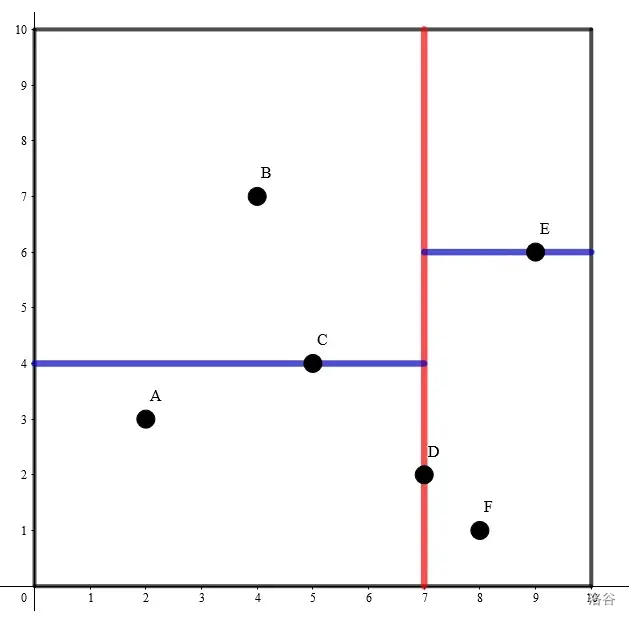
图中红色的线表示第一次划分的线,蓝色表示第二次划分的线。上面哪些点根据这样的划分建出来的 K-D Tree 长这个样子(也是从 OI Wiki 盗的):
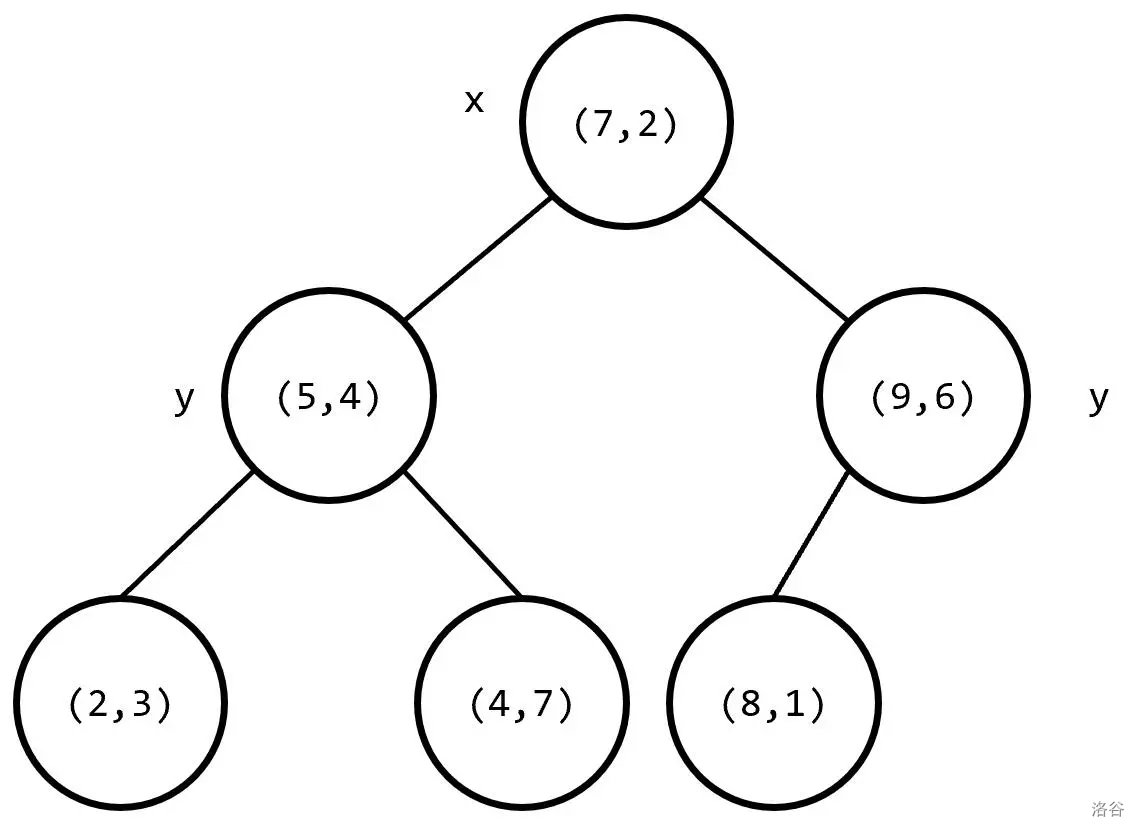
优化
但是直接用上面的方式建出来的树对查询操作极不友好。我们需要用一些优化让复杂度正确:
- 每次选择划分点的时候选择这一维的中位数,这样树高就是 的了。
- 选择划分的维度沿 个维度依次选择,这是为了查询的复杂度正确。
在加上以上两个优化之后,我们可以得到一个树高 的,看起来平衡的 K-D Tree。
接着解决如何快速找到中位数的问题。如果直接 sort 一遍,复杂度是 的。但是我们只需要找一个位置的数就行了,可以转化为序列找第 小的问题,可以用快速排序转化一下做。但是有一个 STL 函数 nth_element,可以在 的时间内找到第 大。就可以写成 nth_element(s + l, s + mid, s + r + 1, cmp)。
注意:在划分某一维的时候,点中这一维可能会有重复的数,所以我们可能会把两个在这一维相同的数划分到两个子树中。这点在查询的时候要格外注意。(否则树高就不保证是 的,查询复杂度就伪了)
于是加上这些优化之后 K-D Tree 的建树复杂度就成为了 的。
具体实现看最后的代码。
查询
这里主要讲一下查询一个超正方体中所包含的元素值。我们仿照线段树的思路进行分治查询就行了。具体来说,就是先判断与查询超正方体有没有交点,如果没有就返回;否则判断是否被查询超正方体完全包含,如果完全包含,就直接把这个答案统计进去,否则递归两个子树查询。
时间复杂度我也不会证明,自己去看OI-Wiki 吧。总之复杂度是 的(这也能看出平衡树就是 1-D Tree)。
具体实现也看最后的代码。
修改
我们发现 K-D Tree 貌似不支持修改操作,而且又不能像平衡树一样用各种奇奇怪怪的方式解决,只能重构,那么复杂度还不如暴力。
修改主要有两种解决方案:根号重构和二进制分组。具体怎么选择看你自己。反正二进制分组吊打根号重构就是了。
根号重构
我们选择不每一次插入都进行一次重构,而是进行 次插入后再进行查询。其它的暂时存在数组中,查询的时候遍历一遍判断是否需要计算贡献。
于是插入的均摊复杂度很明显是 的,查询是 的。一共的复杂度就是 。如果 同阶,那么 的最佳取值为 ,修改复杂度就是 ,查询复杂度就是 ;否则 的最佳取值为 ,修改复杂度就是 ,查询复杂度为 的。当然一般取 同阶的情况就行了。
二进制分组
如果点的个数为 ,我们就可以维护 棵 K-D Tree,其中第 棵(从 开始计)存储 个节点。然后仿照二进制进位的方式插入之后进位(合并)。具体来说就是新增一颗大小为 的 K-D Tree,然后不断合并大小相同的树。这样插入的总复杂度是
于是均摊复杂度就是 的了。
查询的时候,就分别在这些树上分别查询,于是单次查询的复杂度就是 的了。
代码实现
从复杂度不难发现二进制分组的效率要高得多,所以我写的是二进制分组。
模板题 AC 代码(K-D Tree 模板):
#include <algorithm>
#include <initializer_list>
#include <iostream>
#include <utility>
#include <vector>

using namespace std;

constexpr int K = 2, N = 2e5 + 10, KN = 20;

class Position {
public:
	Position() {
		for (int i = 0; i < K; i++) dat[i] = 0;
	}

	Position(initializer_list<int> pos) {
		auto it = pos.begin();
		for (int i = 0; i < K; i++, it++) dat[i] = *it;
	}

	Position(const Position& other) {
		for (int i = 0; i < K; i++) dat[i] = other.dat[i];
	}

	const int& operator[](int index) const {
		return dat[index];
	}

	int& operator[](int index) {
		return dat[index];
	}

	void operator=(const Position& other) {
		for (int i = 0; i < K; i++) dat[i] = other.dat[i];
	}

	bool operator==(const Position& other) const {
		for (int i = 0; i < K; i++)
			if (dat[i] != other.dat[i])
				return false;
		return true;
	}

private:
	int dat[K];
};

bool contains(const Position& lpos, const Position& rpos, const Position& pos) {
	bool flag = true;
	for (int i = 0; i < K; i++) flag = flag && (lpos[i] <= pos[i] && pos[i] <= rpos[i]);
	return flag;
}

bool contains(const Position& lpos, const Position& rpos, const Position& qlpos, const Position& qrpos) {
	bool flag = true;
	for (int i = 0; i < K; i++) flag = flag && (lpos[i] <= qlpos[i] && qrpos[i] <= rpos[i]);
	return flag;
}

bool notintersect(const Position& lpos, const Position& rpos, const Position& qlpos, const Position& qrpos) {
	bool flag = false;
	for (int i = 0; i < K; i++) flag = flag || (qrpos[i] < lpos[i] || qlpos[i] > rpos[i]);
	return flag;
}

ostream& operator<<(ostream& output, Position pos) {
	output << "[";
	for (int i = 0; i < K; i++) output << pos[i] << (i == K - 1 ? "" : ", ");
	output << "]";
	return output;
}

int trushCan[N], trushTop = 0, curIdx;

void poolPush(int pos) {
	trushCan[++trushTop] = pos;
}

int poolGet() {
	if (trushTop) return trushCan[trushTop--];
	return ++curIdx;
}

struct Node {
	int val;
	Position pos;
	int sum;
	Position lpos, rpos;
	int lson, rson, fg;

	Node() : val(0), pos(), sum(0), lpos(), rpos(), lson(0), rson(0), fg(0) {
	}

	Node(int val, Position pos) : val(val), pos(pos), sum(val), lpos(), rpos(), lson(0), rson(0), fg(0) {
	}
} tree[N];

void pushup(int x) {
	tree[x].sum = tree[tree[x].lson].sum + tree[tree[x].rson].sum + tree[x].val;
	tree[x].lpos = tree[x].pos, tree[x].rpos = tree[x].pos;
	for (int i = 0; i < K; i++) {
		if (tree[x].lson) {
			tree[x].lpos[i] = min(tree[x].lpos[i], tree[tree[x].lson].lpos[i]);
			tree[x].rpos[i] = max(tree[x].rpos[i], tree[tree[x].lson].rpos[i]);
		}
		if (tree[x].rson) {
			tree[x].lpos[i] = min(tree[x].lpos[i], tree[tree[x].rson].lpos[i]);
			tree[x].rpos[i] = max(tree[x].rpos[i], tree[tree[x].rson].rpos[i]);
		}
	}
}

void print(int x, int cs) {
	for (int i = 0; i < cs; i++) cout << '-';
	cout << "At[" << x << "], val=" << tree[x].val << ", pos=" << tree[x].pos << "; sum=" << tree[x].sum << ", lpos=" << tree[x].lpos << ", rpos=" << tree[x].rpos << "; lson=" << tree[x].lson << ", rson=" << tree[x].rson << ", fg=" << tree[x].fg << endl;
	if (tree[x].lson) print(tree[x].lson, cs + 1);
	if (tree[x].rson) print(tree[x].rson, cs + 1);
}

int mergeTop;
pair<Position, int> mergeTmp[N];

void expend(int cur) {
	if (tree[cur].lson) expend(tree[cur].lson);
	poolPush(cur);
	mergeTmp[++mergeTop] = make_pair(tree[cur].pos, tree[cur].val);
	if (tree[cur].rson) expend(tree[cur].rson);
}

int rebuild(int l, int r, int curfg) {
	if (l > r) return 0;
	int x = poolGet();
	if (l == r) {
		tree[x].pos = mergeTmp[l].first;
		tree[x].val = mergeTmp[l].second;
		tree[x].fg = curfg;
		tree[x].lson = tree[x].rson = 0;
		pushup(x);
		return x;
	}
	int mid = (l + r + 1) >> 1;
	nth_element(mergeTmp + l, mergeTmp + mid, mergeTmp + r + 1, [&](const pair<Position, int>& a, const pair<Position, int>& b) { return a.first[curfg] < b.first[curfg]; });
	tree[x].pos = mergeTmp[mid].first;
	tree[x].val = mergeTmp[mid].second;
	tree[x].fg = curfg;
	tree[x].lson = rebuild(l, mid - 1, (curfg + 1) % K);
	tree[x].rson = rebuild(mid + 1, r, (curfg + 1) % K);
	pushup(x);
	return x;
}

int merge(int ra, int rb) {
	mergeTop = 0;
	expend(ra);
	expend(rb);
	sort(mergeTmp + 1, mergeTmp + mergeTop + 1, [](pair<Position, int> a, pair<Position, int> b) {
		for (int i = 0; i < K; i++)
			if (a.first[i] != b.first[i])
				return a.first[i] < b.first[i];
		return a.second < b.second;
	});
	int j = 0;
	for (int i = 1; i <= mergeTop; i++) {
		if (j && mergeTmp[i].first == mergeTmp[j].first) {
			mergeTmp[j].second += mergeTmp[i].second;
		} else {
			mergeTmp[++j] = mergeTmp[i];
		}
	}
	mergeTop = j;
	return rebuild(1, mergeTop, 0);
}

int roots[KN];

void push(Position pos, int val) {
	mergeTmp[mergeTop = 1] = {pos, val};
	int rt = rebuild(1, 1, 0);
	int i = 0;
	for (; i < KN && roots[i]; i++) {
		rt = merge(rt, roots[i]);
		roots[i] = 0;
	}
	roots[i] = rt;
}

int queryone(int cur, Position& lpos, Position& rpos) {
	if (!cur) return 0;
	if (notintersect(lpos, rpos, tree[cur].lpos, tree[cur].rpos)) return 0;
	if (contains(lpos, rpos, tree[cur].lpos, tree[cur].rpos)) return tree[cur].sum;
	int ans = 0;
	if (contains(lpos, rpos, tree[cur].pos)) ans += tree[cur].val;
	ans += queryone(tree[cur].lson, lpos, rpos);
	ans += queryone(tree[cur].rson, lpos, rpos);
	return ans;
}

int query(Position lpos, Position rpos) {
	int ans = 0;
	for (int i = 0; i < KN; i++) ans += queryone(roots[i], lpos, rpos);
	return ans;
}

int main() {
	int n, lastans = 0;
	cin >> n;
	while (true) {
		int opt;
		cin >> opt;
		if (opt == 1) {
			int x, y, v;
			cin >> x >> y >> v;
			x ^= lastans, y ^= lastans, v ^= lastans;
			push({x, y}, v);
		} else if (opt == 2) {
			int x1, y1, x2, y2;
			cin >> x1 >> y1 >> x2 >> y2;
			x1 ^= lastans, y1 ^= lastans, x2 ^= lastans, y2 ^= lastans;
			cout << (lastans = query({x1, y1}, {x2, y2})) << endl;
		} else {
			break;
		}
	}
	return 0;
}
2-D Tree 模板
#include <algorithm>
#include <iostream>
#define endl '\n'

using namespace std;

constexpr int N = 2e5 + 10, K = 21;

struct Pos {
	int x, y;
};

bool contains(Pos lpos, Pos rpos, Pos pos) { return lpos.x <= pos.x && pos.x <= rpos.x && lpos.y <= pos.y && pos.y <= rpos.y; }
bool contains(Pos lpos, Pos rpos, Pos qlpos, Pos qrpos) { return lpos.x <= qlpos.x && qrpos.x <= rpos.x && lpos.y <= qlpos.y && qrpos.y <= rpos.y; }
bool notintersect(Pos lpos, Pos rpos, Pos qlpos, Pos qrpos) { return lpos.x > qrpos.x || rpos.x < qlpos.x || lpos.y > qrpos.y || rpos.y < qlpos.y; }

int POOL[N], POOL_TOP, IDX;

void poolPush(int u) {
	POOL[++POOL_TOP] = u;
}

int poolGet() {
	if (POOL_TOP) return POOL[POOL_TOP--];
	return ++IDX;
}

struct Node {
	Pos lpos, rpos, pos;
	int val, sum, lson, rson, fg;
} e[N];

void pushup(int u) {
	e[u].sum = e[e[u].lson].sum + e[e[u].rson].sum + e[u].val;
	e[u].lpos = e[u].rpos = e[u].pos;
	if (e[u].lson) {
		e[u].lpos.x = min(e[u].lpos.x, e[e[u].lson].lpos.x);
		e[u].rpos.x = max(e[u].rpos.x, e[e[u].lson].rpos.x);
		e[u].lpos.y = min(e[u].lpos.y, e[e[u].lson].lpos.y);
		e[u].rpos.y = max(e[u].rpos.y, e[e[u].lson].rpos.y);
	}
	if (e[u].rson) {
		e[u].lpos.x = min(e[u].lpos.x, e[e[u].rson].lpos.x);
		e[u].rpos.x = max(e[u].rpos.x, e[e[u].rson].rpos.x);
		e[u].lpos.y = min(e[u].lpos.y, e[e[u].rson].lpos.y);
		e[u].rpos.y = max(e[u].rpos.y, e[e[u].rson].rpos.y);
	}
}

int buildTop;
pair<Pos, int> buildTmp[N];

int build(int l, int r, int curfg) {
	if (l > r) return 0;
	int u = poolGet();
	if (l == r) {
		e[u].pos = buildTmp[l].first, e[u].val = buildTmp[l].second;
		e[u].lson = e[u].rson = 0;
		e[u].fg = curfg;
		pushup(u);
		return u;
	}
	int mid = (l + r) >> 1;
	nth_element(buildTmp + l, buildTmp + mid, buildTmp + r + 1, [&](const pair<Pos, int>& a, const pair<Pos, int>& b) { return curfg ? a.first.y < b.first.y : a.first.x < b.first.x; });
	e[u].pos = buildTmp[mid].first, e[u].val = buildTmp[mid].second;
	e[u].lson = build(l, mid - 1, curfg ^ 1);
	e[u].rson = build(mid + 1, r, curfg ^ 1);
	e[u].fg = curfg;
	pushup(u);
	return u;
}

void expand(int u) {
	if (!u) return;
	buildTmp[++buildTop] = {e[u].pos, e[u].val};
	poolPush(u);
	expand(e[u].lson);
	expand(e[u].rson);
}

int merge(int u, int v) {
	buildTop = 0;
	expand(u), expand(v);
	return build(1, buildTop, 0);
}

int roots[K];

void insert(Pos pos, int val) {
	buildTmp[buildTop = 1] = {pos, val};
	int root = build(1, buildTop, 0), i = 0;
	for (; i < K && roots[i]; i++) {
		root = merge(root, roots[i]);
		roots[i] = 0;
	}
	roots[i] = root;
}

int queryone(Pos lpos, Pos rpos, int u) {
	if (!u || notintersect(lpos, rpos, e[u].lpos, e[u].rpos)) return 0;
	if (contains(lpos, rpos, e[u].lpos, e[u].rpos)) return e[u].sum;
	int res = 0;
	if (contains(lpos, rpos, e[u].pos)) res += e[u].val;
	res += queryone(lpos, rpos, e[u].lson) + queryone(lpos, rpos, e[u].rson);
	return res;
}

int query(Pos lpos, Pos rpos) {
	int res = 0;
	for (int i = 0; i < K; i++) res += queryone(lpos, rpos, roots[i]);
	return res;
}

int lastans, FW_NUMBER, opt;

int main() {
	ios::sync_with_stdio(false);
	cin.tie(nullptr);
	cin >> FW_NUMBER;
	while ((cin >> opt, opt) != 3) {
		if (opt == 1) {
			int val;
			Pos pos;
			cin >> pos.x >> pos.y >> val;
			pos.x ^= lastans, pos.y ^= lastans, val ^= lastans;
			insert(pos, val);
		} else {
			Pos lpos, rpos;
			cin >> lpos.x >> lpos.y >> rpos.x >> rpos.y;
			lpos.x ^= lastans, lpos.y ^= lastans, rpos.x ^= lastans, rpos.y ^= lastans;
			cout << (lastans = query(lpos, rpos)) << endl;
		}
	}
	return 0;
}
指针版本代码 from LBY:
#include<bits/stdc++.h>
using namespace std;
int n;
vector<pair<pair<int,int>,int> >re;
inline bool cmp1(pair<pair<int,int>,int>x,pair<pair<int,int>,int>y){return x.first.second<y.first.second;}
inline bool cmp0(pair<pair<int,int>,int>x,pair<pair<int,int>,int>y){return x.first.first<y.first.first;}
struct KDT{
	int siz;
	struct node{
		node *l,*r;
		int val,sum,p[2],mx[2],mn[2];
	}*root,*null;
	inline KDT(){
		null=new node;
		null->l=null->r=null;
		null->val=null->sum=0,root=null,null->mn[0]=null->mn[1]=2e9,null->mx[0]=null->mx[1]=0;
		siz=0;
	}
	inline node *new_node(){
		node *p=new node;
		p->l=p->r=null,p->val=0;
		return p;
	}
	void update(int t[2],int v,node *&root,bool d){
		if(root==null){
			siz++;
			root=new_node(),root->val=root->sum=v;
			root->p[0]=root->mx[0]=root->mn[0]=t[0],root->p[1]=root->mx[1]=root->mn[1]=t[1];
			return;
		}
		if(root->p[0]==t[0] && root->p[1]==t[1]){
			root->val+=v,root->sum+=v;
			return;
		}
		if(t[d]<root->p[d]) update(t,v,root->l,d^1);
		else update(t,v,root->r,d^1);
		root->sum=root->l->sum+root->r->sum+root->val;
		root->mx[0]=max(max(root->l->mx[0],root->mx[0]),root->r->mx[0]),root->mx[1]=max(max(root->l->mx[1],root->mx[1]),root->r->mx[1]);
		root->mn[0]=min(min(root->l->mn[0],root->mn[0]),root->r->mn[0]),root->mn[1]=min(min(root->l->mn[1],root->mn[1]),root->r->mn[1]);
	}
	int ask(int u[2],int v[2],node *root){
		if(root==null) return 0;
		if(root->mn[0]>=u[0] && root->mx[0]<=v[0] && root->mn[1]>=u[1] && root->mx[1]<=v[1]) return root->sum;
		int tot=0;
		if(root->p[0]>=u[0] && root->p[0]<=v[0] && root->p[1]>=u[1] && root->p[1]<=v[1]) tot=root->val;
	 	if(!(root->l->mx[0]<u[0] || root->l->mn[0]>v[0] || root->l->mx[1]<u[1] || root->l->mn[1]>v[1])) tot+=ask(u,v,root->l);
	 	if(!(root->r->mx[0]<u[0] || root->r->mn[0]>v[0] || root->r->mx[1]<u[1] || root->r->mn[1]>v[1])) tot+=ask(u,v,root->r);
		return tot;
	}
	inline void FREE(node *root){
		if(root==null) return;
		FREE(root->l),FREE(root->r);
		delete root;
	}
	inline void get_node(node *root){
		if(root==null) return;
		re.push_back({{root->p[0],root->p[1]},root->val});
		get_node(root->l),get_node(root->r);
	}
	inline node *RECON(int l,int r,int d=0){
		if(l>r) return null;
		if(l==r){
			int t[2]={re[l].first.first,re[l].first.second},v=re[l].second;
			node *root=new_node();root->val=root->sum=v;
			root->p[0]=root->mx[0]=root->mn[0]=t[0],root->p[1]=root->mx[1]=root->mn[1]=t[1];
			return root;
		}
		if(d) sort(re.begin()+l,re.begin()+r+1,cmp1);else sort(re.begin()+l,re.begin()+r+1,cmp0);
		int mid=l+r>>1;
		int t[2]={re[mid].first.first,re[mid].first.second},v=re[mid].second;
		node *t1=RECON(l,mid-1,d^1),*t2=RECON(mid+1,r,d^1);
		node *u=new_node();u->val=v;
		u->l=t1,u->r=t2;
		u->p[0]=u->mx[0]=u->mn[0]=t[0],u->p[1]=u->mx[1]=u->mn[1]=t[1];
		u->mx[0]=max(max(u->l->mx[0],u->mx[0]),u->r->mx[0]),u->mx[1]=max(max(u->l->mx[1],u->mx[1]),u->r->mx[1]);
		u->mn[0]=min(min(u->l->mn[0],u->mn[0]),u->r->mn[0]),u->mn[1]=min(min(u->l->mn[1],u->mn[1]),u->r->mn[1]);
		u->sum=u->l->sum+u->r->sum+u->val;
		return u;
	}
	inline void recon(){
		get_node(root);
		FREE(root);
		root=RECON(0,re.size()-1);
		re.clear();
	}
}ttt[50];
signed main() {
	cin>>n;
	int lans=0;
	while(true){
		int opt;
		cin>>opt;
		if(opt==1){
			int x,y,a;
			cin>>x>>y>>a;
			x^=lans,y^=lans,a^=lans;
			KDT T;
			int t[2]={x,y};
			T.update(t,a,T.root,0);
			for(int i=0;i<=30;i++) if(ttt[i].siz==0){
				ttt[i]=T;
				break;
			}else ttt[i].get_node(ttt[i].root),ttt[i].FREE(ttt[i].root),T.recon(),ttt[i]=KDT();
		}
		if(opt==2){
			int x,y,x2,y2;
			cin>>x>>y>>x2>>y2;
			x^=lans,y^=lans,x2^=lans,y2^=lans;
			int t1[2]={x,y},t2[2]={x2,y2},ans=0;
			for(int i=0;i<=30;i++) ans+=ttt[i].ask(t1,t2,ttt[i].root);
			cout<<(lans=ans)<<"\n";
		}
		if(opt==3) return 0;
	}
	return 0;
}
练习题
P4169 [Violet] 天使玩偶/SJY摆棋子 - 洛谷