
P7073 [CSP-J2020] 表达式
cin.putback()
可以将你已经读入了的吐出来
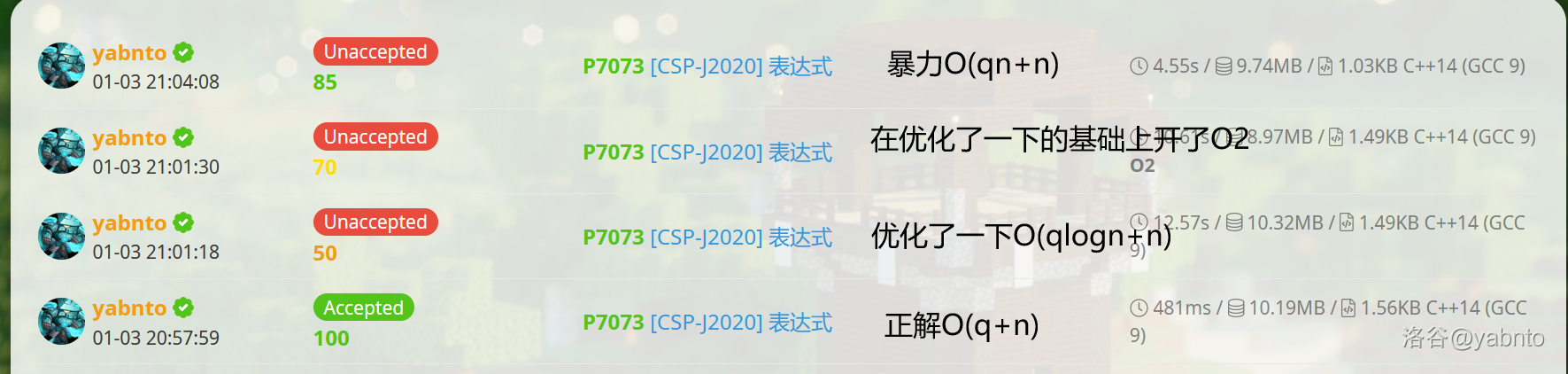
暴力
暴力建树,暴力更改、求解
#include <iostream>

using namespace std;

const int MaxN = 1e6 + 10;

struct E {
  int x;        // 数值
  char c;       // 符号
  int l, r, f;  // 左儿子,右儿子,父亲
} e[MaxN];

int n, m = 1e5 + 1, q;
int s[MaxN], top;
int x;

int C(int x) {
  if (e[x].c) {
    return e[x].x = (e[x].c == '&' ? C(e[x].l) && C(e[x].r) : (e[x].c == '!' ? !C(e[x].r) : C(e[x].l) || C(e[x].r)));
  } else {
    return e[x].x;
  }
}

int main() {
  ios::sync_with_stdio(0);
  cin.tie(0), cout.tie(0);
  for (char c; cin >> c; s[++top] = x) {
    if (c >= '0' && c <= '9') {
      cin.putback(c);
      break;
    } else if (c == 'x') {
      cin >> x;
    } else if (c == '&' || c == '|') {
      e[s[top]].f = x, e[s[top - 1]].f = x;
      e[x = m++] = {0, c, s[top--], s[top--], -1};
    } else if (c == '!') {
      e[x = m++] = {0, c, -1, s[top--], -1};
    }
  }
  cin >> n;
  for (int i = 1; i <= n; i++) {
    cin >> e[i].x;
  }
  // C(s[1]);
  for (cin >> q; q; q--) {
    int x;
    cin >> x;
    e[x].x ^= 1;
    cout << C(s[1]) << endl;
    e[x].x ^= 1;
  }
  return 0;
}
优化一点
因为只有那一个叶子变了,所以当前叶子从下往上更新就可以了
#include <iostream>

using namespace std;

const int MaxN = 1e6 + 90;

struct E {
  bool x;       // 数值
  char c;       // 符号
  int l, r, f;  // 左儿子,右儿子,父亲
} e[MaxN];

int n, m = 1e5, q;
int s[MaxN], top;
int x;

void update(int u) {
  if (e[u].l == -1 && e[u].r == -1) {
    update(e[u].f);
    return;
  }
  if (u == -1) {
    return;
  }
  e[u].x = (e[u].c == '&' ? e[e[u].l].x & e[e[u].r].x : (e[u].c == '!' ? !e[e[u].r].x : e[e[u].l].x | e[e[u].r].x));
  update(e[u].f);
}

int C(int u) {
  if (u == -1) {
    return 1;
  }
  if (e[u].c) {
    return e[u].x = (e[u].c == '&' ? C(e[u].l) & C(e[u].r) : (e[u].c == '!' ? !C(e[u].r) : C(e[u].l) | C(e[u].r)));
  } else {
    return e[u].x;
  }
}

int main() {
  ios::sync_with_stdio(0);
  cin.tie(0), cout.tie(0);
  for (char c; cin >> c; s[++top] = x) {
    if (c >= '0' && c <= '9') {
      cin.putback(c);
      break;
    } else if (c == 'x') {
      cin >> x;
    } else if (c == '&' || c == '|') {
      x = m++;
      e[s[top]].f = x, e[s[top - 1]].f = x;
      e[x] = {0, c, s[top--], s[top--], -1};
    } else if (c == '!') {
      x = m++;
      e[s[top]].f = x;
      e[x] = {0, c, -1, s[top--], -1};
    }
  }
  cin >> n;
  for (int i = 1; i <= n; i++) {
    cin >> e[i].x;
    e[i].l = e[i].r = -1;
  }
  C(s[1]);
  for (cin >> q; q; q--) {
    cin >> x;
    e[x].x ^= 1;                // 取反
    update(x);                  // 更新
    cout << e[s[1]].x << endl;  // 输出
    e[x].x ^= 1;                // 取反
    update(x);                  // 更新
  }
  return 0;
}
正解
可以记录当前结点改变了,是否会对根造成改变,只要对于当前节点做出一些判断即可:
根结点边了绝对有影响。
-
记录当前结点对根结点有影响。
-
如果当前结点是个
!那么给予它改变的结点就是它的右儿子 -
如果当前节点是个
&:-
如果之前的值是
1,左右儿子都会对它有影响 -
如果它的左儿子是
1,那它的右儿子会对它有影响 -
如果它的右儿子是
1,那它的左儿子会对它有影响
-
-
如果当前节点是个
|:-
如果之前的值是
0,左右儿子都会对它有影响 -
如果它的左儿子是
0,那它的右儿子会对它有影响 -
如果它的右儿子是
0,那它的左儿子会对它有影响
-
#include <iostream>

using namespace std;

const int MaxN = 1e6 + 10;

struct E {
  int x;        // 数值
  char c;       // 符号
  int l, r, o;  // 左儿子,右儿子,是否会对根有影响
} e[MaxN];

int n, m = 1e5 + 1, q;
int s[MaxN], top;
int x;

void F(int u) {
  e[u].o = 1;
  if (e[u].c == '!') {
    F(e[u].r);
  } else if (e[u].c == '&') {
    if (e[u].x) {
      F(e[u].l), F(e[u].r);
    } else {
      if (e[e[u].l].x) {
        F(e[u].r);
      }
      if (e[e[u].r].x) {
        F(e[u].l);
      }
    }
  } else if (e[u].c == '|') {
    if (!e[u].x) {
      F(e[u].l), F(e[u].r);
    } else {
      if (!e[e[u].l].x) {
        F(e[u].r);
      }
      if (!e[e[u].r].x) {
        F(e[u].l);
      }
    }
  }
}

int C(int u) {
  if (u == -1) {
    return 1;
  }
  if (e[u].c) {
    return e[u].x = (e[u].c == '&' ? C(e[u].l) & C(e[u].r)
                                   : (e[u].c == '!' ? !C(e[u].r)
                                                    : C(e[u].l) | C(e[u].r)));
  } else {
    return e[u].x;
  }
}

int main() {
  ios::sync_with_stdio(0);
  cin.tie(0), cout.tie(0);
  for (char c; cin >> c; s[++top] = x) {
    if (c >= '0' && c <= '9') {
      cin.putback(c);
      break;
    } else if (c == 'x') {
      cin >> x;
    } else if (c == '&' || c == '|') {
      x = m++;
      e[x] = {0, c, s[top--], s[top--]};
    } else if (c == '!') {
      x = m++;
      e[x] = {0, c, -1, s[top--]};
    }
  }
  cin >> n;
  for (int i = 1; i <= n; i++) {
    cin >> e[i].x;
  }
  C(s[1]);
  F(s[1]);
  for (cin >> q; q; q--) {
    cin >> x;
    cout << (e[s[1]].x ^ e[x].o) << endl;
  }
  return 0;
}