
没学过树就别看
字典树 其实就是 树的扩展,
给树的每个边起个名字,他就变成了字典树。
如图:
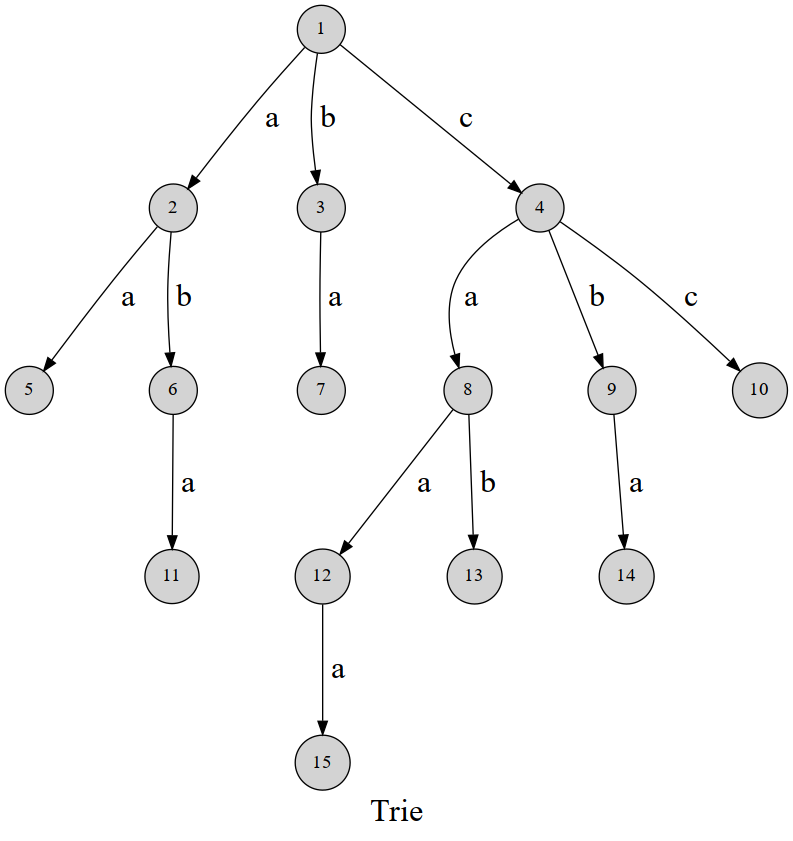
我们举几个例子,我们给 连接 1 和 2 的边 起名为 a,
给 连接 1 和 3 的边 起名为 b,
给 连接 1 和 4 的边 起名为 c。
树上两个节点,不经过重复的边,只有一条路径。
为 Trie 上的某个节点。
从根节点到 的路径是唯一的,
把路径的名字连在一起,就是 表示的状态。
例如
从 根节点到 的路径是 。
共三条边,分别为 ,名字分别为 。
所以 表示的状态就是
那字典树有什么作用呢?
每个节点表示一个 唯一(要求无重边) 的状态,
所以它可以用来表示字符串、维护异或极值、维护异或和。
接下来我们看一下 P2580 的具体实现
struct node {
  int g [26], b;
  node () = default;
} a [1000006];
int tot;
第二行中的 g [26] 是用 邻接列表存储,
第三行 b 表示节点状态(一般为是否模式串结尾)。
int insert (string s)
{
  int j = 0;
  for (const char & c : s)
  {
    int & to = a [j].g [To (c)];
    j = (to ? to : to = ++ tot);
  }
  a [j].b = 1;
  return j;
}int To (char c)
{
return c - 'a';
}To (c) 就是把字符 c 变成整数索引。
j 是当前节点,to 是从 j 连 To (c) 的边。
to ? to : to = ++ tot 表示如果 to 不存在,就建一个新的点,把 to 设为那个点。
最后把 j 移动到 to。
int query (string s)
{
int j = 0;
for (const char & c : s)
{
int & to = a [j].g [To (c)];
if (! to) return - 1;
j = to;
}
int ans = a [j].b - 1;
if (a [j].b != - 1) a [j].b = 2;
return ans;
}不断把 s 喂给字典树。
如果在中间没有跳成功,就返回 (失败)
如果最后发现不是 某个名字 的结尾,依旧返回 。
如果是第一次访问,返回 。
如果不是第一次访问,返回 。
在主函数输入,插入,最后在每一次访问时查询并判断类型。
完整实现
#include <iostream>
using namespace std;
class Trie
{
struct node {
int g [26], b;
node () = default;
} a [1000006];
int tot;
int To (char c)
{
  return c - 'a';
}
public :
Trie (void) : tot (0) {
;
}
void clear ()
{
for (int i = 0; i <= tot; ++ i)
{
a [i].b = 0;
for (int j = 0; j < 26; ++ j) a [i].g [j] = 0;
}
}
int insert (string s)
{
int j = 0;
for (const char & c : s)
{
int & to = a [j].g [To (c)];
j = (to ? to : to = ++ tot);
}
a [j].b = 1;
return j;
}
int query (string s)
{
  int j = 0;
  for (const char & c : s)
  {
    int & to = a [j].g [To (c)];
    if (! to) return - 1;
    j = to;
  }
  int ans = a [j].b - 1;
  if (a [j].b != - 1) a [j].b = 2;
  return ans;
}
}T;
string name;
int n;
signed main ()
{
cin >> n;
for (int i = 0; i < n; ++ i) cin >> name, T.insert (name);
cin >> n;
for (int op, i = 0; i < n; ++ i)
{
cin >> name;
op = T.query (name);
if (op == - 1) puts ("WRONG");
else if (! op) puts ("OK");
else puts ("REPEAT");
}
return 0;
}