跳到正文

学习·文化课

2024 年高考数学·新课标 I 卷 T11/T18/T19

Christmas_Defunct约 7 分钟
原文
文章信息与版本

文章信息

发布
2025年10月18日
收录
2025年12月12日
更新
2026年11月17日
篇幅
约 7 分钟

版本

  1. v4当前
  2. v3
  3. v2
  4. v1

2024 年高考数学·新课标 I 卷

T11

题面

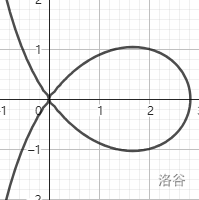
造型 ∝\propto 可以看作途中曲线 CC 的一部分,已知 CC 过坐标原点 OO,且 CC 上的点满足横坐标大于 −2-2,到点 F(2,0)F(2,0) 的距离与到定直线 x=a(a<0)x=a(a<0) 的距离之积为 44,则 ________。

  • A.\mathrm{A}. a=−2a=-2
  • B.\mathrm{B}. 点 (22,0)(2\sqrt2,0) 在 CC 上
  • C.\mathrm{C}. CC 在第一象限的点的纵坐标的最大值为 11
  • D.\mathrm{D}. 当点 (x0,y0)(x_0,y_0) 在 CC 上时,y0⩽4x0+2y_{0}\leqslant\frac{4}{x_0+2}

题解

正确答案:ABD\color{green}\mathrm{ABD}

  • A\color{green}\mathrm{A} 选项分析

∵\because OO 在曲线 CC 上
∴\therefore OO 到 x=ax=a 的距离为 −a-a
∵\because OF=2OF=2
∴\therefore −2a=4-2a=4
∴\therefore a=−2a=-2

  • B\color{green}\mathrm{B} 选项分析

由上述分析易知 C:(x+2)⋅(x−2)2+y2=4C:(x+2)\cdot\sqrt{(x-2)^2+y^2}=4
将 (22,0)(2\sqrt2,0) 代入得原方程成立
∴\therefore 点 (22,0)(2\sqrt2,0) 在 CC 上

  • C\color{red}\mathrm{C} 选项分析

∵\because y2=(4x+2)2−(x−2)2=f(x)y^2=(\frac{4}{x+2})^2-(x-2)^2=f(x)
∴\therefore f′(x)=−32(x+2)3−2(x−2)f'(x)=-\frac{32}{(x+2)^3}-2(x-2)
∴\therefore f(2)=1,f′(2)=−12<0f(2)=1,f'(2)=-\frac{1}{2}<0
∴\therefore 在 x=2x=2 左侧存在 (2− ,2)(2-\ ,2) 满足 f(x)>1f(x)>1
∴\therefore ymax>1y_{max}>1
∴\therefore CC 在第一象限的点的纵坐标的最大值大于 11

  • D\color{green}\mathrm{D} 选项分析

∵\because y02=(4x0+2)2−(x0−2)2⩽(4x0+2)2y_0^2=(\frac{4}{x_0+2})^2-(x_0-2)^2\leqslant(\frac{4}{x_0+2})^2
∴\therefore y0⩽4x0+2y_0\leqslant\frac{4}{x_0+2}
∴\therefore 当点 (x0,y0)(x_0,y_0) 在 CC 上时,y0⩽4x0+2y_{0}\leqslant\frac{4}{x_0+2}

T18

题面

已知函数 f(x)=ln⁡x2−x+ax+b(x−1)3f(x)=\ln\frac{x}{2-x}+ax+b(x-1)^3

  • (I)(\mathrm{I}) 若 b=0b=0,且 f′(x)⩾0f'(x)\geqslant0,求 aa 的最小值。
  • (II)(\mathrm{II}) 证明:曲线 y=f(x)y=f(x) 是中心对称图形。
  • (III)(\mathrm{III}) 若 f(x)>−2f(x)>-2 当且仅当 1<x<21<x<2,求 bb 的取值范围。

题解

  • (I)(\mathrm{I})

当 b=0b=0 时,f(x)=ln⁡x2−x+axf(x)=\ln\frac{x}{2-x}+ax
∴f′(x)=1x+12−x+a=2x(2−x)+a⩾0\therefore f'(x)=\frac{1}{x}+\frac{1}{2-x}+a=\frac{2}{x(2-x)}+a\geqslant0
即 a⩾−2x(2−x)a\geqslant-\frac{2}{x(2-x)}
当 x=1x=1 时,a⩾−21×(2−1)=−2a\geqslant-\frac{2}{1\times(2-1)}=-2
∴amin=2\therefore a_{min}=2

  • (II)(\mathrm{II})

∵f(x)+f(2−x)\because f(x)+f(2-x)
=ln⁡x2−x+ax+b(x−1)3+ln⁡2−xx+a(2−x)+b(1−x)3=\ln\frac{x}{2-x}+ax+b(x-1)^3+\ln\frac{2-x}{x}+a(2-x)+b(1-x)^3
=2a=2a
=2×f(1)=2\times f(1)
∴ y=f(x)\therefore\ y=f(x) 是关于 (1,a)(1,a) 的中心对称图形

  • (III)(\mathrm{III})

由题,a=f(1)⩽−2a=f(1)\leqslant-2
假设 a<−2a<-2,由 f(2⋅e∣b∣+11+e∣b∣+1)>∣b∣+1−∣b∣=1f(\frac{2\cdot e^{\left|b\right|+1}}{1+e^{\left|b\right|+1}})>\left|b\right|+1-\left|b\right|=1
应用零点存在定理知存在 x1∈(1,2⋅e∣b∣+11+e∣b∣+1),f(x1)=0x_1\in{(1,\frac{2\cdot e^{\left|b\right|+1}}{1+e^{\left|b\right|+1}})},f(x_1)=0
该结论与 f(2⋅e∣b∣+11+e∣b∣+1)>1f(\frac{2\cdot e^{\left|b\right|+1}}{1+e^{\left|b\right|+1}})>1 矛盾
∴a=−2\therefore a=-2
此时,f′(x)=(x−1)2x(2−x)⋅[3b⋅x(2−x)+2]f'(x)=\frac{(x-1)^2}{x(2-x)}\cdot[3b\cdot x(2-x)+2]
当 b⩾−23b\geqslant-\frac{2}{3} 时,f′(x)⩾(x−1)2x(2−x)⋅(2x2−4x+2)⩾0f'(x)\geqslant\frac{(x-1)^2}{x(2-x)}\cdot(2x^2-4x+2)\geqslant0 且不恒为 00
∴f(x)\therefore f(x) 在 (0,2)(0,2) 递增,其中,当且仅当 1<x<21<x<2 时,f(x)>−2=f(1)f(x)>-2=f(1)
当 b<−23b<-\frac{2}{3} 时,令 x0=3b−9b2−6b3b∈(0,1),f′(x0)=0x_0=\frac{3b-\sqrt{9b^2-6b}}{3b}\in{(0,1)},f'(x_0)=0
且当 x∈(x0,1)x\in{(x_0,1)} 时,f′(x)<0f'(x)<0
∴f(x)\therefore f(x) 在 (x0,1)(x_0,1) 递减
∴f(x0)>f(1)=−2\therefore f(x_0)>f(1)=-2
而 x0∉(1,2)x_0\notin{(1,2)},此时矛盾

综上所述,b∈[−23,+∞)b\in{[-\frac{2}{3},+\infty)}

T19

题面

设 mm 为正整数,数列 a1,a2,a3,⋯ ,a4m+2a_1,a_2,a_3,\cdots,a_{4m+2} 是公差不为 00 的等差数列,若从中删去两项 aia_i 和 aja_j (i<j)(i<j) 后剩余的 4m4m 项都可被平均分为 mm 组,且每组的 44 个数都能构成等差数列,则称数列 a1,a2,⋯ ,a4m+2a_1,a_2,\cdots,a_{4m+2} 是 (i,j)—可分数列\color{blue}(i,j)—可分数列。

  • (I)(\mathrm{I}) 写出所有的 (i,j),1⩽i<j⩽6(i,j),1\leqslant i<j\leqslant6,使数列 a1,a2,a3,a4,a5,a6a_1,a_2,a_3,a_4,a_5,a_6 是 (i,j)—可分数列\color{green}(i,j)—可分数列。
  • (II)(\mathrm{II}) 当 m⩾3m\geqslant3 时,证明:数列 a1,a2,a3,⋯ ,a4m+2a_1,a_2,a_3,\cdots,a_{4m+2} 是 (2,13)—可分数列\color{red}(2,13)—可分数列。
  • (III)(\mathrm{III}) 从 1,2,3,⋯ ,4m+21,2,3,\cdots,4m+2 中一次任取两个数 ii 和 jj (i<j)(i<j),记数列 a1,a2,a3,⋯ ,a4m+2a_1,a_2,a_3,\cdots,a_{4m+2} 是 (i,j)—可分数列\color{purple}(i,j)—可分数列 的概率为 PmP_m,证明:Pm>18P_m>\frac{1}{8}。

题解

  • (I)\mathrm{(I)}

由题,显然有 (i,j)=(1,2),(5,6),(1,6)(i,j)=(1,2),(5,6),(1,6)

  • (II)\mathrm{(II)}

去掉 a2,a13a_2,a_{13} 后剩下 a1,a3,⋯ ,a12,a14a_1,a_3,\cdots,a_{12},a_{14}
该 1212 个可分割为以下三个四元组
(1,4,7,10),(3,6,9,12),(5,8,11,14)(1,4,7,10),(3,6,9,12),(5,8,11,14)
当 aia_i 中 i>14i>14 时,连续四个分为一组即可
∴\therefore 数列 a1,a2,,⋯ ,a4m+2a_1,a_2,,\cdots,a_{4m+2} 是 (2,13)—可分数列\color{red}(2,13)—可分数列

  • (III)\mathrm{(III)}

实则是不会写了,嘴硬说是不想写 LaTeX\LaTeX 了。