版本比较
【学习笔记】ACAM(有图哟~)

标题
增加 1 行删除 1 行
11从 Trie 到 SAM【学习笔记】ACAM(有图哟~)正文
增加 1900 行删除 60 行
112334567891011121314151617181920212223242526272829303132333435363738394041424344454647484950515253545556575859606156637891011121314151617181920212223242526272829303132333435363738394041424344454647484950515253545556575859606162636465666768697071727374757677787980818283848586878889909192939495969798991001011021031041051061071081091101111121131141151161171181191201211221231241251261271281291301311321331341351361371381391401411421431441451461471481491501511521531541551561571581591601611621631641651661671681691701711721731741751761771781791801811821831841851861871881891901911921931941951961971981992002012022032042052062072082092102112122132142152162172182192202212222232242252262272282292302312322332342352362372382392402412422432442452462472482492502512522532542552562572582592602612622632642652662672682692702712722732742752762772782792802812822832842852862872882892902912922932942952962972982993003013023033043053063073083093103113123133143153163173183193203213223233243253263273283293303313323333343353363373383393403413423433443453463473483493503513523533543553563573583593603613623633643653663673683693703713723733743753763773783793803813823833843853863873883893903913923933943953963973983994004014024034044054064074084094104114124134144154164174184194204214224234244254264274284294304314324334344354364374384394404414424434444454464474484494504514524534544554564574584594604614624634644654664674684694704714724734744754764774784794804814824834844854864874884894904914924934944954964974984995005015025035045055065075085095105115125135145155165175185195205215225235245255265275285295305315325335345355365375385395405415425435445455465475485495505515525535545555565575585595605615625635645655665675685695705715725735745755765775785795805815825835845855865875885895905915925935945955965975985996006016026036046056066076086096106116126136146156166176186196206216226236246256266276286296306316326336346356366376386396406416426436446456466476486496506516526536546556566576586596606616626636646656666676686696706716726736746756766776786796806816826836846856866876886896906916926936946956966976986997007017027037047057067077087097107117127137147157167177187197207217227237247257267277287297307317327337347357367377387397407417427437447457467477487497507517527537547557567577587597607617627637647657667677687697707717727737747757767777787797807817827837847857867877887897907917927937947957967977987998008018028038048058068078088098108118128138148158168178188198208218228238248258268278288298308318328338348358368378388398408418428438448458468478488498508518528538548558568578588598608618628638648658668678688698708718728738748758768778788798808818828838848858868878888898908918928938948958968978988999009019029039049059069079089099109119129139149159169179189199209219229239249259269279289299309319329339349359369379389399409419429439449459469479489499509519529539549559569579589599609619629639649659669679689699709719729739749759769779789799809819829839849859869879889899909919929939949959969979989991000100110021003100410051006100710081009101010111012101310141015101610171018101910201021102210231024102510261027102810291030103110321033103410351036103710381039104010411042104310441045104610471048104910501051105210531054105510561057105810591060106110621063106410651066106710681069107010711072107310741075107610771078107910801081108210831084108510861087108810891090109110921093109410951096109710981099110011011102110311041105110611071108110911101111111211131114111511161117111811191120112111221123112411251126112711281129113011311132113311341135113611371138113911401141114211431144114511461147114811491150115111521153115411551156115711581159116011611162116311641165116611671168116911701171117211731174117511761177117811791180118111821183118411851186118711881189119011911192119311941195119611971198119912001201120212031204120512061207120812091210121112121213121412151216121712181219122012211222122312241225122612271228122912301231123212331234123512361237123812391240124112421243124412451246124712481249125012511252125312541255125612571258125912601261126212631264126512661267126812691270127112721273127412751276127712781279128012811282128312841285128612871288128912901291129212931294129512961297129812991300130113021303130413051306130713081309131013111312131313141315131613171318131913201321132213231324132513261327132813291330133113321333133413351336133713381339134013411342134313441345134613471348134913501351135213531354135513561357135813591360136113621363136413651366136713681369137013711372137313741375137613771378137913801381138213831384138513861387138813891390139113921393139413951396139713981399140014011402140314041405140614071408140914101411141214131414141514161417141814191420142114221423142414251426142714281429143014311432143314341435143614371438143914401441144214431444144514461447144814491450145114521453145414551456145714581459146014611462146314641465146614671468146914701471147214731474147514761477147814791480148114821483148414851486148714881489149014911492149314941495149614971498149915001501150215031504150515061507150815091510151115121513151415151516151715181519152015211522152315241525152615271528152915301531153215331534153515361537153815391540154115421543154415451546154715481549155015511552155315541555155615571558155915601561156215631564156515661567156815691570157115721573157415751576157715781579158015811582158315841585158615871588158915901591159215931594159515961597159815991600160116021603160416051606160716081609161016111612161316141615161616171618161916201621162216231624162516261627162816291630163116321633163416351636163716381639164016411642164316441645164616471648164916501651165216531654165516561657165816591660166116621663166416651666166716681669167016711672167316741675167616771678167916801681168216831684168516861687168816891690169116921693169416951696169716981699170017011702170317041705170617071708170917101711171217131714171517161717171817191720172117221723172417251726172717281729173017311732173317341735173617371738173917401741174217431744174517461747174817491750175117521753175417551756175717581759176017611762176317641765176617671768176917701771177217731774177517761777177817791780178117821783178417851786178717881789179017911792179317941795179617971798179918001801180218031804180518061807180818091810181118121813181418151816181718181819182018211822182318241825182618271828182918301831183218331834183518361837183818391840184118421843184418451846184718481849185018511852185318541855185618571858185918601861186218631864186518661867186818691870187118721873187418751876187718781879188018811882188318841885188618871888188918901891189218931894189518961897189818991900190119021903坑……# 前言
# 从 Trie 到 SAM[书接上回](https://www.luogu.com.cn/article/14cmiom7),学习字符串实在太过于痛苦,未尝深刻理解。故作此文,用以加深印象。
> 我家后面有一个很大的机房,相传叫作“字符串库”。现在是早已和教室一起租给隔壁的化竞班了,连那最末次的相见也已经隔了三四月,其中似乎确凿只有一些字符串;但那时却是我的乐园。>> 不必说朴素的模式匹配,野蛮的暴力枚举,高大的动态规划树;也不必说 KMP 在文本串里长吟,轻捷的 AC 自动机忽然从 Trie 树上直窜向云端里去了。单是周围的短短的 Trie 树一带,就有无限趣味。字符在这里低唱,指针在这里跳舞。翻开断砖来,有时会遇见哈希冲突;还有后缀数组,倘若用手指按住它的首项,便会“啪”的一声,从后面喷出一阵烟雾。字典树有伞盖般的结构,后缀树有臃肿的结点。有人说,Trie 的根是有像人形的,理解了便可以成仙,我于是常常研究它,连续不断地调试,也曾因此弄坏了键盘,却从来没有见过有一个结构像人样。如果不怕 WA,还可以摘到后缀自动机,像小珊瑚珠攒成的小球,又酸又涩,色味都比线段树要好得远。>> 长的教练是不常来的,因为相传这园里有一条很大的“红黑树”。> > 长的教练曾经讲给我一个故事听:先前,有一个 OIer 在机房里刷题,夜晚在屏幕前写代码时,突然听到有人叫他。答应着,四面看时,却见一个美女的脸露在屏幕前,向他一笑,隐去了。他很高兴;但竟给那走来夜谈的教练看出了破绽,说他脸上有些妖气,一定遇见“美女蛇”了;这是人首蛇身的怪物,能唤人名,倘一答应,夜间便要来吃这人的肉的。他自然吓得要死,而那教练却道无妨,给他一个小盒子,说只要放在枕边,便可高枕而卧。他虽然照样办,却总是睡不着——当然睡不着的。到半夜,果然来了,沙沙沙!门外像是风雨声。他正抖作一团时,却听得豁的一声,一道金光从枕边飞出,外面便什么声音也没有了,那金光也就飞回来,敛在盒子里。后来呢?后来,教练说,这是飞蜈蚣,它能吸蛇的脑髓,美女蛇就被它治死了。> > 结末的教训是:所以倘有陌生的变量名出现在代码里,你万不可轻易使用它。> > 这故事很使我觉得做 OIer 之险,夏夜乘凉,往往有些担心,不敢去看代码,而且极想得到一盒教练的飞蜈蚣。走到 Trie 树的旁边时,也常常这样想。但直到现在,总还没有得到,但也没有遇见过红黑树和美女蛇。叫我变量名的陌生函数自然是常有的,然而都不是美女蛇。> > 冬天的 Trie 树比较的无味;雪一下,可就两样了。拍雪人(将自己的全形印在雪上)和塑雪罗汉需要人们鉴赏,这是荒园,人迹罕至,所以不相宜,只好来“对拍”。薄薄的雪,是不行的;总须积雪盖了地面一两天,数据点久已无处生成的时候才好。打开一块磁盘,露出接口,用一台旧电脑支起一面大的编译器,下面放些测试数据,电脑上连着一条长线,人远远地操作着,看数据点进去运行,走到编译器里面的时候,将脚本一跑,便出结果了。但所得的是小数据居多,也有大数据“TLE”,性子很躁,跑不过夜的。> > 这是学长所传授的方法,我却不大能用。明明见它们进去了,运行了,跑去看,却什么都没有,费了半天力,对出来的不过三四组。学长是小半天便能对出几十组,装在 U 盘里叫着撞着的。我曾经问他得失的缘由,他只静静地笑道:你太性急,来不及等它走到中间去。> > 我不知道为什么家里的人要将我送进书塾里去了,而且还是全城中最严的书塾。也许是因为把Trie树里的字符都玩坏了吧,也许是因为将指针乱丢进内存池里去了吧,也许是因为站在树上看代码看得太久了吧……都无从知道。总而言之:我将不能常到 Trie 树了。Ade,我的哈希冲突!Ade,我的 KMP 和 AC 自动机们!> > 出门向东,不上半里,走过一道石桥,便是我的先生的家了。从一扇黑油的竹门进去,第三间是书房。中间挂着一块匾道:三味书屋;匾下面是一幅画,画着一只很肥大的梅花鹿伏在古树下。没有孔子牌位,我们便对着那匾和鹿行礼。第一次算是拜孔子,第二次算是拜先生。> > 第二次行礼时,先生便和蔼地在一旁答礼。他是一个高而瘦的老人,须发都花白了,还戴着大眼镜。我对他很恭敬,因为我早听到,他是本城中最博学的人,尤其精通字符串。> > 我便对着书屋里的梅花鹿行礼,算是拜了师。先生给我上了第一课,便是在黑板上写下两个大字:“后缀”。> > “后缀!”他说。> > 于是大家放开喉咙读一阵书,真是人声鼎沸。有念“parent 树父亲是后缀”的,有念“endpos 集合要合并”的,有念“状态转移要复制”的,有念“link 指针往上跳”的……先生自己也念。后来,我们的声音便低下去,静下去了,只有他还大声朗读着:> > “状态数不超过 $2n$,转移数不超过 $3n$,构建时间复杂度 $O(n)$……”> > 我疑心这是极好的文章,因为读到这里,他总是微笑起来,而且将头仰起,摇着,向后面拗过去,拗过去。> > 先生读书入神的时候,于我们是很相宜的。有几个用纸糊的键盘敲代码的,也有用指甲在桌上模拟算法的。我是喜欢在纸上画状态转移图的,用一种叫作“自动机”的图画。读的书多起来,画的图也多起来;代码没有写,图的成绩却不少了,从最简单的 DFA 到 NFA,终于到 SAM。> > 三味书屋后面也有一个小机房,虽然小,但在那里也可以偷偷打游戏,或是在草稿纸上寻思路。最好的工作是捉了 bug 喂样例,静悄悄地没有声音。然而同窗们到机房里的太多,太久,可就不行了,先生在书房里便大叫起来:> > “人都到哪里去了!”> > 人们便一个个陆续走回去;一同回去,也不行的。他有一条戒尺,但是不常用,也有罚站的规矩,但也不常用,普通总不过瞪几眼,大声道:> > “读书!”> > 于是大家放开喉咙读一阵书,真是人声鼎沸。有念“广义后缀自动机”的,有念“子串出现次数”的,有念“本质不同子串数”的……先生自己也读书。后来,我们的声音便低下去,静下去了,只有他还大声朗读着:> > “当 `maxlen[q] > maxlen[p] + 1` 时,需要复制节点……”> > 我疑心这是极难的文章,因为读到这里,他总是紧皱眉头,而且将头埋下,叹着,向前面垂下去,垂下去。> > 大家便接着哄笑起来:书屋里充满了快活的空气。> > 先生对于我,渐渐的也不那么严厉了。他让我自己看博客,看论文,从《后缀自动机——张一飞的训练营》到《后缀自动机学习笔记——陈立杰》。我于是常常去图书馆,在那些晦涩的符号中寻找一点乐趣。也终于明白,原来这“后缀自动机”真是极难的东西,至今也没有几个人能完全弄懂。> > 后来,因为要准备竞赛,我对 SAM 的兴致也终于完全消散。但直到现在,我还是不知道那 SAM 究竟是怎样构建的——也许先生也不知道罢。> > 如今,我已经离开书屋很久了,但每当看到字符串的题目,总会想起那摇头晃脑的先生,和那快活的空气。> > Ade,我的 Trie 树!Ade,我的后缀自动机和书屋!同时,在这里给大家道歉,由于本人太菜,刷题量很少,所以例题放得太简单了!请各位谅解。
以上内容由 AI 生成。# $\text{ACAM}$
前置知识:$\text{Trie}$、$\text{KMP}$(其实不会也无大碍)。
$\text{ACAM}$,中文名称其为 $\text{AC}$ 自动机。是一种可以用来处理多模式串匹配等问题的自动机。
# 引入
我们通过一个[简单的问题](https://www.luogu.com.cn/problem/P3808)引入 $\text{ACAM}$:> 给定 $n$ 个模式串 $s_i$ 和一个文本串 $t$。求有多少个 $s_i$ 在 $t$ 中出现过,$\sum|s_i|,t\le5\times 10^6$。
考虑一个最暴力的做法,直接枚举 $t$ 的每一个子串,判断是否存在 $s_i$ 与其相等。这个东西可以 $\text{hash}$ 加上 ```unordered_map``` 实现,做到 $O(n^2)$。但显然这并不能通过此题。如何优化,注意到这是多模式串问题,所以想到建 $\text{Trie}$。建出 $\text{Trie}$ 后可以在每一个 $s_i$ 的结束字符上进行标记,然后匹配时用 $t$ 在 $\text{Trie}$ 上走就行了。由于这个是 $\text{Trie}$ 的经典应用,故在此不展开。
可是在 $\text{Trie}$ 上匹配的最劣时间复杂度仍然是 $O(n^2)$ 的,具体地说,如果当前 $t_i$ 匹配到 $\text{Trie}$ 中的节点 $u$,但 $u$ 不存在一个子节点满足 $son_u=t_{i+1}$,那么此时我们称其为失配了。而在现在,处理失配唯一的方法便是从最初始的 $t_x$ 的下一位 $t_{x+1}$ 开始从 $\text{Trie}$ 的根节点重新匹配。
所以如果我们能在 $O(1)$ 的时间内处理失配的问题,那就可以做到线性。观察失配的问题出在哪里?对于下面这一组数据:
- $t$ 为 `abcd`。- $s_i$ 分别为 `abc`、`bc`。
那么对于 $s$ 建出的 $\text{Trie}$ 就长这样:
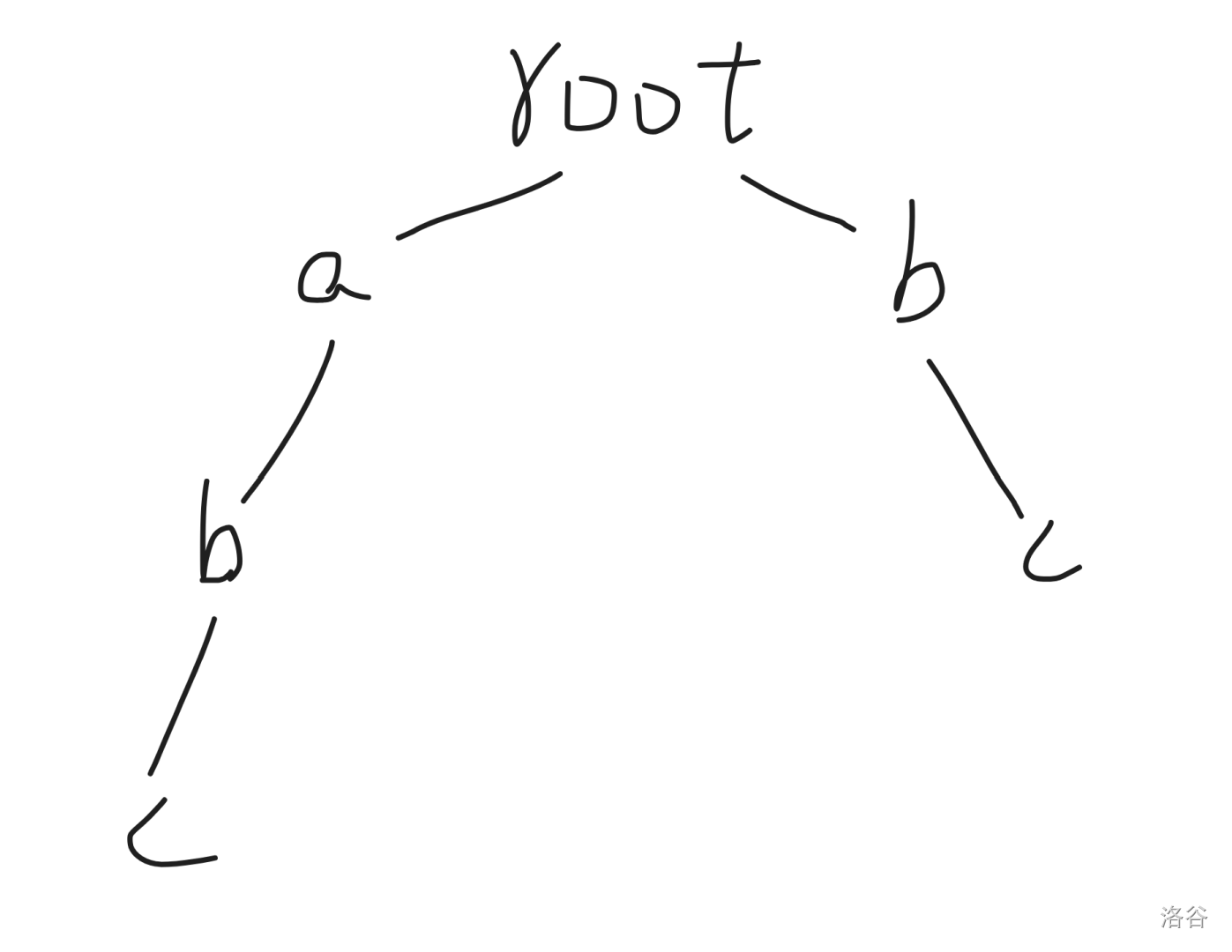
不妨模拟一下匹配的过程,发现是先从根走到 `a`,然后再依次走到 `b`、`c`。再想往下匹配时发现不存在 `d` 这个子节点了,所以重新退回根,然后用 $t$ 的初始的下一位 `b` 再进行第二次匹配。这样我们便可以匹配出 `abc` 和 `bc` 这两个子串,但是观察一下就会发现,在第一次匹配时因为 `abc` 已经包含 `bc` 作为后缀,所以如果我们对于所有的 `abc` 的后缀都标记一下,就可以直接往下匹配 `d` 了。由此,我们引出了 $\text{fail}$ 指针的概念。
# $\text{fail}$ 指针
$\text{fail}$ 指针,又称失配指针,可以很好地处理上文所提及的失配问题。
详细地说,我们对于先仍然对 $s$ 建出 $\text{Trie}$,而每一个 $\text{Trie}$ 中的节点的对应的状态就是它所代表的 $s_i$ 的一段前缀。然后记 $\text{Trie}$ 中状态 $u$ 的失配指针 $\text{fail}_u$ 指向的是 $u$ 的最长后缀 $v$。这其实就和 $\text{KMP}$ 中的 $\text{next}$ 指针有几分相似。
比如上面那个 $\text{Trie}$ 中便存在这么**一个** $\text{fail}$ 指针(红色的边):
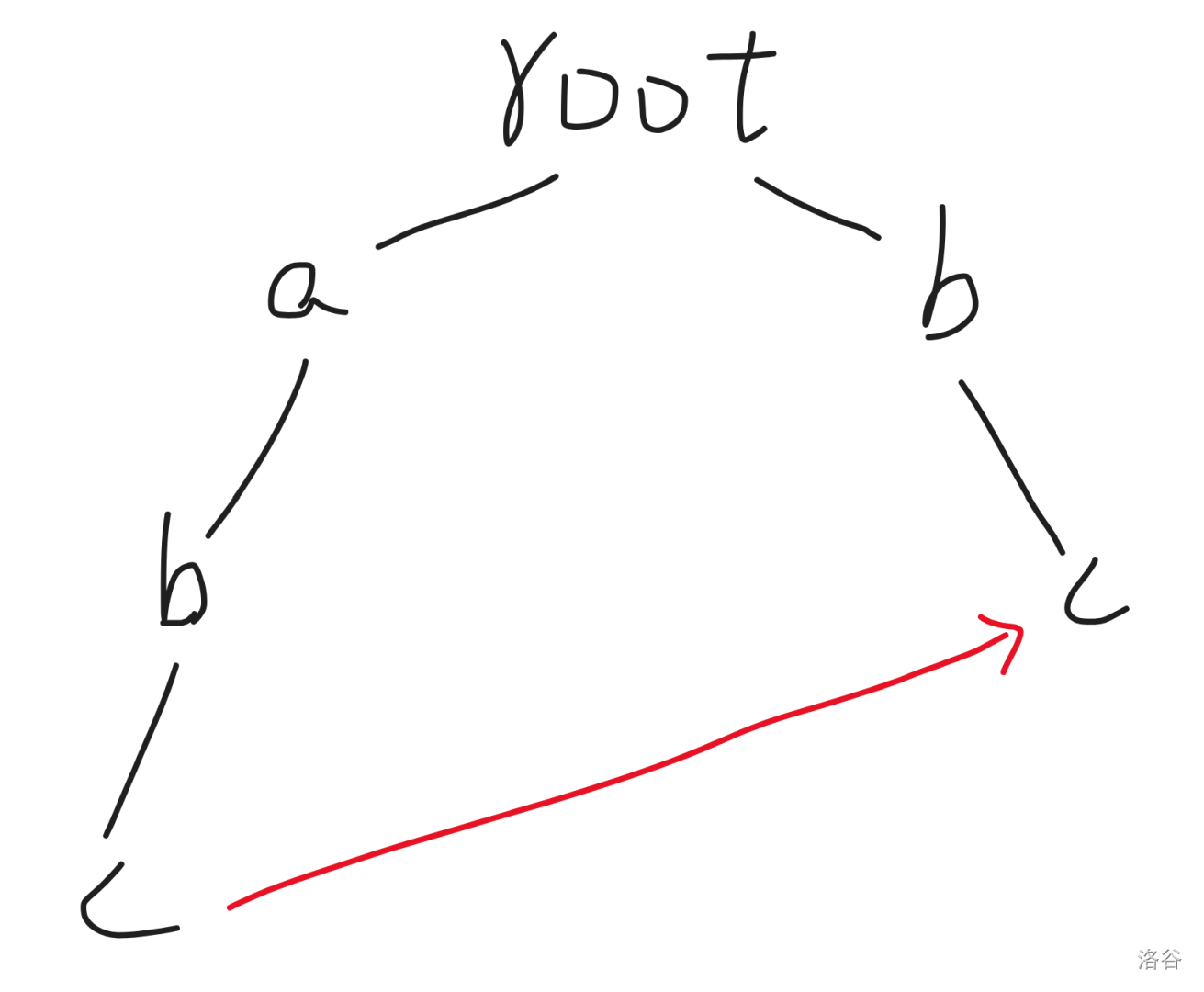
因为 `bc` 是 $\text{Trie}$ 中 `abc` 的最长后缀,所以这条 $\text{fail}$ 指针存在。
而由于这条 $\text{fail}$ 指针的存在,我们可以在走到 `c` 的时候按照这个 $\text{fail}$ 指针跳到 `bc` 的结尾,这样就可以把这两个字符串都标记为出现过。更一般的情况下,一个状态 $u$ 可能可以到达 $\text{fail}_u,\text{fail}_{\text{fail}_u}\cdots$,所以我们需要不断地沿着 $\text{fail}$ 指针往上跳,然后将跳到的状态标记为存在。考虑到如果跳到了一个已经被标记的状态 $u$,我们便可以停止了,因为 $u$ 的 $\text{fail}$ 指针指向的一系列状态都被标记过了。因此每一个状态最多只会被标记一次,时间复杂度是线性的。
每次跳 $\text{fail}$ 都会到达原状态的最长后缀,所以可以做到不漏标记状态,正确性显然。
## $\text{fail}$ 指针的构建
接下来考虑 $\text{fail}$ 指针的构建方法。
由于 $\text{fail}$ 指针和 $\text{next}$ 指针的十分相似,所以可以参考 $\text{next}$ 指针的构建方法。
具体地说,假设当前构建到 $\text{Trie}$ 中的状态 $u$,$u$ 对应的字符为 $x$,$son(u, c)$ 表示 $u$ 的儿子且该儿子对应的字符为 $c$, $u$ 在 $\text{Trie}$ 中的父亲为 $v$。则循环执行以下过程:
- 若 $\text{Trie}$ 中存在 $\text{fail}_{v}\rightarrow son(\text{fail}_{v}, x)$ 的边,则令 $fail_u\leftarrow son(\text{fail}_{v}, x)$。- 否则令 $v\leftarrow \text{fail}_v$。- 若 $v$ 跳到根节点却仍未找到,就令 $\text{fail}_u\leftarrow 0$(钦定 $0$ 为 $\text{Trie}$ 的根)。
为什么这是正确的?
首先,$\text{fail}_v$ 对应的是状态 $v$ 的最长后缀,那么如果存在 $son(\text{fail}_{v}, x)$,则状态 $son(\text{fail}_{v}, x)$ 一定是 $u$ 的最长后缀。
而如果不存在,就不断对 $v$ 跳 $\text{fail}$,因为 $\text{fail}_v$ 对应的仍然是状态 $v$ 的最长后缀,所以第一次找到存在的 $son(\text{fail}_{v}, x)$ 时,状态 $son(\text{fail}_{v}, x)$ 一定也是 $u$ 的最长后缀。
最后,如果整个 $\text{Trie}$ 中都不存在 $son(\text{fail}_{v}, x)$,那么最长后缀为空,所以指向根节点是没问题的。
因为构建过程维持了 $\text{fail}_u$ 的性质,即指向 $u$ 的最长后缀,所以是正确的。
容易发现,在构建过程中我们需要知道所有深度比 $u$ 小的状态的 $\text{fail}$ 指针,所以需要采用 $\text{bfs}$ 构建。
接下来看一个例子:
> 对于 `heatt`、`att`、`earth` 这三个字符串构建 $\text{fail}$ 指针。
首先把 $\text{Trie}$ 建出来,长这样(橙色数字是状态的编号,红色边是 $\text{fail}$ 指针):
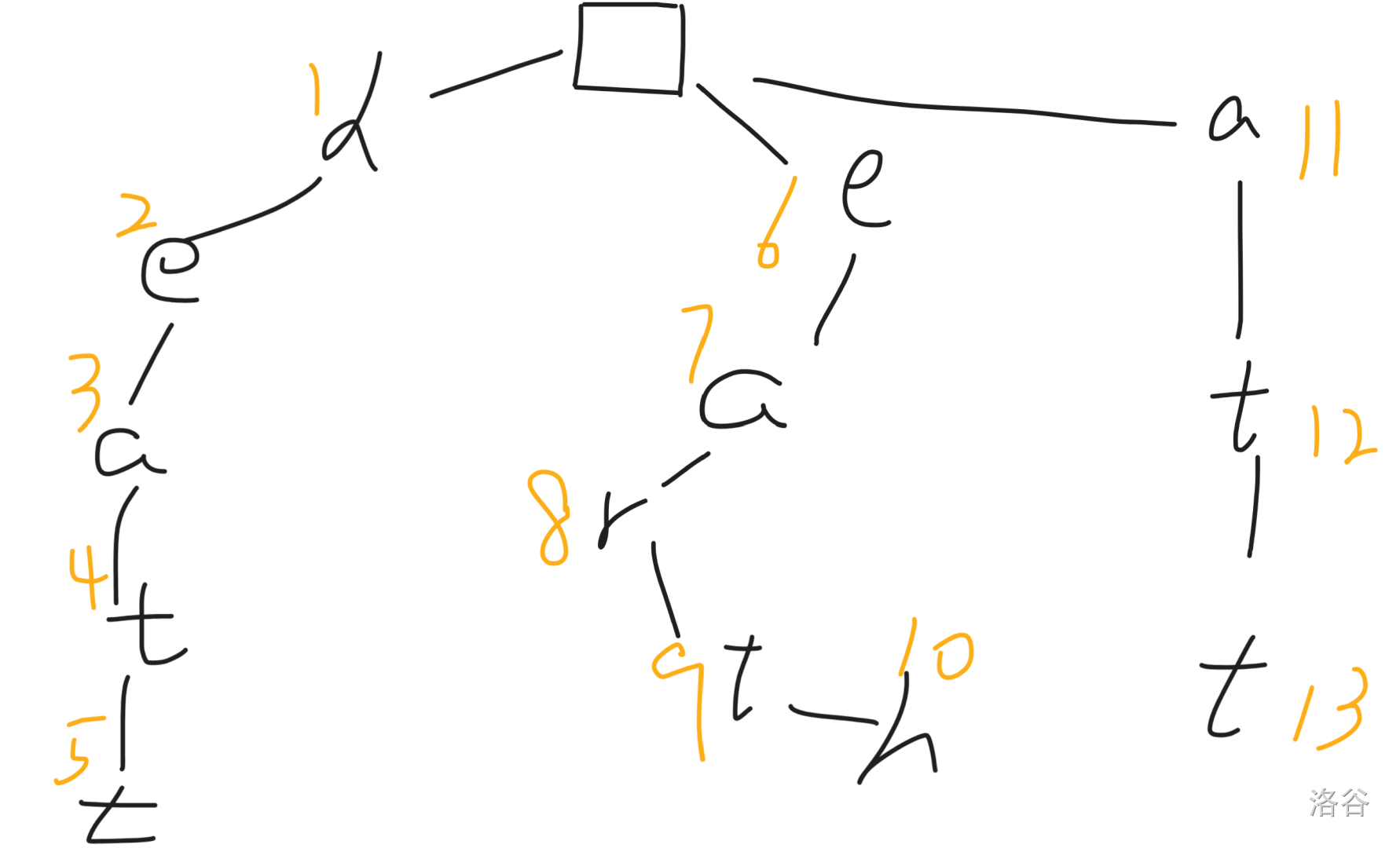
我们记根节点对应第 $0$ 层,则对于第 $1$ 层的每一个节点,其 $\text{fail}$ 指针直接指向根节点(这个是为了方便实现而做的),得到:
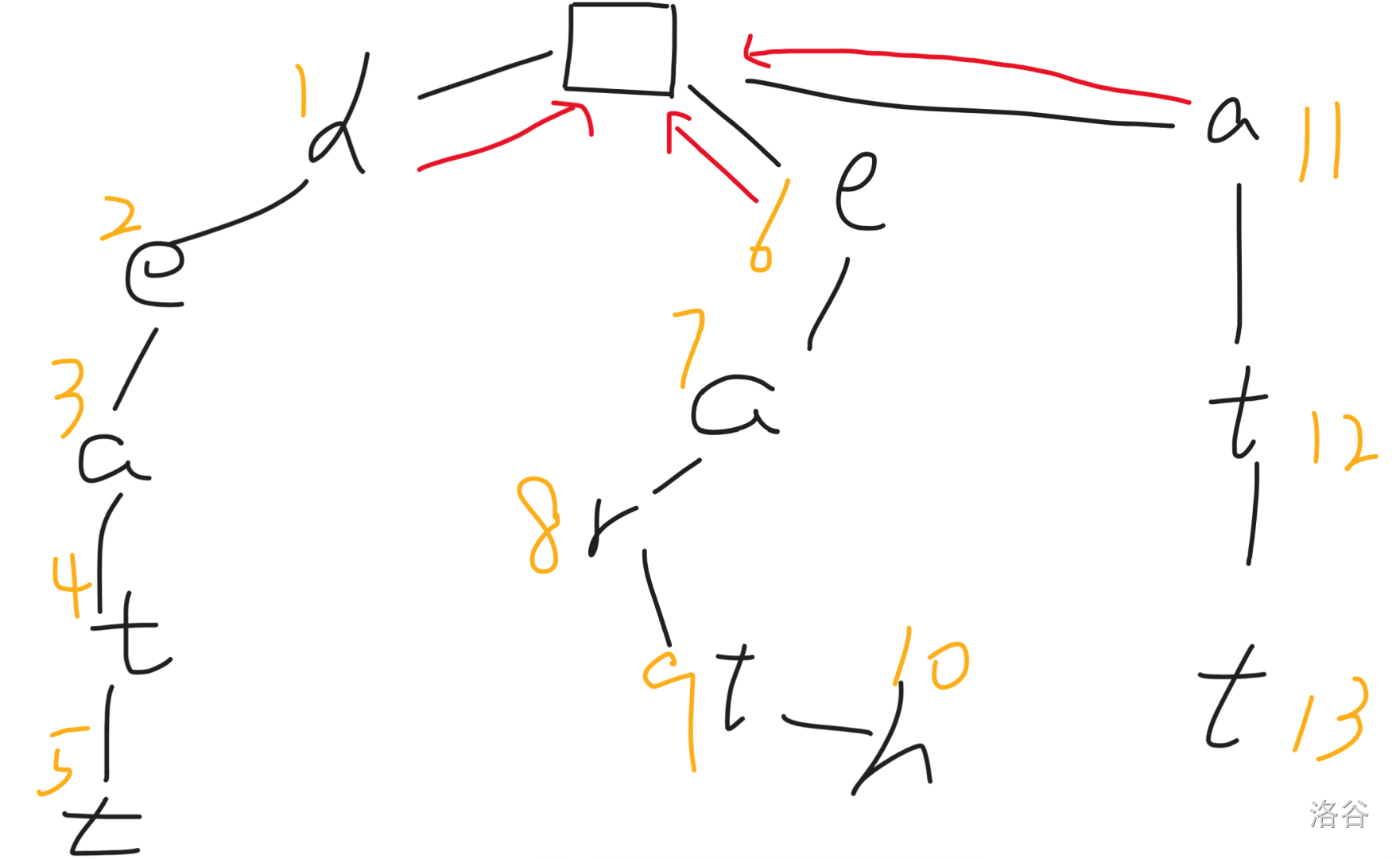
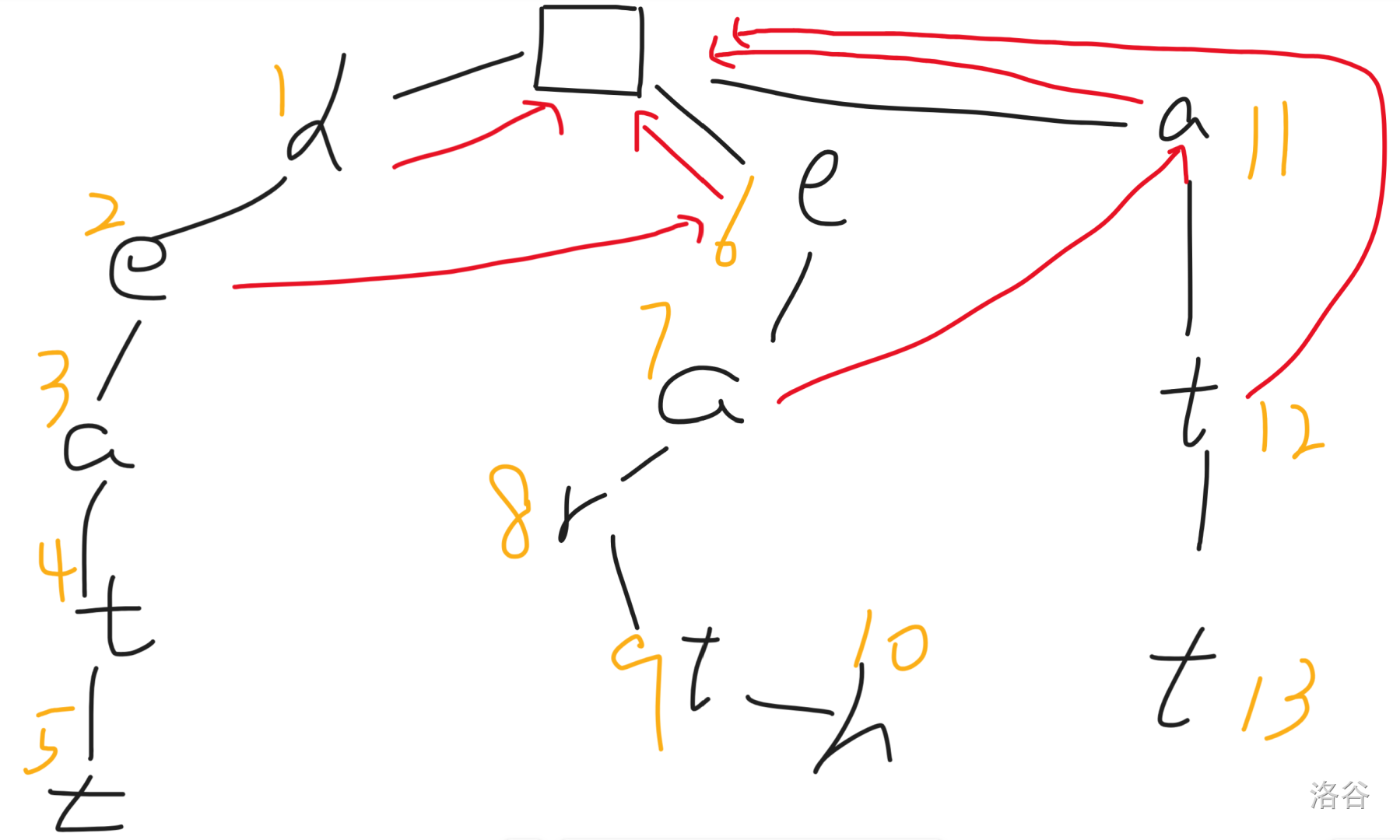
接着,$2$ 号节点的父亲的 $\text{fail}$ 指针指向根节点,且根节点存在字符为 `e` 的子节点 $6$,所以 $\text{fail}_2\leftarrow 6$,同理,$\text{fail}_7\leftarrow 11$。而节点 $12$ 因为没有找到存在的合法状态,所以 $\text{fail}_{12}\leftarrow \text{root}$。即:
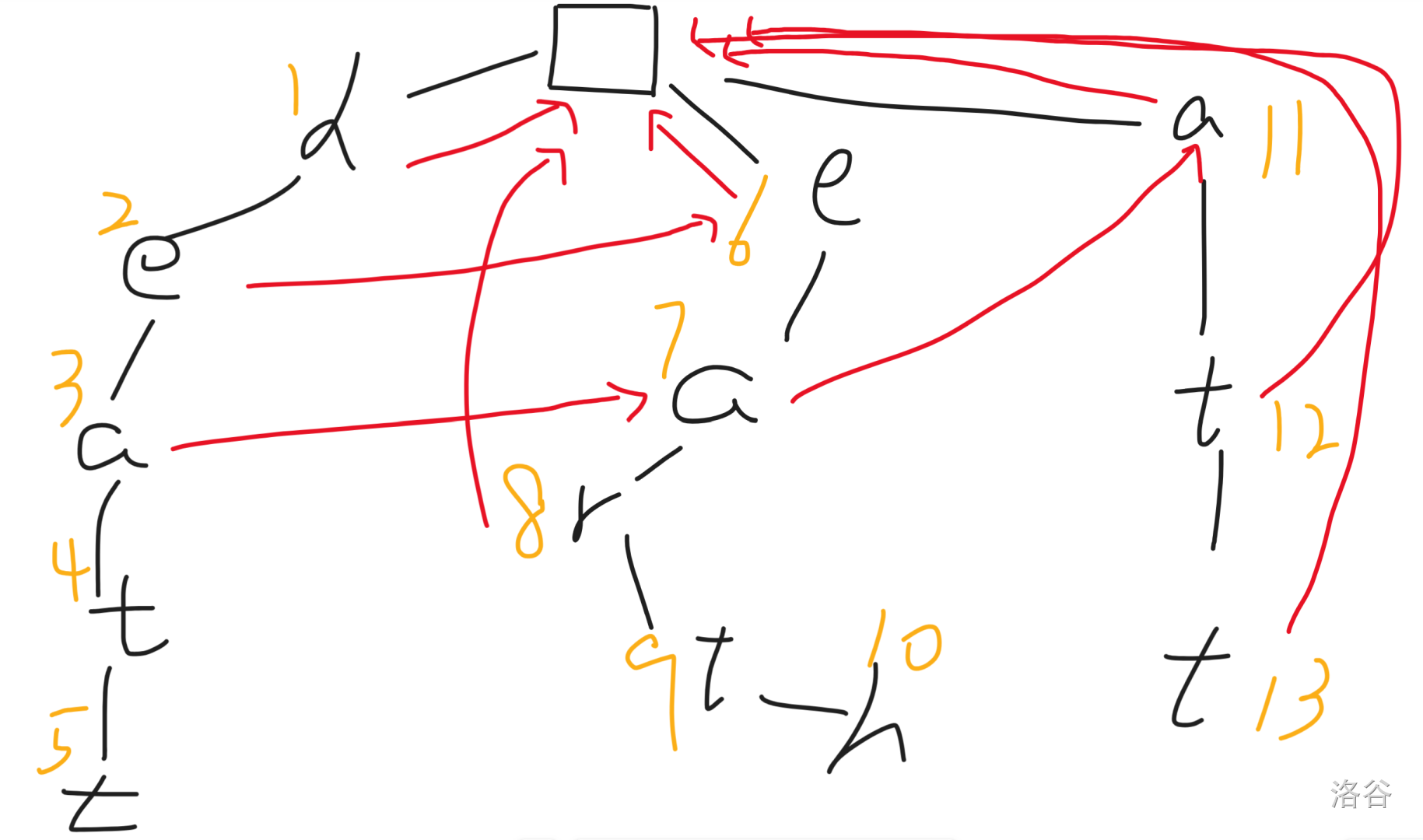
此时,$3$ 号节点对应的父亲 $2$ 的 $\text{fail}$ 指向了 $6$,而 $6$ 节点存在子节点满足字符为 `a`,所以 $\text{fail}_3\leftarrow 7$,而 $8$ 号节点和 $13$ 号节点因为没找到合法的状态,所以指向根节点。如图(~~稍微画得有点乱~~):
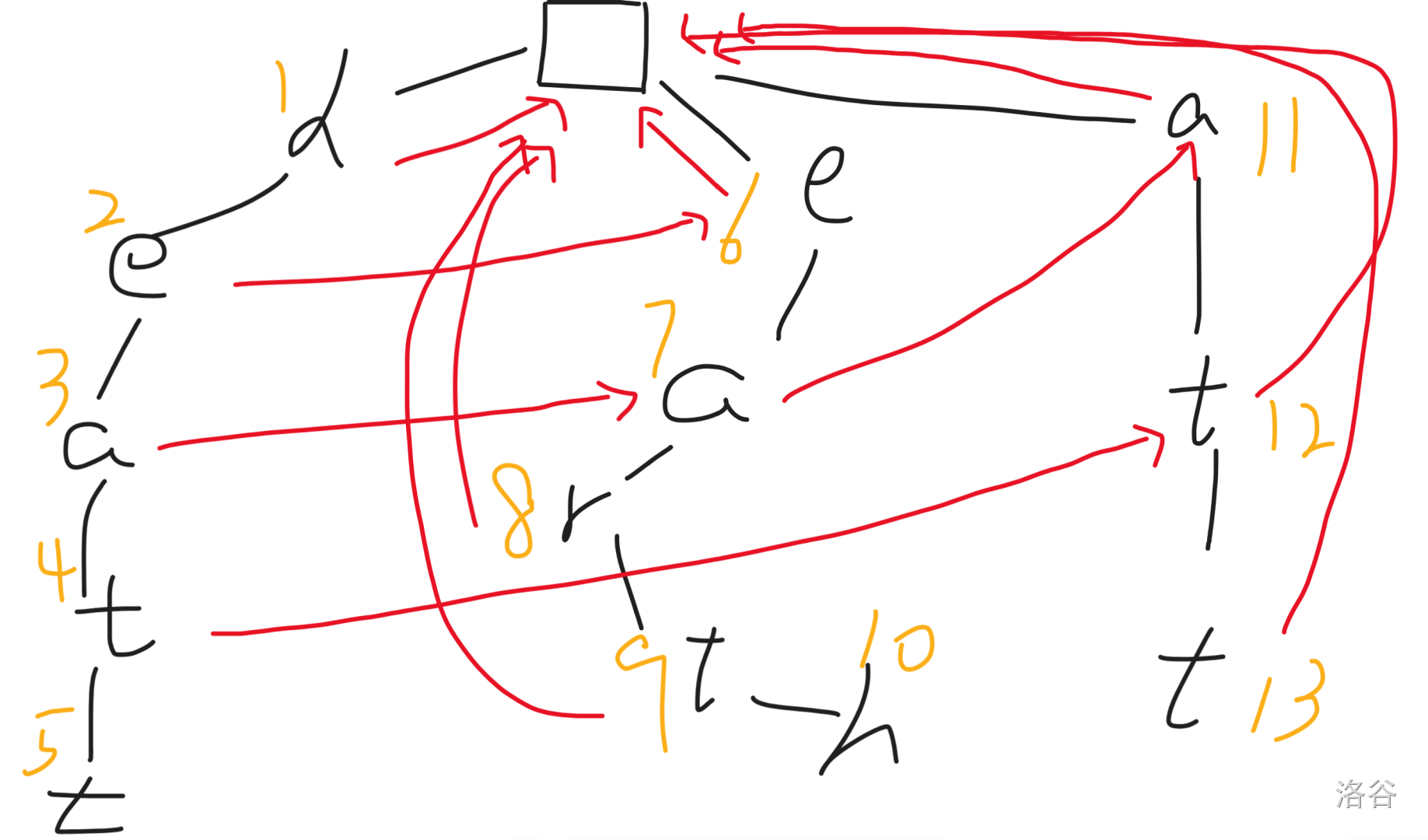
然后,当我们构建 $4$ 号节点的 $\text{fail}$ 指针时,发现其父亲指向的节点 $7$ 不存在一个字符为 `t` 的儿子,所以对其父亲 $3$ 跳 $\text{fail}$,令 $3\leftarrow fail_3$,此时我们再判断 $fail_7$ 是否存在。一个字符为 `t` 的子节点,发现是存在的,于是令 $\text{fail}_4\leftarrow 12$。而 $9$ 则还是连向根节点:
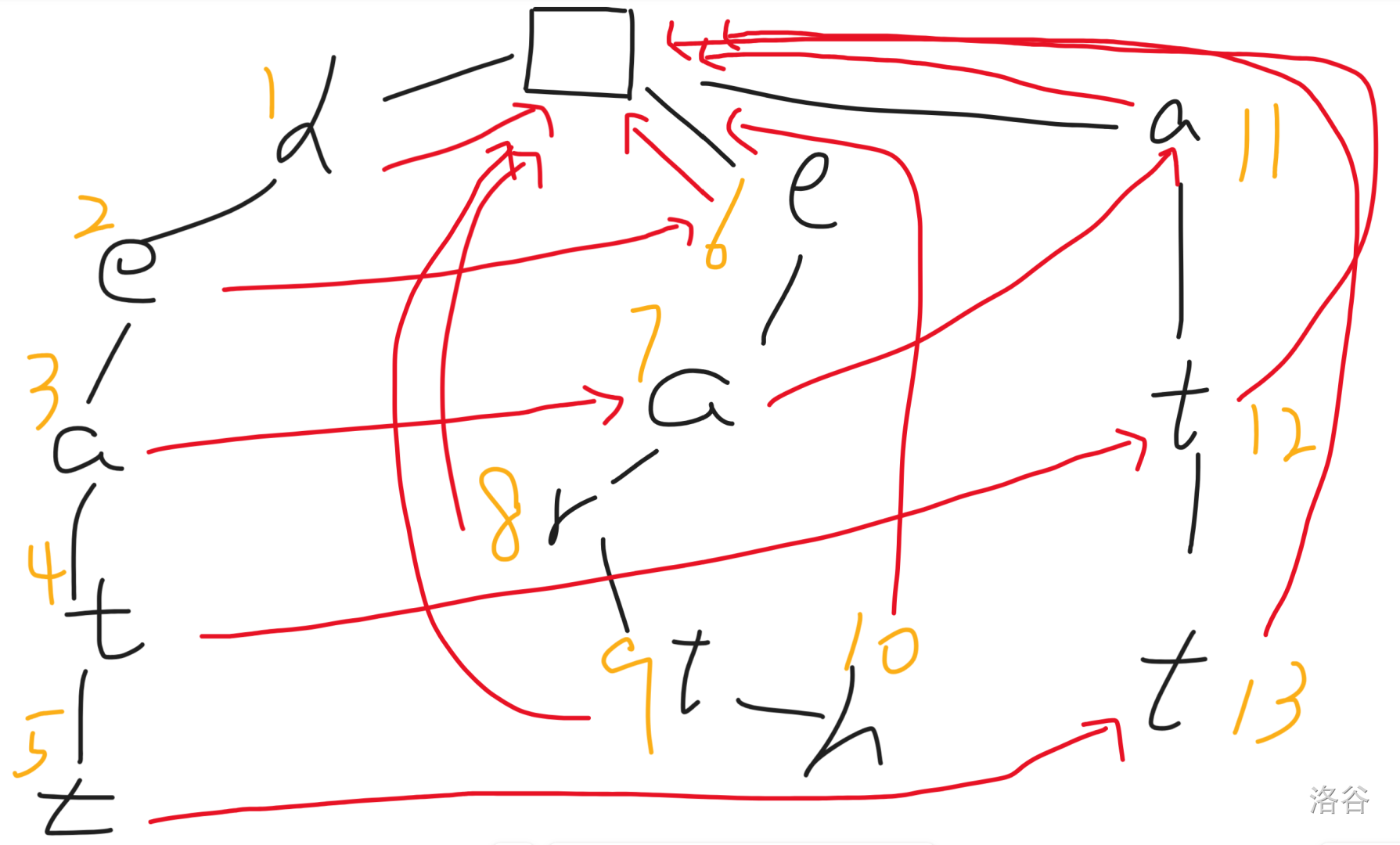
最后的两个节点的构建都是平凡的,不赘述了。构建完成后便是这样的:
## $\text{Trie}$ 图
考虑刚刚那一个构建过程,发现如果每次都暴力跳 $\text{fail}$ 找是否存在合法子节点,这样的时间复杂度是 $O(n^2)$ 的,显然不能被接受。
此时可以使用一个类似并查集的路径压缩的优化,每次都将跳 $\text{fail}$ 的路径进行压缩。详细地说,若构建到状态 $u$:
- 若不存在 $son(u, x)$,则令 $son(u, x)\leftarrow son(\text{fail}_u, x)$。- 否则,直接令 $\text{fail}_{son(u, x)}\leftarrow son(\text{fail}_u, x)$。
这样便可以做到线性构建自动机。
而在这个过程中,$\text{Trie}$ 已经不再是原先的形态,而是新增了一些“路径压缩”的转移边。我们称此时的 $\text{Trie}$ 为 $\text{Trie}$ 图。
在 $\text{Trie}$ 图中,新增的转移边其实就是指向了新增一个字符之后的最长后缀。所以在大多数多模匹配过程中,我们可以直接在 $\text{ACAM}$ 上依照文本串进行遍历,因为新增的转移边可以实现自动跳转最长后缀的功能。
例子的图太乱了,不好画,可以去看 oi-wiki 上的。
### 代码
下面给出构建 $\text{Trie}$ 图的代码:
::::info[Code]```cppstruct Node { int c[26], fail;} trie[N];
void build() { queue<int> q; for (int i = 0; i < 26; i++) { if (trie[0].c[i]) { q.push(trie[0].c[i]); trie[trie[0].c[i]].fail = 0; } } while (!q.empty()) { int p = q.front(); q.pop(); for (int i = 0; i < 26; i++) { if (!trie[p].c[i]) trie[p].c[i] = trie[trie[p].fail].c[i]; else { q.push(trie[p].c[i]); trie[trie[p].c[i]].fail = trie[trie[p].fail].c[i]; } } }}```::::
## 多模式串匹配
有了 $\text{ACAM}$,多模匹配问题就迎刃而解了。
直接从根节点开始进行匹配,每次走到一个状态就开始跳 $\text{fail}$,把所有未被标记的状态都标记上,遇到被标记过的状态就停止(原因在 $\text{fail}$ 指针那一部分有讲)。
这样的时间复杂度是线性的。
### 代码
引入部分的问题的代码:
::::info[Code]```cpp#include<bits/stdc++.h>#define ll long long#define ull unsigned long long#define i128 __int128#define inf (1ll << 62)#define pb push_back#define mp make_pair#define PII pair<int , int>#define fi first#define se secondusing namespace std;const int MAXN = 1e6 + 10;struct Node { int c[26] , fail , cnt;};Node trie[MAXN];int tot;
inline int getnum(char c) {return c - 'a';}
inline void insert(string s) { int p = 0; for(auto i : s) { if(!trie[p].c[getnum(i)]) trie[p].c[getnum(i)] = ++ tot; p = trie[p].c[getnum(i)]; } trie[p].cnt ++; return;}
inline void build() { queue<int>q; for(int i = 0;i < 26;i ++) { if(trie[0].c[i]) { trie[trie[0].c[i]].fail = 0; q.push(trie[0].c[i]); } } while(!q.empty()) { int u = q.front(); q.pop(); for(int i = 0;i < 26;i ++) { if(trie[u].c[i]) { trie[trie[u].c[i]].fail = trie[trie[u].fail].c[i]; q.push(trie[u].c[i]); } else trie[u].c[i] = trie[trie[u].fail].c[i]; } } return;}
inline int AC(string s) { int ans = 0 , n = s.length() , p = 0; for(int i = 0;i < n;i ++) { p = trie[p].c[getnum(s[i])]; for(int j = p;j && trie[j].cnt != -1;j = trie[j].fail) { ans += trie[j].cnt; trie[j].cnt = -1; } } return ans;}
inline void solve() { int n; string s; cin >> n; for(int i = 1;i <= n;i ++) { cin >> s; insert(s); } build(); cin >> s; cout << AC(s) << "\n"; return;}
int main() { ios::sync_with_stdio(0); cin.tie(0); cout.tie(0); int t = 1; while(t --) { solve(); } return 0;}```::::
## $\text{fail}$ 树
有一个显然的结论是 $\text{ACAM}$ 中的 $\text{fail}$ 指针共同构成一棵树。我们称其为 $\text{fail}$ 树。
因为每一个状态的 $\text{fail}$ 指针都会指向比其深度小的状态,所以不会形成环。故会形成 $\text{fail}$ 树。
刚刚那一个例子的 $\text{fail}$ 树如下:
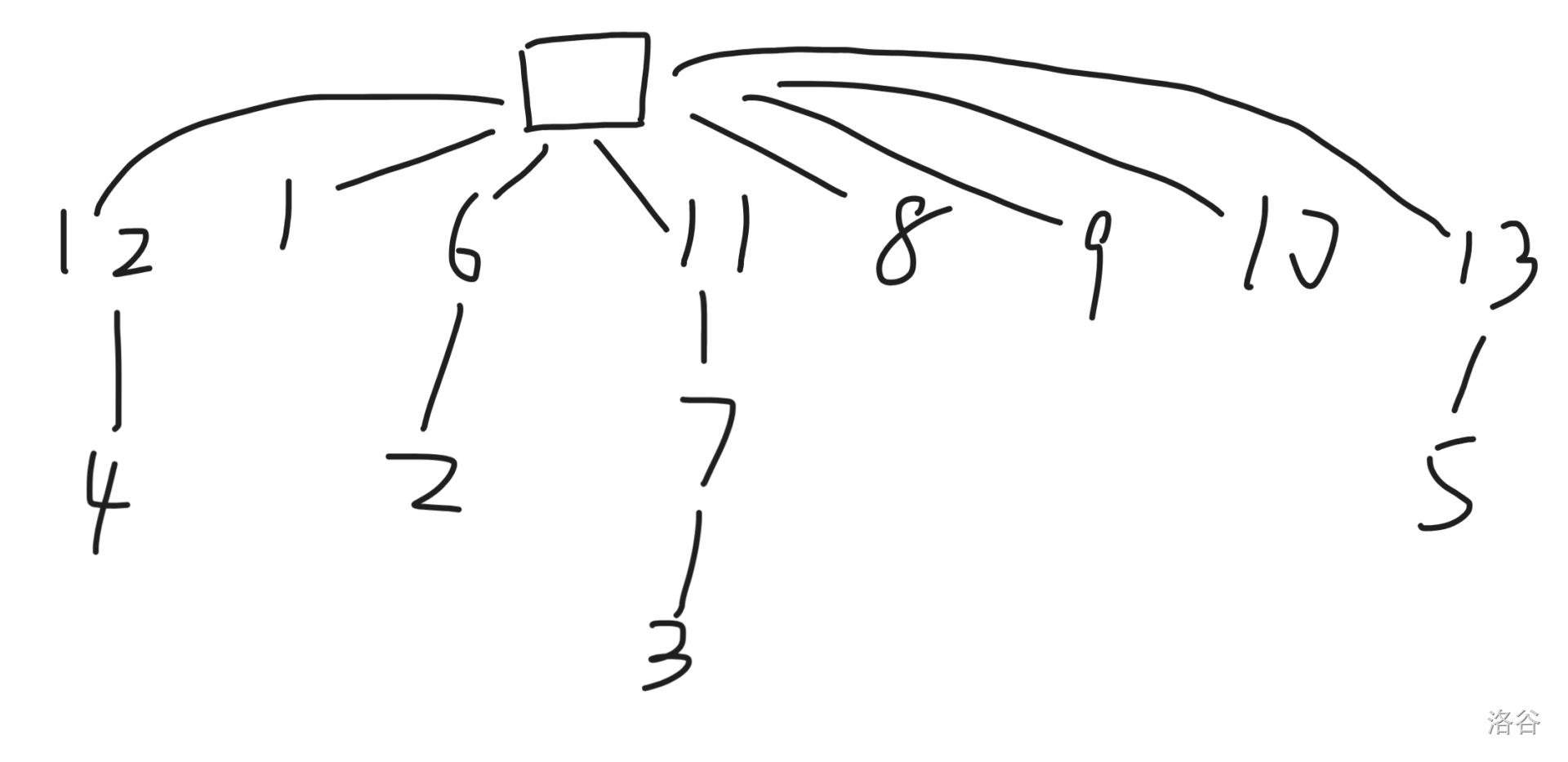
而在 $\text{fail}$ 树中一个很重要的性质是:以 $u$ 为根的子树中所有的状态都包含状态 $u$ 作为后缀。这个性质会在很多题目中发挥极其美妙的作用。
## 拓扑排序优化
再看一道[题](https://www.luogu.com.cn/problem/P5357):
> 给定一个文本串 $s$ 和 $n$ 个模式串 $t_i$,求每个模式串 $t_i$ 在 $s$ 中的出现次数。$\sum|t_i|, s\le 2\times 10^6$。
在这题中,如果我们选择在匹配的过程中不断跳 $\text{fail}$ 然后对跳到的状态的答案进行 $+1$ 的时间复杂度是 $O(n^2)$ 的,因为我们需要把每一个 $\text{fail}$ 的答案都 $+1$。如何优化呢?
观察到,每次走到一个状态 $u$,那么会在 $\text{fail}$ 树中对 $u$ 到根节点的路径上的所有状态的答案增加 $1$。而因为 $\text{fail}$ 指针构成一棵树,所以我们可以将每次在 $u$ 处增加的答案记录下来,最后做一遍拓扑排序更新其到 $\text{fail}$ 树根节点的答案。
### 代码
::::info[Code]```cpp#include <bits/stdc++.h>using namespace std;
using ll = long long;using ld = long double;using ull = unsigned long long;using i128 = __int128;
using PII = pair<int, int>;using PLL = pair<ll, ll>;
constexpr ll inf = (1ll << 62);constexpr int N = 2e5 + 10;
int n;string s;
namespace acam { int tot = N - 1; struct Trie { int son[62], fail, cnt, deg, id, ans; } trie[N]; vector<vector<int>> d(N); //相同的模式串的映射
void Init() { for (int i = 0; i < n; i++) { d.clear(); } for (int i = 0; i <= tot; i++) { for (int j = 0; j < 62; j++) { trie[i].son[j] = 0; } trie[i].fail = trie[i].cnt = trie[i].deg = trie[i].ans = 0; trie[i].id = -1; } tot = 0; }
int get(char c) { if ('0' <= c && c <= '9') return c - '0'; else if ('A' <= c && c <= 'Z') return 10 + c - 'A'; else if ('a' <= c && c <= 'z') return 36 + c - 'a'; }
void update(string s, int id) { int p = 0; for (auto i : s) { int x = get(i); if (!trie[p].son[x]) { trie[p].son[x] = ++tot; } p = trie[p].son[x]; } if (trie[p].id == -1) trie[p].id = id; d[trie[p].id].push_back(id); }
void build() { queue<int> q; for (int i = 0; i < 62; i++) { if (trie[0].son[i]) { trie[trie[0].son[i]].fail = 0; q.push(trie[0].son[i]); } } while (!q.empty()) { int u = q.front(); q.pop(); for (int i = 0; i < 62; i++) { if (!trie[u].son[i]) trie[u].son[i] = trie[trie[u].fail].son[i]; else { trie[trie[u].son[i]].fail = trie[trie[u].fail].son[i]; trie[trie[trie[u].son[i]].fail].deg++; q.push(trie[u].son[i]); } } } }
void ac(string t) { int p = 0; for (auto i : t) { int x = get(i); p = trie[p].son[x]; trie[p].ans++; } }
void topu(vector<int>& ans) { int n = ans.size(); queue<int> q; for (int i = 1; i <= tot; i++) { if (!trie[i].deg) { q.push(i); } } while (!q.empty()) { int u = q.front(); q.pop(); int p = trie[u].fail; trie[p].ans += trie[u].ans; trie[trie[u].fail].deg--; if (!trie[trie[u].fail].deg) { q.push(trie[u].fail); } } for (int i = 1; i <= tot; i++) { if (trie[i].id != -1) { ans[trie[i].id] = trie[i].ans; } } for (int i = 0; i < n; i++) { if (!d[i].size()) continue; for (auto j : d[i]) { ans[j] = ans[d[i][0]]; } } }}
using namespace acam;
void solve() { cin >> n; Init(); for (int i = 0; i < n; i++) { string s; cin >> s; update(s, i); } build(); vector<int> ans(n); string t; cin >> t; ac(t); topu(ans); for (int i = 0; i < n; i++) { cout << ans[i] << "\n"; }}
int main() { ios::sync_with_stdio(0); cin.tie(0); cout.tie(0); int t = 1; while (t--) { solve(); } return 0;}```::::
## 例题
### [P3121](https://www.luogu.com.cn/problem/P3121)
::::info[题意]{open}给定一个文本串 $s$ 和 $n$ 个模式串 $t_{1\dots n}$。Farmer John 每次从 $s$ 中找到出现最早的模式串,然后将其删除,直到文本串中不再包含模式串。
- 保证 $t_i$ 在 $s$ 中起始位置互不相同,且 $t_i$ 之间不存在包含关系。- $\sum|t_i|,|s|\le 10^5$。::::
::::success[做法]观察到是多模匹配,所以先对模式串建出 $\text{ACAM}$。
需要注意到是,在文本串中删去一个模式串后可能会产生新的模式串。但容易发现,这个删除的过程其实可以用栈来模拟。即在匹配时将到达的点的编号压入栈中,然后每次走到代表模式串 $t_i$ 结尾的状态,就弹出 $|t_i|$ 个元素,再回到栈顶的所记录的节点编号。
因为每一个 $s$ 中的字符最多出栈入栈一次,所以时间复杂度是线性的。
:::success[Code]```cpp#include <bits/stdc++.h>using namespace std;
using ll = long long;using ld = long double;using ull = unsigned long long;using i128 = __int128;
using PII = pair<int, int>;using PLL = pair<ll, ll>;
constexpr int N = 1e5 + 10;
int n, tot;struct Trie { int fail, son[26], len;} trie[N];string s;stack<int> st, stk;
int get(char c) { return c - 'a';}
void update(string t) { int p = 0; for (auto i : t) { if (!trie[p].son[get(i)]) { trie[p].son[get(i)] = ++tot; } p = trie[p].son[get(i)]; } trie[p].len = t.length();}
void build() { queue<int> q; for (int i = 0; i < 26; i++) { if (trie[0].son[i]) { q.push(trie[0].son[i]); trie[trie[0].son[i]].fail = 0; } } while (!q.empty()) { int u = q.front(); q.pop(); for (int i = 0; i < 26; i++) { if (!trie[u].son[i]) trie[u].son[i] = trie[trie[u].fail].son[i]; else { trie[trie[u].son[i]].fail = trie[trie[u].fail].son[i]; q.push(trie[u].son[i]); } } }}
void query() { int p = 0; for (int i = 0; i < s.length(); i++) { p = trie[p].son[get(s[i])]; st.push(i); stk.push(p); if (trie[p].len) { int k = trie[p].len; while (k--) { st.pop(); stk.pop(); } if (!stk.empty()) { p = stk.top(); } else { p = 0; } } }}
void solve() { cin >> s >> n; for (int i = 0; i < n; i++) { string t; cin >> t; update(t); } build(); query(); vector<char> ans; while (!st.empty()) { ans.push_back(s[st.top()]); st.pop(); } reverse(ans.begin(), ans.end()); for (auto i : ans) { cout << i; } cout << "\n";}
int main() { ios::sync_with_stdio(0); cin.tie(0); cout.tie(0); int t = 1; while (t--) { solve(); } return 0;}```:::::::
### [AT_abc268_h](https://www.luogu.com.cn/problem/AT_abc268_h)
::::info[题意]{open}给定一个字符串 $S$,可以对 $S$ 进行任意次操作(包括 $0$ 次):- 选择一个整数 $i$,满足 $1\le i\le |S|$,将 $S_i$ 变成 `*`。
请求出若想要 $T_1,T_2,\cdots,T_n$ **不再作为 $S$ 的子串出现**,至少需要进行多少次操作。
- $\sum |T_i|,|S|\le 5\times 10^5$。- $T_i$ 两两互不相同。- $T_i$ 和 $S$ 仅包含小写英文字母。::::
::::success[做法]
容易发现,如果找出了每一个存在于文本串中的模式串,并将这些模式串的左右边界的下标标记出来,记作 $l_i$ 与 $r_i$。则问题就转变成了一个很典的区间选点,即在 $i\in[1, n]$ 中的每一个区间 $[l_i, r_i]$ 中都至少有一个位置被改变。这个东西直接以右端点为第一关键字排序再贪心就行了。所以我们只需要找出文本串中每一个模式串的位置,这就是个多模式串匹配,直接上 $\text{ACAM}$。
假设现在在 $\text{ACAM}$ 上匹配到点 $u$,则由区间选点的贪心考虑,只需要选其最短真后缀且该后缀为模式串,然后放进要贪心的区间中即可。最短真后缀可以在预处理 $\text{fail}$ 的时候计算出来。
:::success[Code]```cpp#include <bits/stdc++.h>using namespace std;
using ll = long long;using ld = long double;using ull = unsigned long long;using i128 = __int128;
using PII = pair<int, int>;using PLL = pair<ll, ll>;
constexpr ll inf = (1ll << 62);constexpr int N = 5e5 + 10;
struct acam { int tot = 0; struct Node { int c[26], fail, depth, flag, cnt; }; vector<Node> trie;
acam(int n) { trie.resize(n); trie[0].depth = trie[0].flag = 0; }
int get(char c) { return c - 'a'; }
void insert(string s) { int p = 0; for (auto i : s) { int x = get(i); if (!trie[p].c[x]) { trie[p].c[x] = ++tot; trie[tot].depth = trie[p].depth + 1; } p = trie[p].c[x]; } trie[p].flag = 1; trie[p].cnt = trie[p].depth; }
void build() { queue<int> q; for (int i = 0; i < 26; i++) { if (trie[0].c[i]) { q.push(trie[0].c[i]); } } while (!q.empty()) { int p = q.front(); q.pop(); for (int i = 0; i < 26; i++) { if (!trie[p].c[i]) trie[p].c[i] = trie[trie[p].fail].c[i]; else { q.push(trie[p].c[i]); trie[trie[p].c[i]].fail = trie[trie[p].fail].c[i]; trie[trie[p].c[i]].flag |= trie[trie[trie[p].c[i]].fail].flag; if (trie[trie[trie[p].c[i]].fail].cnt) { trie[trie[p].c[i]].cnt = trie[trie[trie[p].c[i]].fail].cnt; } } } } }
vector<PII> calc(string t) { vector<PII> v; int p = 0; for (int i = 0; i < t.size(); i++) { int x = get(t[i]); p = trie[p].c[x]; if (trie[p].cnt) { v.emplace_back(i - trie[p].cnt + 1, i); } } return v; }};
void solve() { int n; string s; cin >> s >> n; acam ac(N); for (int i = 0; i < n; i++) { string t; cin >> t; ac.insert(t); } ac.build(); vector<PII> v = ac.calc(s); sort(v.begin(), v.end(), [&](PII a, PII b) { if (a.second == b.second) return a.first < b.first; return a.second < b.second; }); int lst = -1, ans = 0; for (auto [l, r] : v) { if (l > lst) { ans++; lst = r; } } cout << ans << "\n";}
int main() { ios::sync_with_stdio(false); cin.tie(nullptr); int t = 1; // cin >> t; while (t--) { solve(); } return 0;}```:::::::
### [P14363](https://www.luogu.com.cn/problem/P14363)
::::info[题意]{open}Replace。::::::::success[做法]观察直接做似乎很困难,所以想办法对字符串进行一些变换。
容易发现,如果我们要将 $t_1$ 替换成 $t_2$,那么一定要换的部分是除去 $t_1,t_2$ 的最长公共前缀和 $t_1,t_2$ 的最长公共后缀之后的中间的不同的部分。而其最长公共前缀和后缀则是可换可不换的。因此我们有了一个初步的替换方案,即:
- 记 $t_1,t_2$ 的最长公共前缀为 $A$,最长公共后缀为 $B$,$t_1$ 剩下的部分为 $C$,$t_2$ 剩下的部分为 $D$,则将 $t_1$ 与 $t_2$ 拼成 $ACDB$。
我们可以对于字符串二元组 $(s_1, s_2)$ 也进行这样的变换,然后进行多模匹配。
但这会引出一个问题,就是可能 $(s_1,s_2)$ 变换完之后会变成 $AB$,这样显然不满足条件。所以我们要插入特殊字符,使匹配成功当且仅当模式串包含 $CD$。此时我们可以将 $ACDB$ 变成 $A?CD?B$,$(s_1,s_2)$ 同理,这样就可以避免这个问题了。
:::success[Code]```cpp#include <bits/stdc++.h>using namespace std;
using ll = long long;using ld = long double;using ull = unsigned long long;using i128 = __int128;
using PII = pair<int, int>;using PLL = pair<ll, ll>;
constexpr ll inf = (1ll << 62);constexpr int N = 6e6 + 10;constexpr char C = char('a' + 26);
int n, q;
struct acam { int tot = 0; struct Trie { int son[27], fail, cnt; }; vector<Trie> trie;
acam(int _n) { trie.resize(_n); }
int get(char c) { return c - 'a'; }
void update(string s) { int p = 0; for (auto i : s) { int x = get(i); if (!trie[p].son[x]) { trie[p].son[x] = ++tot; } p = trie[p].son[x]; } trie[p].cnt++; }
void build() { queue<int> q; for (int i = 0; i < 27; i++) { if (trie[0].son[i]) { trie[trie[0].son[i]].fail = 0; q.push(trie[0].son[i]); } } while (!q.empty()) { int u = q.front(); q.pop(); for (int i = 0; i < 27; i++) { if (!trie[u].son[i]) trie[u].son[i] = trie[trie[u].fail].son[i]; else { trie[trie[u].son[i]].fail = trie[trie[u].fail].son[i]; trie[trie[u].son[i]].cnt += trie[trie[trie[u].son[i]].fail].cnt; q.push(trie[u].son[i]); } } } }
int query(string s) { int p = 0, ans = 0; for (auto i : s) { int x = get(i); p = trie[p].son[x]; ans += trie[p].cnt; } return ans; }};
void solve() { cin >> n >> q; acam ac(N); for (int i = 0; i < n; i++) { vector<string> s(2); for (int j = 0; j < 2; j++) { cin >> s[j]; } string t1 = "", t2 = ""; int l = -1, r = -1; for (int j = 0; j < s[0].size(); j++) { if (s[0][j] != s[1][j]) { l = j; break; } t1 += s[0][j]; } for (int j = s[0].size() - 1; j >= 0; j--) { if (s[0][j] != s[1][j]) { r = j; break; } t2 += s[0][j]; } reverse(t2.begin(), t2.end()); ac.update(t1 + C + (l != -1 ? s[0].substr(l, r - l + 1) + s[1].substr(l, r - l + 1) : "") + C + t2); } ac.build(); while (q--) { vector<string> s(2); for (int j = 0; j < 2; j++) { cin >> s[j]; } string t1 = "", t2 = ""; int l = -1, r = -1; for (int j = 0; j < s[0].size(); j++) { if (s[0][j] != s[1][j]) { l = j; break; } t1 += s[0][j]; } for (int j = s[0].size() - 1; j >= 0; j--) { if (s[0][j] != s[1][j]) { r = j; break; } t2 += s[0][j]; } reverse(t2.begin(), t2.end()); string t = t1 + C + (l != -1 ? s[0].substr(l, r - l + 1) + s[1].substr(l, r - l + 1) : "") + C + t2; cout << ac.query(t) << "\n"; }}
int main() { ios::sync_with_stdio(false); cin.tie(nullptr); int t = 1; // cin >> t; while (t--) { solve(); } return 0;}```:::::::
### [P2444](https://www.luogu.com.cn/problem/P2444)
::::info[题意]{open}给出 $n$ 个非空 $01$ 串 $s_{1\dots n}$,判断是否存在无限长的 $01$ 串 $t$,使 $t$ 不包含任何一个 $s_i$。
- $\sum|s_i|\le 3\times 10^4$。::::::::success[做法]考虑先对于 $s_i$ 建出 $\text{ACAM}$,然后因为 $\text{ACAM}$ 的本质就是将 $\text{Trie}$ 树变成 $\text{Trie}$ 图,所以如果把一个无限长的满足题意的字符串丢到 $\text{ACAM}$ 上取匹配。那么就会一直走不到 $s_i$ 的结束状态且会绕着一个环走。
故我们只需要在 $\text{ACAM}$ 上找是否存在从根节点出发的环即可。
:::success[Code]```cpp#include <bits/stdc++.h>using namespace std;
using ll = long long;using ld = long double;using ull = unsigned long long;using i128 = __int128;
using PII = pair<int, int>;using PLL = pair<ll, ll>;
constexpr ll inf = (1ll << 62);constexpr int N = 6e7 + 10;
int n;struct acam { int tot = 0; struct Node { int c[2], fail; bool flag; } trie[N]; bitset<N> vis, flag;
int get(char c) { return c - '0'; }
void insert(string s) { int p = 0; for (auto i : s) { int x = get(i); if (!trie[p].c[x]) { trie[p].c[x] = ++tot; } p = trie[p].c[x]; } trie[p].flag = true; }
void build() { queue<int> q; for (int i = 0; i < 2; i++) { if (trie[0].c[i]) { q.push(trie[0].c[i]); trie[trie[0].c[i]].fail = 0; } } while (!q.empty()) { int u = q.front(); q.pop(); for (int i = 0; i < 2; i++) { if (!trie[u].c[i]) trie[u].c[i] = trie[trie[u].fail].c[i]; else { q.push(trie[u].c[i]); trie[trie[u].c[i]].fail = trie[trie[u].fail].c[i]; if (trie[trie[trie[u].c[i]].fail].flag) { trie[trie[u].c[i]].flag = true; } } } } }
void dfs(int u) { vis[u] = true; flag[u] = true; for (int i = 0; i < 2; i++) { int x = trie[u].c[i]; if (vis[x]) { cout << "TAK"; exit(0); } if (trie[x].flag || flag[x]) continue; dfs(x); } vis[u] = false; }} ac;
void solve() { cin >> n; for (int i = 0; i < n; i++) { string s; cin >> s; ac.insert(s); } ac.build(); ac.dfs(0); cout << "NIE";}
int main() { ios::sync_with_stdio(0); cin.tie(0); cout.tie(0); int t = 1; while (t--) { solve(); } return 0;}```:::::::
### [CF1202E](https://www.luogu.com.cn/problem/CF1202E)::::info[题意]{open}给定一个字符串 $t$ 和 $n$ 个字符串 $s_1,s_2,\cdots,s_n$。
令 $f(t,s)$ 表示字符串 $s$ 作为子串在 $t$ 中的出现次数。
计算 $\sum\limits_{i=1}^n\sum\limits_{j=1}^n f(t,s_i+s_j)$。$s_i+s_j$ 表示 $s_j$ 拼接在 $s_i$ 之后形成的字符串。
- 字符串中仅包含小写英文字母。- $\sum|s_i|, t\le 2\times 10^5$。::::::::success[做法]设 $m=|t|$。
拆贡献,然后考虑在 $t$ 中枚举划分点,即枚举 $x$,而 $s_i$ 是 $t[1: x]$ 的后缀,$s_j$ 则是 $t[x+1: m]$ 的前缀。
根据乘法原理,记 $f_x$ 表示是 $t[1: x]$ 的后缀的字符串个数,$g_x$ 表示是 $t[x+1: m]$ 的前缀的字符串个数,答案就是 $\sum_{i=1}^{m-1} f_ig_{i+1}$。
考虑如何求 $f$,发现在对于 $s_i$ 建出的 $\text{ACAM}$ 上匹配到一个点时,字符串个数即为在 $\text{fail}$ 树上,其到根节点的的路径上有几个字符串的终止节点。这个东西直接在 `build` 的时候可以累加预处理出来。
$g$ 的求法同理,只需要反转然后匹配就行了。:::success[Code]```cpp#include <bits/stdc++.h>using namespace std;
using ll = long long;using ld = long double;using ull = unsigned long long;using i128 = __int128;
using PII = pair<int, int>;using PLL = pair<ll, ll>;
constexpr ll inf = (1ll << 62);constexpr int N = 2e5 + 10;
struct acam { int tot = 0; struct Node { int son[26], val, fail; } trie[N];
int get(char c) { return c - 'a'; }
void insert(string s) { int p = 0; for (auto i : s) { int x = get(i); if (!trie[p].son[x]) trie[p].son[x] = ++tot; p = trie[p].son[x]; } trie[p].val++; }
void build() { queue<int> q; for (int i = 0; i < 26; i++) { if (trie[0].son[i]) { trie[trie[0].son[i]].fail = 0; q.push(trie[0].son[i]); } } while (!q.empty()) { int u = q.front(); q.pop(); for (int i = 0; i < 26; i++) { if (!trie[u].son[i]) trie[u].son[i] = trie[trie[u].fail].son[i]; else { trie[trie[u].son[i]].fail = trie[trie[u].fail].son[i]; trie[trie[u].son[i]].val += trie[trie[trie[u].fail].son[i]].val; q.push(trie[u].son[i]); } } } }
vector<ll> query(string s) { int p = 0, n = s.length(); vector<ll> ans(n); for (int i = 0; i < n; i++) { int x = get(s[i]); p = trie[p].son[x]; ans[i] = trie[p].val; } return ans; }} ac1, ac2;
void solve() { string t; int n; cin >> t >> n; for (int i = 0; i < n; i++) { string s; cin >> s; ac1.insert(s); reverse(s.begin(), s.end()); ac2.insert(s); } ac1.build(); ac2.build(); vector<ll> f1 = ac1.query(t); reverse(t.begin(), t.end()); vector<ll> f2 = ac2.query(t); ll ans = 0; for (int i = 1; i < t.length(); i++) { ans += f1[i - 1] * f2[t.length() - i - 1]; } cout << ans << "\n";}
int main() { ios::sync_with_stdio(0); cin.tie(0); cout.tie(0); int t = 1; // cin >> t; while (t--) { solve(); } return 0;}```:::::::
### [CF547E](https://www.luogu.com.cn/problem/CF547E)
::::info[题意]{open}给定 $n$ 个串串 $s_{1\dots n}$,设 $f(i, j)$ 表示 $s_j$ 在 $s_i$ 中出现的次数。有 $q$ 次询问,给定 $l$、$r$ 和 $k$,求:
$$\sum_{i=l}^{r}f(i, k)$$
- $n,\sum|s_i|\le 2\times 10^5,q\le 5\times 10^5$。::::::::success[做法]观察到直接做非常难,所以离线下来,想办法简化问题。
通过前缀和进行转化,每次询问可以变成:
$$\sum_{i=1}^{r}f(i, k)-\sum_{i=1}^{l-1}f(i,k)$$
此时我们将询问的左端点定下来了。考虑先对 $s_i$ 建出 $\text{ACAM}$。然后因为 $\text{fail}$ 树有一个重要的性质,那就是 $u$ 的子树中的状态都包含 $u$ 作为后缀。所以想到把询问丢到 $\text{fail}$ 树上去考虑。发现对于 $f(x, y)$ 这个函数,我们只需要知道有多少个 $x$ 的前缀在 $\text{fail}$ 树中的状态包含 $y$ 作为后缀就能得到其值。而包含 $y$ 的后缀的状态则显然都在 $y$ 的终止状态的子树中,所以我们可以把 $x$ 在 $\text{fail}$ 树中的状态都 $+1$,然后查询 $y$ 的子树和。
故考虑扫描线,从左往右扫,每次都将扫到的 $s_i$ 的所有状态 $+1$,然后查询只需要查终止状态的子树和即可。可以用树状数组维护 $\text{dfs}$ 序实现。
[P2414](https://www.luogu.com.cn/problem/P2414) 和此题十分相似,可以做一下。
:::success[Code]```cpp#include <bits/stdc++.h>using namespace std;
using ll = long long;using ld = long double;using ull = unsigned long long;using i128 = __int128;
using PII = pair<int, int>;using PLL = pair<ll, ll>;
constexpr ll inf = (1ll << 62);constexpr int N = 5e5 + 10;
template <typename T> void chkmax(T& a, T b) { a = max(a, b); }template <typename T> void chkmin(T& a, T b) { a = min(a, b); }
int n, q, tot = 0, endpos[N];struct Node { int c[26], fail;};vector<Node> trie(N);vector<vector<int>> G(N);
int get(char c) { return c - 'a'; }
void insert(string s, int id) { int p = 0; for (auto i : s) { int x = get(i); if (!trie[p].c[x]) { trie[p].c[x] = ++tot; } p = trie[p].c[x]; } endpos[id] = p;}
void build() { queue<int> q; for (int i = 0; i < 26; i++) { if (trie[0].c[i]) { q.push(trie[0].c[i]); G[0].emplace_back(trie[0].c[i]); G[trie[0].c[i]].emplace_back(0); } } while (!q.empty()) { int p = q.front(); q.pop(); for (int i = 0; i < 26; i++) { if (!trie[p].c[i]) { trie[p].c[i] = trie[trie[p].fail].c[i]; } else { q.push(trie[p].c[i]); trie[trie[p].c[i]].fail = trie[trie[p].fail].c[i]; G[trie[p].c[i]].emplace_back(trie[trie[p].c[i]].fail); G[trie[trie[p].c[i]].fail].emplace_back(trie[p].c[i]); } } }}
int cnt, dfn[N], sz[N];
void dfs(int u, int fa) { dfn[u] = ++cnt; sz[u] = 1; for (auto v : G[u]) { if (v == fa) continue; dfs(v, u); sz[u] += sz[v]; }}
struct info { int k, id, w;};
template <typename T>struct BIT { int n; vector<T> bit;
BIT(int _n) : n(_n) { bit.resize(n + 1); }
int lowbit(int x) { return x & (-x); }
void update(int x, T k) { for (int i = x; i <= n; i += lowbit(i)) { bit[i] += k; } }
T sum(int x) { T ans = 0; for (int i = x; i; i -= lowbit(i)) { ans += bit[i]; } return ans; }
T query(int l, int r) { return sum(r) - sum(l - 1); }
void clear() { for (int i = 1; i <= n; i++) { bit[i] = 0; } }};
void solve() { cin >> n >> q; vector<string> s(n); for (int i = 0; i < n; i++) { cin >> s[i]; insert(s[i], i); } build(); dfs(0, -1); vector<vector<info>> pos(n); for (int i = 0; i < q; i++) { int l, r, k; cin >> l >> r >> k; l--; r--; k--; if (l) { pos[l - 1].emplace_back(k, i, -1); } pos[r].emplace_back(k, i, 1); } BIT<int> bit(tot + 5); vector<int> ans(q); for (int i = 0; i < n; i++) { string t = s[i]; int p = 0; for (auto j : t) { int x = get(j); p = trie[p].c[x]; bit.update(dfn[p], 1); } for (auto [j, id, w] : pos[i]) { ans[id] += w * bit.query(dfn[endpos[j]], dfn[endpos[j]] + sz[endpos[j]] - 1); } } for (int i = 0; i < q; i++) { cout << ans[i] << "\n"; }}
int main() { ios::sync_with_stdio(false); cin.tie(nullptr); int t = 1; while (t--) { solve(); } return 0;}```:::::::
### [CF587F](https://www.luogu.com.cn/problem/CF587F)
::::info[题意]{open}给定 $n$ 个字符串 $s_{1\dots n}$。设 $f(x, y)$ 表示 $s_x$ 在 $s_y$ 中出现的次数。有 $q$ 次询问,每次给出 $l$、$r$ 和 $k$。请求出:
$$\sum_{i=l}^{r}f(i, k)$$
- $n, q, \sum|s_i|\le 10^5$。::::::::success[做法]神奇的题目。
先建出 $\text{ACAM}$,然后考虑根号分治。钦定阈值 $B$,有:
若 $|s_k|\ge B$,则这样的 $s_k$ 只有 $O(\frac{\sum|s_i|}{B})$ 个,可以直接对于每一个 $s_k$ 线性暴力地去做。即直接枚举其它串串在 $s_k$ 中的出现次数。这只需要用到 $\text{fail}$ 树的性质就行了。
否则,可以 $O(|s_k|)$ 处理每一次询问。所以直接扫描线,用树状数组维护 $s_i$ 终止节点处的子树加,然后暴力在 $\text{fail}$ 树上查 $s_k$ 每一个节点的贡献。这个东西放到 $\text{dfs}$ 序上是区间加,单点查,差分维护即可。
记 $m=\sum |s_i|$,平衡一下,当 $B$ 取 $\frac{m}{\sqrt{q\log m}}$ 时最优。总时间复杂度是 $O(n\log m+q\log q+m\sqrt{q\log m})$。:::success[Code]```cpp#include <bits/stdc++.h>using namespace std;
using ll = long long;using ld = long double;using ull = unsigned long long;using i128 = __int128;
using PII = pair<int, int>;using PLL = pair<ll, ll>;
constexpr ll inf = (1ll << 62);constexpr int N = 1e5 + 10;
template <typename T> void chkmax(T& a, T b) { a = max(a, b); }template <typename T> void chkmin(T& a, T b) { a = min(a, b); }
int n, q, B, endpos[N], tot, m, sum, dfn[N], sz[N], val[N];ll ans[N];string s[N];vector<vector<int>> adj(N);
struct Node { int fail, c[26];} trie[N];
int get(char c) { return c - 'a'; }
void insert(string s, int id) { int p = 0; for (auto i : s) { int x = get(i); if (!trie[p].c[x]) trie[p].c[x] = ++tot; p = trie[p].c[x]; } endpos[id] = p;}
#define fail(p) trie[p].fail
void build() { queue<int> q; for (int i = 0; i < 26; i++) { if (trie[0].c[i]) { q.push(trie[0].c[i]); fail(trie[0].c[i]) = 0; adj[0].emplace_back(trie[0].c[i]); } } while (!q.empty()) { int p = q.front(); q.pop(); for (int i = 0; i < 26; i++) { if (!trie[p].c[i]) trie[p].c[i] = trie[fail(p)].c[i]; else { q.push(trie[p].c[i]); fail(trie[p].c[i]) = trie[fail(p)].c[i]; adj[fail(trie[p].c[i])].emplace_back(trie[p].c[i]); } } }}
#undef fail
template <typename T>struct BIT { int n; vector<T> bit;
BIT(int _n) : n(_n) { bit.resize(n + 1); }
int lowbit(int x) { return x & (-x); }
void update(int x, T k) { for (int i = x; i <= n; i += lowbit(i)) { bit[i] += k; } }
T sum(int x) { T ans = 0; for (int i = x; i; i -= lowbit(i)) { ans += bit[i]; } return ans; }
T query(int l, int r) { return sum(r) - sum(l - 1); }
void clear() { for (int i = 1; i <= n; i++) { bit[i] = 0; } }};
void dfs(int u) { sz[u] = 1; dfn[u] = ++tot; for (auto v : adj[u]) { dfs(v); sz[u] += sz[v]; }}
void calc(int u) { for (auto v : adj[u]) { calc(v); val[u] += val[v]; }}
struct Query { int pos, w, id;};
void solve() { cin >> n >> q; for (int i = 1; i <= n; i++) { cin >> s[i]; m += s[i].size(); insert(s[i], i); } build(); tot = -1; dfs(0); B = m / sqrt(q * __lg(m)); vector<vector<Query>> qry(n + 1), qry1(n + 1); for (int i = 0; i < q; i++) { int l, r, k; cin >> l >> r >> k; if (s[k].size() >= B) { if (l > 1) qry[k].emplace_back(l - 1, -1, i); qry[k].emplace_back(r, 1, i); } else { if (l > 1) qry1[l - 1].emplace_back(k, -1, i); qry1[r].emplace_back(k, 1, i); } }
auto add = [&](ll w, int i) -> void { int p = 0; for (auto j : s[i]) { int x = get(j); p = trie[p].c[x]; val[p] += w; } };
for (int i = 1; i <= n; i++) { if (!qry[i].size()) continue; add(1, i); calc(0); vector<ll> pre(n + 1); for (int j = 1; j <= n; j++) { pre[j] = pre[j - 1] + val[endpos[j]]; } for (auto [pos, w, id] : qry[i]) { ans[id] += pre[pos] * w; } for (int j = 0; j <= tot; j++) { val[j] = 0; } } BIT<ll> bit(tot); for (int i = 1; i <= n; i++) { bit.update(dfn[endpos[i]], 1); if (dfn[endpos[i]] + sz[endpos[i]] <= tot) { bit.update(dfn[endpos[i]] + sz[endpos[i]], -1); } for (auto [pos, w, id] : qry1[i]) { int p = 0; for (auto j : s[pos]) { int x = get(j); p = trie[p].c[x]; ans[id] += w * bit.query(1, dfn[p]); } } } for (int i = 0; i < q; i++) { cout << ans[i] << "\n"; }}
int main() { ios::sync_with_stdio(false); cin.tie(nullptr); int t = 1; // cin >> t; while (t--) { solve(); } return 0;}```:::::::
### [P8571](https://www.luogu.com.cn/problem/P8571)
::::info[题意]{open}对于字符串 $x,y$,定义 $w(x,y)$ 为 $x$ 在 $y$ 中的出现次数。
给定 $n$ 个字符串 $s_{1\dots n}$,$m$ 次询问,每次询问给定 $l,r,k$,求 $\max_{i=l}^r w(s_i,s_k)$。
- $n, m\le 10^5,\sum|s_i|\le 5\times 10^5$。::::::::success[做法]这题耗了我一个下午,妥妥重工业。
受到 [CF587F](https://www.luogu.com.cn/problem/CF587F) 的启发,考虑根号分治一下。设 $\sum|s_i|=m$,钦定阈值 $B$,则:
- 若 $|s_k|\ge B$,则将 $s_k$ 的节点在 $\text{fail}$ 树上标记为 $1$,然后暴力枚举每一个 $s_i$,查询其终止状态在 $\text{fail}$ 树中子树的权值和。然后用线段树维护一下询问。则这部分的时间复杂度为:$O(\frac{mn}{B}+q\log n)$。- 若 $|s_k|<B$,发现最终答案不会超过 $B$ 且不同的答案不会超过 $2B$ 种。所以考虑对于每一个 $s_k$ 建立虚树,然后如果对于一个虚树上的点 $u$,若存在 $u$ 的一个祖先节点且该节点为询问 $i\in [l, r]$ 区间中 $s_i$ 的终止节点,则该次询问的答案至少为 $sz_u$(是虚树中的 $sz$)。故考虑扫描线,把询问挂到 $r$ 上去,每次枚举虚树中的点查答案就行了。判断是否存在 $i\in [l, r]$ 只需要维护当前 $\text{fail}$ 树中每一个节点对应的最大 $i$。所以可以用分块维护 $\text{dfs}$ 序,然后在扫描线的时候将扫到的串串结束位置的子树取 $\max$,每次询问单点查询。用 $O(\sqrt{N})-O(1)$ 分块可以做到:$O(m\log m+n\sqrt{m}+qB)$。
总时间复杂度为:$O(\frac{mn}{B}+q\log n+m\log m+n\sqrt{m}+qB)$。取 $B=\sqrt{m}$,可以做到 $O((n+q)\sqrt{m}+q\log n)$。
代码太长,放[剪贴板](https://www.luogu.com.cn/paste/v7ddb8jb)里了。::::
### [P4052](https://www.luogu.com.cn/problem/P4052)
::::info[题意]{open}给定 $n$ 个字符串 $s_{1\dots n}$,需要计算有多少个长度为 $m$ 的串串 $t$ 满足 $t$ 至少包含一个 $s_i$ 作为子串。**答案对 $10^4+7$ 取模**。
- $n\le 60, m,|s_i|\le 100$。::::::::success[做法]$\text{ACAM}$ 上 $\text{dp}$ 的板子。
考虑先对 $s_i$ 建出 $\text{ACAM}$,然后在上面 $\text{dp}$。设:
- $f_{i, j, 0}$ 表示 $\text{dp}$ 完 $t$ 的前 $i$ 位,当前这一位走到 $\text{ACAM}$ 上的节点 $j$ 且还不包含任意一个 $s_i$ 作为子串。- $f_{i, j, 1}$ 则表示已经包含至少一个 $s_i$ 作为子串。
记 $fa_u$ 表示 $u$ 在 $\text{ACAM}$ 中的父亲,转移是十分容易的:
- $f_{i, j, 0}\leftarrow f_{i-1, fa_j, 0}$- $f_{i,j,1}\leftarrow f_{i-1,fa_j,1}+f_{i-1,fa_j,0}\times [j\ \text{is}\ \text{an}\ \text{endposition}]$
注意,这里的 $\text{endposition}$ 需要在 `build` 时预处理出来,因为若 $j$ 的 $\text{fail}$ 指针指向的状态包含 $s_i$,则说明 $j$ 也包含 $s_i$。
:::success[Code]```cpp#include <bits/stdc++.h>using namespace std;
using ll = long long;using ld = long double;using ull = unsigned long long;using i128 = __int128;
using PII = pair<int, int>;using PLL = pair<ll, ll>;
constexpr ll inf = (1ll << 62);constexpr int N = 2e5 + 10;
int n, m;
struct acam { int tot = 0, mod; struct Trie { int son[26], fail, flag; }; vector<Trie> trie;
acam(int _n, int _mod) : mod(_mod) { trie.resize(_n); }
int get(char c) { return c - 'A'; }
void insert(string s) { int p = 0; for (auto i : s) { int x = get(i); if (!trie[p].son[x]) { trie[p].son[x] = ++tot; } p = trie[p].son[x]; } trie[p].flag = 1; }
void build() { queue<int> q; for (int i = 0; i < 26; i++) { if (trie[0].son[i]) { trie[trie[0].son[i]].fail = 0; q.push(trie[0].son[i]); } } while (!q.empty()) { int u = q.front(); q.pop(); for (int i = 0; i < 26; i++) { if (!trie[u].son[i]) trie[u].son[i] = trie[trie[u].fail].son[i]; else { trie[trie[u].son[i]].fail = trie[trie[u].fail].son[i]; trie[trie[u].son[i]].flag |= trie[trie[trie[u].son[i]].fail].flag; q.push(trie[u].son[i]); } } } }
void add(ll& x, ll y) { x += y; if (x >= mod) { x -= mod; } }
ll calc(int len) { vector<vector<array<ll, 2>>> f(tot + 1); for (int i = 0; i <= tot; i++) { f[i].resize(len + 1); } for (int i = 0; i < 26; i++) { if (trie[trie[0].son[i]].flag) { add(f[trie[0].son[i]][1][1], 1); } else { add(f[trie[0].son[i]][1][0], 1); } } for (int i = 1; i < len; i++) { for (int j = 0; j <= tot; j++) { for (int k = 0; k < 26; k++) { if (trie[trie[j].son[k]].flag) { add(f[trie[j].son[k]][i + 1][1], f[j][i][0]); add(f[trie[j].son[k]][i + 1][1], f[j][i][1]); } else { add(f[trie[j].son[k]][i + 1][1], f[j][i][1]); add(f[trie[j].son[k]][i + 1][0], f[j][i][0]); } } } } ll ans = 0; for (int i = 0; i <= tot; i++) { add(ans, f[i][len][1]); } return ans; }};
void solve() { cin >> n >> m; acam ac(N, 1e4 + 7); for (int i = 0; i < n; i++) { string s; cin >> s; ac.insert(s); } ac.build(); cout << ac.calc(m) << "\n";}
int main() { ios::sync_with_stdio(false); cin.tie(nullptr); int t = 1; // cin >> t; while (t--) { solve(); } return 0;}```;;;::::
### [CF696D](https://www.luogu.com.cn/problem/CF696D)
::::info[题意]{open}给定 $n$ 个字符串 $s_{1\dots n}$ 和其价值 $a_{1\dots n}$。求长度不超过 $l$ 的字符串 $t$ 的最大价值是多少。
- $n, \sum|s_i|\le 200,l\le 10^{14}$。::::::::success[做法]如果 $l$ 的值域很小,则可以直接暴力 $\text{ACAM}$ 上 $\text{dp}$。但 $l$ 取到了 $10^{14}$,所以得考虑如何进行优化。
不妨先把状态和转移方程写出来。设 $f_{u, i}$ 表示走到 $\text{ACAM}$ 上的点 $u$ 且当前处理的字符串长度为 $i$ 的最大答案。转移就是刷表,$w_u$ 是贡献,可以在建 $\text{ACAM}$ 时顺便处理 $\text{fail}$ 指针算出来:
$$f_{u,i}\leftarrow f_{fa_u, i-1}+w_u$$
观察到,这个转移式其实等同于从 $fa_u$ 向 $u$ 走过了一条边权为 $w_u$ 的边。而求长度不超过 $l$ 的字符串其实就相当于在 $\text{ACAM}$ 上从根节点开始走 $l$ 步。由此联想到邻接矩阵加矩阵快速幂。但此时应使用广义矩阵乘,每次计算的是 $c_{i,j}=\max\{a_{i,k}+b_{k,j}\}$。
时间复杂度为 $O(n^3\log l)$。
:::success[Code]```cpp#include <bits/stdc++.h>using namespace std;
using ll = long long;using ld = long double;using ull = unsigned long long;using i128 = __int128;
using PII = pair<int, int>;using PLL = pair<ll, ll>;
constexpr ll inf = (1ll << 62);constexpr int N = 2e5 + 10;
template <typename T> void chkmax(T& a, T b) { a = max(a, b); }template <typename T> void chkmin(T& a, T b) { a = min(a, b); }
template <typename T>struct Matrix { int n; vector<vector<T>> mat;
Matrix(int _n) : n(_n) { mat.resize(n + 1, vector<T> (n + 1)); for (int i = 0; i <= n; i++) { mat[i][i] = 1; } }
Matrix(int _n, T flag) : n(_n) { mat.resize(n + 1, vector<T> (n + 1, flag)); }
Matrix operator*(const Matrix& a) { Matrix<T> c(n, -1); for (int i = 0; i <= n; i++) { for (int j = 0; j <= n; j++) { for (int k = 0; k <= n; k++) { if (mat[i][k] < 0 || a.mat[k][j] < 0) continue; // cout << i << " " << k << " " << mat[i][k] << " 1\n"; // cout << k << " " << j << " " << a.mat[k][j] << " 2\n"; chkmax(c.mat[i][j], mat[i][k] + a.mat[k][j]); } } } return c; }
Matrix qpow(ll x) const { Matrix<T> base = *this; Matrix<T> res = base; x--; while (x) { if (x & 1) res = res * base; x >>= 1; base = base * base; } return res; }};
template <typename T>struct ACAM { int tot = 0; struct Trie { int son[26], fail, ans;
Trie() : fail(0), ans(0) { memset(son, 0, sizeof(son)); } }; vector<Trie> trie; vector<int> a;
ACAM(int _n) { trie.resize(_n + 1); a.resize(_n + 1); }
int get(char c) { return c - 'a'; }
void insert(string s, int id) { int p = 0; for (auto i : s) { int x = get(i); if (!trie[p].son[x]) { trie[p].son[x] = ++tot; } p = trie[p].son[x]; } trie[p].ans += a[id]; }
void build() { queue<int> q; for (int i = 0; i < 26; i++) { if (trie[0].son[i]) { trie[trie[0].son[i]].fail = 0; q.push(trie[0].son[i]); } } while (!q.empty()) { int u = q.front(); q.pop(); for (int i = 0; i < 26; i++) { if (!trie[u].son[i]) trie[u].son[i] = trie[trie[u].fail].son[i]; else { trie[trie[u].son[i]].fail = trie[trie[u].fail].son[i]; trie[trie[u].son[i]].ans += trie[trie[trie[u].son[i]].fail].ans; q.push(trie[u].son[i]); } } } }
T calc(ll l) { Matrix<T> mapp(tot, -1); for (int i = 0; i <= tot; i++) { for (int j = 0; j < 26; j++) { mapp.mat[i][trie[i].son[j]] = trie[trie[i].son[j]].ans; } } mapp = mapp.qpow(l); T ans = 0; for (int i = 0; i <= tot; i++) { chkmax(ans, mapp.mat[0][i]); } return ans; }};
void solve() { int n; ll l; cin >> n >> l; ACAM<ll> ac(210); for (int i = 1; i <= n; i++) { cin >> ac.a[i]; } for (int i = 1; i <= n; i++) { string s; cin >> s; ac.insert(s, i); } ac.build(); cout << ac.calc(l) << "\n";}
int main() { ios::sync_with_stdio(false); cin.tie(nullptr); int t = 1; // cin >> t; while (t--) { solve(); } return 0;}```:::::::
# 后记
给两个题单:[一](https://www.luogu.com.cn/training/911723)、[二](https://www.luogu.com.cn/training/408760)。第一个是我自己做过的一些简单 $\text{ACAM}$,拜谢 fjy666。
真的爆肝了数天啊,给个赞吧!